

Analys
Kvartalsrapport för råvaror – Optimismen spirar

 På toppen av en minicykel
Optimismen spirar
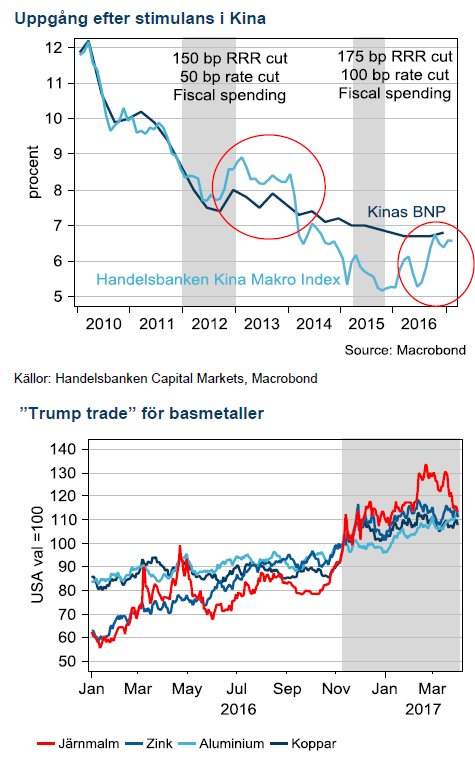 Global optimism i kombination med goda ekonomiska data har spillt över till en förväntan om en självuppfyllande global återhämtning. Vi ser tre drivkrafter till att den globala ekonomiska aktiviteten tagit fart igen sedan i höstas. De första två gäller centralbankers stimulativa penningpolitik samt den expansiva politiken i Kina. Den tredje är återhämtningen på råvarumarknaderna, i synnerhet för oljepriset.
Optimismen efter det amerikanska valet i november förra året har allmänt betraktats som en ”Trump trade”, Vi tror dock att bättre ekonomisk statistik i hög grad är en effekt av de tre ovannämnda faktorerna, snarare än Trump. De här tre drivkrafterna har tillsammans haft kraft att lyfta ekonomin och tillväxtförväntningarna, men effekten kommer att avta längre fram under 2017 och Trump ser ut att få svårt att kompensera för det.
OPEC förlänger avtalet?
Det halvårsvisa OPEC-mötet i Wien gav ett styrkebesked från den slumrande kartellen. Knappt har pumparna strypts fören marknadens fokus ligger på om gruppen förlänger avtalet vid nästa möte den 25e maj. Marknaden tror på en förlängning men vi argumenterar för att ett överraskande uppbrott från avtalet inte är så osannolikt ändå. Oljepriset tror vi kommer närma sig USD 40 oavsett OPEC-mötets utfall.
Basmetallerna följer Kinas minicykel
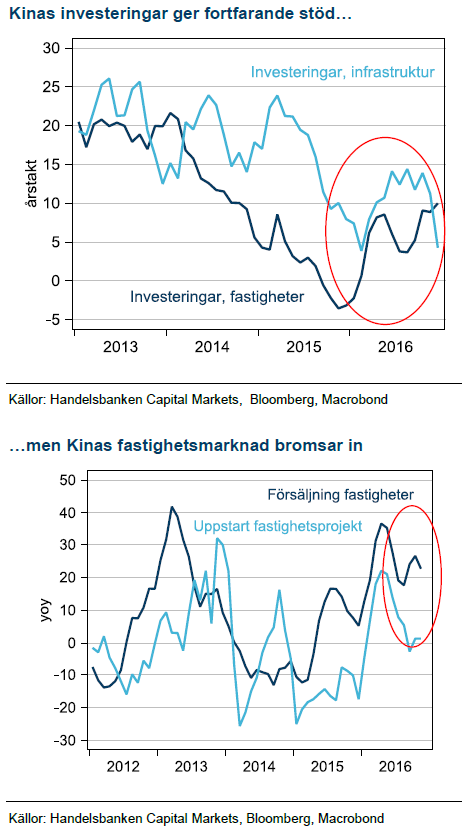
Kinas återhämtning under 2016 ser ut att hålla i sig allt längre. Senaste dataskörden indikerar åtminstone ytterligare sex månader med stark aktivitet.

Basmetaller
 Boomen fortsätter
Fastighetsboomen i Kina fortsätter trots politikers insatser för att kyla rallyt. Cykeln har förlängts och har redan vida överträffat vår första bedömning av varaktigheten i Kinas minicykel. Den förra stimulansdrivna cykeln varade omkring 15 månader och det är precis så gammal den nuvarande är nu
Konsensus är fortfarande att aktiviteten ska bromsa kraftigt under hösten. Det är även vår huvudlinje men risken för en positiv överraskning från politiker som håller tillväxten under armarna är större den här gången.
Kopparstrejkerna är över
Vår tro på lägre pris för koppar under året kom på skam under första kvartalet när stora strejker i Chile och Peru förde en betydande del av produktionen ur marknaden. Nu är strejkerna lösta och produktionen växlar upp, därmed blir koppar åter ett derivat på Kinas aktivitet och vi tror att stigande produktion kommer öka prispressen nedåt. Därför behåller vi USD 5000 som riktmärke för priset.
Produktionsreformer i Kina
Aluminium har stigit i bakvattnet av Kinas policyförändring kring produktion av aluminium, stål, kol och järnmalm. Till slut har Kina tagit krafttag och begränsar produktionen från de mindre och minst miljövänliga anläggningarna. Nettokapaciteten av aluminium växer dock fortfarande stadigt och på sikt skiftar Kina in i stabil lågkostandskostym som kommer pressa priserna. Ännu är vi inte där och vi tycker att senaste prisuppgången står på säker mark kommande halvår.
Zinkrallyt har planat ut
 Efter en makalös prisuppgång på nära 100% på ett år har zinkrallyt tappat kraft. Även om vi trott på högre priser hela vägen har kraften i uppgången överraskat oss. Från dagens nivåer är det svårt att motivera risk för ytterligare uppgång och vid slutet av året borde ökad småskalig produktion göra avtryck i prispress.
Nickelstoryn gick i kras
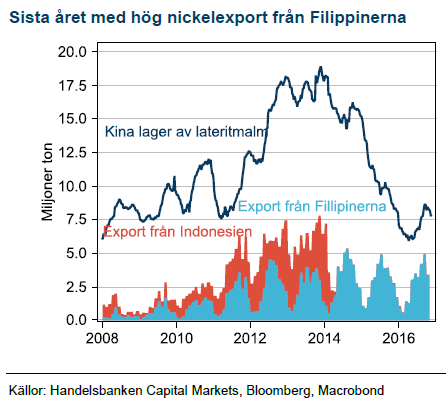
Våra högt ställda förväntningar på lägre export från Filipinerna håller på att förverkligas. Priserna tar dock inte fart eftersom Indonesien luckrar upp exportförbudet lagom till marknadsbalansen skulle stramas åt. Vi tror fortfarande på högre nickelpriser men Indonesien kommer sannolikt dämpa uppgångar likt zink.
Energi
 OPEC visade vägen
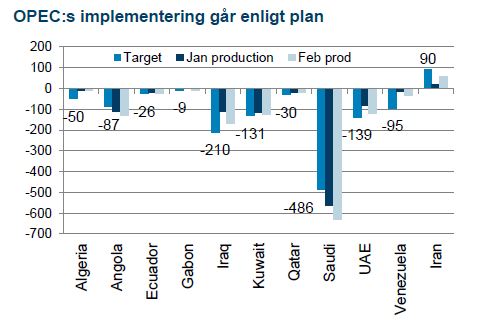
OPEC:s möte i Wien slutade med en skräll. Priset steg 10% på beskedet att gruppen nått ett avtal om att begränsa produktionen tillsammans med flera länder som inte är medlemmar i OPEC. Tre månader in i avtalet kan vi konstatera att genomförandet av produktionssänkningarna är bättre än historiskt. OPEC ligger nära 100% implementering och de övriga omkring 50%.
Fokus på nästa möte
Med halva avtalsperioden bakom oss ligger nu fokus på huruvida OPEC ska förlänga avtalet den 25e maj. Bloomberg genomförde en undersökning som visade att 13 av 13 tillfrågade oljeanalytiker tror att OPEC ska förlänga avtalet. Mycket tyder därför på att det scenariot redan är inprisat och att oljepriset inte borde stiga speciellt mycket mer på det temat, trots OPEC:s alla utspel.
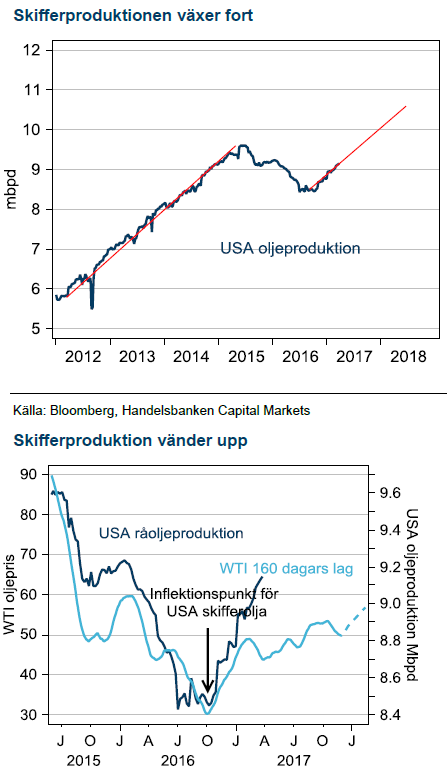 Vi tror snarare att risken att det inte blir en förlängning är en intressant möjlighet. Med en så enhetlig förväntansbild kan ett enskilt lands motstånd till en förlängning av avtalet bli tuvan som stjälper hela lasset. Ryssland kanske motsätter sig fortsatt understöd till en snabbt ökande oljeproduktion hos de amerikanska skifferproducenterna. Övriga medlemmar kanske kräver att Iran nu ska vara med eller så önskar Irak att avsluta. Irak har de mest ambitiösa planerna på att expandera produktionen och därmed minst att vinna på att sitta kvar i avtalet.
Skifferoljan är vinnare
Skifferoljan är tillbaka i samma tillväxttakt som uppvisades omkring USD 100/fat. Den snabba tillväxten på dagens priser gör OPEC:s strategi omöjlig i längden. OPEC kan möjligen förlänga avtalet i maj men efter den perioden kommer alla länder återgå till jakten på marknadsandelar och priset kommer komma under press. Vi har därför USD 40 som medelpris för 2017.
Elpriset utan volatilt
Efter en turbulent avslutning på förra året har ännu en mild vinter skapat ett stabilt elpris på relativt låga nivåer. Kolprisbubblan, inflaterad av Kina, har spruckit och minskar risken för de toppar som etablerades för årsskiftet.
Ädelmetaller
 Guldet får revansch
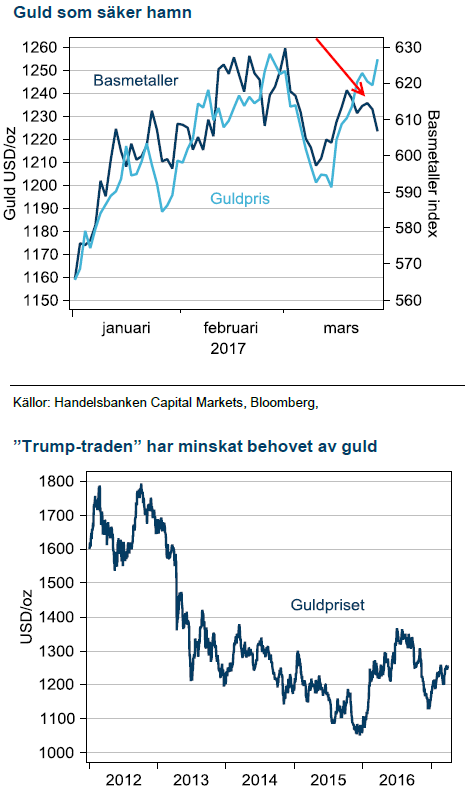
Fed kommer att fortsätta med en stramare penningpolitik även om fokus i USA kommer att tiltas mot den kommande finanspolitiken. Guld har redan handlat in den effekten och all form av besvikelse på Trump kommer gynna guld.
Fed har succesivt blivit tydligare och mars månads höjning med 25bps var redan 100% prisad inför mötet, nyheten framöver ligger i eventuell förändrad prognos för räntebana. För 2017 har Fed ytterligare två höjningar och för 2018 tre.
Trumps huvudvärk kan bli guldets gnista
Efter en initial press på guld efter amerikanska presidentvalet har guld börjat visa sig känsligt för Trumps motgångar. Ännu har testen av Trumps möjligheter att genomföra expansiv politik bara börjat. Minsta tecken på motgång har dock stärkt guld och vid ett större debakel kommer säkerligen efterfrågan på guld som säker hamn att återuppstå.
Jordbruk
Viktigaste USDA rapporten
 Mars kvartalsrapport från USDA visar visserligen bara data för USA men det är den viktigaste marknaden för årets prisutveckling. I USA vann tveklöst sojaböner kampen om odlingsareal när anspråken ökar med 7,3% mot förra odlingsåret. Majsarealen blev något mindre än förväntat och därför föll sojapriset mest på rapporten. Fjolårets sojaskörd visade god avkastning och i kombination med bra priser i förhållandet till majs fanns alla incitament att öka arealen i år. Rebalanseringen av USA:s lager fortsätter därmed då vetearealen minskas som en följd av låga priser. Vi ser inte den lägre arealen i USA som ett skäl till högre pris. Det krävs sämre skörd som följd av dålig avkastning för att priserna ska stiga.
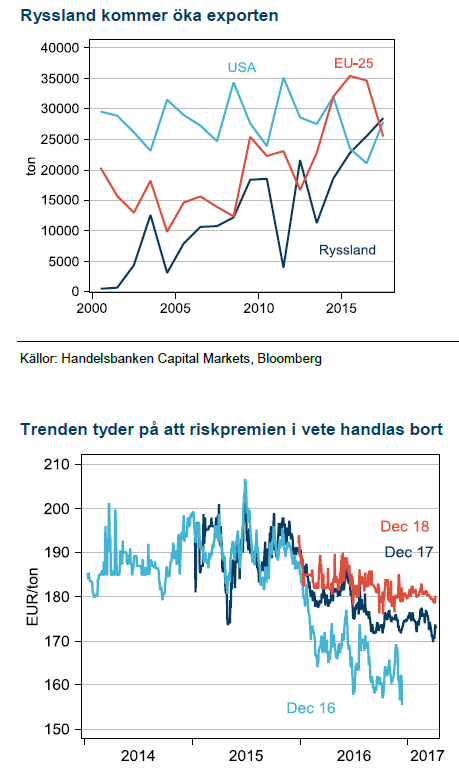
Risk för hög rysk export Förra året blev Rysslands höga veteexport ett sänke för MATIF-priserna. Vi ser risk för en repris i år. Vi har en tro på lägre oljepris och Putin har parerat lägre oljepriser med svagare rubel under de senaste åren. Amerikanska centralbanken fortsätter höja räntan och det ger USD stöd. Således tror vi att Ryssland kommer fortsätta ta marknadsandelar på exportmarknaden från USA vilket pressar även europeiskt vete. Senaste åren har vi sett en tydlig trend där veteterminer handlas med en riskpremie för dåligt väder och när skörden sedan kommer in på normala nivåer pyser riskpremien ur. Baserat på detta resonemang tror vi att december 17 kommer gå till förfall omkring EUR 160/ton.
Rapspremien
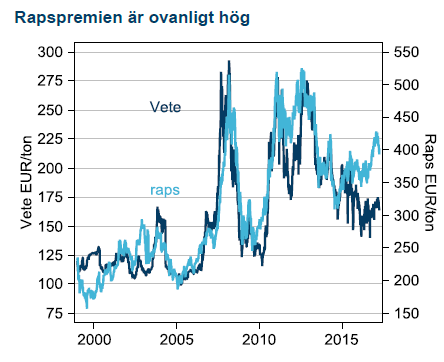 Högre oljepris och vissa väderproblem i Europa och Ukraina fick rapspriset att stiga oväntat under förra odlingsåret. Vi ser starka skäl för den ovanligt höga premien över vete att suddas ut under året. Främsta skälet är att vi tror på lägre oljepris, andra skälet att USA sannolikt kommer leverera en rekordskörd av soja och tredje skälet att en normal skörd i Europa kommer sänka rapspriset. Raps är därmed den gröda där vi ser störst anledning att sälja terminer och tror att november 17 slutar på omkring 320 EUR/ton 15 % under dagens nivå.
[box]Producerat av Handelsbanken och publiceras i samarbete och med tillstånd på Råvarumarknaden.se[/box]
Ansvarsbegränsning
Detta material är producerat av Svenska Handelsbanken AB (publ) i fortsättningen kallad Handelsbanken. De som arbetar med innehållet är inte analytiker och materialet är inte oberoende investeringsanalys. Innehållet är uteslutande avsett för kunder i Sverige. Syftet är att ge en allmän information till Handelsbankens kunder och utgör inte ett personligt investeringsråd eller en personlig rekommendation. Informationen ska inte ensamt utgöra underlag för investeringsbeslut. Kunder bör inhämta råd från sina rådgivare och basera sina investeringsbeslut utifrån egen erfarenhet.
Informationen i materialet kan ändras och också avvika från de åsikter som uttrycks i oberoende investeringsanalyser från Handelsbanken. Informationen grundar sig på allmänt tillgänglig information och är hämtad från källor som bedöms som tillförlitliga, men riktigheten kan inte garanteras och informationen kan vara ofullständig eller nedkortad. Ingen del av förslaget får reproduceras eller distribueras till någon annan person utan att Handelsbanken dessförinnan lämnat sitt skriftliga medgivande. Handelsbanken ansvarar inte för att materialet används på ett sätt som strider mot förbudet mot vidarebefordran eller offentliggörs i strid med bankens regler.

Down on Friday. Up on Monday. The Brent June crude oil contract traded down 5.1% last week to a close of $90.38/b. It reached a high of $103.87/b last Monday and a low of $86.09/b on Friday as Iran announced that the Strait of Hormuz was fully open for transit. That quickly changed over the weekend as the US upheld its blockade of Iranian oil exports while Iran naturally responded by closing the SoH again. The US blew a hole in the engine room of the Iranian ship TOUSKA and took custody of the ship on Sunday. Brent crude is up 5.6% this morning to $95.4/b.

The cease-fire is expiring tomorrow. The US has said it will send a delegation for a second round of negotiations in Islamabad in Pakistan. But Iran has for now rejected a second round of talks as it views US demands as unrealistic and excessive while the US is also blocking the Strait of Hormuz.
While Brent is up 5% this morning, the financial market is still very optimistic that progress will be made. That talks will continue and that the SoH will fully open by the start of May which is consistent with a rest-of-year average Brent crude oil price of around $90/b with the market now trading that balance at around $88/b.
Financial optimism vs. physical deterioration. We have a divergence where the financial market is trading negotiations, improvements and resolution while at the same time the physical market is deteriorating day by day. Physical oil flows remain constrained by disrupted flows, longer voyage times and elevated freight and insurance costs.
Financial markets are betting that a US/Iranian resolution will save us in time from violent shortages down the road. But every day that the SoH remains closed is bringing us closer to a potentially very painful point of shortages and much higher prices.
The US blockade is also a weapon of leverage against its European and Asian allies. When Iran closed the SoH it held the world economy as a hostage against the US. The US blockade of the SoH is of course blocking Iranian oil exports. But it is also an action of disruption directed towards Europe and Asia. The US has called for the rest of the world to engaged in the war with Iran: ”If you want oil from the Persian Gulf, then go and get it”. A risk is that the US plays brinkmanship with the global oil market directed towards its European and Asian allies and maybe even towards China to force them to engage and take part. Maybe unthinkable. But unthinkable has become the norm with Trump in the White House.
Wild moves yesterday. Brent crude traded to a high of $114.43/b and a low of $96.0/b and closed at $99.94/b yesterday.
US – Iran negotiations ongoing or not? What a day. Donald Trump announced that good talks were ongoing between Iran and the US and that the 48 hour deadline before bombing Iranian power plants and energy infrastructure was postponed by five days subject to success of ongoing meetings. Iranian media meanwhile stated that no meetings were ongoing at all.
Today we are scratching our heads trying to figure out what yesterday was all about.
Friends and family playing the market? Was it just Trump and his friends and family who were playing with oil and equity markets with $580m and $1.46bn in bets being placed by someone in oil and equity markets just 15 minutes before Trump’s announcement?
Was Trump pulling a TACO as he reached his political and economic pain point: Brent at $112/b, US Gas at $4/gal, SPX below 200dma and US 10yr above 4.4%?
Different Iranian factions with Trump talking with one of them? Are there real negotiations going on but with the US talking to one faction in Iran while another, the hardliners, are not involved and are denying any such negotiations going on?
Extending the ultimatum to attack and invade Kharg island next weekend? Or, is the five day delay of the deadline a tactical decision to allow US amphibious assault ships and marines to arrive in the Gulf in the upcoming weekend while US and Israeli continues to degrade Iranian military targets till then. And then next weekend a move by the US/Israel to attack and conquer for example the Kharg island?
We do not really know which it is or maybe a combination of these.
We did get some kind of TACO ydy. But markets have been waiting for some kind of TACO to happen and yesterday we got some kind of TACO. And Brent crude is now trading at $101.5/b as a result rather than at $112-114/b as it did no the high yesterday.
But what really matters in our view is the political situation on the ground in Iran. Will hardliners continue to hold power or will a more pragmatic faction gain power?
If the hardliners remain in power then oil pain should extend all the way to US midterm elections. The hardliners were apparently still in charge as of last week. Iran immediately retaliated and damaged LNG infrastructure in Qatar after Israel hit Iranian South Pars. The SoH was still closed and all messages coming out of Iran indicated defiance. Hardliners continues in power has a huge consequence for oil prices going forward. The regime has played its ’oil-weapon’ (closing or chocking the Strait of Hormuz). It is using it to achieve political goals. Deterrence: it needs to be so politically and economically expensive to attack Iran that it won’t happen again in the future. Or at least that the US/Israel thinks 10-times over before they attack again. The highest Brent crude oil closing price since the start of the war is $112.19/b last Friday. In comparison the 20-year inflation adjusted Brent price is $103/b. So Brent crude last Friday at $112.19/b isn’t a shockingly high price. And it is still far below the nominal high of $148/b from 2008 which is $220/b if inflation adjusted. So once in a lifetime Iran activates its most powerful weapon. The oil weapon. It needs to show the power of this weapon and it needs to reap political gains. Getting Brent to $112/b and intraday high of $119.5/b (9 March) isn’t a display of the power of that weapon. And it is not a deterrence against future attacks.
So if the hardliners remain in power in Iran, then the SoH will likely remain chocked all the way to US midterm elections and Brent crude will at a minimum go above the historical nominal high of $148/b from 2008.
Thus the outlook for the oil price for the rest of the year doesn’t depend all that much of whether Trump pulls a TACO or not. Stops bombing or not. It depends more on who is in charge in Iran. If it is the hardliners, then deterrence against future attacks via chocking of the SoH and high oil prices is the likely line of action. It is impacting the world but the Iranian ’oil-weapon’ is directed towards the US president and the the US midterm elections.
If a pragmatic faction gets to power in Iran, then a very prosperous future is possible. However, if power is shifting towards a more pragmatic faction in Iran then a completely different direction could evolve. Such a faction could possibly be open for cooperation with the US and the GCC and possibly put its issues versus Israel aside. Then the prosperity we have seen evolving in Dubai could be a possible future also for Iran.
So far it looks like the hardliners are fully in charge. As far as we can see, the hardliners are still fully in control in Iran. That points towards continued chocking of the SoH and oil prices ticking higher as global inventories (the oil market buffers) are drawn lower. And not just for a few more weeks, but possibly all the way to the US midterm elections.
A brief sigh of relief yesterday as oil infra at Kharg wasn’t damaged. But higher today. Brent crude dabbled around a bit yesterday in relief that oil infrastructure at Iran’s Kharg island wasn’t damaged. It traded briefly below the 100-line and in a range of $99.54 – 106.5/b. Its close was near the low at $100.21/b.
No easy victorious way out for Trump. So no end in sight yet. Brent is up 3.2% today to $103.4/b with no signs that the war will end anytime soon. Trump has no easy way to declare victory and mission accomplished as long as Iran is in full control of the Strait of Hormuz while also holding some 440 kg of uranium enriched to 60% and not far from weapons grade at 90%. As long as these two factors are unresolved it is difficult for Trump to pull out of the Middle East. Naturally he gets increasingly frustrated over the situation as the oil price and US retail gas prices keeps ticking higher while the US is tied into the mess in the Middle East. Trying to drag NATO members into his mess but not much luck there.
When commodity prices spike they spike 2x, 3x, 4x or 5x. Supply and demand for commodities are notoriously inflexible. When either of them shifts sharply, the the price can easily go to zero (April 2022) or multiply 2x, 3x, or even 5x of normal. Examples in case cobalt in 2025 where Kongo restricted supply and the price doubled. Global LNG in 2022 where the price went 5x normal for the full year average. Demand for tungsten in ammunition is up strongly along with full war in the middle east. And its price? Up 537%.
Why hasn’t the Brent crude oil price gone 2x, 3x, 4x or 5x versus its normal of $68/b given close to full stop in the flow of oil of the Strait of Hormuz? We are after all talking about close to 20% of global supply being disrupted. The reason is the buffers. It is fairly easy to store oil. Commercial operators only hold stocks for logistical variations. It is a lot of oil in commercial stocks, but that is predominantly because the whole oil system is so huge. In addition we have Strategic Petroleum Reserves (SPRs) of close to 2500 mb of crude and 1000 mb of oil products. The IEA last week decided to release 400 mb from global SPR. Equal to 20 days of full closure of the Strait of Hormuz. Thus oil in commercial stocks on land, commercial oil in transit at sea and release of oil from SPRs is currently buffering the situation.
But we are running the buffers down day by day. As a result we see gradually increasing stress here and there in the global oil market. Asia is feeling the pinch the most. It has very low self sufficiency of oil and most of the exports from the Gulf normally head to Asia. Availability of propane and butane many places in India (LPG) has dried up very quickly. Local prices have tripled as a result. Local availability of crude, bunker oil, fuel oil, jet fuel, naphtha and other oil products is quickly running down to critical levels many places in Asia with prices shooting up. Oman crude oil is marked at $153/b. Jet fuel in Singapore is marked at $191/b.
Oil at sea originating from Strait of Hormuz from before 28 Feb is rapidly emptied. Oil at sea is a large pool of commercial oil. An inventory of oil in constant move. If we assume that the average journey from the Persian Gulf to its destinations has a volume weighted average of 13.5 days then the amount of oil at sea originating from the Persian Gulf when the the US/Israel attacked on 28 Feb was 13.5 days * 20 mb/d = 269 mb. Since the strait closed, this oil has increasingly been delivered at its destinations. Those closest to the Strait, like Pakistan, felt the emptying of this supply chain the fastest. Propane prices shooting to 3x normal there already last week and restaurants serving cold food this week is a result of that. Some 50-60% of Asia’s imports of Naphtha normally originates from the Persian Gulf. So naphtha is a natural pain point for Asia. The Gulf also a large and important exporter of Jet fuel. That shut in has lifted jet prices above $200/b.
To simplify our calculations we assume that no oil has left the Strait since that date and that there is no increase in Saudi exports from Yanbu. Then the draining of this inventory at sea originated from the Persian Gulf will essentially look like this:
The supply chain of oil at sea originating from the Strait of Hormuz is soon empty. Except for oil allowed through the Strait of Hormuz by Iran and increased exports from Yanbu in the Red Sea. Not included here.
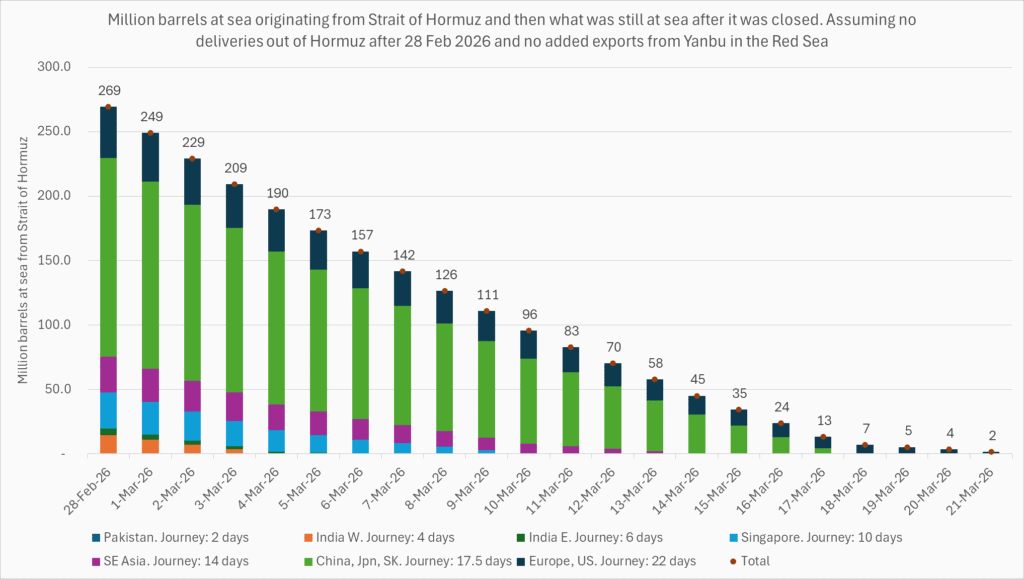
Oil at sea is falling fast as oil is delivered without any new refill in the Persian Gulf. Waivers for Russian crude is also shifting Russian crude to consumers. Brent crude will likely start to feel the pinch much more forcefully when oil at sea is drawn down another 200 mb to around 1000 mb. That is not much more than 10 days from here.
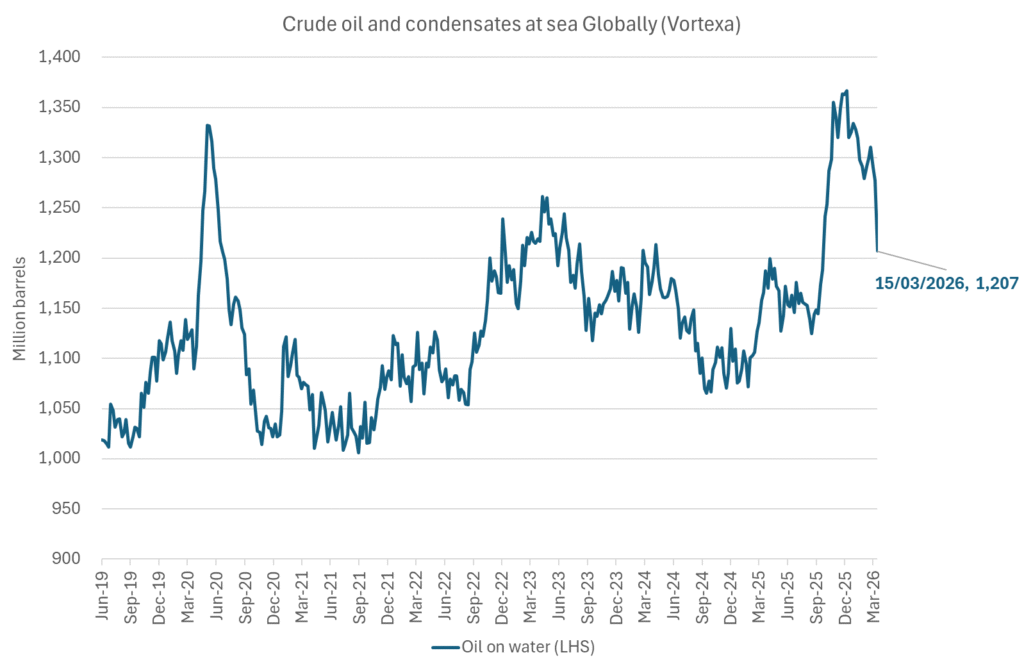
Oil and oil products are starting to become very pricy many places. Brent crude has still been shielded from spiking like the others.
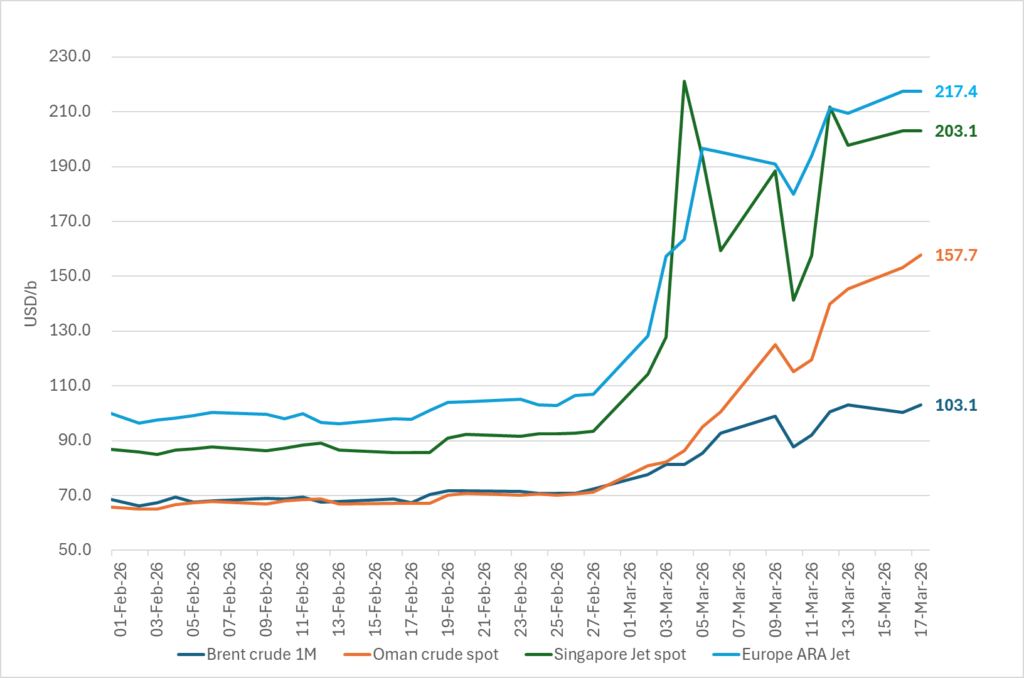



Market Still Betting on Timely Resolution, But Each Day Raises Shortage Risk

Christian Kopfer om läget för oljan

Marknaden måste börja betrakta de höga kopparpriserna som det nya normala

Det fysiska spotpriset på brentolja har slagit nytt rekord

40 minuter med Javier Blas om hur världen verkligen påverkas av energikrisen
40 minuter med Javier Blas om hur världen verkligen påverkas av energikrisen

Elpriserna fördubblas, stor osäkerhet inför sommaren

MP Materials, USA:s svar på Kinas dominans över sällsynta jordartsmetaller
Det fysiska spotpriset på brentolja har slagit nytt rekord

Studsvik har idag ansökt om att få bygga 1200-1600 MW kärnkraft i Valdemarsvik
-
 Nyheter3 veckor sedan
40 minuter med Javier Blas om hur världen verkligen påverkas av energikrisen
-
 Nyheter4 veckor sedan
Elpriserna fördubblas, stor osäkerhet inför sommaren
-
 Nyheter4 veckor sedan
MP Materials, USA:s svar på Kinas dominans över sällsynta jordartsmetaller
-
 Nyheter2 veckor sedan
Det fysiska spotpriset på brentolja har slagit nytt rekord
-
 Nyheter4 veckor sedan
Studsvik har idag ansökt om att få bygga 1200-1600 MW kärnkraft i Valdemarsvik
-
 Nyheter2 veckor sedan
Marknaden måste börja betrakta de höga kopparpriserna som det nya normala
-
Analys4 veckor sedan
TACO (or Whatever It Was) Sends Oil Lower — Iran Keeps Choking Hormuz
-

 Nyheter4 veckor sedan
Matproduktion är beroende av gödsel, Gulfkriget skapar brist