

Analys
SHB Råvarubrevet 15 mars 2013

 Råvaror allmänt
Makro ställs mot politik, ännu en gång
Drivkraften i närtid är främst det osäkra valutfallet i Italien. Även om vissa datautfall som inköpschefsindex för EMU-området och Kina varit något sämre än väntat har dataskörden överlag varit fortsatt god. Börsrallyt har fortsatt att sätta avtryck i företagens och hushållens stämningsläge, skattehöjningar och nedskärningar till trots. Råvaror har planat ut efter februari månads branta fall.
Den bild vi har av makroutvecklingen ger stöd för bred uppgång för råvaror. För den amerikanska ekonomin handlar det mycket om att hushållen svarar mot den förbättring som äger rum på bostadsmarknaden. Trots att bostadsmarknaden överraskade positivt under hela 2012 har marknaden inte dragit några större växlar för vad det innebär för konsumenternas välbefinnande. Ingen räknar idag med att ”den amerikanska konsumenten” kommer tillbaka på allvar. Men tänk om!
Skattehöjningar, nedskärningar och kanske även en minskning av federala utgifter i slutet av april utgör motvindar i USA. Detta har dock hittills motverkats av positiva förmögenhets- och sentimentseffekter. Som vanligt är läget i EMU-området värre. Det italienska valet resulterade i ett oklart parlamentariskt läge utan någon tydlig vinnare. Rapporter gör gällande att Bersani kommer att försöka sy ihop en bred regering tillsammans med Berlusconis allians eller delar därav. Ett sådant utfall vore marknadspositivt pga. minskad osäkerhet.
Bernanke har lugnat marknaderna, som sondmatats med lätt hökiga signaler från de senaste protokollen. Bernanke sade att ”en signifikant majoritet” bland röstande ledamöterna är för nuvarande penningpolitik. Han tonade även ned riskerna med den lätta penningpolitiken, vidhöll att Fed kan hålla köpta obligationer till förfall och att det inte är aktuellt att sänka köptakten ännu.
Basmetallerna
Kina ökar produktionstakten
Kineserna har dragit upp produktionstakten på såväl basmetaller som stål visar färsk statistik. 2.21 miljoner ton stål per dag produceras och All-time-high vilket vittnar om god efterfrågan från både transport- och fastighetssektorn. Kina har ytterligare 35 procent i installerad kapacitet, ca 970 miljoner ton, som man inte kör utan målet är att hålla produktionstakten i nivå med efterfrågan kring ca 700 miljoner ton.
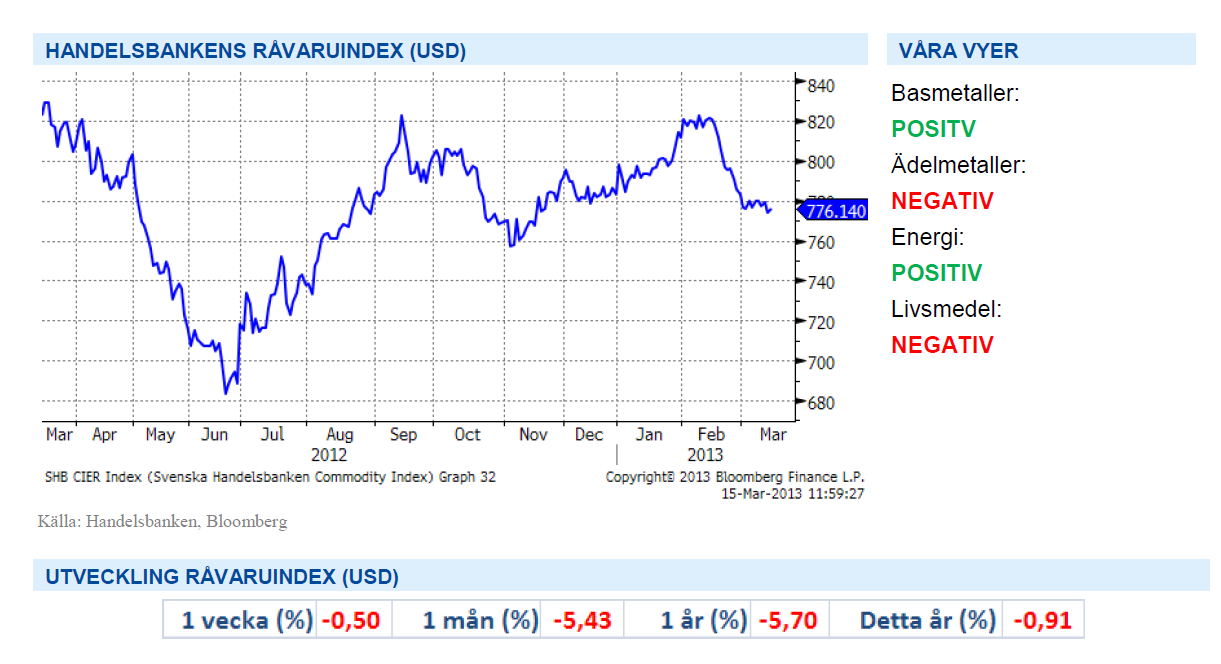
På Aluminium har produktionstakten ökat med 15 procent YoY till och betydande smältkapacitet installeras nu i de Nordvästra provinserna. Oroande kan tyckas om man ser till överskottet på Aluminium men intressant när även på Kopparproduktionen ökar kraftigt (+11.9% YoY) så trenden tycks bekräfta en stor förändring i mönstret på Kinas import av råvaror. Från import av färdiga varor (raffinerad koppar exempelvis) till att i större utsträckning kontrollera förädlingen (import av koncentrat). Landet är fortfarande långt ifrån självförsörjande när det gäller raffinerad metall och den kinesiska importen kommer att förbli en stor del av den globala handeln, men inte nödvändigtvis i samma utsträckning som historiskt varit fallet. Detta kommer naturligtvis också pressa marginalerna för smält- och raffinaderier ytterligare. Vårt Basmetallindex stiger 1 procent under veckan efter att ha fallit med 6 procent under februari och vi bedömer att detta ger möjlighet att kliva in i metaller på bra nivåer.
Nedan finner du en graf ser du hur Handelsbankens Basmetallindex (rött) rört sig i förhållande till Råvaruindex (blått) och OMX 30 (grönt).
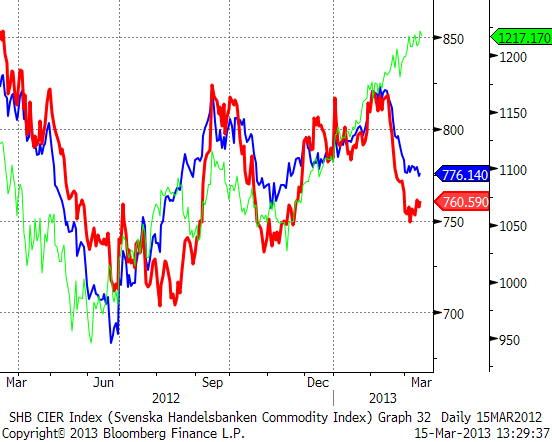
Trots nedgången under veckan tror vi på högre priser på basmetaller och ser istället möjlighet till ”buy on dip”. Vi tror på: BASMET H
Ädelmetaller
Vi behåller vår negativa syn på guldet
Sedan förra veckan har guldet knappt rört sig, varken upp eller ner. Vi behåller dock vår negativa – väldigt negativa – syn på guldet, och ägnar veckans spalt åt att fördjupa resonemanget bakom vår vy. Under nästa vecka hoppas vi kunna titta närmare på guldprisets utveckling under 70-talet, vilken åtföljdes av en halvering av priset, och se om det finns likheter med det läge vi befinner oss i nu.
Det absolut viktigaste skälet till vår negativa syn är att guld inte behövs. Alla överlever vi utan guld – till skillnad från spannmål – och vi behöver inte guld vare sig när vi bygger hus, broar, bilar eller mobiltelefoner. Många av oss vill ha guld, men ingen behöver guld. Detta faktum gör att guldets dynamik är väsensskild från övriga råvaror. Vi köper guld som en värdebevarare, som inflationsskydd, eller som en ren spekulation. Och naturligtvis för att det är en vacker utsmyckare och statussymbol att bära synligt.
Problemet med allt detta är att det krävs fantastiskt mycket nya köpare bara för att hindra guldet från att falla i pris. Det produceras guld för runt 170 miljarder dollar varje år, guld som måste köpas av de som hoppas kunna sälja det till ett ännu högre pris till någon annan. Eller sätta det på fingret eller runt halsen. För allt guld som någonsin producerats finns fortfarande, så man kan säga att lagernivån är god.
Så, glöm resonemang om att det är tilltagande riskaptit som kommer att sänka värdet på guld, det är bara triggern till att priset nu börjat falla. Det är guldets totala brist på nytta som kommer att sätta rätt värde i slutändan.
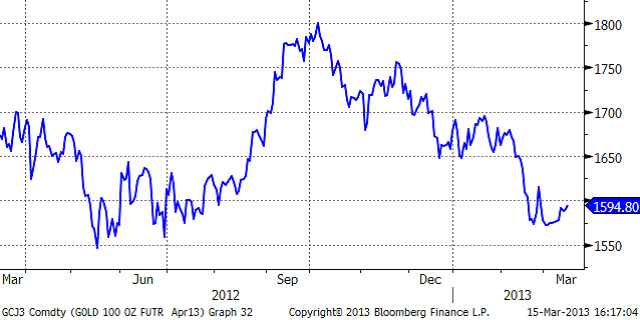
Starkare dollar och högre räntor blir utmanande för guldet samtidigt som inflationen väntas vara låg under året. Vi tror på: GULD S H
Energi
Oljan finner stöd
Oljan återhämtar sig mot slutet av veckan efter positiva amerikanska arbetslöshetssiffror och en svagare dollarutveckling. Samtidigt som Sudan meddelat att man beordrat alla utländska oljebolag och operatörer att återuppta oljeproduktionen (350kbpd) efter avmilitarisering i området kring gränsen mot södra Sudan, finner oljan fortsatt stöd från risk för produktionsbortfall. President Obama besöker Israel nästa vecka och diskussioner kring Iran´s kärnvapen och en förlängning av sanktionerna är självklart en intressant punkt på agendan. OPEC har dock signalerat att man är beredd att skruva upp produktionen med ytterligare 300kb (+1.2%) under de kommande veckorna för att täcka upp efterfrågan så fundamentalt är det svårt att motivera köp på dessa nivåer. Däremot verkar oljan finna stöd på strax under 110 så vi bedömer att potential just nu finns på uppsidan. Lägg därtill en fortsatt backwardation (avdrag) på Brentterminerna om ca 6 procent 1 år ut vilket gynnar ett innehav.
Elen oförändrad över veckan, samtidigt som kalla och torra prognoser verkar för uppsidan backar energikol (-2%) och utsläppsrätterna tillbaka vilket resulterar i en stillastående marknad. Så länge vi inte får en kraftigt förändrad energibalans (förväntas vara -11.5 TWh mot slutet av nästa vecka) eller brytpris på kol är det svårt att vara annat än neutral.
Vad gäller utsläppsrätterna anordnade man i veckan en icke bindande testomröstning inom EU Parlamentet (vilken för övrigt gick igenom) och det är i dagsläget väldigt osäkert när den officiella omröstningen sker, senaste datum är angivet till den 15e april. Därefter inleder man diskussionerna kring strukturen för hela systemet. Mer information för den som är intresserad finns att läsa på EU Kommissionens hemsida.
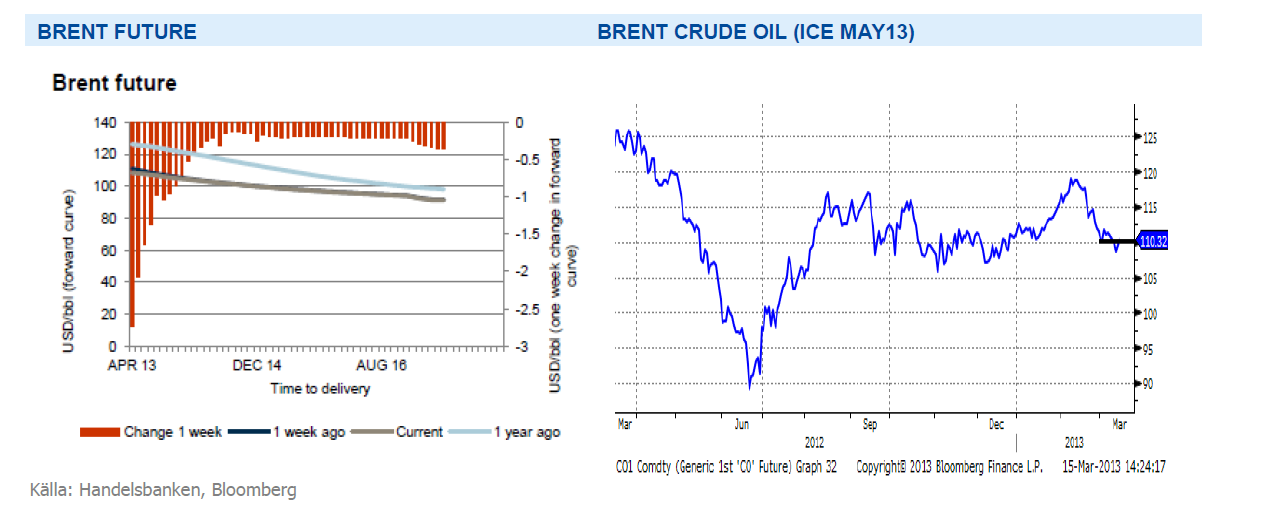
Den råvarugrupp som är mest beroende av den globala konjunkturen är Energi och med en starkare konjunktur ser vi positivt på utvecklingen för denna sektor. Vi tror på: ENERGI H
Livsmedel
Ökad europeisk veteproduktion
Terminspriserna på vete noteras upp sedan förra veckan i både Chicago och Paris. Uppgången är delvis en följd av något torrare och varmare väderlek för det amerikanska höstvetet, vilket inte gynnar grödan inför våren. Större amerikansk export än väntat har även det bidragit till prisuppgången.
I EU har nederbörd i söder saktat upp vårbruket i en del regioner samtidigt som klart kyligare väder och en del snö fördröjer vårbruket i norra Europa. EU-kommissionen spår den högsta europeiska veteskörden på fem år med 140 miljoner ton, upp 6,2 procent från förra året. I dagsläget upplevs bara problem i Storbritannien och norra Frankrike som båda fått för mycket regn. I Ukraina har det fallit regn eller snö i de centrala och norra delarna vilket fördröjer vårbruket, landets södra delar är dock mildare och torrare. Andelen utvintring uppskattas till omkring 9 procent, klart lägre än förra årets 25 procent. Ryssland är med tanke på begränsat snötäcke i en del sydliga regioner något för kallt. Förutom torrt väder för höstvetet i USA och än så länge relativt små problem i EU finns det i dagsläget inte mycket som oroar och all anledning att tro på en ökad global veteproduktion. Även för den amerikanska majsen, vilken har stor påverkan på vetet, har situationen förbättrats. Givet inga större väderproblem bör vi kunna vänta oss fortsatt lägre priser lite längre fram på året.
På kaffemarknaden väntas rekordskördar i Brasilien där produktionen beräknas öka från 47 till 48 miljoner bags (1 bag = 60 kg) för säsongen 2013/-14. Kaffe är en varannan-år-råvara och efter ett år (2012) med rekordskördar brukar normalt året efter innebära ett produktionsbortfall med omkring 30 procent. Men med bättre beskärningsteknik och ökat antal planterade träd per hektar har man i år lyckats minska produktionsbortfallet till omkring 10 procent. Vi har med anledning av detta noterat fallande priser efter en svajig tid med delvis stigande priser som följd av oroligheterna kring svampsjukdomar i Centralamerika. Juice är en av råvarorna som stigit mest i år, upp 18 procent sedan årsskiftet.
Torkan i Florida fortsätter drabba apelsinodlingen och torrare väder väntas de kommande två veckorna. Regnsäsongen drar i gång i juni men mycket mer regn behövs. I förra veckan sänkte det amerikanska jordbruksdepartementet, USDA sin prognos för apelsinproduktionen i Florida med 1,8 procent vilket fått priset på apelsinterminen att skjuta i höjden.
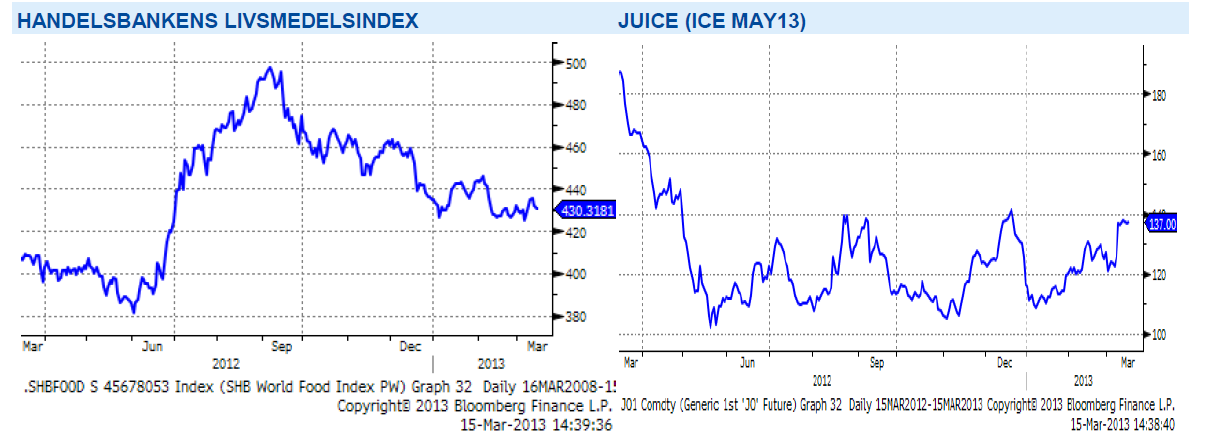
Vi behåller vår negativa syn för soja, majs och vete, trots riskerna för torrt väder i USA. Normal väderlek bör ge press på spannmålspriserna. Vi tror på: LIVSMEDEL S H
Handelsbankens Råvaruindex
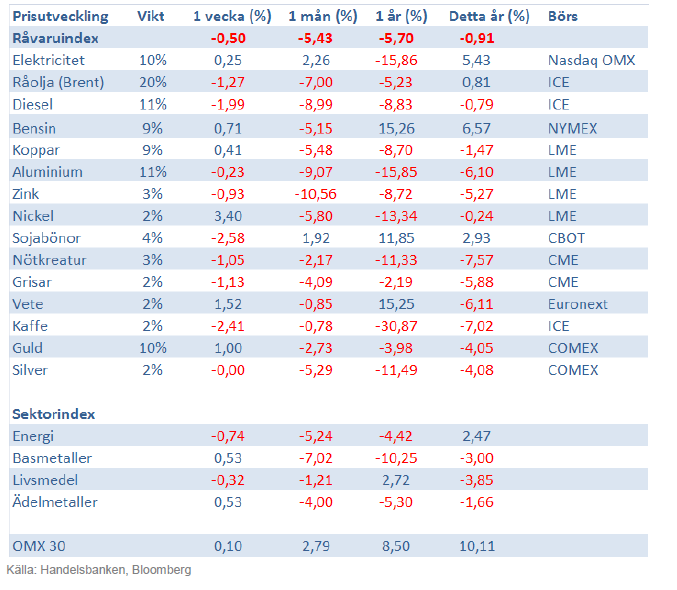
Handelsbankens råvaruindex består av de underliggande indexen för respektive råvara. Vikterna är bestämda till hälften från värdet av global produktion och till hälften från likviditeten i terminskontrakten.
[box]SHB Råvarubrevet är producerat av Handelsbanken och publiceras i samarbete och med tillstånd på Råvarumarknaden.se[/box]
Ansvarsbegränsning
Detta material är producerat av Svenska Handelsbanken AB (publ) i fortsättningen kallad Handelsbanken. De som arbetar med innehållet är inte analytiker och materialet är inte oberoende investeringsanalys. Innehållet är uteslutande avsett för kunder i Sverige. Syftet är att ge en allmän information till Handelsbankens kunder och utgör inte ett personligt investeringsråd eller en personlig rekommendation. Informationen ska inte ensamt utgöra underlag för investeringsbeslut. Kunder bör inhämta råd från sina rådgivare och basera sina investeringsbeslut utifrån egen erfarenhet.
Informationen i materialet kan ändras och också avvika från de åsikter som uttrycks i oberoende investeringsanalyser från Handelsbanken. Informationen grundar sig på allmänt tillgänglig information och är hämtad från källor som bedöms som tillförlitliga, men riktigheten kan inte garanteras och informationen kan vara ofullständig eller nedkortad. Ingen del av förslaget får reproduceras eller distribueras till någon annan person utan att Handelsbanken dessförinnan lämnat sitt skriftliga medgivande. Handelsbanken ansvarar inte för att materialet används på ett sätt som strider mot förbudet mot vidarebefordran eller offentliggörs i strid med bankens regler.

Wild moves yesterday. Brent crude traded to a high of $114.43/b and a low of $96.0/b and closed at $99.94/b yesterday.

US – Iran negotiations ongoing or not? What a day. Donald Trump announced that good talks were ongoing between Iran and the US and that the 48 hour deadline before bombing Iranian power plants and energy infrastructure was postponed by five days subject to success of ongoing meetings. Iranian media meanwhile stated that no meetings were ongoing at all.
Today we are scratching our heads trying to figure out what yesterday was all about.
Friends and family playing the market? Was it just Trump and his friends and family who were playing with oil and equity markets with $580m and $1.46bn in bets being placed by someone in oil and equity markets just 15 minutes before Trump’s announcement?
Was Trump pulling a TACO as he reached his political and economic pain point: Brent at $112/b, US Gas at $4/gal, SPX below 200dma and US 10yr above 4.4%?
Different Iranian factions with Trump talking with one of them? Are there real negotiations going on but with the US talking to one faction in Iran while another, the hardliners, are not involved and are denying any such negotiations going on?
Extending the ultimatum to attack and invade Kharg island next weekend? Or, is the five day delay of the deadline a tactical decision to allow US amphibious assault ships and marines to arrive in the Gulf in the upcoming weekend while US and Israeli continues to degrade Iranian military targets till then. And then next weekend a move by the US/Israel to attack and conquer for example the Kharg island?
We do not really know which it is or maybe a combination of these.
We did get some kind of TACO ydy. But markets have been waiting for some kind of TACO to happen and yesterday we got some kind of TACO. And Brent crude is now trading at $101.5/b as a result rather than at $112-114/b as it did no the high yesterday.
But what really matters in our view is the political situation on the ground in Iran. Will hardliners continue to hold power or will a more pragmatic faction gain power?
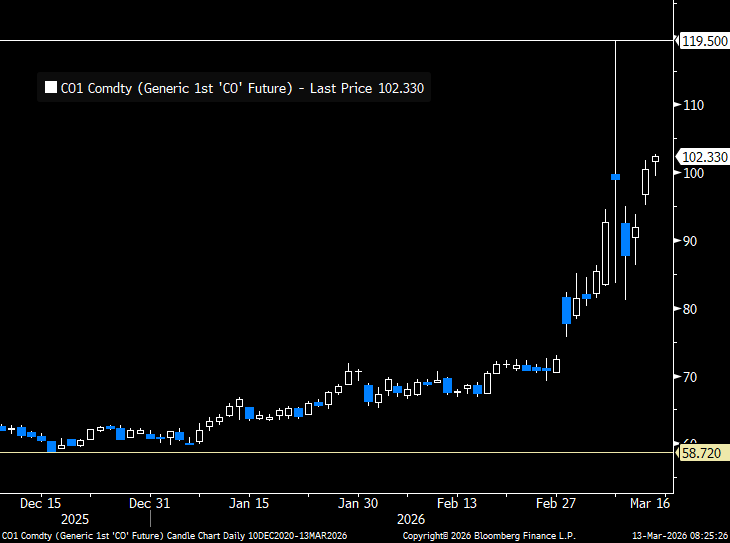
If the hardliners remain in power then oil pain should extend all the way to US midterm elections. The hardliners were apparently still in charge as of last week. Iran immediately retaliated and damaged LNG infrastructure in Qatar after Israel hit Iranian South Pars. The SoH was still closed and all messages coming out of Iran indicated defiance. Hardliners continues in power has a huge consequence for oil prices going forward. The regime has played its ’oil-weapon’ (closing or chocking the Strait of Hormuz). It is using it to achieve political goals. Deterrence: it needs to be so politically and economically expensive to attack Iran that it won’t happen again in the future. Or at least that the US/Israel thinks 10-times over before they attack again. The highest Brent crude oil closing price since the start of the war is $112.19/b last Friday. In comparison the 20-year inflation adjusted Brent price is $103/b. So Brent crude last Friday at $112.19/b isn’t a shockingly high price. And it is still far below the nominal high of $148/b from 2008 which is $220/b if inflation adjusted. So once in a lifetime Iran activates its most powerful weapon. The oil weapon. It needs to show the power of this weapon and it needs to reap political gains. Getting Brent to $112/b and intraday high of $119.5/b (9 March) isn’t a display of the power of that weapon. And it is not a deterrence against future attacks.
So if the hardliners remain in power in Iran, then the SoH will likely remain chocked all the way to US midterm elections and Brent crude will at a minimum go above the historical nominal high of $148/b from 2008.
Thus the outlook for the oil price for the rest of the year doesn’t depend all that much of whether Trump pulls a TACO or not. Stops bombing or not. It depends more on who is in charge in Iran. If it is the hardliners, then deterrence against future attacks via chocking of the SoH and high oil prices is the likely line of action. It is impacting the world but the Iranian ’oil-weapon’ is directed towards the US president and the the US midterm elections.
If a pragmatic faction gets to power in Iran, then a very prosperous future is possible. However, if power is shifting towards a more pragmatic faction in Iran then a completely different direction could evolve. Such a faction could possibly be open for cooperation with the US and the GCC and possibly put its issues versus Israel aside. Then the prosperity we have seen evolving in Dubai could be a possible future also for Iran.
So far it looks like the hardliners are fully in charge. As far as we can see, the hardliners are still fully in control in Iran. That points towards continued chocking of the SoH and oil prices ticking higher as global inventories (the oil market buffers) are drawn lower. And not just for a few more weeks, but possibly all the way to the US midterm elections.
A brief sigh of relief yesterday as oil infra at Kharg wasn’t damaged. But higher today. Brent crude dabbled around a bit yesterday in relief that oil infrastructure at Iran’s Kharg island wasn’t damaged. It traded briefly below the 100-line and in a range of $99.54 – 106.5/b. Its close was near the low at $100.21/b.
No easy victorious way out for Trump. So no end in sight yet. Brent is up 3.2% today to $103.4/b with no signs that the war will end anytime soon. Trump has no easy way to declare victory and mission accomplished as long as Iran is in full control of the Strait of Hormuz while also holding some 440 kg of uranium enriched to 60% and not far from weapons grade at 90%. As long as these two factors are unresolved it is difficult for Trump to pull out of the Middle East. Naturally he gets increasingly frustrated over the situation as the oil price and US retail gas prices keeps ticking higher while the US is tied into the mess in the Middle East. Trying to drag NATO members into his mess but not much luck there.
When commodity prices spike they spike 2x, 3x, 4x or 5x. Supply and demand for commodities are notoriously inflexible. When either of them shifts sharply, the the price can easily go to zero (April 2022) or multiply 2x, 3x, or even 5x of normal. Examples in case cobalt in 2025 where Kongo restricted supply and the price doubled. Global LNG in 2022 where the price went 5x normal for the full year average. Demand for tungsten in ammunition is up strongly along with full war in the middle east. And its price? Up 537%.
Why hasn’t the Brent crude oil price gone 2x, 3x, 4x or 5x versus its normal of $68/b given close to full stop in the flow of oil of the Strait of Hormuz? We are after all talking about close to 20% of global supply being disrupted. The reason is the buffers. It is fairly easy to store oil. Commercial operators only hold stocks for logistical variations. It is a lot of oil in commercial stocks, but that is predominantly because the whole oil system is so huge. In addition we have Strategic Petroleum Reserves (SPRs) of close to 2500 mb of crude and 1000 mb of oil products. The IEA last week decided to release 400 mb from global SPR. Equal to 20 days of full closure of the Strait of Hormuz. Thus oil in commercial stocks on land, commercial oil in transit at sea and release of oil from SPRs is currently buffering the situation.
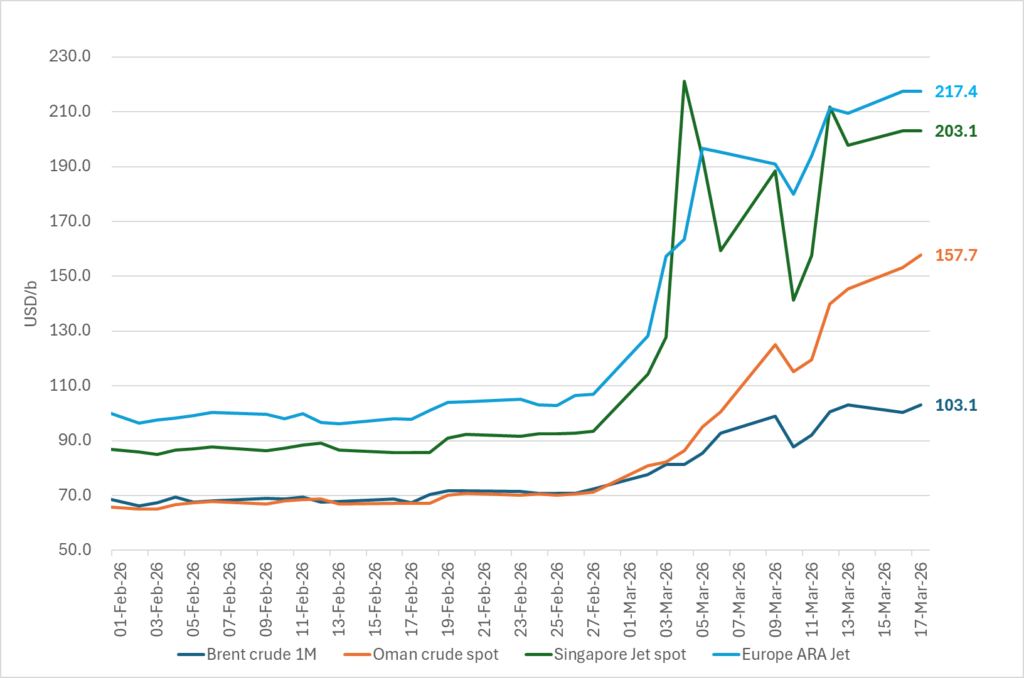
But we are running the buffers down day by day. As a result we see gradually increasing stress here and there in the global oil market. Asia is feeling the pinch the most. It has very low self sufficiency of oil and most of the exports from the Gulf normally head to Asia. Availability of propane and butane many places in India (LPG) has dried up very quickly. Local prices have tripled as a result. Local availability of crude, bunker oil, fuel oil, jet fuel, naphtha and other oil products is quickly running down to critical levels many places in Asia with prices shooting up. Oman crude oil is marked at $153/b. Jet fuel in Singapore is marked at $191/b.
Oil at sea originating from Strait of Hormuz from before 28 Feb is rapidly emptied. Oil at sea is a large pool of commercial oil. An inventory of oil in constant move. If we assume that the average journey from the Persian Gulf to its destinations has a volume weighted average of 13.5 days then the amount of oil at sea originating from the Persian Gulf when the the US/Israel attacked on 28 Feb was 13.5 days * 20 mb/d = 269 mb. Since the strait closed, this oil has increasingly been delivered at its destinations. Those closest to the Strait, like Pakistan, felt the emptying of this supply chain the fastest. Propane prices shooting to 3x normal there already last week and restaurants serving cold food this week is a result of that. Some 50-60% of Asia’s imports of Naphtha normally originates from the Persian Gulf. So naphtha is a natural pain point for Asia. The Gulf also a large and important exporter of Jet fuel. That shut in has lifted jet prices above $200/b.
To simplify our calculations we assume that no oil has left the Strait since that date and that there is no increase in Saudi exports from Yanbu. Then the draining of this inventory at sea originated from the Persian Gulf will essentially look like this:
The supply chain of oil at sea originating from the Strait of Hormuz is soon empty. Except for oil allowed through the Strait of Hormuz by Iran and increased exports from Yanbu in the Red Sea. Not included here.
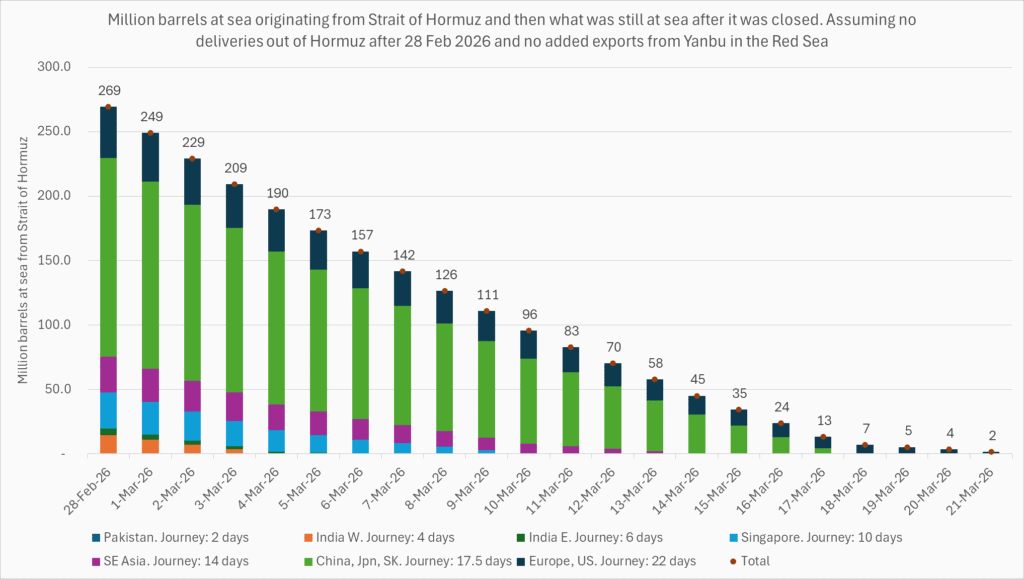
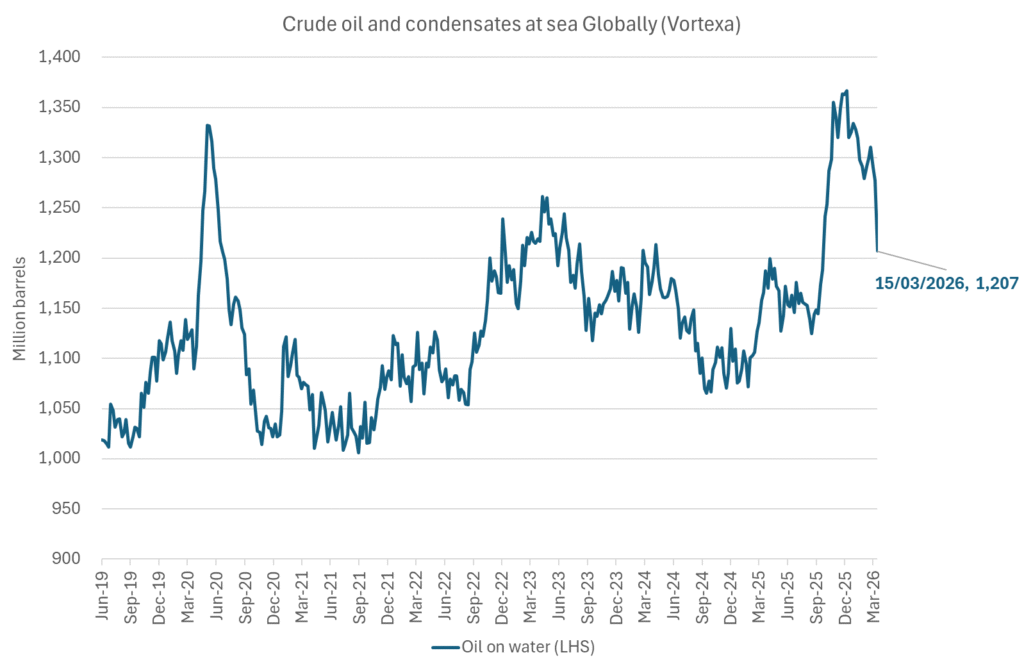
Oil at sea is falling fast as oil is delivered without any new refill in the Persian Gulf. Waivers for Russian crude is also shifting Russian crude to consumers. Brent crude will likely start to feel the pinch much more forcefully when oil at sea is drawn down another 200 mb to around 1000 mb. That is not much more than 10 days from here.
Oil and oil products are starting to become very pricy many places. Brent crude has still been shielded from spiking like the others.
Closing at highest since Aug 2022. Brent crude gained 9.2% yesterday. The trading range was limited to $95.2 – 101.85/b with a close at $100.46/b and higher than the Monday close of $98.96/b. Ydy close was the highest close since August 2022. This morning Brent is up 2% to $102.4/b and is trading at the highest intraday level since Monday when it high an intraday high of $119.5/b.
A military hit at Iran’s Kharg island would be a big, big bang for the oil price. The big, big risk for the weekend is that oil infrastructure could be damaged. For example Iran’s Kharg island which is Iran’s major oil export hub. If damaged we would have a longer lasting loss of supply stretching way beyond Trump’s announced ”two more weeks”. It will make the spot price spike higher and it will lift the curve. Brent crude 2027 swap would jump above $80/b immediately. An attack on Kharg island would naturally lead Iran to strike back at other oil infrastructures in the Gulf. Especially those belonging to countries who harbor US military bases. I.e. countries who essentially are supporting the attack by US and Israel towards Iran. Though if not in spirit, then in practical operational terms. An attack on Kharg island would not just lead to a lasting outage of supply from Iran until it would be repaired. It would immediately endanger other oil infrastructure in the region as well and additional lasting loss of supply.
No one in their right mind would dare to sit short oil over the coming weekend. Oil is thus set to close the week at a very strong note today.
Prepare for another 400 mb SPR release next week. This week’s announcement of a 400 mb release from Strategic Oil Reserves totally underwhelmed the market with the oil price going higher rather than lower following the announcement. For one it means that the market expects the war and the closure of the Strait of Hormuz to last longer than Trump’s recent announced ”two more weeks”. 400 mb only amounts to 20 days of lost supply to the world through Hormuz and we are already at day 14. So next week when we are getting close to the 20 day mark, we are likely to see another announcement of another 400 mb release of SPR stocks to the market. Preparing for the next 20 days of war.
Global oil logistics in total disarray. We have previously addressed the issue of the huge logistical web of the global oil market which is now in total disarray. The logistical disruption started to fry the oil market at the end of last week. Helped to spike the oil market on Monday. What we hear from our shipping clients is that the problems with supply of fuels locally in Korea, Singapore, India and Africa are getting worse with physical availability of fuels there drying up. It is getting increasingly difficult to find physical supply of bunker oil with local, physical prices shooting way higher than financial benchmarks. To the point that biofuels have become the cheap option many places. Availability of fuels in the US is still good. Not so surprising as the US is self-sufficient with crude and refineries.
The disruption in global oil logistics doesn’t seem to improve. Rather the opposite. If you cannot get fuel to run your ships, then how can you distribute fuels to where it is needed.
Buy Brent Dec-2026 calls with strike $150/b!! As the days goes by the oil price is ticking higher while Trump is getting one day closer to US midterm elections. Trump was betting that he could put this war to bead well before November. But that will probably not be up to him to decide. It will be up to Iran to decide when to reopen the Strait of Hormuz. It is very hard to imagine that Iran will let Trump easily off the hock after he has killed its Supreme Leader. This will likely go all the way to November. Buy Brent Dec-2026 calls with strike $150/b!!
Brent closed at highest since 2022 ydy. Will end this Friday at a very strong note! Consumers still dreaming of $60/b oil



Christian Kopfer om läget för oljan

Marknaden måste börja betrakta de höga kopparpriserna som det nya normala

Det fysiska spotpriset på brentolja har slagit nytt rekord

40 minuter med Javier Blas om hur världen verkligen påverkas av energikrisen

Efter tillväxten: Guldbrev satsar på expansion i Europa
40 minuter med Javier Blas om hur världen verkligen påverkas av energikrisen

Elpriserna fördubblas, stor osäkerhet inför sommaren

MP Materials, USA:s svar på Kinas dominans över sällsynta jordartsmetaller
Det fysiska spotpriset på brentolja har slagit nytt rekord

Studsvik har idag ansökt om att få bygga 1200-1600 MW kärnkraft i Valdemarsvik
-
 Nyheter2 veckor sedan
40 minuter med Javier Blas om hur världen verkligen påverkas av energikrisen
-
 Nyheter3 veckor sedan
Elpriserna fördubblas, stor osäkerhet inför sommaren
-
 Nyheter4 veckor sedan
MP Materials, USA:s svar på Kinas dominans över sällsynta jordartsmetaller
-
 Nyheter2 veckor sedan
Det fysiska spotpriset på brentolja har slagit nytt rekord
-
 Nyheter4 veckor sedan
Studsvik har idag ansökt om att få bygga 1200-1600 MW kärnkraft i Valdemarsvik
-
 Nyheter2 veckor sedan
Marknaden måste börja betrakta de höga kopparpriserna som det nya normala
-

 Nyheter4 veckor sedan
Matproduktion är beroende av gödsel, Gulfkriget skapar brist
-
Analys4 veckor sedan
TACO (or Whatever It Was) Sends Oil Lower — Iran Keeps Choking Hormuz