

Analys
SHB Råvarubrevet 13 januari 2012

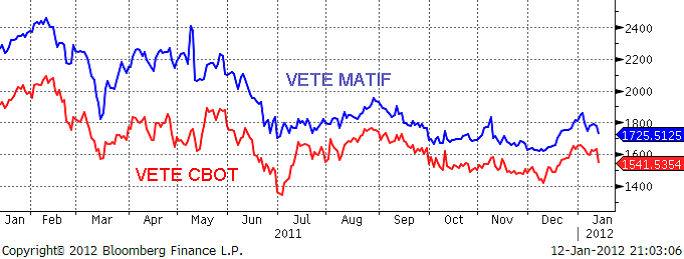
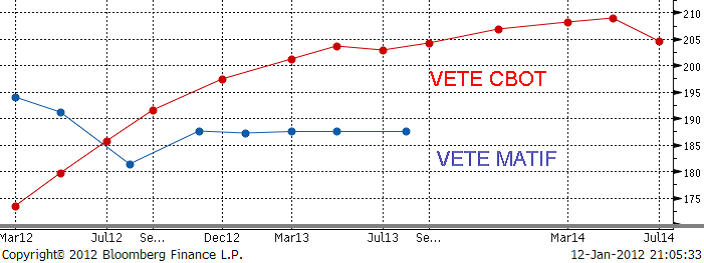
 Vetepriset på Matif stängde igår på en något högre nivå jämfört med förra torsdagen, trots gårdagens kraftiga fall orsakat av januari månads rapport från USDA – se nästa sida. Fallet blev klart större i USA och vetet i Chicago noteras ned sedan förra veckan. En fortsatt försvagning av euron i förhållande till den amerikanska dollarn har påverkat det europeiska vetets relativt bättre utveckling den senaste tiden.
amerikanska vetearealen justerades upp mer än väntat i gårdagens rapport, annars har vetet fortsatt att följa prisutvecklingen för majs och därmed väderutvecklingen i Sydamerika i väldigt hög grad under de senaste veckorna. Efter gårdagens rapport kommer fokus återigen riktas på väderutvecklingen i Sydamerika, vilken är svår att förutse.
Den australiensiska veteskörden är i stort sett klar, trots mycket regn uppges kvaliteten kunna bli något bättre än tidigare befarat. Den argentinska veteskörden är även den i stort sett klar, små regnskurar fördröjde skördearbetet något på slutet men utan större problem. För vetet i EU finns inga större skäl till oro, även om mer snö är önskvärt. Oron är dock större för vetet i Ukraina, som fortfarande även det har för lite snö, men vintern har hittills varit väldigt mild mot det ukrainska vetet med låga temperaturer. Hela 35 procent av höstvetet i Ukraina uppges dock vara i dåligt skick vilket kommer påverka framtida exportvolymer.
Vart vetepriserna är på väg är väldigt osäkert inte minst innan vintern är över och vi får en klar bild över grödornas skick, inte bara i Ukraina utan även i USA där höstvetet är i dåligt skick har dock vintern varit mild. Utan fortsatt torrt och varmt väder i Sydamerika, med stigande majs- och sojapriser som följd, är det i nuläget svårt att se högre vetepriser den närmaste tiden.
Majs
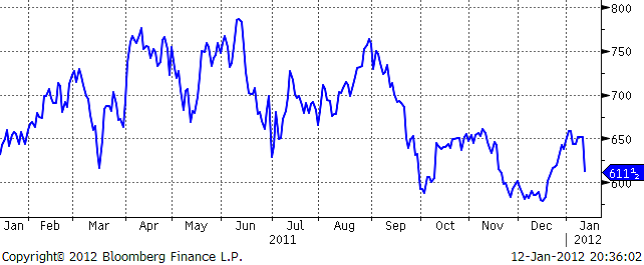
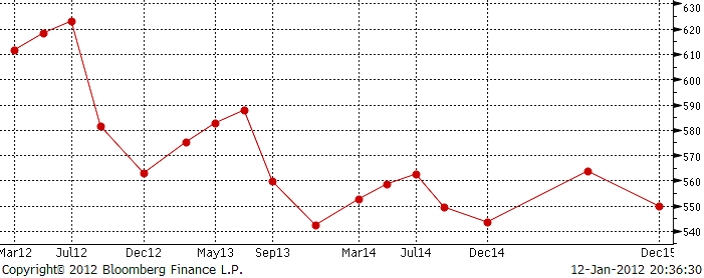
Terminspriserna på majs i Chicago har backat kraftigt sedan förra veckan, en nedgång som orsakades av gårdagens rapport från USDA i vilken siffrorna för utgående lager av majs i USA var klart högre än väntat – se nästa sida. Även utgående globala lager av majs justerades upp.
Efterfrågan på amerikansk majs har varit låg den senaste tiden, oro för minskande efterfrågan från etanolindustrin ger även det press nedåt. Uppgången veckorna innan gårdagens fall har i stort sett helt påverkats av torkan i Sydamerika, främst Argentina. Det har fallit en del regn men ej i tillräcklig mängd och dessutom något för sent i flera områden. Kommande prisutveckling lär under några veckor vara starkt beroende av den fortsatta väderutvecklingen i Argentina och Brasilien, vilken är väldigt svår att förutse.
USDA uppskattar den kommande argentinska majsskörden till 26 miljoner ton, de flesta sydamerikanska analytiker förväntar sig dock en skörd kring 23-25 miljoner ton – alltså klart lägre och risk finns att USDA underskattar torkans effekt. En hel del av detta bortfall bör dock kunna kompenseras av fodervete från andra delar av världen, vilket det finns gott om.
Lite längre fram kommer snart fokus riktas mot kommande sådd i USA, arealen spås av många bli den största någonsin som följd av höga priser – men konkurrens om arealen lär komma från sojabönor.
Sojabönor
Terminspriserna på sojabönor har backat något sedan förra veckan, delvis som följd av viss nederbörd i torkdrabbade Sydamerika men framförallt följde sojabönorna med majsen ned efter USDA-rapporten igår – se nästa sida. Till våren vid tid för sådd i USA kommer de båda grödorna slåss om areal vilket gör att det finns en relativt stark koppling mellan grödornas pris. Under gårdagen backade dock priset på sojabönor klart mindre än majsen med omkring 2 procent jämfört med majsens fall på ungefär 6 procent.
Vädret i Sydamerika har varit under stort fokus under flera veckor nu och lär vara så i flera veckor till. USDA:s nedjustering av den argentinska sojaproduktionen blev klart mindre än många väntat med blygsamma 1,5 miljoner ton – flera sydamerikanska analytiker uppskattar att torkan hittills skapat en skördeförlust på uppemot 6 miljoner ton. Förvånande är kanske också USDA:s nedjustering på 1 miljon ton av den brasilianska skörden, flera analytiker hävdar att en nedjustering med omkring 5 miljoner ton vore mer korrekt. I den näst största sojaproducerande delstaten i Brasilien, Parana, bedöms endast 57 procent av grödan vara i bra skick, att jämföra med 95 procent en månad tidigare.
Den kritiska perioden för sojabönor i Argentina ligger några veckor fram i tiden, men i Brasilien har alltså en ganska kraftig skada redan skett – vilket kanske i alla fall USDA inte riktigt tagit på allvar. Det har fallit en del regn den senaste tiden, men de brasilianska lantbrukarna har lärt sig att inte ta ut segern i förskott – det regnar alltid något, även under riktigt torra år.
Kommande prisutveckling är under en ganska lång tid främst beroende av väderutvecklingen i Sydamerika, vilken är väldigt svårbedömd.
Kaffe
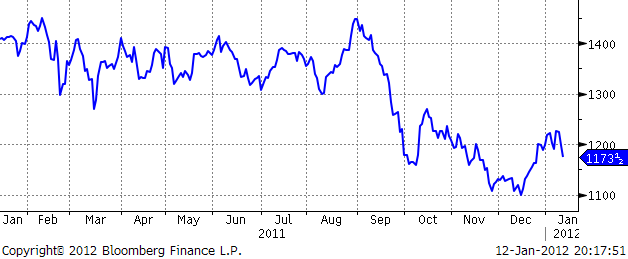
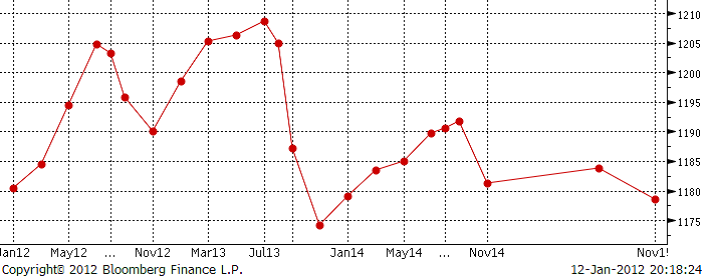
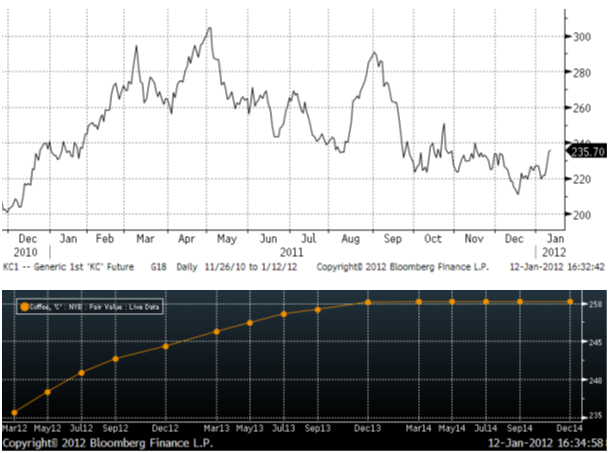
Under 2011 rörde sig kaffepriset mellan ett intervall av 210,95 – 304,90 USd/Ib och ser man till prisutvecklingen från årets början så har kaffe rört sig ned 3-4 procent och stängde innan årets slut på 226,85 USd/Ib.
Hittills har avkastningen från Centralamerika varit en besvikelse, trots att den Mexikanska produktionen visat sig vara stark. Lägre produktion väntas från Colombia om regnet fortsätter. De extrema väderförhållandena som råder i de kaffeproducerande områdena just nu kan komma att påverka kaffeproduktionen för det kommande året.
Det spekuleras om att Brasilien, världens största kaffeproducent, inte kommer att kunna möta den inhemska efterfrågan och den förväntade exporten trots rekordskörd i år. Detta har fått kaffepriset att studsa upp de senaste veckorna. 90 procent av den vietnamesiska skörden har skördats hittills men endast 20-25 procent av bönorna har sålts. Normalt för perioden är att hälften av bönorna ska ha släpps ut på marknaden. Orsaken till detta är att de vietnamesiska bönorna håller tillbaka försäljningen för att pressa upp priserna ytterligare.
Kakao
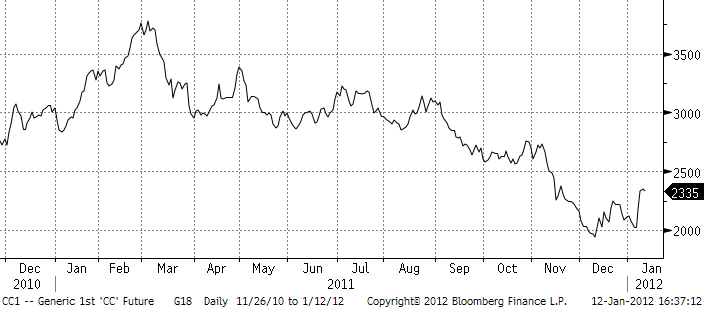
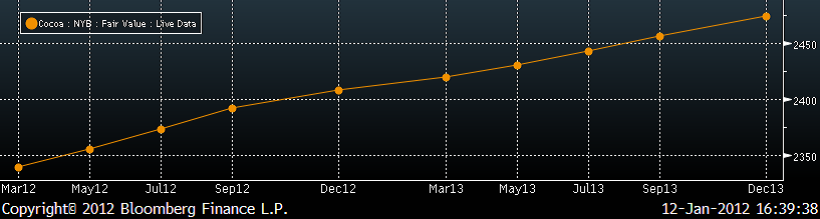
Kakaopriset rörde sig mellan ett intervall av $3774 -1936/ton under 2011. Kakaopriset stängde på $2109/ton vid årets slut, en nedgång med ca 40 procent sedan årets början. Goda väderförhållanden, globalt överskott och lägre konsumtion av kakao samt det svaga ekonomiska läget i världen har lett till att kakao tillhört de råvaror med sämst prisutveckling under förra året.
Under veckan har vi kunnat ta del av rapporter om strejk i Nigeria, världens fjärde största kakaoproducent. Marknaden är orolig för produktionsstörningar i området. Torrt väder kring Elfenbenskusten under de senaste veckorna och signaler om en ökad efterfrågan från Europa har varit några av orsakerna som drivit upp kakaopriset kraftigt.
Kakao terminskurva
Bomull
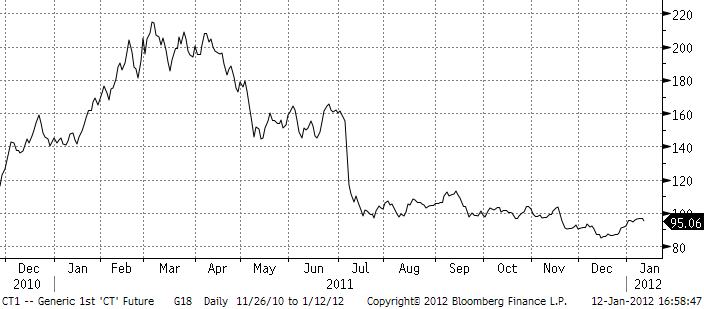
2011 rörde sig bomullspriset mellan ett intervall av 85,12 – 215,15 USd/Ib. Priset har fallit med drygt 55 procent sedan årshögsta och stängde vid årets slut på 91,80 USd/Ib.
Världskonsumtionen av bomull förväntas falla med 2,5 procent från förra säsongen som en följd av den tröga globala ekonomin medan den globala bomullsproduktionen väntas stiga 7 procent till rekordhöga 123,4 miljoner bales (1 bale = 218 kg), enligt USDA’s rapport för 2011/2012 som släpptes 12 december. Australiens produktion väntas stiga 19 procent, medan Brasiliens produktion väntas vara oförändrad. Kina, världens ledande bomullsproducent, väntas odla 10 procent mer bomull jämfört med förra året. Indien och Pakistan väntas öka sin produktion med 8 respektive 14 procent. Den amerikanska skörden 2011/2012 väntas sjunka med 13 procent jämfört med förra året. Den globala exporten för 2011/2012 väntas stiga 3 procent från förra året, i huvudsak p.g.a. den förväntade stigande produktionen. Kinas import, världens största importör av bomull, väntas stiga med hela 29 procent från tidigare år, detta som en följd av att Kina har importerat markant den senaste tiden för att nå sina mål av lagernivå, annars väntas importen hos flera importerade länder att falla.
Sedan årsskiftet har bomullspriset dock stigit något baserat på spekulationer om ökad efterfrågan som en följd av ett lugnare ekonomiskt läge. En annan faktor som varit orsaken till prisrallyt är det torra vädret i Sydamerika och i Texas. Annars har fonder ombalanserat sina portföljer och utökat sina bomullsinnehav. Marknaden oroar sig över ett andra år av minskad efterfrågan om det globala ekonomiska situationen förvärras.
[box]SHB Råvarubrevet är producerat av Handelsbanken och publiceras i samarbete och med tillstånd på Råvarumarknaden.se[/box]
Ansvarsbegränsning
Detta material är producerat av Svenska Handelsbanken AB (publ) i fortsättningen kallad Handelsbanken. De som arbetar med innehållet är inte analytiker och materialet är inte oberoende investeringsanalys. Innehållet är uteslutande avsett för kunder i Sverige. Syftet är att ge en allmän information till Handelsbankens kunder och utgör inte ett personligt investeringsråd eller en personlig rekommendation. Informationen ska inte ensamt utgöra underlag för investeringsbeslut. Kunder bör inhämta råd från sina rådgivare och basera sina investeringsbeslut utifrån egen erfarenhet.
Informationen i materialet kan ändras och också avvika från de åsikter som uttrycks i oberoende investeringsanalyser från Handelsbanken. Informationen grundar sig på allmänt tillgänglig information och är hämtad från källor som bedöms som tillförlitliga, men riktigheten kan inte garanteras och informationen kan vara ofullständig eller nedkortad. Ingen del av förslaget får reproduceras eller distribueras till någon annan person utan att Handelsbanken dessförinnan lämnat sitt skriftliga medgivande. Handelsbanken ansvarar inte för att materialet används på ett sätt som strider mot förbudet mot vidarebefordran eller offentliggörs i strid med bankens regler.



Market is starting to take US/Iran headlines with a pinch of salt. Brent crude rose $2.8/b yesterday to an official close of $112.1/b. But after that it traded as low as $108.05/b before ending late night at around $109.7/b. Through the day it traded in a range of $106.87 – 112.72/b amid a flurry of news or rumors from Iran and the US. ”US temporary sanctions during negotiations” (falls alarm). ”We will bomb Iran” (not anyhow),… etc. While the market is still fluctuating to this kind of news flow, it is starting to take such headlines with a pinch of salt.

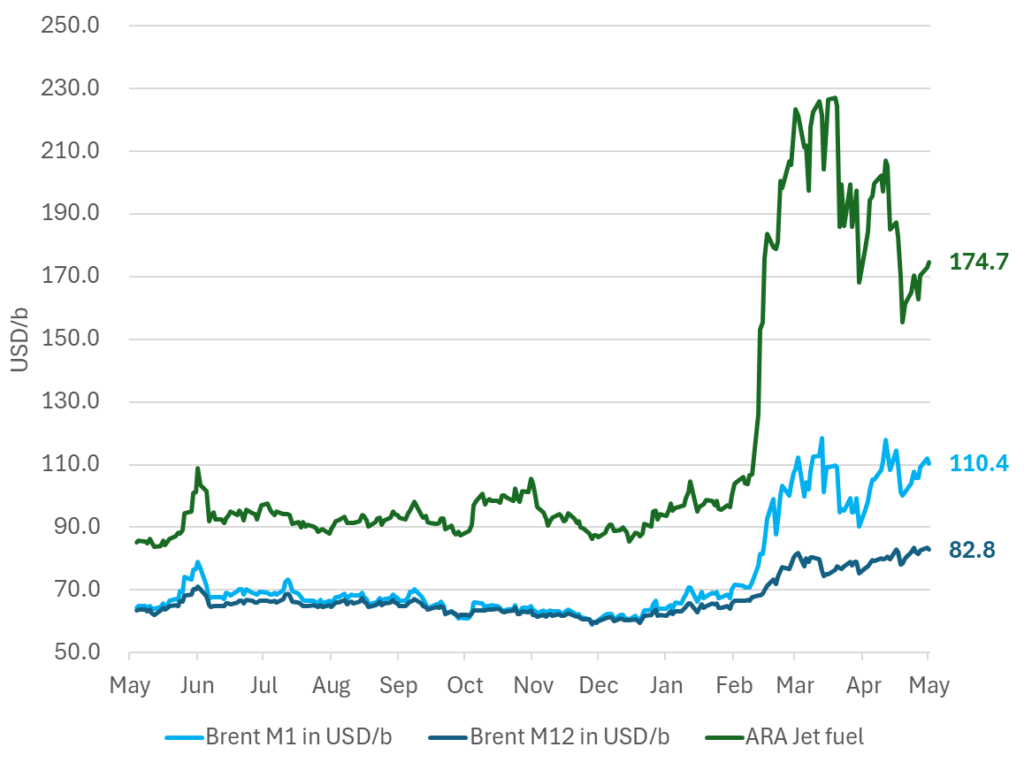
We’ll see. Maybe, maybe not. The Brent M1 contract is trading at $110.2/b this morning which very close to the average ticks through yesterday of $110.4/b.
Trump with bearish, verbal intervention whenever Brent trades above $110/b it seems. What seems to be a pattern is that Trump states something like ”very good negotiations going on with Iran”, ”New leaders in Iran are great,..”, ”Great progress in negotiations,…”, ”Deal in sight,..” etc whenever the Brent M1 contract trades above $110/b. An effort to cool the market. These hot air verbal interventions from Trump used to have a heavy bearish impact on prices, but they now seems to have less and less effect unless they are backed by reality.
As far as we can see there has been no real progress in the negotiations between the US and Iran with both sides still standing by their previous demands.
Iran is getting stronger while the cease fire lasts making a return to war for Trump yet harder. Iran is naturally in constant preparation for a return to war given Trump’s steady threats of bombing Iran again. Iran is naturally doing what ever is possible to prepare for a return to war. And every day the cease fire lasts it is better prepared. This naturally makes it more and more difficult and dangerous for the US to return to warring activity versus Iran as the consequences for energy infrastructure in the Persian Gulf will be more and more severe the longer the cease fire lasts. Israel seems to see it this way as well. That the war is not won and that current frozen state of a cease fire gives Iran opportunity to rebuild military and politically.
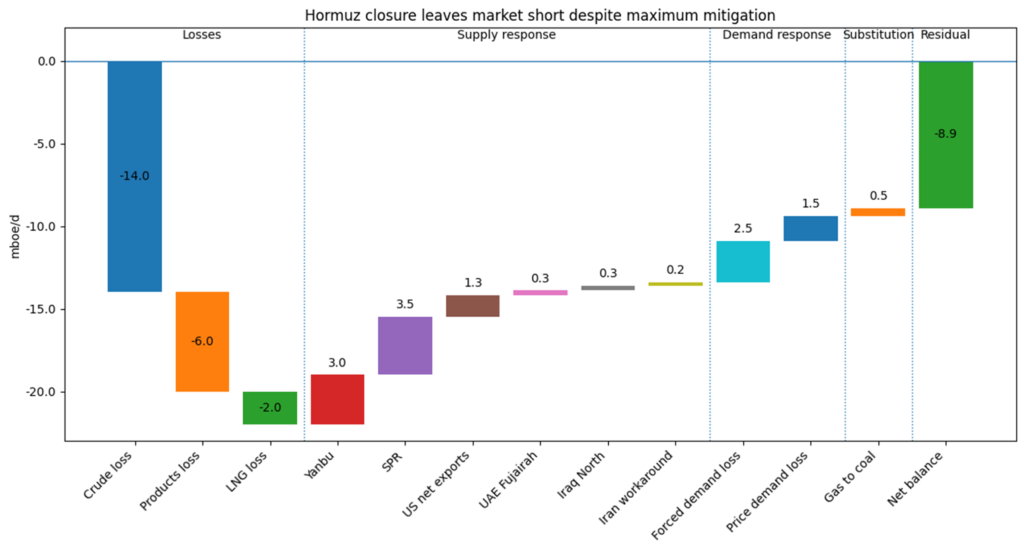
Global inventories are drawing down day by day. How much? In the meantime the Strait of Hormuz stays closed. There is varying measures and estimates of how much global inventories are drawing down. Our rough estimate, back of the envelope, is that global inventories are drawing down by at least some 10 mb/d or about 300 mb/d in a balance between loss of supply versus demand destruction. Other estimates we see are a monthly draw of 250-270 mb/d. The IEA only ’measured’ a draw in global observable stocks of 117 mb in April with oil on water rising 53 mb while on shore stocks fell 170 mb. But global stocks are hard to measure with large invisible, unmeasured stocks. As such a back of the envelope approach may be better.
Oil products is what the world is consuming. Oil product prices likely to rise while product stocks fall. Strategic Petroleum Reserves (SPR) are predominantly crude oil. Discharging oil from OECD SPR stocks, a sharp reduction in Chinese crude imports and a reduction in global refinery throughput of 6-7 mb/d has helped to keep crude oil markets satisfactorily supplied. But global inventories are drawing down none the less. And oil products is really what the world is consuming. So if global refinery throughput stays subdued, then demand will eventually have to match the supply of oil products. The likely path forward this summer is a steady draw down in jet fuel, diesel and gasoline. Higher prices for these. Then, if possible, higher refinery throughput and higher usage of crude in response to very profitable refinery margins. And lastly sharper draw in crude stocks and higher prices for these. But some 6 mb/d of oil products used to be exported through the Strait of Hormuz. And it may not be so easy to ramp up refinery activity across the world to compensate. Especially as Ukraine continues to damage Russian refineries as well as Russian crude production and export facilities.
Watch oil product stocks and prices as well as Brent calendar 2027. What to watch for this summer is thus oil product inventories falling and oil product premiums to crude rising. Another measure to watch is the Brent crude 2027 contract as it rises steadily day by day as the Strait of Hormuz stays closed and global oil inventories decline. The latter is close to the highest level since the start of the war and keeps rising.
The Brent M1 contract and the Brent 2027 prices and current price of jet fuel in Europe (ARA). All in USD/b
Our back of the envelope calculation of the global shortage created by the closure of the Strait of Hormuz. Note that 3.5 mb/d of discharge from SPR is also a draw. Note also that ’Forced demand loss’ of 2.5 mb/d is probably temporary and will fall back towards zero as logistics are sorted out leaving ’Price demand loss’ to do the job of balancing the market. Thus a shortfall of at least 9 mb/d created by the closure. More if SPR discharge is included and more if Forced demand loss recedes.
Brent is climbing higher. Front-month is at USD 106.3/bl this morning, close to a weekly high and a USD 9/bl jump from Mondays open. This is the move we flagged as a risk earlier in the week: the market shifting from ”a deal is around the corner” to ”this is going to take longer than we thought”.

Analyst Commodities, SEB
During April, rest-of-year Brent remained remarkably stable around USD 90/bl. A stability which rested on one single assumption: the SoH reopens around 1 May. That assumption is now slowly falling apart.
As we highlighted yesterday: every week of delay beyond 1 May adds (theoretically) ish USD 5/bl to the rest-of-year average, as global inventories draw 100 million barrels per week. i.e., a mid-May reopening implies rest-of-year Brent closer to USD 100/bl, and anything pushing into June or July takes us meaningfully higher.
What’s changed in the last 48 hours:
#1: The US military has formally warned that clearing suspected sea mines from SoH could take up to six months. That is a completely different timescale from what the financial market is pricing. Even a political deal tomorrow does not immediately reopen the strait.
#2: Trump has shifted his tone from urgency to ”strategic patience”. In yesterday’s press conference: ”Don’t rush me… I want a great deal.” The market is reading this as a president no longer feeling pressured by timelines, with the naval blockade running in the background.
#3: So far, the military activity is escalating, not de-escalating. Axios reports Iran is laying more mines in SoH. The US 3rd carrier strike group (USS George H.W. Bush) is arriving with two countermine vessels. Trump yesterday ordered the US Navy to destroy any Iranian boats caught laying mines. While CNN reports that the Pentagon is actively drawing up plans to strike Iranian SoH capabilities and individual Iranian military leaders if the ceasefire collapses. i.e., NOT a attitude consistent with an imminent deal!
Spot crude and product prices eased off the early-April highs on a combination of system rerouting and deal optimism. Both now weakening. Goldman estimates April Gulf output is reduced by 14.5 mbl/d, or 57% of pre-war supply, a number that keeps getting worse the longer this drags on.
Demand-side adaptation is ongoing: S. Korea has cut its Middle East crude dependence from 69% to 56% by pulling more from the Americas and Africa, and Japan is kicking off a second round of SPR releases from 1 May. But SPRs are finite.
Ref. to the negotiations, we should not bet on speed. The current Iranian leadership is dominated by genuine hardliners willing to absorb economic pain and run the clock to extract concessions. That is not a setup for a rapid resolution. US/Israeli media briefings keep framing the delay as ”internal Iranian divisions”, the reality is more complicated and points toward weeks and months, not days.
Our point is that the complexity is large, and higher prices have only just started (given a scenario where the negotiations drag out in time). The market spent April leaning on the USD 90/bl rest-of-year assumption; that case is diminishing by the hour. If ”early May reopening” is replaced by ”June, July or later” over the next week or two, both crude and products have meaningful room to reprice higher from here. There is a high risk being short energy and betting on any immediate political resolution(!).
Down on Friday. Up on Monday. The Brent June crude oil contract traded down 5.1% last week to a close of $90.38/b. It reached a high of $103.87/b last Monday and a low of $86.09/b on Friday as Iran announced that the Strait of Hormuz was fully open for transit. That quickly changed over the weekend as the US upheld its blockade of Iranian oil exports while Iran naturally responded by closing the SoH again. The US blew a hole in the engine room of the Iranian ship TOUSKA and took custody of the ship on Sunday. Brent crude is up 5.6% this morning to $95.4/b.
The cease-fire is expiring tomorrow. The US has said it will send a delegation for a second round of negotiations in Islamabad in Pakistan. But Iran has for now rejected a second round of talks as it views US demands as unrealistic and excessive while the US is also blocking the Strait of Hormuz.
While Brent is up 5% this morning, the financial market is still very optimistic that progress will be made. That talks will continue and that the SoH will fully open by the start of May which is consistent with a rest-of-year average Brent crude oil price of around $90/b with the market now trading that balance at around $88/b.
Financial optimism vs. physical deterioration. We have a divergence where the financial market is trading negotiations, improvements and resolution while at the same time the physical market is deteriorating day by day. Physical oil flows remain constrained by disrupted flows, longer voyage times and elevated freight and insurance costs.
Financial markets are betting that a US/Iranian resolution will save us in time from violent shortages down the road. But every day that the SoH remains closed is bringing us closer to a potentially very painful point of shortages and much higher prices.
The US blockade is also a weapon of leverage against its European and Asian allies. When Iran closed the SoH it held the world economy as a hostage against the US. The US blockade of the SoH is of course blocking Iranian oil exports. But it is also an action of disruption directed towards Europe and Asia. The US has called for the rest of the world to engaged in the war with Iran: ”If you want oil from the Persian Gulf, then go and get it”. A risk is that the US plays brinkmanship with the global oil market directed towards its European and Asian allies and maybe even towards China to force them to engage and take part. Maybe unthinkable. But unthinkable has become the norm with Trump in the White House.




Sommarväder skapar prisrally på elbörsen
Oil product price pain is set to rise as the Strait of Hormuz stays closed into summer

Solkraften pressar elpriserna dagtid

Michel Gubel ger sin syn på oljemarknaden