

Analys
Modity om elpriset vecka 10 2015

Veckans marknadskommentar
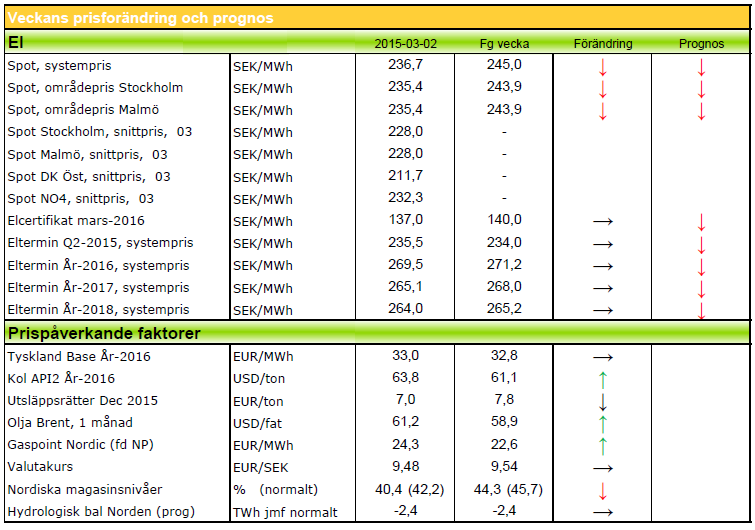
Brents uppgång har mattats medan WTI har vänt ned igen. Kolet upp en aning. Elen är upp på inte fullt så varma, blöta och blåsiga prognoser som förut. Utsläppsrätterna ned idag men trendkanalen är uppåt. Hydrobalansen blev starkare och är nu klart över normal nivå. Elcertens fall har pausat och stannat kvar på låg nivå.
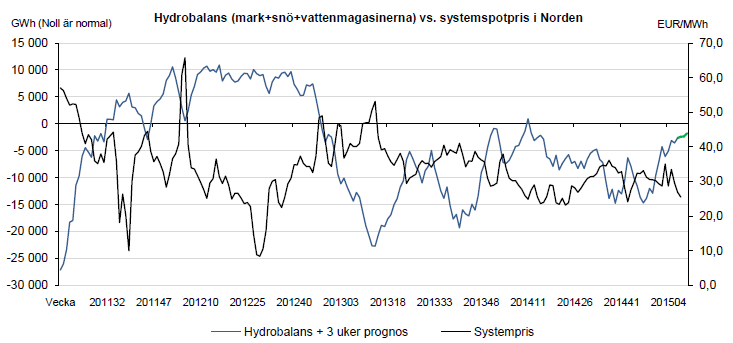
Hydrobalansen ligger v08 på 1,4 TWh över normalen. Det är lite mindre än vad som var väntat och det beror på att den väntade påfyllningen från massiva lågtryck inte blev riktigt så stor, när de i stället vek av söderut. Avsmältningen på lägre nivåer har dock ökat och eftersom man fått balansera stor vindkraft så har vattenmagasinen byggts på en del under förra veckan. Fortfarande ligger det mycket snö högre upp, så totalt sett ser det alltså bra ut! Väderprognoserna har i viss mån ändrat karaktär mot det kallare hållet – åtminstone på kontinenten. Över Skandinavien är det fortfarande milt med aningen lägre nederbörd. Dock mer än normalt.
Kärnkraftverken i Norden har idag den 2/3 en produktion på 87 % (10 881 MW). Ringhals 1 kör nu aningen reducerat men väntas komma tillbaka upp under dagen. Annars är Oskarshamn 2 kvar ute till september och Ringhals 2 till november. De finska verken körs nu som vi är vana vid – 100 %.
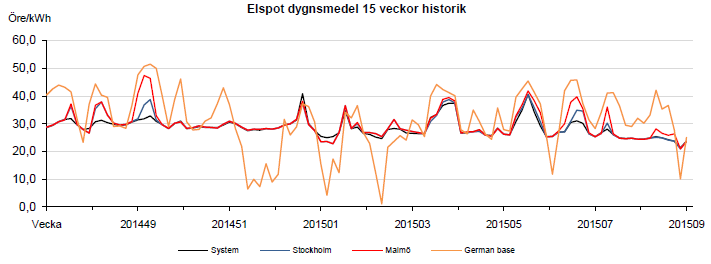
Systemspotpriset förra veckan blev 25,52 €/MWh. Det var en tillbakagång på nästan tre euro. I prisområde SE3 blev den 25,34 och i SE4 26,73. Fortfarande ser vi press på vattenkraften. Systemet är känsligt i detta läge när magasinsnivåerna för sommaren och hösten behöver justeras lite nedåt men då vinden kräver återhållsamhet med vattnet, får det ju stanna kvar i magasinen så länge. I går visades några timmar med negativa siffror i DK2 på grund av stort vindtillskott.
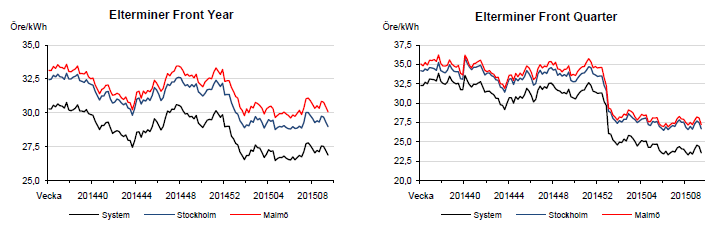
Terminspriser
Och jag hann inte mer än säga ned innan det vände och började gå upp! Det var ett trendbrott i vädret som uppenbarade sig från mitten av förra veckan. Där syntes både lägre temperaturer och blockerande högtryck med lite nederbörd. Däremot var det en kortvarig uppenbarelse och strax därefter kom de våta, varma prognoserna med inrullande lågtryck från norra Atlanten tillbaka i prognosbilden. Där är vi nu. Priserna har följaktligen vänt ned igen. Inte ända ned till läget innan men nästan. Just idag har nederbörden i prognoserna dragits ned över perioden, så vi ser ett litet uppställ för närvarande. Som skrivet ovan är vattenläget gott och vi ser inga fundamentala faktorer som tyder på högre priser i dagsläget. Q2 omsätts i skrivande stund på 25,20. År 16 handlas nu på 28,80 €/MWh.
Bränslemarknaden
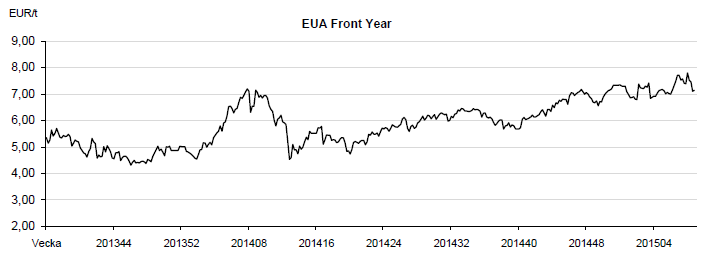
Utsläppsrätter, CO2
ENVI:s förslag gick igenom i tisdags, när omröstningen var. Det betyder i korthet att MSR ska vara fungerande senast 31 dec 2018. Detta kunde tydligen accepteras av alla parter och det innebär i praktiken en skärpning av nuvarande tidsschema. Marknaden reagerade lamt med fallande priser. Återstoden av veckan blev också en nedgång. Omsätts idag kring drygt sju euro. Tittar man på kursutveckingen i ett tekniskt analytiskt perspektiv är vi i en uppåtgående trendkanal.
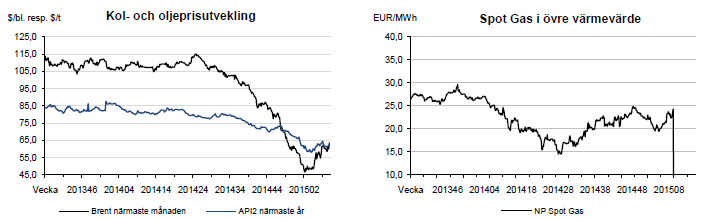
Olja: Det är stor spread mellan amerikanska WTI-oljan och europeiska Brent. Brent prisas högre. För att det ska jämna ut sig krävs att USA bestämmer sig för att exportera sin olja genom att bygga rör, främst till Kanada. Detta verkar inte vara aktuellt för den sittande administrationen. Prissituationen är i stort sett sidledes men eftersom det är ett överutbud totalt i marknaden är antydan nedåt.
Kol: Australiensiska Glencore har annonserat en reduktion av sin kolproduktion. Något som stabliliserat priserna en aning och till och med fått dem att gå upp. Vi kan samtidigt se att torrfrakterna nu kostar mindre än på mycket länge, vilket håller nere konsumentpriserna. Fortfarande råder en överutbudssituation.
Naturgas: I England har man tagit ut den för uppvärmning lagrade gasen lite snabbare än vad som var tänkt. En kallare vinter har lett till en sådan åtgärd. Detta skulle normalt trigga en press uppåt på priserna i marknaden men man har lyckats ersätta mycket av volymen men billig LNG. I Ukraina är det förstås inte helt stabilt men landet har lyckats betala en del av den närmsta skulden man hade till Ryssland för levererad gas. Man försöker komma undan betalningsansvar för den del av gasen som gått till ryskdominernade områden. Ett understatement är att alla parter inte är helt överens i denna fråga..!
Elcertifikat
Efter förra veckans kraftiga nedgång har det stannat upp och hållit sig på den historiskt låga nivån. Lite oklart vad det var som gjorde nedgången så stor. Det har under förra veckan varit normal omsättning och senast är det en liten knorr uppåt i kursen. Mars -15 stängde i fredags på 137 SEK. Övriga priser: Mars-16 141 SEK och Mars-17 143,5 SEK.
Valuta
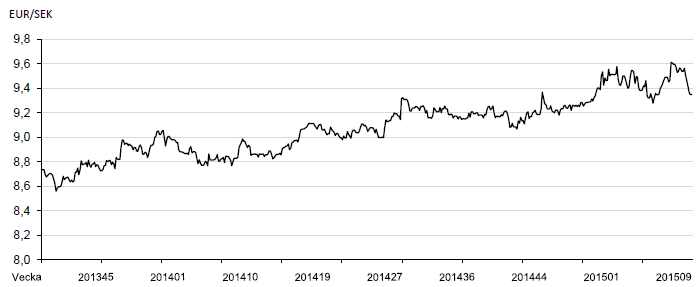
Valutakommentar
Som vi sa i senaste veckobrevet borde kronan stärkas mot euron och handla ner mot stödet på 9,30. Vi trodde inte att det skulle gå så snabbt men förra veckan stärktes kronan till 9,32 på anledning av den mycket starka BNP siffran som släpptes. BNP överraskade på uppsidan och steg 2,7% på årsbasis mot förväntat 1,5%. 9,30 förväntas hålla på nedsidan och vi handlar alltjämt i samma range som tidigare, 9,30 – 9,70. Mot dollarn är kronan alltjämt svag och man får betala 8,35 på spotmarknaden för en dollar. Vi har nu 11 månader bakom oss med högre bottnar och högre toppar. Rekyler är alltjämt köpvärda.
Teknisk analys
Teknisk analys Q2-15
Q2 handlades mellan 24,21 och 26,30 €/MWh förra veckan. Just nu handlas den på 25,15. Även om nedåttrenden är bruten så såg vi en kraftig avvisning av priset efter uppstället. Det är bearish och innebär att högre priser ansågs säljvärda och att marknaden nu kan komma att vilja testa botten av befintlig range, dvs 24,21. Ett test av botten av rangen kommer visa oss om den nivån fortfarande anses köpvärd eller om den ger vika för ännu lägre priser.
Teknisk analys År-16
År-16 handlades mellan 28,15 och 29,10 €/MWh förra veckan. Precis som för frontkvartalet så blev kontraktet avvisat efter att ha testat toppen av den €1-breda prisintervallet vi befinner oss i. Just nu omsätts 28,65 vilket är i mitten av rangen och det är inte helt omöjligt att marknaden nu vill handla ner mot botten på 27,95 även om det i nuläget är hugget som stucket vilket håll priset vill bryta ut. Det är en förhållandevis smal och lång range vilket innebär att när botten eller toppen väl bryts så kommer vi i snabb takt handla ner eller upp ett par Euro.
[box]Denna energimarknadskommentar om elpriset publiceras på Råvarumarknaden.se med tillstånd och i samarbete med Modity Energy Trading.[/box]
Ansvarsfriskrivning
Energimarknadskommentaren har producerats av Modity Energy Trading. Informationen är rapporterad i god tro och speglar de aktuella åsikterna hos medarbetarna, dessa kan ändras utan varsel. Modity Energy Trading tar inget ansvar för handlingar baserade på informationen.
Om Modity Energy Trading
Modity Energy Trading erbjuder energibolag och större företag den erfarenhet, kompetens och analysredskap som krävs för en trygg och effektiv förvaltning av energiportföljen. Modity bedriver handel med allt från el och gas, till elcertifikat, valutor och utsläppsrätter. Företagets kunder får dessutom ta del av deras analysprodukter som t.ex det fullständiga marknadsbrevet med ytterligare kommentarer och prognoser. För ytterligare information se hemsidan.


Market is starting to take US/Iran headlines with a pinch of salt. Brent crude rose $2.8/b yesterday to an official close of $112.1/b. But after that it traded as low as $108.05/b before ending late night at around $109.7/b. Through the day it traded in a range of $106.87 – 112.72/b amid a flurry of news or rumors from Iran and the US. ”US temporary sanctions during negotiations” (falls alarm). ”We will bomb Iran” (not anyhow),… etc. While the market is still fluctuating to this kind of news flow, it is starting to take such headlines with a pinch of salt.

We’ll see. Maybe, maybe not. The Brent M1 contract is trading at $110.2/b this morning which very close to the average ticks through yesterday of $110.4/b.
Trump with bearish, verbal intervention whenever Brent trades above $110/b it seems. What seems to be a pattern is that Trump states something like ”very good negotiations going on with Iran”, ”New leaders in Iran are great,..”, ”Great progress in negotiations,…”, ”Deal in sight,..” etc whenever the Brent M1 contract trades above $110/b. An effort to cool the market. These hot air verbal interventions from Trump used to have a heavy bearish impact on prices, but they now seems to have less and less effect unless they are backed by reality.
As far as we can see there has been no real progress in the negotiations between the US and Iran with both sides still standing by their previous demands.
Iran is getting stronger while the cease fire lasts making a return to war for Trump yet harder. Iran is naturally in constant preparation for a return to war given Trump’s steady threats of bombing Iran again. Iran is naturally doing what ever is possible to prepare for a return to war. And every day the cease fire lasts it is better prepared. This naturally makes it more and more difficult and dangerous for the US to return to warring activity versus Iran as the consequences for energy infrastructure in the Persian Gulf will be more and more severe the longer the cease fire lasts. Israel seems to see it this way as well. That the war is not won and that current frozen state of a cease fire gives Iran opportunity to rebuild military and politically.
Global inventories are drawing down day by day. How much? In the meantime the Strait of Hormuz stays closed. There is varying measures and estimates of how much global inventories are drawing down. Our rough estimate, back of the envelope, is that global inventories are drawing down by at least some 10 mb/d or about 300 mb/d in a balance between loss of supply versus demand destruction. Other estimates we see are a monthly draw of 250-270 mb/d. The IEA only ’measured’ a draw in global observable stocks of 117 mb in April with oil on water rising 53 mb while on shore stocks fell 170 mb. But global stocks are hard to measure with large invisible, unmeasured stocks. As such a back of the envelope approach may be better.
Oil products is what the world is consuming. Oil product prices likely to rise while product stocks fall. Strategic Petroleum Reserves (SPR) are predominantly crude oil. Discharging oil from OECD SPR stocks, a sharp reduction in Chinese crude imports and a reduction in global refinery throughput of 6-7 mb/d has helped to keep crude oil markets satisfactorily supplied. But global inventories are drawing down none the less. And oil products is really what the world is consuming. So if global refinery throughput stays subdued, then demand will eventually have to match the supply of oil products. The likely path forward this summer is a steady draw down in jet fuel, diesel and gasoline. Higher prices for these. Then, if possible, higher refinery throughput and higher usage of crude in response to very profitable refinery margins. And lastly sharper draw in crude stocks and higher prices for these. But some 6 mb/d of oil products used to be exported through the Strait of Hormuz. And it may not be so easy to ramp up refinery activity across the world to compensate. Especially as Ukraine continues to damage Russian refineries as well as Russian crude production and export facilities.
Watch oil product stocks and prices as well as Brent calendar 2027. What to watch for this summer is thus oil product inventories falling and oil product premiums to crude rising. Another measure to watch is the Brent crude 2027 contract as it rises steadily day by day as the Strait of Hormuz stays closed and global oil inventories decline. The latter is close to the highest level since the start of the war and keeps rising.
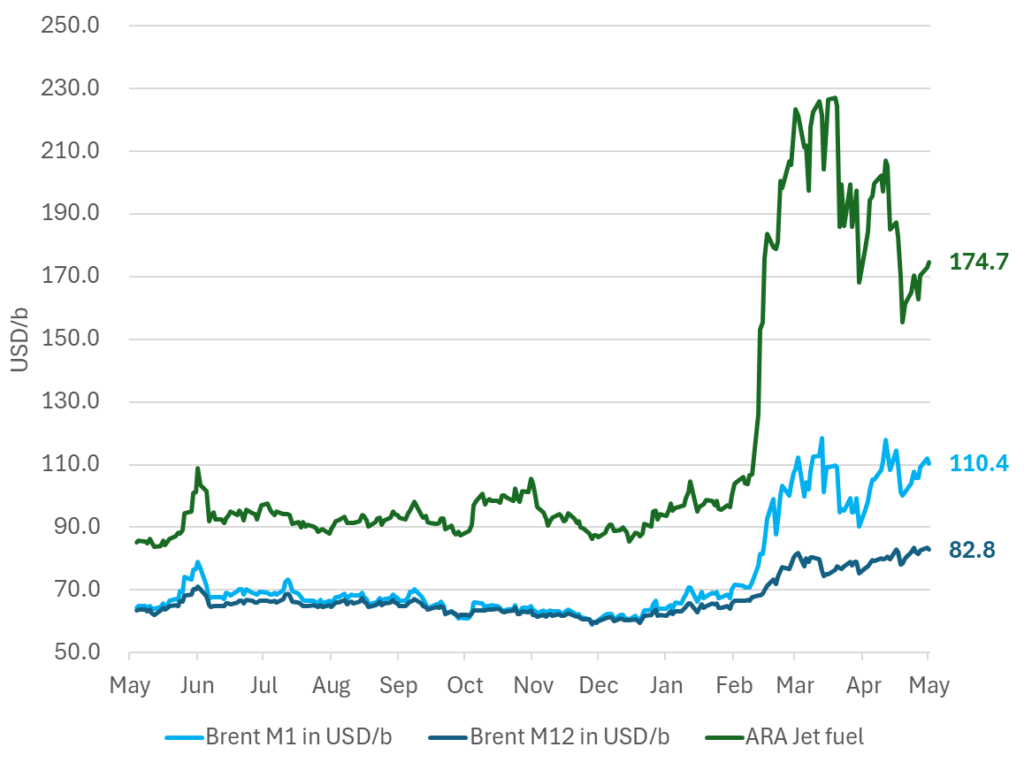
The Brent M1 contract and the Brent 2027 prices and current price of jet fuel in Europe (ARA). All in USD/b
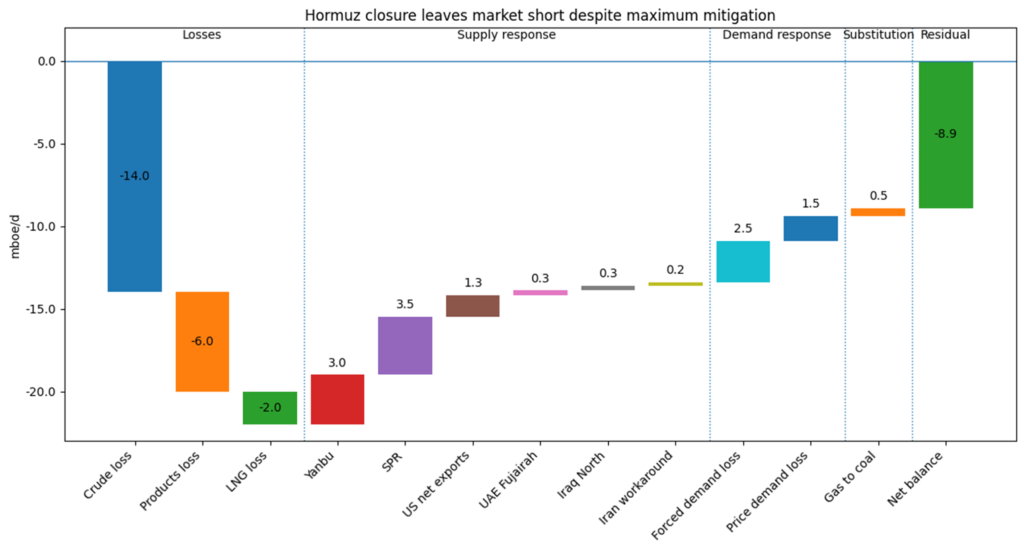
Our back of the envelope calculation of the global shortage created by the closure of the Strait of Hormuz. Note that 3.5 mb/d of discharge from SPR is also a draw. Note also that ’Forced demand loss’ of 2.5 mb/d is probably temporary and will fall back towards zero as logistics are sorted out leaving ’Price demand loss’ to do the job of balancing the market. Thus a shortfall of at least 9 mb/d created by the closure. More if SPR discharge is included and more if Forced demand loss recedes.
Brent is climbing higher. Front-month is at USD 106.3/bl this morning, close to a weekly high and a USD 9/bl jump from Mondays open. This is the move we flagged as a risk earlier in the week: the market shifting from ”a deal is around the corner” to ”this is going to take longer than we thought”.

Analyst Commodities, SEB
During April, rest-of-year Brent remained remarkably stable around USD 90/bl. A stability which rested on one single assumption: the SoH reopens around 1 May. That assumption is now slowly falling apart.
As we highlighted yesterday: every week of delay beyond 1 May adds (theoretically) ish USD 5/bl to the rest-of-year average, as global inventories draw 100 million barrels per week. i.e., a mid-May reopening implies rest-of-year Brent closer to USD 100/bl, and anything pushing into June or July takes us meaningfully higher.
What’s changed in the last 48 hours:
#1: The US military has formally warned that clearing suspected sea mines from SoH could take up to six months. That is a completely different timescale from what the financial market is pricing. Even a political deal tomorrow does not immediately reopen the strait.
#2: Trump has shifted his tone from urgency to ”strategic patience”. In yesterday’s press conference: ”Don’t rush me… I want a great deal.” The market is reading this as a president no longer feeling pressured by timelines, with the naval blockade running in the background.
#3: So far, the military activity is escalating, not de-escalating. Axios reports Iran is laying more mines in SoH. The US 3rd carrier strike group (USS George H.W. Bush) is arriving with two countermine vessels. Trump yesterday ordered the US Navy to destroy any Iranian boats caught laying mines. While CNN reports that the Pentagon is actively drawing up plans to strike Iranian SoH capabilities and individual Iranian military leaders if the ceasefire collapses. i.e., NOT a attitude consistent with an imminent deal!
Spot crude and product prices eased off the early-April highs on a combination of system rerouting and deal optimism. Both now weakening. Goldman estimates April Gulf output is reduced by 14.5 mbl/d, or 57% of pre-war supply, a number that keeps getting worse the longer this drags on.
Demand-side adaptation is ongoing: S. Korea has cut its Middle East crude dependence from 69% to 56% by pulling more from the Americas and Africa, and Japan is kicking off a second round of SPR releases from 1 May. But SPRs are finite.
Ref. to the negotiations, we should not bet on speed. The current Iranian leadership is dominated by genuine hardliners willing to absorb economic pain and run the clock to extract concessions. That is not a setup for a rapid resolution. US/Israeli media briefings keep framing the delay as ”internal Iranian divisions”, the reality is more complicated and points toward weeks and months, not days.
Our point is that the complexity is large, and higher prices have only just started (given a scenario where the negotiations drag out in time). The market spent April leaning on the USD 90/bl rest-of-year assumption; that case is diminishing by the hour. If ”early May reopening” is replaced by ”June, July or later” over the next week or two, both crude and products have meaningful room to reprice higher from here. There is a high risk being short energy and betting on any immediate political resolution(!).
Down on Friday. Up on Monday. The Brent June crude oil contract traded down 5.1% last week to a close of $90.38/b. It reached a high of $103.87/b last Monday and a low of $86.09/b on Friday as Iran announced that the Strait of Hormuz was fully open for transit. That quickly changed over the weekend as the US upheld its blockade of Iranian oil exports while Iran naturally responded by closing the SoH again. The US blew a hole in the engine room of the Iranian ship TOUSKA and took custody of the ship on Sunday. Brent crude is up 5.6% this morning to $95.4/b.
The cease-fire is expiring tomorrow. The US has said it will send a delegation for a second round of negotiations in Islamabad in Pakistan. But Iran has for now rejected a second round of talks as it views US demands as unrealistic and excessive while the US is also blocking the Strait of Hormuz.
While Brent is up 5% this morning, the financial market is still very optimistic that progress will be made. That talks will continue and that the SoH will fully open by the start of May which is consistent with a rest-of-year average Brent crude oil price of around $90/b with the market now trading that balance at around $88/b.
Financial optimism vs. physical deterioration. We have a divergence where the financial market is trading negotiations, improvements and resolution while at the same time the physical market is deteriorating day by day. Physical oil flows remain constrained by disrupted flows, longer voyage times and elevated freight and insurance costs.
Financial markets are betting that a US/Iranian resolution will save us in time from violent shortages down the road. But every day that the SoH remains closed is bringing us closer to a potentially very painful point of shortages and much higher prices.
The US blockade is also a weapon of leverage against its European and Asian allies. When Iran closed the SoH it held the world economy as a hostage against the US. The US blockade of the SoH is of course blocking Iranian oil exports. But it is also an action of disruption directed towards Europe and Asia. The US has called for the rest of the world to engaged in the war with Iran: ”If you want oil from the Persian Gulf, then go and get it”. A risk is that the US plays brinkmanship with the global oil market directed towards its European and Asian allies and maybe even towards China to force them to engage and take part. Maybe unthinkable. But unthinkable has become the norm with Trump in the White House.




Sommarväder skapar prisrally på elbörsen
Oil product price pain is set to rise as the Strait of Hormuz stays closed into summer

Solkraften pressar elpriserna dagtid

Michel Gubel ger sin syn på oljemarknaden