

Analys
SEB – Råvarukommentarer, 4 mars 2015

Fortsatt full fart framåt
MARKNADEN I KORTHET
 Temat från förra veckans Råvarubrev med full fart fortsätter. Olika marknader går i olika takt och olika data för samma land kan säga olika saker. Ett exempel är Sverige, där förra veckans BNP-siffra överraskade positivt: Förändringen årsvis var 2,8 procent, jämfört med marknadens konsensus om 1,5 procent. Riksbankens stödköpsprogram fortsätter denna vecka, men senast i morse konstaterade Ingves att Sveriges ekonomi är i en ”extremt ovanlig” situation. Vi ser oväntat stark BNP-tillväxt och låg inflation som riskerar att pressas ytterligare nedåt i och med att valutan stärks.
Ett annat land som ständigt är i fokus är Kina och den senaste tidens data är tämligen likriktade. PMI kom för andra månaden i rad in på under 50 som, även om siffran var bättre än förväntat, i sig betyder att ekonomin är i kontraktionsfas. Samtidigt kom beskedet att Kinas centralbank sänkte räntan för att stimulera ekonomin, men enligt data från Bloomberg fortsätter trenden med i genomsnitt sjunkande priser på nybyggda hem i 70 kinesiska städer. Implikationerna är förstås flera, men den uppenbara tolkningen är att ekonomin saktar in. Som världens största importör av guld får det naturligtvis påverkan på guldpriset – se avsnittet nedan.
Brentoljan stängde på sin årshögsta veckostängningsnotering i fredags och den höga volatiliteten fortsätter. Som vi tidigare har beskrivit är effekterna av det låga oljepriset tudelade – det slår mot vissa delar av ekonomin samtidigt som andra gynnas. Länder som kämpar med låg inflation och är stora importörer av olja, exempelvis Japan, är uppenbart missgynnade då situationen innebär ett ytterligare tryck nedåt på inflationen.
Förra veckans uppgång i oljepriset i kombination med positiva makrofaktorer fick priserna på basmetaller att börja stiga under samma period. Det kinesiska nyåret är snart slut och marknaden förväntar sig en ökad aktivitet efteråt. Läs mer i kommentaren nedan!
TRENDER I SAMMANDRAG
- Fortsatt geopolitisk oro i världen
- Kina minskar import av guld
- Tecken på ökad global efterfrågan på olja
- Antalet amerikanska oljeriggar fortsätter att minska, men i fallande takt
- Nordisk el fortsatt sidledes rörelse med möjligheter för den aktiva investeraren
REKOMMENDATIONER
En placering i certifikat och warranter är förknippat med risker. Du kan förlora hela ditt investerade kapital. Läs mer om riskerna i SEB:s offentliggjorda Grundprospekt för certifikat- och warrantprogram på seb.se/cert eller seb.se/mini.
OLJA
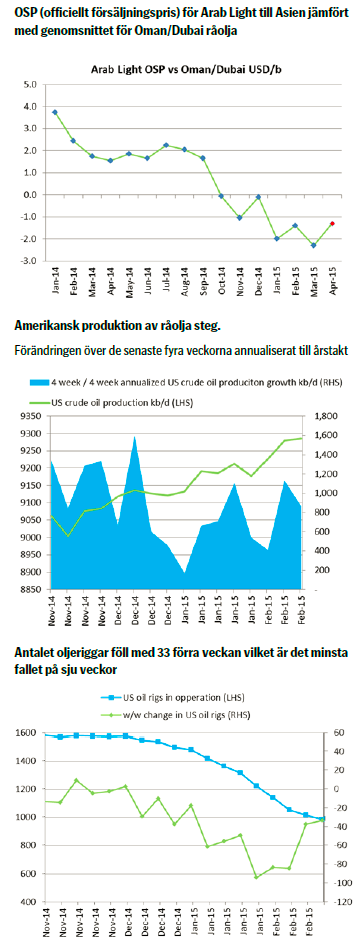
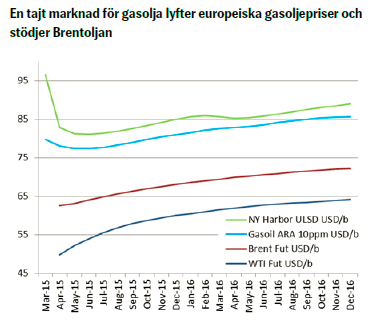 Brentoljan steg med 3,9 procent i förra veckan då priset hoppade upp med 4,2 procent på fredagen och stängde på 62,58 US-dollar/fat. Det innebar således en veckostängning på årshögsta. Prisökningen i Brentoljan kom trots en 1,1 procent ökning i USD-index. Brentoljan fick skjuts av en tajt marknad för gasoljeprodukter i USA och det spiller över i den globala marknaden med kraftig backwardation i amerikanska gasoljeterminer som driver upp gasoljepriser även i Europa. En andra faktor som påverkade priset positivt är tecken på ökad efterfrågan globalt. Detta kan utläsas av Kinas inköpschefsindex (publicerat av HSBC) som kom ut bättre än väntat, Energy Aspects som såg 2,2 procents tillväxt i efterfrågan på olja mätt årsvis i december, Saudiarabien som uttalar sig angående bättre efterfrågan samt IEA:s chefsekonom Fatih Birol som kommenterar att oljemarknaden kommer att stabilisera sig under de kommande månaderna. Hårda data avseende en starkare efterfrågan är dock svåra att hitta, då vi tvärtom exempelvis ser japansk import av råolja ner 8,3 procent i årstakt i december och ner 12,8 procent i årstakt i januari. Om Saudiarabiens utlåtande om ökad efterfrågan är sanna borde vi se en justering uppåt i Saudiarabiens officiella försäljningspris (OSP) för april vilket förväntas enligt en undersökning som nyligen publicerades av Reuters.
REKOMMENDATION
- Förra veckans rekommendation i BEAR OLJA X5 B S gick tyvärr med förlust, och vi går ur den positionen. För den kommande veckan är vi neutrala.
GULD
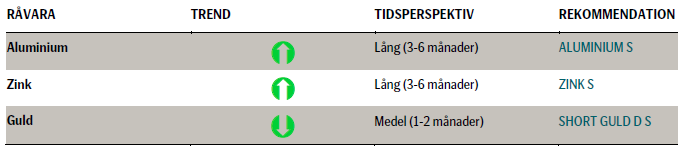
Förra veckan valde vi att gå ur vår kortposition i guld vilket visade sig vara ett klokt beslut. Trots ett starkare dollarindex steg guldpriset i dollartermer cirka 1,6 procent. För kommande vecka ser vi inga tydliga signaler för ett högre guldpris. Förväntningarna att FED kommer att höja styrräntan i år stärktes då statistik visade att amerikansk inflation hamnade under nollstrecket för januari månad. Detta har inte skett sedan oktober 2009. Amerikanska konsumentpriser steg vilket också spädde på förväntningarna om en räntehöjning. En räntehöjning från den amerikanska centralbankens sida skulle innebära en ökad alternativkostnad för att hålla guld.
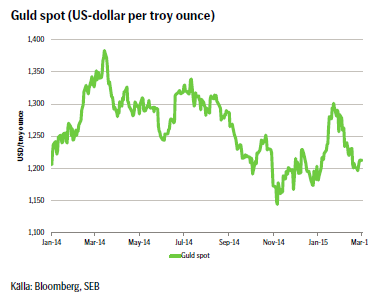 I lördags annonserade den kinesiska centralbanken att man återigen sänker räntan i ett försök att stimulera ekonomin. Problemen i Kina är främst kopplade till en svag utveckling på husmarknaden där priserna på bostäder visar tecken på en accelererande nedgång i många av Kinas större städer. Enligt en sammanställning av Bloomberg föll priset på nybyggda bostäder i 64 av de 70 största städerna i januari. Samtidigt är inflationen fortsatt låg och det finns en ökande oro för att priserna till och med kan komma att falla. Kina, som är världens största importör av guld, såg en minskning av importen av guld vilken föll till den lägsta nivån på fem månader. Eurozonens finansministrar fortsätter diskussionerna med Greklands regering vilken öppnat upp för eftergifter. En sista minuten-lösning och Grekland kvar i eurozonen kommer att dämpa intresset för guld. Generellt har vi emellertid inte sett någon större påverkan på guldpriset av oron i Grekland.
TREND
- Kina minskar sin import av guld och generellt har vi emellertid inte sett någon större påverkan på guldpriset av oron i Grekland.
- En räntehöjning från den amerikanska centralbankens sida skulle innebära en ökad alternativkostnad för att hålla guld.
REKOMMENDATION
- Short Guld D S rekommenderas på 1 till 2 månader.
BASMETALLER
Aluminium & Zink
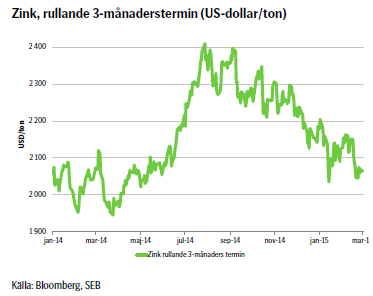
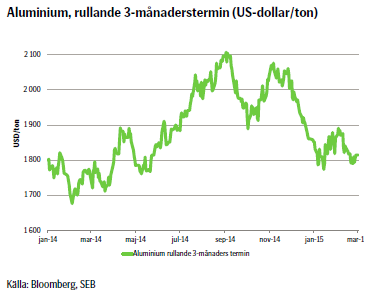 Förra veckan inleddes trevande med allmän avvaktan inför att kineserna återgår till arbetet efter en veckolång ledighet. Förlängningen av Greklands stödprogram, en något ”mjukare” Yellen i sitt tal inför kongressen samt ett stigande oljepris, räckte för att metallpriserna skulle börja röra sig uppåt. Onsdag och torsdag steg priserna på bred front. Fredagen bjöd dock på motstånd, främst beroende av den fortsatt starka dollarn. Den något motsägelsefulla effekten gjorde sig gällande, där dollarkomponenten tar ut den positiva effekten av starka amerikanska konjunktursiffor. Innevarande vecka har börjat på samma tema. Förväntan om ökad industriell aktivitet i Kina efter nyåret kvarstår, men marknadens aktörer är avvaktande. Priserna på aluminium och zink har varit svagt fallande under perioden. Ur ett tekniskt perspektiv har zinkpriset fallit till stödnivån 2050 US-dollar/ton. Aluminium har i skrivandes stund brutit under stödet vid 1800 US-dollar/ton, vilket öppnar upp för en ytterligare potentiell nedgång mot ca 1750 US-dollar. Vår rekommendation på metallerna är på 3-6 månaders sikt och vi begränsar oss till certifikat utan hävstång.
 TREND
TREND
- I takt med att den fundamentala balansen förbättras bedöms priserna på aluminium och zink succesivt stärkas under året.
- Flera gruvstängningar i år och nästa, kommer inte fullt ut att ersättas. Risk för brist 2016 (zink).
- Efterfrågan på aluminium har ökat 4-7 procent den senaste 3-4 åren, en trend som förväntas fortsätta.
- Terminskurvorna på båda metallerna är attraktiva. Terminspremien (contangon) är endast ca 2 procent sett 12 månader framåt.
- Bra köpläge nu efter det Kinesiska nyåret.
REKOMMENDATION
- Köp Aluminium S och Zink S
SOCKER
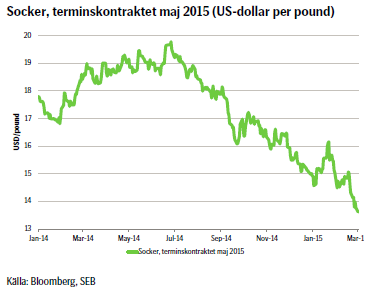 Priset på socker har under förra veckan fortsatt att falla kraftigt, vilket fick Maj15-kontraktet att bryta igenom 14 US cent och därmed notera en ny lägsta nivå. Säljtrycket verkar vara tekniskt baserat för att dra nytta av ett svagt momentum, där den ena försäljningen triggar den andra vartefter priserna sjunker. Fallet i den brasilianska valutan real har också varit en bidragande faktor liksom den senaste rapporten från International Sugar Organization (IS0) som visar att den globala produktionen av socker förväntas nå rekordhöga 172,1 miljoner ton under 2014/15 – detta trots prognoser om lägre skördar i flera ledande producentländer, däribland Brasilien, Kina och Thailand.
TREND
- Slutsatsen som vi drar är att det för närvarande inte finns tillräckligt med fysiska köpintressen för att ge stöd åt marknaden – vilket signalerar att konsumenter bara är villiga att köpa mer på ”billiga nivåer”. Så länge motståndet på 14 US cent håller så föredrar vi en kort position.
REKOMMENDATION
- Neutral/kort
EL
Sedan vår senaste kommentar om el för två veckor sedan har marknaden fortsatt att utvecklas ungefär som förväntat. SEB rullar nu från den innevarande Q215-terminen till Q315-terminen.
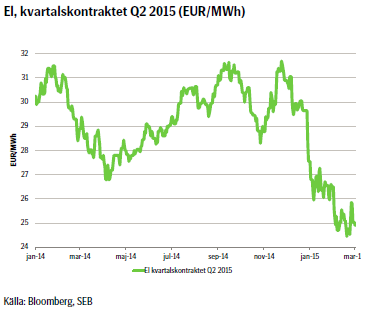 Det är svårt att med nuvarande fundamentala situation se att vi varaktigt ska bryta vad som snarast är ett dödläge vad gäller prisutvecklingen på el. Trots att priset rör sig inom ett väl definierat intervall bjöd dock förra veckan på ett imponerande rally som så småningom reverserades till dito baisse. I skrivande stund handlas Q215-terminen strax över 25 euro per MWh, vilket är i den nedre delen av det intervall som kontraktet har rört sig i sedan årsskiftet. Vi tror att botten sannolikt är nådd i den längre nedåtgående trenden, även om det säkert kommer att fortsatt finnas ett visst nedåttryck.
För en aktiv investerare som dagligen följer marknaden kan det vara intressant att handla inom det aktuella intervallet då rörelserna trots allt procentuellt sett kan vara stora under kort tid, men någon rekommendation inom ramen för detta marknadsbrevs tidsperspektiv är svårare att ge. För en investerare som redan har gjort en god vinst på nedåttrenden kan det vara värt att avvakta och se om en ytterligare nedgång i priset sker, men för en trendföljande investerare är det nog klokt att vänta på att intervallet bryts.
TREND
- Priset på el rör sig inom väldefinierat intervall
- Korta rörelser kan ge möjligheter för aktiva investerare
REKOMMENDATION
- Neutral
[box]SEB Veckobrev Veckans råvarukommentar är producerat av SEB:s Commodities Sales desk och publiceras i samarbete och med tillstånd på Råvarumarknaden.se[/box]
KÄLLOR
Bloomberg, Reuters, SEB
VILLKOR
För varje enskilt certifikat/mini future finns Slutliga Villkor som anger de fullständiga villkoren. Slutliga Villkor finns tillgängligt på kurssidan för respektive certifikat/mini future på www.seb.se, Börs & finans, fliken Strukturerade placeringar.
RISKER
En sammanfattning av de risker som är förknippade med Börshandlade certifikat generellt finns i Produktbroschyren för respektive certifikat eller mini future som är tillgängligt på seb.se/cert respektive seb.se/mini. För en fullständig bild av riskerna behöver du ta del av SEB:s offentliggjorda Grundprospekt för Certifikat- och Warrantprogram som är publicerat på www.seb.se/cert respektive seb.se/mini.
DISCLAIMER
Detta marknadsföringsmaterial, framtaget av SEB:s Commodities Sales desk, har upprättats enbart i informationssyfte.
Även om innehållet är baserat på källor som SEB bedömt som tillförlitliga ansvarar SEB inte för fel eller brister i informationen. Den utgör inte oberoende, objektiv investeringsanalys och skyddas därför inte av de bestämmelser som SEB har infört för att förebygga potentiella intressekonflikter. Yttranden från SEB:s Commodities Sales desk kan vara oförenliga med tidigare publicerat material från SEB, då den senare hänvisas uppmanas du att läsa den fullständiga rapporten innan någon åtgärd vidtas.
Dokumentationen utgör inte någon investeringsrådgivning och tillhandahålls till dig utan hänsyn till dina investeringsmål. Du uppmanas att självständigt bedöma och komplettera uppgifterna i denna dokumentation och att basera dina investeringsbeslut på material som bedöms erforderligt. Alla framåtblickande uttalanden, åsikter och förväntningar är föremål för risker, osäkerheter och andra faktorer och kan orsaka att det faktiska resultatet avviker väsentligt från det förväntade. Historisk avkastning är ingen garanti för framtida resultat. Detta dokument utgör inte ett erbjudande att teckna några värdepapper eller andra finansiella instrument. SEB svarar inte för förlust eller skada – direkt eller indirekt, eller av vad slag det vara må – som kan uppkomma till följd av användandet av detta material eller dess innehåll.
Observera att det kan förekomma att SEB, dess ledamöter, dess anställda eller dess moder- och/eller dotterbolag vid olika tillfällen innehar, har innehaft eller kommer att inneha aktier, positioner, rådgivningsuppdrag i samband med corporate finance-transaktioner, investment- eller merchantbanking-uppdrag och/eller lån i de bolag/finansiella instrument som nämns i materialet.
Materialet är avsett för mottagaren, all spridning, distribuering mångfaldigande eller annan användning av detta meddelande får inte ske utan SEB:s medgivande. Materialet riktar sig inte till personer vars medverkan kräver ytterligare prospekt, registrerings- eller andra åtgärder än vad som följer av svensk rätt. Det åligger var och en att iaktta sådana restriktioner. Materialet får inte distribueras i eller till land där distribution kräver ovan nämnda åtgärder eller strider mot reglering i sådant land. Materialet riktar sig således inte till fysiska eller juridiska personer hemmahörande i USA eller i något annat land där publicering eller tillhandahållande av materialet är förbjudet eller strider mot tillämpliga bestämmelser i landet.
Oaktat detta får SEB tillåta omfördelning av materialet till utvald tredje part i enlighet med gällande avtal. Materialet får inte spridas till fysiska eller juridiska personer som är medborgare eller har hemvist i ett land där sådan spridning är otillåten enligt tillämplig lag eller annan bestämmelse.
Skandinaviska Enskilda Banken AB (publ) är ett publikt aktiebolag och står under tillsyn av Finansinspektionen samt de lokala finansiella tillsynsmyndigheter i varje jurisdiktionen där SEB har filial eller dotterbolag.

Market is starting to take US/Iran headlines with a pinch of salt. Brent crude rose $2.8/b yesterday to an official close of $112.1/b. But after that it traded as low as $108.05/b before ending late night at around $109.7/b. Through the day it traded in a range of $106.87 – 112.72/b amid a flurry of news or rumors from Iran and the US. ”US temporary sanctions during negotiations” (falls alarm). ”We will bomb Iran” (not anyhow),… etc. While the market is still fluctuating to this kind of news flow, it is starting to take such headlines with a pinch of salt.

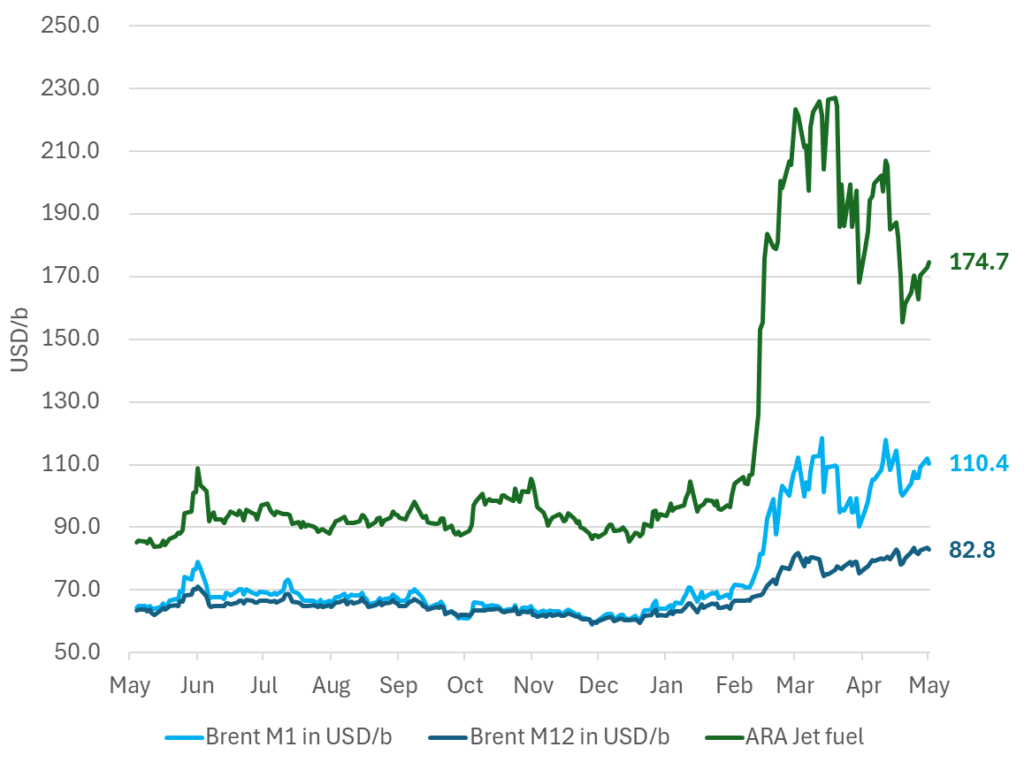
We’ll see. Maybe, maybe not. The Brent M1 contract is trading at $110.2/b this morning which very close to the average ticks through yesterday of $110.4/b.
Trump with bearish, verbal intervention whenever Brent trades above $110/b it seems. What seems to be a pattern is that Trump states something like ”very good negotiations going on with Iran”, ”New leaders in Iran are great,..”, ”Great progress in negotiations,…”, ”Deal in sight,..” etc whenever the Brent M1 contract trades above $110/b. An effort to cool the market. These hot air verbal interventions from Trump used to have a heavy bearish impact on prices, but they now seems to have less and less effect unless they are backed by reality.
As far as we can see there has been no real progress in the negotiations between the US and Iran with both sides still standing by their previous demands.
Iran is getting stronger while the cease fire lasts making a return to war for Trump yet harder. Iran is naturally in constant preparation for a return to war given Trump’s steady threats of bombing Iran again. Iran is naturally doing what ever is possible to prepare for a return to war. And every day the cease fire lasts it is better prepared. This naturally makes it more and more difficult and dangerous for the US to return to warring activity versus Iran as the consequences for energy infrastructure in the Persian Gulf will be more and more severe the longer the cease fire lasts. Israel seems to see it this way as well. That the war is not won and that current frozen state of a cease fire gives Iran opportunity to rebuild military and politically.
Global inventories are drawing down day by day. How much? In the meantime the Strait of Hormuz stays closed. There is varying measures and estimates of how much global inventories are drawing down. Our rough estimate, back of the envelope, is that global inventories are drawing down by at least some 10 mb/d or about 300 mb/d in a balance between loss of supply versus demand destruction. Other estimates we see are a monthly draw of 250-270 mb/d. The IEA only ’measured’ a draw in global observable stocks of 117 mb in April with oil on water rising 53 mb while on shore stocks fell 170 mb. But global stocks are hard to measure with large invisible, unmeasured stocks. As such a back of the envelope approach may be better.
Oil products is what the world is consuming. Oil product prices likely to rise while product stocks fall. Strategic Petroleum Reserves (SPR) are predominantly crude oil. Discharging oil from OECD SPR stocks, a sharp reduction in Chinese crude imports and a reduction in global refinery throughput of 6-7 mb/d has helped to keep crude oil markets satisfactorily supplied. But global inventories are drawing down none the less. And oil products is really what the world is consuming. So if global refinery throughput stays subdued, then demand will eventually have to match the supply of oil products. The likely path forward this summer is a steady draw down in jet fuel, diesel and gasoline. Higher prices for these. Then, if possible, higher refinery throughput and higher usage of crude in response to very profitable refinery margins. And lastly sharper draw in crude stocks and higher prices for these. But some 6 mb/d of oil products used to be exported through the Strait of Hormuz. And it may not be so easy to ramp up refinery activity across the world to compensate. Especially as Ukraine continues to damage Russian refineries as well as Russian crude production and export facilities.
Watch oil product stocks and prices as well as Brent calendar 2027. What to watch for this summer is thus oil product inventories falling and oil product premiums to crude rising. Another measure to watch is the Brent crude 2027 contract as it rises steadily day by day as the Strait of Hormuz stays closed and global oil inventories decline. The latter is close to the highest level since the start of the war and keeps rising.
The Brent M1 contract and the Brent 2027 prices and current price of jet fuel in Europe (ARA). All in USD/b
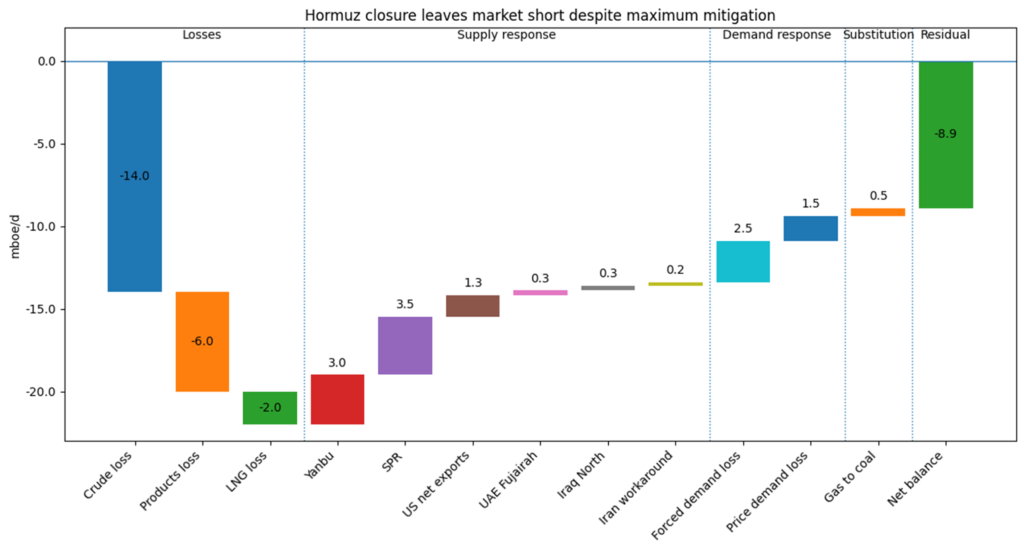
Our back of the envelope calculation of the global shortage created by the closure of the Strait of Hormuz. Note that 3.5 mb/d of discharge from SPR is also a draw. Note also that ’Forced demand loss’ of 2.5 mb/d is probably temporary and will fall back towards zero as logistics are sorted out leaving ’Price demand loss’ to do the job of balancing the market. Thus a shortfall of at least 9 mb/d created by the closure. More if SPR discharge is included and more if Forced demand loss recedes.
Brent is climbing higher. Front-month is at USD 106.3/bl this morning, close to a weekly high and a USD 9/bl jump from Mondays open. This is the move we flagged as a risk earlier in the week: the market shifting from ”a deal is around the corner” to ”this is going to take longer than we thought”.

Analyst Commodities, SEB
During April, rest-of-year Brent remained remarkably stable around USD 90/bl. A stability which rested on one single assumption: the SoH reopens around 1 May. That assumption is now slowly falling apart.
As we highlighted yesterday: every week of delay beyond 1 May adds (theoretically) ish USD 5/bl to the rest-of-year average, as global inventories draw 100 million barrels per week. i.e., a mid-May reopening implies rest-of-year Brent closer to USD 100/bl, and anything pushing into June or July takes us meaningfully higher.
What’s changed in the last 48 hours:
#1: The US military has formally warned that clearing suspected sea mines from SoH could take up to six months. That is a completely different timescale from what the financial market is pricing. Even a political deal tomorrow does not immediately reopen the strait.
#2: Trump has shifted his tone from urgency to ”strategic patience”. In yesterday’s press conference: ”Don’t rush me… I want a great deal.” The market is reading this as a president no longer feeling pressured by timelines, with the naval blockade running in the background.
#3: So far, the military activity is escalating, not de-escalating. Axios reports Iran is laying more mines in SoH. The US 3rd carrier strike group (USS George H.W. Bush) is arriving with two countermine vessels. Trump yesterday ordered the US Navy to destroy any Iranian boats caught laying mines. While CNN reports that the Pentagon is actively drawing up plans to strike Iranian SoH capabilities and individual Iranian military leaders if the ceasefire collapses. i.e., NOT a attitude consistent with an imminent deal!
Spot crude and product prices eased off the early-April highs on a combination of system rerouting and deal optimism. Both now weakening. Goldman estimates April Gulf output is reduced by 14.5 mbl/d, or 57% of pre-war supply, a number that keeps getting worse the longer this drags on.
Demand-side adaptation is ongoing: S. Korea has cut its Middle East crude dependence from 69% to 56% by pulling more from the Americas and Africa, and Japan is kicking off a second round of SPR releases from 1 May. But SPRs are finite.
Ref. to the negotiations, we should not bet on speed. The current Iranian leadership is dominated by genuine hardliners willing to absorb economic pain and run the clock to extract concessions. That is not a setup for a rapid resolution. US/Israeli media briefings keep framing the delay as ”internal Iranian divisions”, the reality is more complicated and points toward weeks and months, not days.
Our point is that the complexity is large, and higher prices have only just started (given a scenario where the negotiations drag out in time). The market spent April leaning on the USD 90/bl rest-of-year assumption; that case is diminishing by the hour. If ”early May reopening” is replaced by ”June, July or later” over the next week or two, both crude and products have meaningful room to reprice higher from here. There is a high risk being short energy and betting on any immediate political resolution(!).
Down on Friday. Up on Monday. The Brent June crude oil contract traded down 5.1% last week to a close of $90.38/b. It reached a high of $103.87/b last Monday and a low of $86.09/b on Friday as Iran announced that the Strait of Hormuz was fully open for transit. That quickly changed over the weekend as the US upheld its blockade of Iranian oil exports while Iran naturally responded by closing the SoH again. The US blew a hole in the engine room of the Iranian ship TOUSKA and took custody of the ship on Sunday. Brent crude is up 5.6% this morning to $95.4/b.
The cease-fire is expiring tomorrow. The US has said it will send a delegation for a second round of negotiations in Islamabad in Pakistan. But Iran has for now rejected a second round of talks as it views US demands as unrealistic and excessive while the US is also blocking the Strait of Hormuz.
While Brent is up 5% this morning, the financial market is still very optimistic that progress will be made. That talks will continue and that the SoH will fully open by the start of May which is consistent with a rest-of-year average Brent crude oil price of around $90/b with the market now trading that balance at around $88/b.
Financial optimism vs. physical deterioration. We have a divergence where the financial market is trading negotiations, improvements and resolution while at the same time the physical market is deteriorating day by day. Physical oil flows remain constrained by disrupted flows, longer voyage times and elevated freight and insurance costs.
Financial markets are betting that a US/Iranian resolution will save us in time from violent shortages down the road. But every day that the SoH remains closed is bringing us closer to a potentially very painful point of shortages and much higher prices.
The US blockade is also a weapon of leverage against its European and Asian allies. When Iran closed the SoH it held the world economy as a hostage against the US. The US blockade of the SoH is of course blocking Iranian oil exports. But it is also an action of disruption directed towards Europe and Asia. The US has called for the rest of the world to engaged in the war with Iran: ”If you want oil from the Persian Gulf, then go and get it”. A risk is that the US plays brinkmanship with the global oil market directed towards its European and Asian allies and maybe even towards China to force them to engage and take part. Maybe unthinkable. But unthinkable has become the norm with Trump in the White House.




Sommarväder skapar prisrally på elbörsen
Oil product price pain is set to rise as the Strait of Hormuz stays closed into summer

Solkraften pressar elpriserna dagtid

Michel Gubel ger sin syn på oljemarknaden