

Analys
SHB Råvarubrevet 5 september 2014

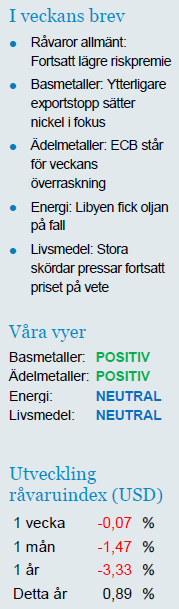 Råvaror allmänt: Fortsatt lägre riskpremie
Under veckan har presidenterna Porosjenko och Putin avtalat vapenvila. Förra veckan kom Israel och Hamas överens om ny vapenvila efter att Egypten medlat. Sammantaget har riskpremien kommit ner och bland råvaror har olja handlats upp med hopp om en starkare konjunktur utan handelssanktioner kring Ryssland på beskedet.
Makromässigt är Europa största orosmolnet just nu, även förut så starka Tyskland börjar visa svagare makrosiffror. ECB:s Draghi är redo att göra mer, men uppmanar också politiker att agera. Bland annat vill Draghi se sänkta skatter och ökade offentliga investeringar. Konjunkturtermometern visar just nu rimfrost i Europa, ljummet i Kina och bikramyogatemperatur i USA. I det klimatet trivs aluminium med sin stora USA exponering bra. Just basmetaller har utvecklats starkt senaste veckorna med stöd i USA makrodata.
Förväntningarna var högt ställda inför ECB:s möte under torsdagen. Draghi lyckades dock än en gång att överraska marknaderna positivt. Räntan sänktes och man kommer även köpa säkerställda obligationer. Fallande inflationsförväntningar, svag statistik och geopolitik oroar uppenbarligen ECB. Man öppnar också för QE-spåret. Om ECB går hela vägen som man gjort i USA återstå att se men beskedet är positivt för guld och minskar våra föraningar om att guld ska tappa när vi närmar oss Fed-räntehöjningar.
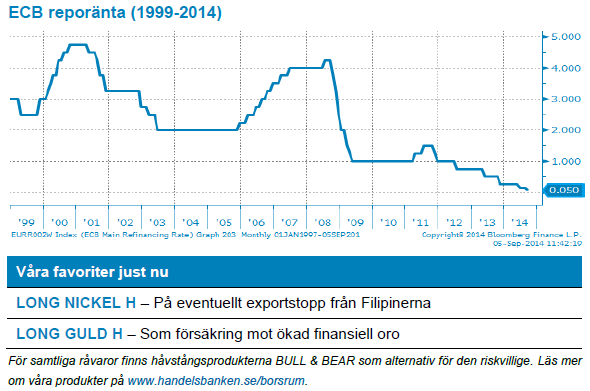
Basmetaller: Ytterligare exportstopp sätter nickel i fokus
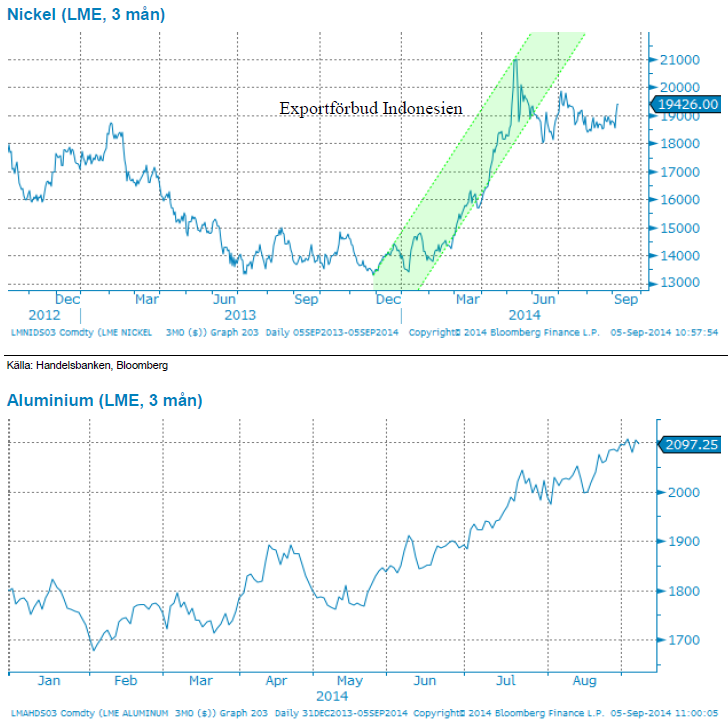
Tidigare i veckan skickade vi ut ytterligare ett trading case på nickel, denna gång på oro för att Filipinerna vill efterlikna Indonesien och införa exportstopp på oförädlad malm. Men timingen är viktigt och hur stor påverkan ett eventuellt exportförbud påverkar prisbilden beror på hur snabbt beslut och genomförande tar. Läs mer i vårt trading case här.
Basmetallerna i övrigt har haft en stark utveckling under sommaren och ser ut att kunna fortsätta. Främst pådrivna av den starka amerikanska konjunkturdatan. USA trenden ser robust ut och kompenserar för den stiltje som nu råder i Kina efter vårens katastrofala makrodata där. Aluminium fortsätter sin starka trend, drivet av stark efterfråga i USA och vårens nedstängningar av då olönsam produktion. Priset kan säkerligen gå högre före vi tror att nedstängdas smältverk dras igång igen och mättar efterfrågeuppgången. Med undantaget för koppar ser vi fortsatt positivt på basmetallerna.
Ädelmetaller: ECB står för veckans överraskning
Gårdagens ovanligt resoluta besked från Europeiska Centralbanken, ECB, kvalar in som veckans nyhet i finansmarknaden. Vi har ju sedan en tid en positiv syn på ädelmetaller, framför allt guld, med reservationen att hålla koll på om Federal Reserve börjar höja räntan.
Gårdagens besked från ECB, i kombination med att amerikanska räntor inte stigit nämnvärt under sommaren, gör att vi blir mer övertygade i vår positiva syn på ädelmetallsektorn. Fortsatt nedpressade räntenivåer, medvetet orkestrerade av en ganska enig centralbankskår, tvingar investerare in i mer riskfyllda tillgångsslag. I denna jakt på avkastning finns det naturligt nog många som blir tveksamma till vad konsekvensen blir för värderingar av finansiella tillgångar, och till vad som händer med dessa värderingar när centralbankerna börjar ta tillbaks sina extrema stimulanser.
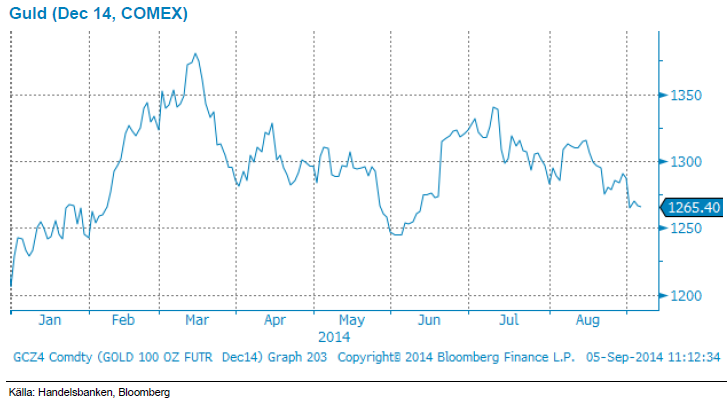
Vårt resonemang runt guldet har byggt – och bygger alltjämt – på balansen mellan guldets ”säker hamn-status” och alternativkostnaden för innehav i guld (vilket ju inte ger någon ränta). Höjd ränta borde – allt annat lika – leda till press nedåt på guldet, medan finansiell oro – som skulle kunna skapas av höjd ränta – brukar leda till köp av guld. Hittills i år har denna balans varit ganska jämn, vilket gjort att guldet visat upp osedvanligt små prisrörelser. ECB:s besked igår ska ses som att denna balans skiftas en bit i guldets favör.
Gårdagen besked skapade ju ingen rörelse i guldet, ett par dollar upp eller ner höjde inga ögonbryn. Men i den miljö vi har nu ska man inte titta på guldet – eller andra råvaror – i sin ”vanliga” prissättning i dollar. Gårdagens besked från ECB skapade en stor dollarförstärkning, varför man måste se hur guldet rör sig mot euron, eller – i vårt fall – den svenska kronan. ECB-beskedet igår fick guldet att stiga 1,5 procent mot euron, och 1 procent mot kronan. Sammantaget betyder detta att en svensk placerare som äger guld eller guldcertifikat kunnat se sina innehav stiga i värde under sommaren, trots att guldpriset mot dollar bara stigit marginellt. Handelsbankens raka certifikat, LONG GULD H, har stigit nära 7 procent under de tre senaste månaderna, drivet av att dollarkursen stärkts.
Sammanfattningsvis ser vi fortsatt bra potential i att äga guld, både som ett skydd mot finansiell oro, och då räntorna fortsätter pressas. Vi vill dessutom påminna om Handelsbankens syn på dollarn, som är fortsatt väldigt positiv trots senaste tidens förstärkning, med en ettårsprognos på 7,95. Som vanligt när det gäller mer långsiktiga positioner anser vi att hävstångscertifikat inte är lämpliga, utan det raka LONG GULD H är det som passar bäst.
Energi: Libyen fick oljan på fall
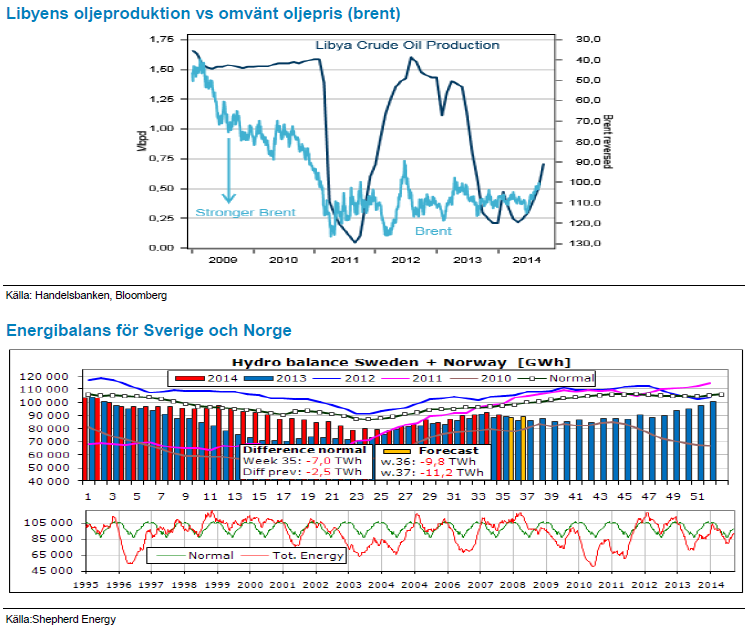
Olja har handlats i princip oförändrat över denna vecka dock med en rejäl dip efter att Libyen utropat höjd oljeproduktion. Priset hämtade sig dock efter vapenvilan i Ryssland/Ukraina. Vi var tidigare övertygade om att oljan skulle rekylera tillbaka upp efter dykningen i augusti.
När vi nu ser Libyen på väg tillbaka blir vi mer försiktiga. USA har inlett året med en kraftig ökning i produktionen. Texas har nu adderat ett helt Norge på 3 år. Hittills har priseffekten av den ökade produktionen neutraliserats av utbudsstörningar i Mellanöstern. Om nu Libyen är på väg tillbaka blir det utbudspress både där och fortsatt från USA. Det är dock svårt att lita på trenden i Libyen, även vid årets början var Libyen på väg att öka produktionen men det föll snart samman i interna stridigheter där rebeller ville sälja oljan oberoende av de styrande i Tripoli.
Elmarknaden handlas oförändrat under veckan men prisbilden får stöd av det högtrycksområde som vuxit in och pressat undan ett nederbördsrikt lågtrycksområde. Sämre påfyllnad i magasinen med andra ord och trenden med en försvagad energibalans fortsätter där man räknar med underskott om 11.2 TWh efter nästa vecka (se bilden nedan). Ser vi till bränslekomplexet är det fortsatt fokus på Ukraina/Ryssland som skapar osäkerhet främst på gasmarknaden där stigande priser ger stöd åt kontinentala elmarknader. Energikolet fortsätter dock ned då det finns gott om kol tillgängligt på exportmarknaden men där EURUSD balanserar. Även utsläppsrätterna försvagas något till omkring 6 EUR/ton men vi räknar med att dessa fortsätter att rangehandlas mellan 6-7 EUR i väntan på besked från kommissionen kring stabilitetsmekanismen så sammantaget en ganska mixad bild där vi bör kunna se ytterligare någon euro eller två på uppsidan om väderprognoserna står sig.
Livsmedel: Stora skördar pressar fortsatt priset på vete
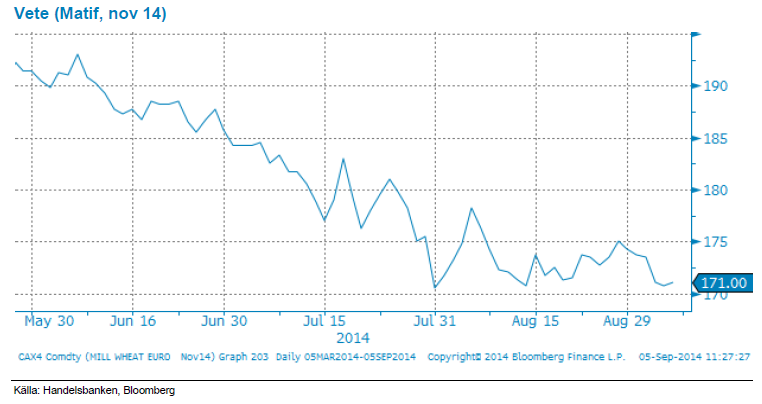
Lägre riskpremie till följd av minskad oro i Ukraina har pressat vetepriset som under veckan handlades under 170 EUR/ton (nu något högre). Även skördepress med historiskt stora majsskördar i USA sätter press på både priset på majs och vetet då båda används som djurfoder.
För det amerikanska vetet verkar också brist på järnvägstransporter i USA bidra. Kall vinter har gjort att tågen som ska skeppa ut spannmål har fått vara kortare och stå stilla vissa veckor. Ökad konkurrens med att skeppa ut olja från Backen i North Dakota bidrar också till att järnvägarna är överbelastade. Vi behåller en neutral syn för utvecklingen på livsmedelssektorn.
För kaffet är det omvänt där september månad inleddes med stigande priser till följd av nedjustering av prognoserna för nästa års produktionssiffror. Det råder viss oro om världsproduktionen kan komma att möta efterfrågan trots flera år av rekordskördar. Under veckan har terminspriserna handlats uppemot 2,10 dollar/Ib för att sedan backa tillbaka. Den långa perioden av torka i början av året har nu orsakat stress och en för tidig utblomning av kaffeplantorna i vissa regioner av Brasilien. Den för tidiga utblomningen har försvårat skördearbetet och på de platser där maskiner använts har blommor rycks ut och skadats, vilket är ett stort orosmoment för de brasilianska kaffeodlarna. Frågan är nu vilka effekter detta kommer ha på den kommande skörden. Kaffemarknaden kan kort sammanfattas som fortsatt volatil och vi kan mycket väl se terminspriser över veckans högsta nivåer snart igen.
Handelsbankens råvaruindex (USD)
*Uppdaterade vikter från 29 november 2013
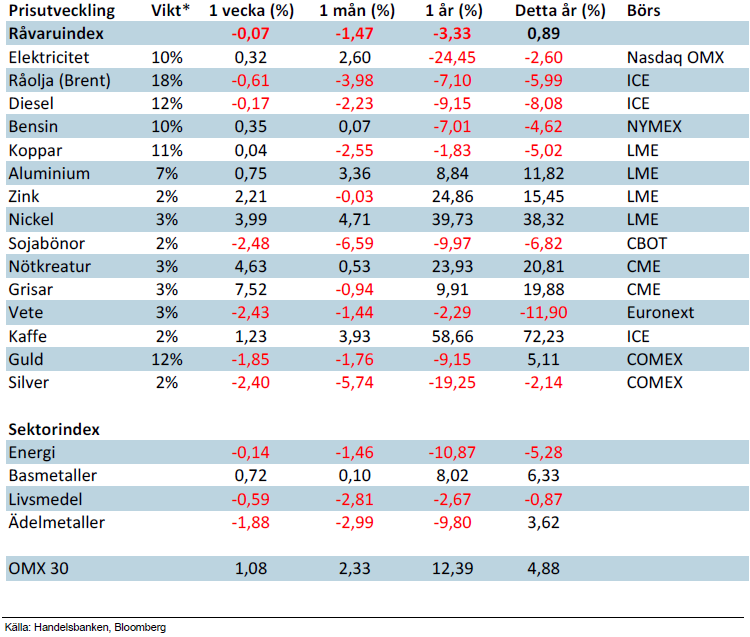
Handelsbankens råvaruindex består av de underliggande indexen för respektive råvara. Vikterna är bestämda till hälften från värdet av nordisk produktion (globala produktionen för sektorindex) och till hälften från likviditeten i terminskontrakten.
[box]SHB Råvarubrevet är producerat av Handelsbanken och publiceras i samarbete och med tillstånd på Råvarumarknaden.se[/box]
Ansvarsbegränsning
Detta material är producerat av Svenska Handelsbanken AB (publ) i fortsättningen kallad Handelsbanken. De som arbetar med innehållet är inte analytiker och materialet är inte oberoende investeringsanalys. Innehållet är uteslutande avsett för kunder i Sverige. Syftet är att ge en allmän information till Handelsbankens kunder och utgör inte ett personligt investeringsråd eller en personlig rekommendation. Informationen ska inte ensamt utgöra underlag för investeringsbeslut. Kunder bör inhämta råd från sina rådgivare och basera sina investeringsbeslut utifrån egen erfarenhet.
Informationen i materialet kan ändras och också avvika från de åsikter som uttrycks i oberoende investeringsanalyser från Handelsbanken. Informationen grundar sig på allmänt tillgänglig information och är hämtad från källor som bedöms som tillförlitliga, men riktigheten kan inte garanteras och informationen kan vara ofullständig eller nedkortad. Ingen del av förslaget får reproduceras eller distribueras till någon annan person utan att Handelsbanken dessförinnan lämnat sitt skriftliga medgivande. Handelsbanken ansvarar inte för att materialet används på ett sätt som strider mot förbudet mot vidarebefordran eller offentliggörs i strid med bankens regler.

Selling down on a ”deal”. Brent crude fell 6.2% last week with accelerated weakness towards the end of the week. Close of the week at $87.33/b and low of the week (and on Friday) of $85.8/b. Brent is falling another 4% this morning to $83.7/b on confirmation by Iran that a MoU text has been reached and that it will be signed on Friday this week.

So what is this ”deal” worth? Talk on the desk here this morning is that it is much like ”putting lipstick on a pig” where Trump has to sell this at home as a victory where ”the SoH has reopened”, the nuclear issue will be ironed out over the coming 60 days (or maybe 600 days?) and US consumers are getting a lower gasoline price and maybe US republicans survives the midterm elections.
The importance for Iran is that it emerges as the defacto winner of this war in the eyes of the non-US public world. That Iran now onwards is the ”ruler of the SoH” (combo of geography and new weapons systems like drones) or more softer: ”the guarantor of safe passage through the SoH”.
Iran doesn’t need nuclear weapons any more. Nuclear deterrence doesn’t work any more. Ukraine has made many attacks deep into Russia without being nuked in return. Plenty of Iranian ballistic rockets blasts over Israel but Iran wasn’t nuked in return.
There is no trust between the US and Iran. We don’t know all the details yet of the MoU. But what we do know is that there is no trust between the US and Iran what so ever. This is probably more like a descriptive text on how they can cooperate in a way where both sides keeps tactical leverage. Neither side makes irreversible concessions. Violations can be punished quickly. Cooperation produces immediate benefits.
This is a fragile structure. It can easily break down. There may be details which cannot be overcome. To be seen on Friday. The US has to show that it is willing put enough force behind managing and restraining Israel versus Hezbollah in Lebanon. We have seen that Netanyahu hasn’t listened all that much to Trump’s directives and wishes. This could be a major obstacle.
A gradual reopening is tactically preferable for Iran. A tactical leverage for Iran right now is that global oil stocks have been drawn down towards painful and increasingly dangerous levels with increasing risks for oil price spikes in mid-July to August. This together with US midterm elections on 3 November gives tactical leverage to Iran. Iran probably doesn’t want to fully give up on that leverage. A rapid, full reopening where global stocks are able to refill over the coming 60 days will significantly erode that leverage. If Iran reinstates a closure of the SoH after 60 days (if talks break down again), then the effect won’t be that impactful in terms of prices and the US midterm elections.
So a gradual and partial reopening where global markets gets the oil they need while they are unable to rebuild stocks could be a practical middle way for both parties. Trump can sell it as ”the SoH has reopened” and get affordable gasoline for US consumers. Iran can sell it as ”the SoH has fully reopened, but there is some friction” so flow is only 60-80% of normal.
Not much real demand destruction below $100/b. What we do know is that there is not much real price pain demand destruction for oil globally at an oil price below $100/b. A lot of demand-shock destruction. Fear. But demand should now come roaring back towards normal with fear for exceptionally high prices now is rapidly receding.
Sudden China demand destruction due to EVs? Bullocks. EV share of total Chinese carpool now around 13%. Share of new sales of EVs has reached 50%. This is a very gradual process. It doesn’t make oil demand fall like a rock over night. When EV new sales share reaches 100%, then the gasoline car pool will contract by some 5-10% per year. But that is only gasoline. Sudden reduction in Chinese oil demand is more about shock and risk.
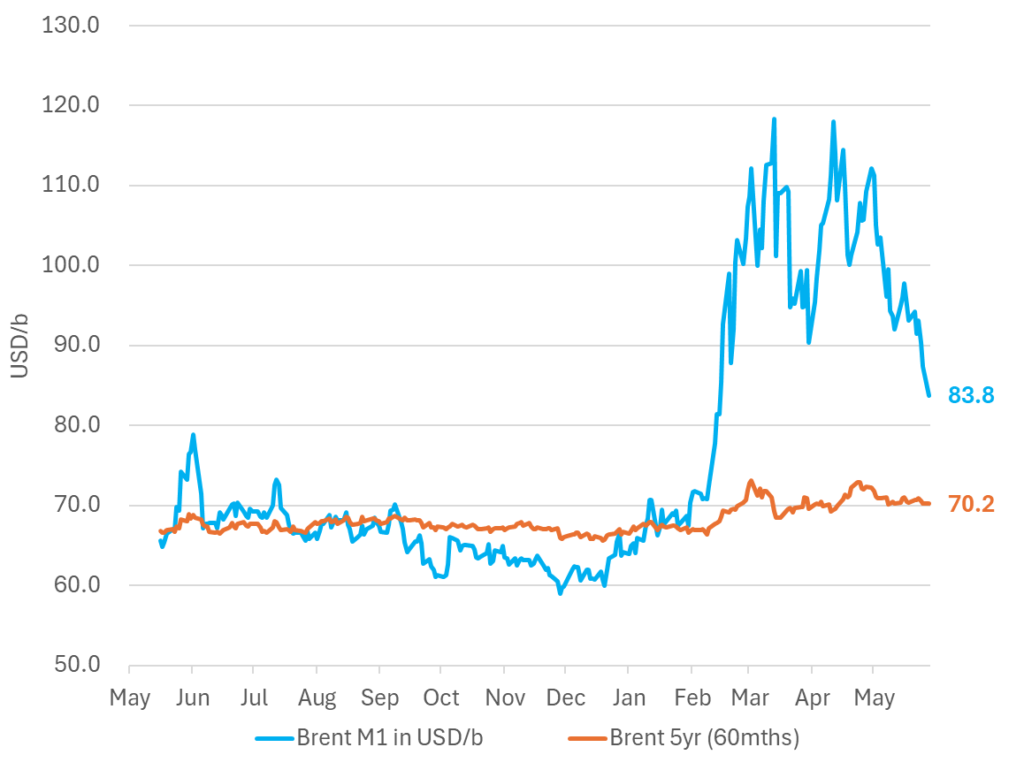
Chinese crude oil imports will come roaring back. At what price? Today’s ”neutral” oil price is $70/b. That is the five year price which has steadily traded around the $70/b mark over the past 3-4 years. With still a risky picture one would think that China and the rest of the world will be big buyers of oil in the range of $70-85/b.
Global demand will likely snap back towards normal, forecasted demand and growth at such prices.
Physical reopening is a gradual process. The physical and practical reopening of the SoH will likely be gradual rather than sudden. And that probably suites Iran tactically as well.
Brent M1 price versus the Brent 5-yr (today’s ”normal” price)
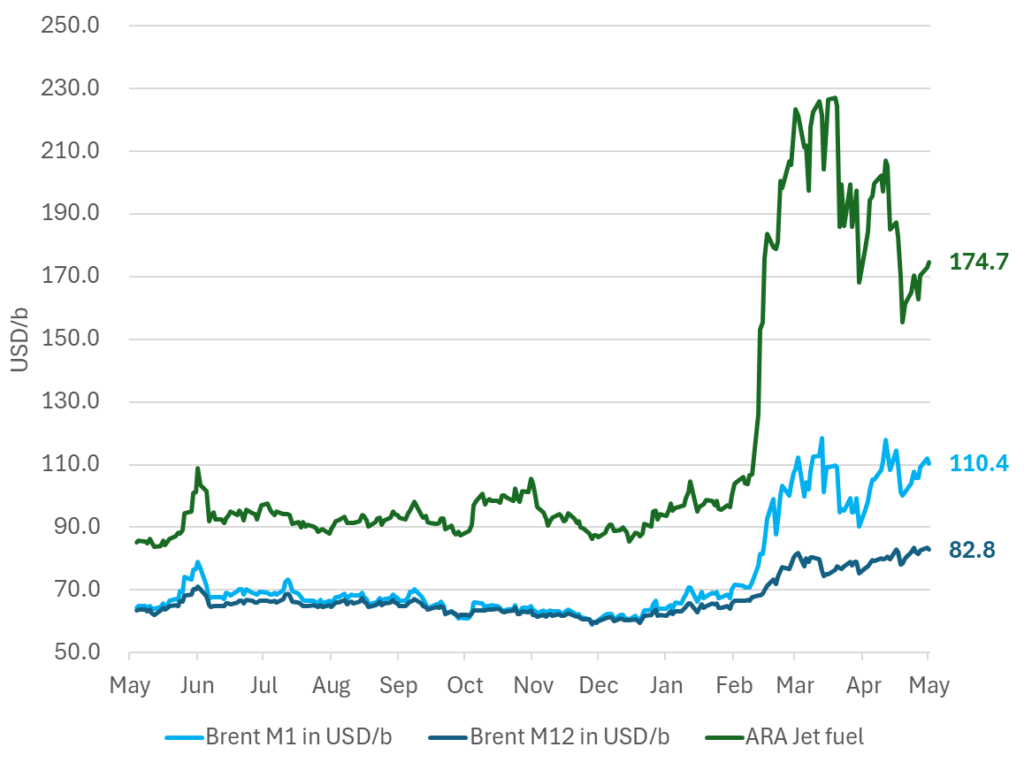
Market is starting to take US/Iran headlines with a pinch of salt. Brent crude rose $2.8/b yesterday to an official close of $112.1/b. But after that it traded as low as $108.05/b before ending late night at around $109.7/b. Through the day it traded in a range of $106.87 – 112.72/b amid a flurry of news or rumors from Iran and the US. ”US temporary sanctions during negotiations” (falls alarm). ”We will bomb Iran” (not anyhow),… etc. While the market is still fluctuating to this kind of news flow, it is starting to take such headlines with a pinch of salt.
We’ll see. Maybe, maybe not. The Brent M1 contract is trading at $110.2/b this morning which very close to the average ticks through yesterday of $110.4/b.
Trump with bearish, verbal intervention whenever Brent trades above $110/b it seems. What seems to be a pattern is that Trump states something like ”very good negotiations going on with Iran”, ”New leaders in Iran are great,..”, ”Great progress in negotiations,…”, ”Deal in sight,..” etc whenever the Brent M1 contract trades above $110/b. An effort to cool the market. These hot air verbal interventions from Trump used to have a heavy bearish impact on prices, but they now seems to have less and less effect unless they are backed by reality.
As far as we can see there has been no real progress in the negotiations between the US and Iran with both sides still standing by their previous demands.
Iran is getting stronger while the cease fire lasts making a return to war for Trump yet harder. Iran is naturally in constant preparation for a return to war given Trump’s steady threats of bombing Iran again. Iran is naturally doing what ever is possible to prepare for a return to war. And every day the cease fire lasts it is better prepared. This naturally makes it more and more difficult and dangerous for the US to return to warring activity versus Iran as the consequences for energy infrastructure in the Persian Gulf will be more and more severe the longer the cease fire lasts. Israel seems to see it this way as well. That the war is not won and that current frozen state of a cease fire gives Iran opportunity to rebuild military and politically.
Global inventories are drawing down day by day. How much? In the meantime the Strait of Hormuz stays closed. There is varying measures and estimates of how much global inventories are drawing down. Our rough estimate, back of the envelope, is that global inventories are drawing down by at least some 10 mb/d or about 300 mb/d in a balance between loss of supply versus demand destruction. Other estimates we see are a monthly draw of 250-270 mb/d. The IEA only ’measured’ a draw in global observable stocks of 117 mb in April with oil on water rising 53 mb while on shore stocks fell 170 mb. But global stocks are hard to measure with large invisible, unmeasured stocks. As such a back of the envelope approach may be better.
Oil products is what the world is consuming. Oil product prices likely to rise while product stocks fall. Strategic Petroleum Reserves (SPR) are predominantly crude oil. Discharging oil from OECD SPR stocks, a sharp reduction in Chinese crude imports and a reduction in global refinery throughput of 6-7 mb/d has helped to keep crude oil markets satisfactorily supplied. But global inventories are drawing down none the less. And oil products is really what the world is consuming. So if global refinery throughput stays subdued, then demand will eventually have to match the supply of oil products. The likely path forward this summer is a steady draw down in jet fuel, diesel and gasoline. Higher prices for these. Then, if possible, higher refinery throughput and higher usage of crude in response to very profitable refinery margins. And lastly sharper draw in crude stocks and higher prices for these. But some 6 mb/d of oil products used to be exported through the Strait of Hormuz. And it may not be so easy to ramp up refinery activity across the world to compensate. Especially as Ukraine continues to damage Russian refineries as well as Russian crude production and export facilities.
Watch oil product stocks and prices as well as Brent calendar 2027. What to watch for this summer is thus oil product inventories falling and oil product premiums to crude rising. Another measure to watch is the Brent crude 2027 contract as it rises steadily day by day as the Strait of Hormuz stays closed and global oil inventories decline. The latter is close to the highest level since the start of the war and keeps rising.
The Brent M1 contract and the Brent 2027 prices and current price of jet fuel in Europe (ARA). All in USD/b
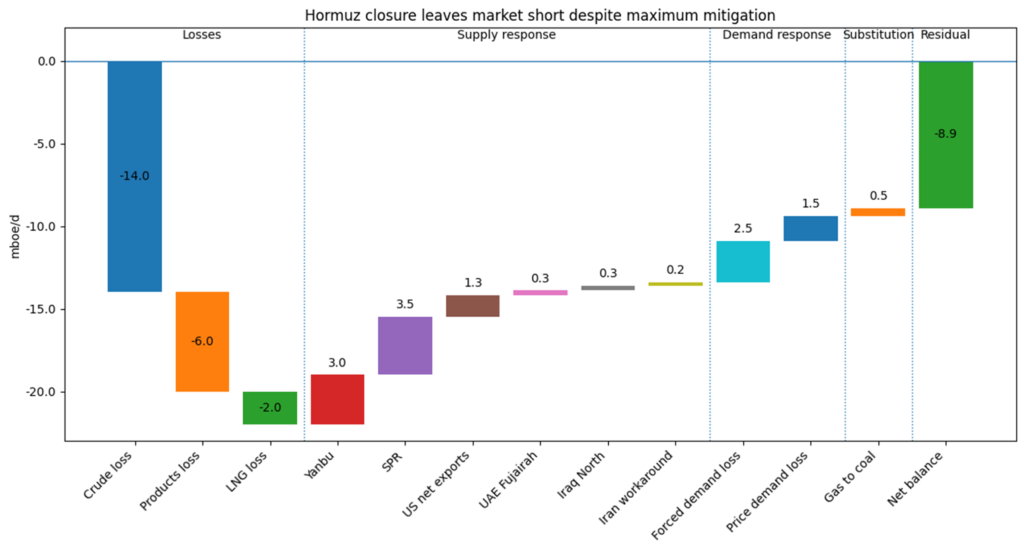
Our back of the envelope calculation of the global shortage created by the closure of the Strait of Hormuz. Note that 3.5 mb/d of discharge from SPR is also a draw. Note also that ’Forced demand loss’ of 2.5 mb/d is probably temporary and will fall back towards zero as logistics are sorted out leaving ’Price demand loss’ to do the job of balancing the market. Thus a shortfall of at least 9 mb/d created by the closure. More if SPR discharge is included and more if Forced demand loss recedes.
Brent is climbing higher. Front-month is at USD 106.3/bl this morning, close to a weekly high and a USD 9/bl jump from Mondays open. This is the move we flagged as a risk earlier in the week: the market shifting from ”a deal is around the corner” to ”this is going to take longer than we thought”.

Analyst Commodities, SEB
During April, rest-of-year Brent remained remarkably stable around USD 90/bl. A stability which rested on one single assumption: the SoH reopens around 1 May. That assumption is now slowly falling apart.
As we highlighted yesterday: every week of delay beyond 1 May adds (theoretically) ish USD 5/bl to the rest-of-year average, as global inventories draw 100 million barrels per week. i.e., a mid-May reopening implies rest-of-year Brent closer to USD 100/bl, and anything pushing into June or July takes us meaningfully higher.
What’s changed in the last 48 hours:
#1: The US military has formally warned that clearing suspected sea mines from SoH could take up to six months. That is a completely different timescale from what the financial market is pricing. Even a political deal tomorrow does not immediately reopen the strait.
#2: Trump has shifted his tone from urgency to ”strategic patience”. In yesterday’s press conference: ”Don’t rush me… I want a great deal.” The market is reading this as a president no longer feeling pressured by timelines, with the naval blockade running in the background.
#3: So far, the military activity is escalating, not de-escalating. Axios reports Iran is laying more mines in SoH. The US 3rd carrier strike group (USS George H.W. Bush) is arriving with two countermine vessels. Trump yesterday ordered the US Navy to destroy any Iranian boats caught laying mines. While CNN reports that the Pentagon is actively drawing up plans to strike Iranian SoH capabilities and individual Iranian military leaders if the ceasefire collapses. i.e., NOT a attitude consistent with an imminent deal!
Spot crude and product prices eased off the early-April highs on a combination of system rerouting and deal optimism. Both now weakening. Goldman estimates April Gulf output is reduced by 14.5 mbl/d, or 57% of pre-war supply, a number that keeps getting worse the longer this drags on.
Demand-side adaptation is ongoing: S. Korea has cut its Middle East crude dependence from 69% to 56% by pulling more from the Americas and Africa, and Japan is kicking off a second round of SPR releases from 1 May. But SPRs are finite.
Ref. to the negotiations, we should not bet on speed. The current Iranian leadership is dominated by genuine hardliners willing to absorb economic pain and run the clock to extract concessions. That is not a setup for a rapid resolution. US/Israeli media briefings keep framing the delay as ”internal Iranian divisions”, the reality is more complicated and points toward weeks and months, not days.
Our point is that the complexity is large, and higher prices have only just started (given a scenario where the negotiations drag out in time). The market spent April leaning on the USD 90/bl rest-of-year assumption; that case is diminishing by the hour. If ”early May reopening” is replaced by ”June, July or later” over the next week or two, both crude and products have meaningful room to reprice higher from here. There is a high risk being short energy and betting on any immediate political resolution(!).



Vattenfalls och Industrikrafts kärnkraftsbolag Videberg Kraft har valt Rolls-Royce SMR
Selling down on a ”deal”

Sommarväder skapar prisrally på elbörsen
Oil product price pain is set to rise as the Strait of Hormuz stays closed into summer

Solkraften pressar elpriserna dagtid
Oil product price pain is set to rise as the Strait of Hormuz stays closed into summer
Sommarväder skapar prisrally på elbörsen
Vattenfalls och Industrikrafts kärnkraftsbolag Videberg Kraft har valt Rolls-Royce SMR
Selling down on a ”deal”
-
Analys4 veckor sedan
Oil product price pain is set to rise as the Strait of Hormuz stays closed into summer
-
Nyheter2 veckor sedan
Sommarväder skapar prisrally på elbörsen
-
 Nyheter2 dagar sedan
Vattenfalls och Industrikrafts kärnkraftsbolag Videberg Kraft har valt Rolls-Royce SMR
-
Analys3 dagar sedan
Selling down on a ”deal”