

Analys
SHB Råvarubrevet 7 december 2012

 Råvaror allmänt
Global förbättring
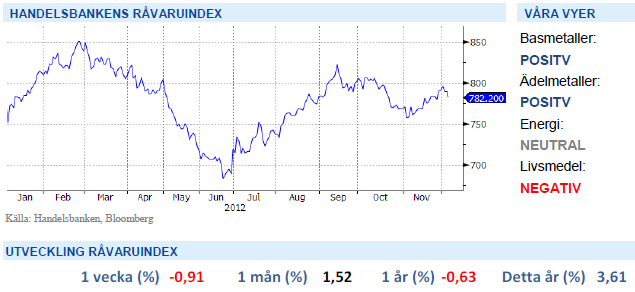
Dataskörden sedan förra veckan förstärker bilden om en starkare global konjunktur. Amerikansk inhemsk efterfrågan växer snabbare men industrin hålls tillbaka av finanspolitisk oro (budgetstupet). Konsumentförtroendet ligger på relativt höga nivåer. Faktisk konsumtion var svag i oktober, men av bilförsäljningen att döma accelererar den i november igen. Byggaktiviteten tilltar, drivet av bostadsmarknaden. Inköpschefsindex (ISM) för tillverkningsindustrin var en besvikelse då den återigen landade under 50-strecket. Vi tar inte det så allvarligt utan räknar med ett betydande hopp upp i industriaktivitet i början av 2013, naturligtvis under förutsättning att det finanspolitiska stupet undviks, vilket är vårt huvudscenario.
Novemberdata ger stöd för bottenkänning inom europeisk (läs tysk) industri. Någon snabb återhämtning blir det inte tal om med tanke på bred finanspolitisk åtstramning och fortsatt djup recession i Sydeuropa. Med tanke på de lågt ställda förväntningarna ser vi dock begränsade risker på nedsidan. ECB fortsätter också att begränsa finansiell oro.
Snabbare uppåt går det däremot i Kina. Sedan återhämtningen tog fart på allvar under hösten har de kinaberoende basmetallerna stigit kraftigt. Vi var tidigare oroliga för att den svaga kinesiska börsen skulle få uppgången på fall men denna vecka har kinabörsen tagit ett rejält kliv uppåt och ger stöd för fortsatt uppgång bland basmetallerna.
Den råvara som sticker ut på nedsidan är olja där vi fortfarande har en riskpremie i brentpriset. En vecka utan eskalerande tumult i Mellanöstern får priset på fall.
Basmetaller
Kina stärker basmetallerna
Stark data från Kina och en svag dollar har drivit basmetallerna egentligen under hela november. Senaste veckan har dock uppgången bytts till nedgång men handelsbankens basmetallindex stänger ändå upp 0,79 % på en vecka. Under veckan har koppar återigen handlats upp över 8000 nivån, senast på denna nivå var i mitten av oktober. Rykten om nya QE samtal på Fed´s FOMC möte nästa vecka kan komma att driva basmetaller ytterligare, tidigare har det visat sig att basmetaller är väldigt känsliga för vad Fed säger och gör.
Basmetallerna stärktes ytterligare på fredag eftermiddag efter positiv arbetsmarknads statisk från USA. Nonfarm payroll för november, som anger antal nya jobb utanför jordbrukssektorn, kom in på 146 000 mot väntade 85 000.
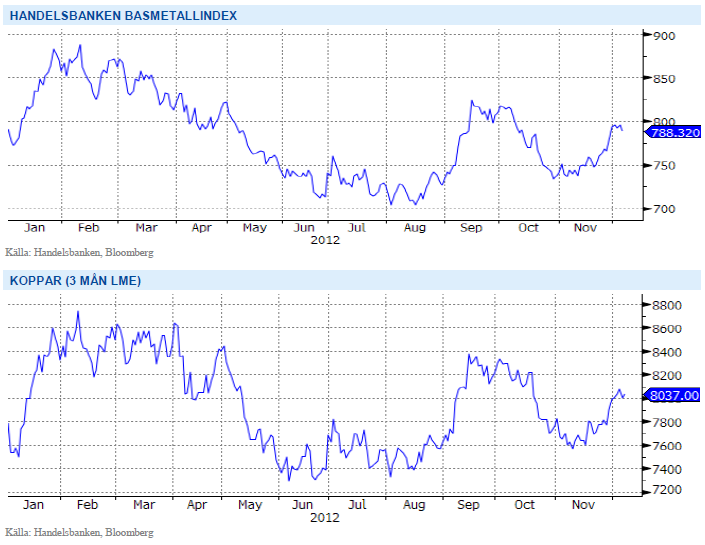
Under oktober hade basmetallerna ett kraftigt ras, efter den kraftiga uppgången i september. Finansmarknaden hade handlat in för mycket på för kort tid. Däremot ser Kinadata allt bättre ut nu. Vi tror på: BASMET H
Ädelmetaller
Vi tror fortsatt på guldet
Guldet har fallit med ungefär en procent sedan förra veckans brev, en vecka som präglats av stigande börser men fallande basmetallpriser. Vårt huvudscenario är alltjämt att de exceptionellt låga räntorna globalt och tilltagande inflationsoro kommer att pressa guldpriset uppåt. Vi ser detta som viktigare drivkraft för guldpriset än det mer vanliga skälet att man skyddar sig mot riskaversion.
Vi har tidigare under året lyft fram det faktum att hela ädelmetallsektorn varit väldigt väl korrelerad med basmetallsektorn, en utveckling som inte har varit jättevanlig i ett historiskt perspektiv. De senaste fem åren har dessa sektorer uppvisat väldigt olika prisutveckling, fram till september förra året då guldet också toppade ut i absoluta tal. Därefter har de rört sig i samklang med varann, med väldigt små skillnader.
Under november månad har basmetallerna – drivna av Kinas återhämtning – stigit kraftigt jämfört med guldet, och frågan är nu om den resan är klar nu (se graf nedan, guld mot Handelsbankens basmetallindex). Vi är fortsatt positiva till basmetaller, och om vi återgår till mönstret vi sett sedan september förra året kommer även basmetallerna att agera draglok åt guldet.
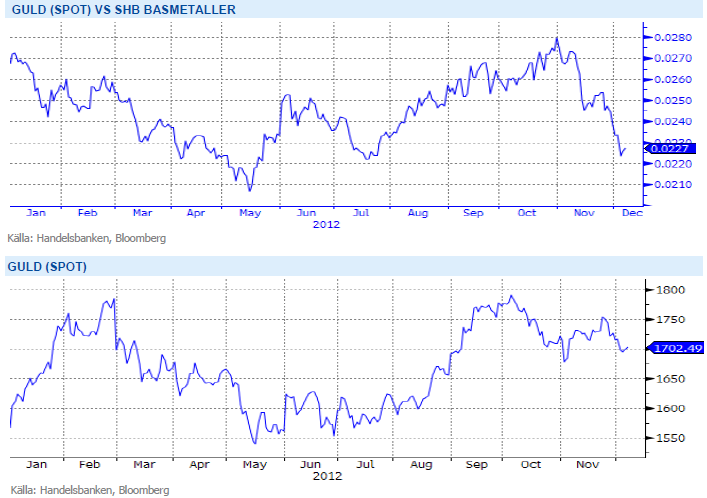
Vi är fortsatt positiva till ädelmetaller med den främsta anledningen att vi tror på fortsatt mjuk penningpolitik från FED och att central bankernas stimulanser forstätter att ge stöd. Vi tror på: ADELMET H
Energi
Kärnkraften sviker, trots tidigare löfte
I höstas utlovades det att Sveriges kärnkraftverk skulle gå på full installerad effekt under vintern och därmed minska risken för höga elpriser. I samband med kyla kommer nu även rapporter om stopp i kärnkraftverken och spotpriset. Ringhals 1 är åter i drift efter turbinunderhåll men i Oskarshamn står två av tre reaktorer stilla. Oskarshamn 1 är nere på grund av turbinarbeten, väntas åter i drift i slutet av vecka 50 och Oskarshamn 2 stoppades igår efter krav från Strålsäkerhetsmyndighen att se underhållssituationen på två av sina dieselreservkraftverk, osäkert när reaktorn kan tas i drift igen. Trots gårdagens incident vid oskarshamnsverken har både termins- och spotpriset fallit till idag. Kvartalskontraktet, Q1 2013 (som är underliggande till SHB POWER), har stigit med 2 % under veckan, men faller under senare delen då väderprognoser talar för mildare temperaturer. Med fortsatt energiöverskott behåller vi en neutral syn för elpriset. Från och med måndag är underliggande till SHB POWER kvartalskontraktet Q2 2013, även kallat vårflodskontraktet.
Priset på olja har fallit under veckan, Brent-oljan handlas nu 4,2 % lägre än veckans öppning. Riskpremie för upptrappad konflikt i mellanösterns finns fortfarande men har pyst ut något under veckan. Även dystra utsikter för euroområdets tillväxt grusar oljans prisutveckling. ECB, som i september trodde på en BNP tillväxt på -0,4% har nu reviderat ned till -0,5% för 2012. Oro över en fördjupad kris för euroområdet dämpar förväntningar på ökad efterfrågan för drivmedel.
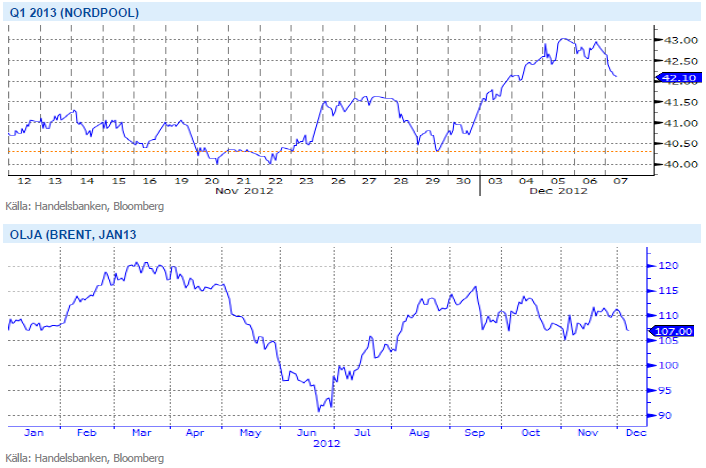
Oljan har sett allt svagare ut och vi fortsätter tycka att underliggande fundamenta är väl balanserad. Vi ser även att förutsättningarna för fortsatt lågt elpris kvarstår. Vi håller en neutral syn på energisektorn.
Livsmedel
Fortsatt problem för vetet
Terminspriser på vete är i stort sett oförändrade sedan förra veckan i både Chicago och Paris. I USA har höstvetet bara fått mycket små regnmängder under veckan, dessutom är temperaturerna högre än normalt för den här tiden på året så grödornas skick riskerar att försämras ytterligare innan vintervilan. I Australien har det generellt sett varit torrt så skörden har fortsatt utan större problem, varierande kvalitet uppges vad gäller proteinhalt – dock inga stora problem. I Argentina har det fallit mer regn, vilket inte alls är bra för pågående skörd och kvalitetsnivå – torrare väder väntas dock igen nästa vecka.
I EU har det blivit kallare och grödorna kommer allt närmare vintervilan. I Ukraina har det varit varmare än normalt, ofta med plusgrader så vintervilan får dröja ett tag till ser det ut som. De torra delarna av södra Ryssland har fått en del regn och grödorna bedöms vara i tillfredställande skick.
Med inte alls obetydliga problem för de höstsådda grödorna, och även för pågående skörd på södra halvklotet, bör en eventuell nedsida vara väldigt begränsad på kort sikt. En bra start på grödan är givetvis att föredra men mycket kan hända tills nästa års skörd, helt klart är oron stor för det amerikanska vetet men vi har sett förr att de höstsådda grödorna återhämtat sig väl efter vintern.
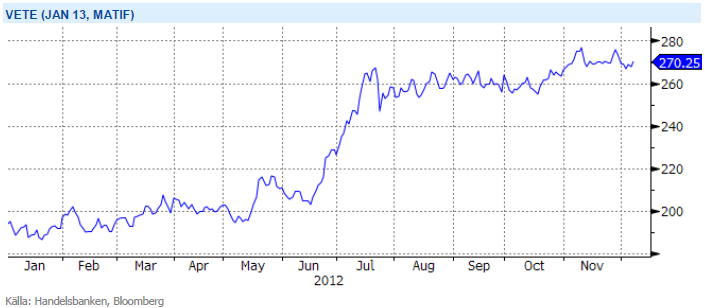
Vi ser soja, majs och vete som klara säljcase där vi väntar oss prisfall senast till påsk. Vi tror på: LIVSMEDEL S H
Handelsbankens Råvaruindex
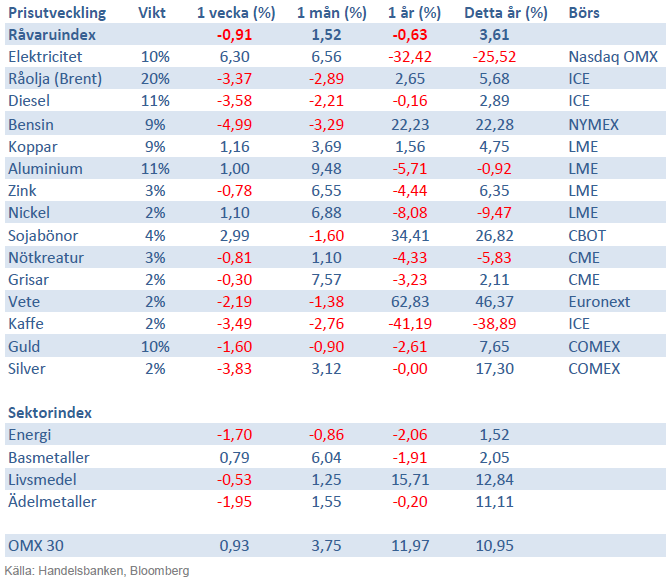
Handelsbankens råvaruindex består av de underliggande indexen för respektive råvara. Vikterna är bestämda till hälften från värdet av global produktion och till hälften från likviditeten i terminskontrakten.
[box]SHB Råvarubrevet är producerat av Handelsbanken och publiceras i samarbete och med tillstånd på Råvarumarknaden.se[/box]
Ansvarsbegränsning
Detta material är producerat av Svenska Handelsbanken AB (publ) i fortsättningen kallad Handelsbanken. De som arbetar med innehållet är inte analytiker och materialet är inte oberoende investeringsanalys. Innehållet är uteslutande avsett för kunder i Sverige. Syftet är att ge en allmän information till Handelsbankens kunder och utgör inte ett personligt investeringsråd eller en personlig rekommendation. Informationen ska inte ensamt utgöra underlag för investeringsbeslut. Kunder bör inhämta råd från sina rådgivare och basera sina investeringsbeslut utifrån egen erfarenhet.
Informationen i materialet kan ändras och också avvika från de åsikter som uttrycks i oberoende investeringsanalyser från Handelsbanken. Informationen grundar sig på allmänt tillgänglig information och är hämtad från källor som bedöms som tillförlitliga, men riktigheten kan inte garanteras och informationen kan vara ofullständig eller nedkortad. Ingen del av förslaget får reproduceras eller distribueras till någon annan person utan att Handelsbanken dessförinnan lämnat sitt skriftliga medgivande. Handelsbanken ansvarar inte för att materialet används på ett sätt som strider mot förbudet mot vidarebefordran eller offentliggörs i strid med bankens regler.

Down on Friday. Up on Monday. The Brent June crude oil contract traded down 5.1% last week to a close of $90.38/b. It reached a high of $103.87/b last Monday and a low of $86.09/b on Friday as Iran announced that the Strait of Hormuz was fully open for transit. That quickly changed over the weekend as the US upheld its blockade of Iranian oil exports while Iran naturally responded by closing the SoH again. The US blew a hole in the engine room of the Iranian ship TOUSKA and took custody of the ship on Sunday. Brent crude is up 5.6% this morning to $95.4/b.

The cease-fire is expiring tomorrow. The US has said it will send a delegation for a second round of negotiations in Islamabad in Pakistan. But Iran has for now rejected a second round of talks as it views US demands as unrealistic and excessive while the US is also blocking the Strait of Hormuz.
While Brent is up 5% this morning, the financial market is still very optimistic that progress will be made. That talks will continue and that the SoH will fully open by the start of May which is consistent with a rest-of-year average Brent crude oil price of around $90/b with the market now trading that balance at around $88/b.
Financial optimism vs. physical deterioration. We have a divergence where the financial market is trading negotiations, improvements and resolution while at the same time the physical market is deteriorating day by day. Physical oil flows remain constrained by disrupted flows, longer voyage times and elevated freight and insurance costs.
Financial markets are betting that a US/Iranian resolution will save us in time from violent shortages down the road. But every day that the SoH remains closed is bringing us closer to a potentially very painful point of shortages and much higher prices.
The US blockade is also a weapon of leverage against its European and Asian allies. When Iran closed the SoH it held the world economy as a hostage against the US. The US blockade of the SoH is of course blocking Iranian oil exports. But it is also an action of disruption directed towards Europe and Asia. The US has called for the rest of the world to engaged in the war with Iran: ”If you want oil from the Persian Gulf, then go and get it”. A risk is that the US plays brinkmanship with the global oil market directed towards its European and Asian allies and maybe even towards China to force them to engage and take part. Maybe unthinkable. But unthinkable has become the norm with Trump in the White House.
Wild moves yesterday. Brent crude traded to a high of $114.43/b and a low of $96.0/b and closed at $99.94/b yesterday.
US – Iran negotiations ongoing or not? What a day. Donald Trump announced that good talks were ongoing between Iran and the US and that the 48 hour deadline before bombing Iranian power plants and energy infrastructure was postponed by five days subject to success of ongoing meetings. Iranian media meanwhile stated that no meetings were ongoing at all.
Today we are scratching our heads trying to figure out what yesterday was all about.
Friends and family playing the market? Was it just Trump and his friends and family who were playing with oil and equity markets with $580m and $1.46bn in bets being placed by someone in oil and equity markets just 15 minutes before Trump’s announcement?
Was Trump pulling a TACO as he reached his political and economic pain point: Brent at $112/b, US Gas at $4/gal, SPX below 200dma and US 10yr above 4.4%?
Different Iranian factions with Trump talking with one of them? Are there real negotiations going on but with the US talking to one faction in Iran while another, the hardliners, are not involved and are denying any such negotiations going on?
Extending the ultimatum to attack and invade Kharg island next weekend? Or, is the five day delay of the deadline a tactical decision to allow US amphibious assault ships and marines to arrive in the Gulf in the upcoming weekend while US and Israeli continues to degrade Iranian military targets till then. And then next weekend a move by the US/Israel to attack and conquer for example the Kharg island?
We do not really know which it is or maybe a combination of these.
We did get some kind of TACO ydy. But markets have been waiting for some kind of TACO to happen and yesterday we got some kind of TACO. And Brent crude is now trading at $101.5/b as a result rather than at $112-114/b as it did no the high yesterday.
But what really matters in our view is the political situation on the ground in Iran. Will hardliners continue to hold power or will a more pragmatic faction gain power?
If the hardliners remain in power then oil pain should extend all the way to US midterm elections. The hardliners were apparently still in charge as of last week. Iran immediately retaliated and damaged LNG infrastructure in Qatar after Israel hit Iranian South Pars. The SoH was still closed and all messages coming out of Iran indicated defiance. Hardliners continues in power has a huge consequence for oil prices going forward. The regime has played its ’oil-weapon’ (closing or chocking the Strait of Hormuz). It is using it to achieve political goals. Deterrence: it needs to be so politically and economically expensive to attack Iran that it won’t happen again in the future. Or at least that the US/Israel thinks 10-times over before they attack again. The highest Brent crude oil closing price since the start of the war is $112.19/b last Friday. In comparison the 20-year inflation adjusted Brent price is $103/b. So Brent crude last Friday at $112.19/b isn’t a shockingly high price. And it is still far below the nominal high of $148/b from 2008 which is $220/b if inflation adjusted. So once in a lifetime Iran activates its most powerful weapon. The oil weapon. It needs to show the power of this weapon and it needs to reap political gains. Getting Brent to $112/b and intraday high of $119.5/b (9 March) isn’t a display of the power of that weapon. And it is not a deterrence against future attacks.
So if the hardliners remain in power in Iran, then the SoH will likely remain chocked all the way to US midterm elections and Brent crude will at a minimum go above the historical nominal high of $148/b from 2008.
Thus the outlook for the oil price for the rest of the year doesn’t depend all that much of whether Trump pulls a TACO or not. Stops bombing or not. It depends more on who is in charge in Iran. If it is the hardliners, then deterrence against future attacks via chocking of the SoH and high oil prices is the likely line of action. It is impacting the world but the Iranian ’oil-weapon’ is directed towards the US president and the the US midterm elections.
If a pragmatic faction gets to power in Iran, then a very prosperous future is possible. However, if power is shifting towards a more pragmatic faction in Iran then a completely different direction could evolve. Such a faction could possibly be open for cooperation with the US and the GCC and possibly put its issues versus Israel aside. Then the prosperity we have seen evolving in Dubai could be a possible future also for Iran.
So far it looks like the hardliners are fully in charge. As far as we can see, the hardliners are still fully in control in Iran. That points towards continued chocking of the SoH and oil prices ticking higher as global inventories (the oil market buffers) are drawn lower. And not just for a few more weeks, but possibly all the way to the US midterm elections.
A brief sigh of relief yesterday as oil infra at Kharg wasn’t damaged. But higher today. Brent crude dabbled around a bit yesterday in relief that oil infrastructure at Iran’s Kharg island wasn’t damaged. It traded briefly below the 100-line and in a range of $99.54 – 106.5/b. Its close was near the low at $100.21/b.
No easy victorious way out for Trump. So no end in sight yet. Brent is up 3.2% today to $103.4/b with no signs that the war will end anytime soon. Trump has no easy way to declare victory and mission accomplished as long as Iran is in full control of the Strait of Hormuz while also holding some 440 kg of uranium enriched to 60% and not far from weapons grade at 90%. As long as these two factors are unresolved it is difficult for Trump to pull out of the Middle East. Naturally he gets increasingly frustrated over the situation as the oil price and US retail gas prices keeps ticking higher while the US is tied into the mess in the Middle East. Trying to drag NATO members into his mess but not much luck there.
When commodity prices spike they spike 2x, 3x, 4x or 5x. Supply and demand for commodities are notoriously inflexible. When either of them shifts sharply, the the price can easily go to zero (April 2022) or multiply 2x, 3x, or even 5x of normal. Examples in case cobalt in 2025 where Kongo restricted supply and the price doubled. Global LNG in 2022 where the price went 5x normal for the full year average. Demand for tungsten in ammunition is up strongly along with full war in the middle east. And its price? Up 537%.
Why hasn’t the Brent crude oil price gone 2x, 3x, 4x or 5x versus its normal of $68/b given close to full stop in the flow of oil of the Strait of Hormuz? We are after all talking about close to 20% of global supply being disrupted. The reason is the buffers. It is fairly easy to store oil. Commercial operators only hold stocks for logistical variations. It is a lot of oil in commercial stocks, but that is predominantly because the whole oil system is so huge. In addition we have Strategic Petroleum Reserves (SPRs) of close to 2500 mb of crude and 1000 mb of oil products. The IEA last week decided to release 400 mb from global SPR. Equal to 20 days of full closure of the Strait of Hormuz. Thus oil in commercial stocks on land, commercial oil in transit at sea and release of oil from SPRs is currently buffering the situation.
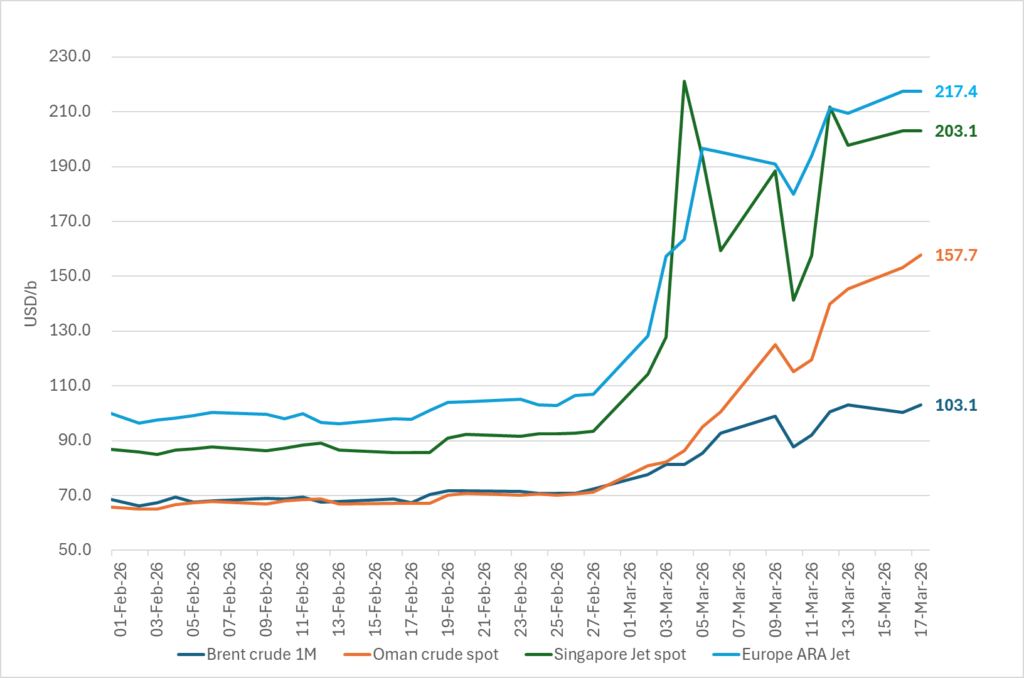
But we are running the buffers down day by day. As a result we see gradually increasing stress here and there in the global oil market. Asia is feeling the pinch the most. It has very low self sufficiency of oil and most of the exports from the Gulf normally head to Asia. Availability of propane and butane many places in India (LPG) has dried up very quickly. Local prices have tripled as a result. Local availability of crude, bunker oil, fuel oil, jet fuel, naphtha and other oil products is quickly running down to critical levels many places in Asia with prices shooting up. Oman crude oil is marked at $153/b. Jet fuel in Singapore is marked at $191/b.
Oil at sea originating from Strait of Hormuz from before 28 Feb is rapidly emptied. Oil at sea is a large pool of commercial oil. An inventory of oil in constant move. If we assume that the average journey from the Persian Gulf to its destinations has a volume weighted average of 13.5 days then the amount of oil at sea originating from the Persian Gulf when the the US/Israel attacked on 28 Feb was 13.5 days * 20 mb/d = 269 mb. Since the strait closed, this oil has increasingly been delivered at its destinations. Those closest to the Strait, like Pakistan, felt the emptying of this supply chain the fastest. Propane prices shooting to 3x normal there already last week and restaurants serving cold food this week is a result of that. Some 50-60% of Asia’s imports of Naphtha normally originates from the Persian Gulf. So naphtha is a natural pain point for Asia. The Gulf also a large and important exporter of Jet fuel. That shut in has lifted jet prices above $200/b.
To simplify our calculations we assume that no oil has left the Strait since that date and that there is no increase in Saudi exports from Yanbu. Then the draining of this inventory at sea originated from the Persian Gulf will essentially look like this:
The supply chain of oil at sea originating from the Strait of Hormuz is soon empty. Except for oil allowed through the Strait of Hormuz by Iran and increased exports from Yanbu in the Red Sea. Not included here.
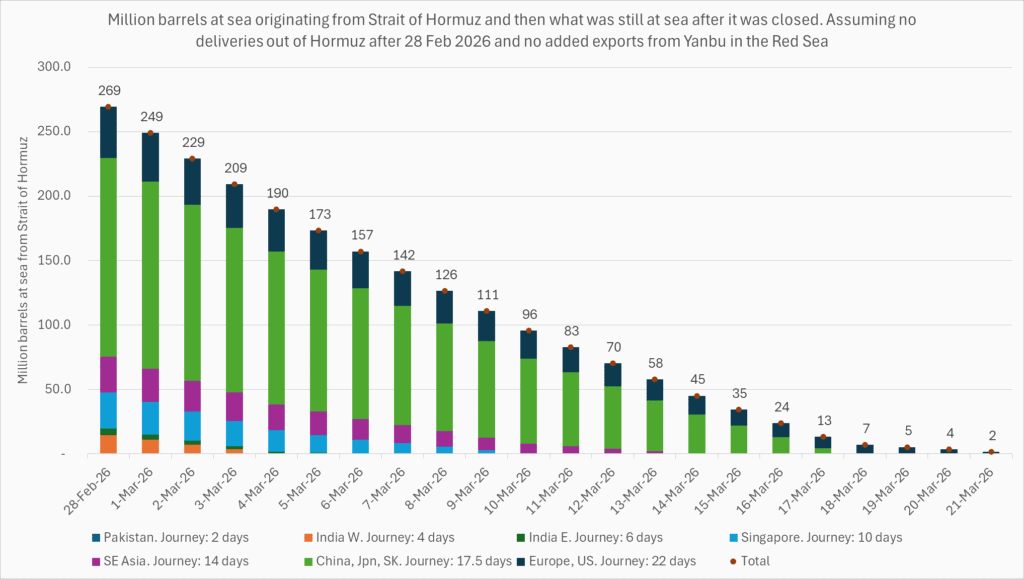
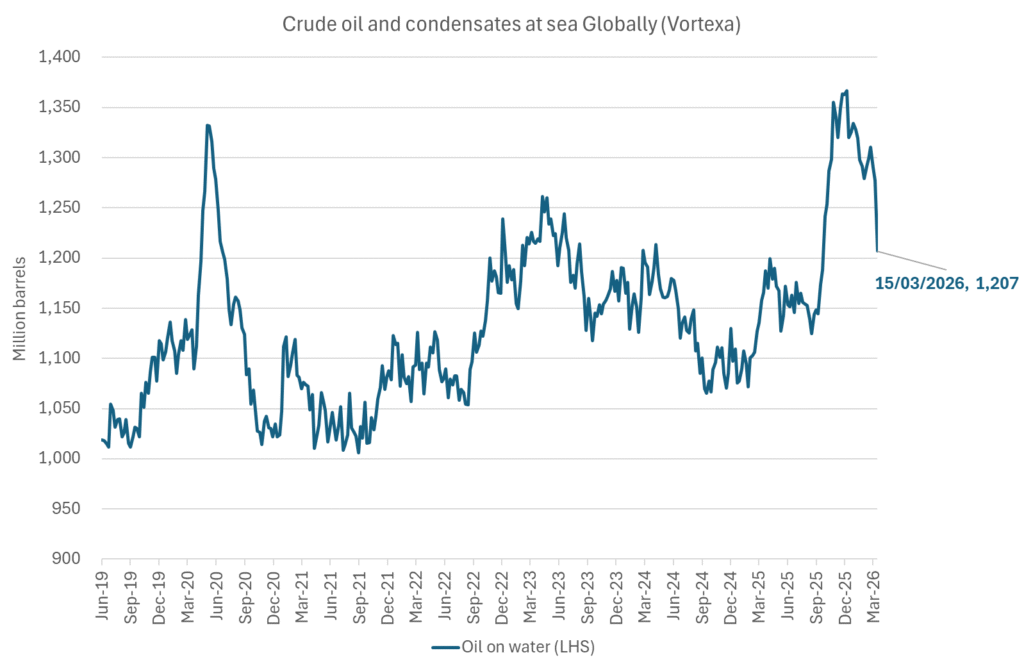
Oil at sea is falling fast as oil is delivered without any new refill in the Persian Gulf. Waivers for Russian crude is also shifting Russian crude to consumers. Brent crude will likely start to feel the pinch much more forcefully when oil at sea is drawn down another 200 mb to around 1000 mb. That is not much more than 10 days from here.
Oil and oil products are starting to become very pricy many places. Brent crude has still been shielded from spiking like the others.



Market Still Betting on Timely Resolution, But Each Day Raises Shortage Risk

Christian Kopfer om läget för oljan

Marknaden måste börja betrakta de höga kopparpriserna som det nya normala

Det fysiska spotpriset på brentolja har slagit nytt rekord

40 minuter med Javier Blas om hur världen verkligen påverkas av energikrisen
40 minuter med Javier Blas om hur världen verkligen påverkas av energikrisen

Elpriserna fördubblas, stor osäkerhet inför sommaren

MP Materials, USA:s svar på Kinas dominans över sällsynta jordartsmetaller
Det fysiska spotpriset på brentolja har slagit nytt rekord

Studsvik har idag ansökt om att få bygga 1200-1600 MW kärnkraft i Valdemarsvik
-
 Nyheter3 veckor sedan
40 minuter med Javier Blas om hur världen verkligen påverkas av energikrisen
-
 Nyheter4 veckor sedan
Elpriserna fördubblas, stor osäkerhet inför sommaren
-
 Nyheter4 veckor sedan
MP Materials, USA:s svar på Kinas dominans över sällsynta jordartsmetaller
-
 Nyheter2 veckor sedan
Det fysiska spotpriset på brentolja har slagit nytt rekord
-
 Nyheter4 veckor sedan
Studsvik har idag ansökt om att få bygga 1200-1600 MW kärnkraft i Valdemarsvik
-
 Nyheter2 veckor sedan
Marknaden måste börja betrakta de höga kopparpriserna som det nya normala
-
Analys4 veckor sedan
TACO (or Whatever It Was) Sends Oil Lower — Iran Keeps Choking Hormuz
-

 Nyheter4 veckor sedan
Matproduktion är beroende av gödsel, Gulfkriget skapar brist