

Analys
Veckans råvarukommentarer: Årskrönika 2015

 QE skapade produktion – inte konsumtion
Nu är epoken med gratis pengar slut
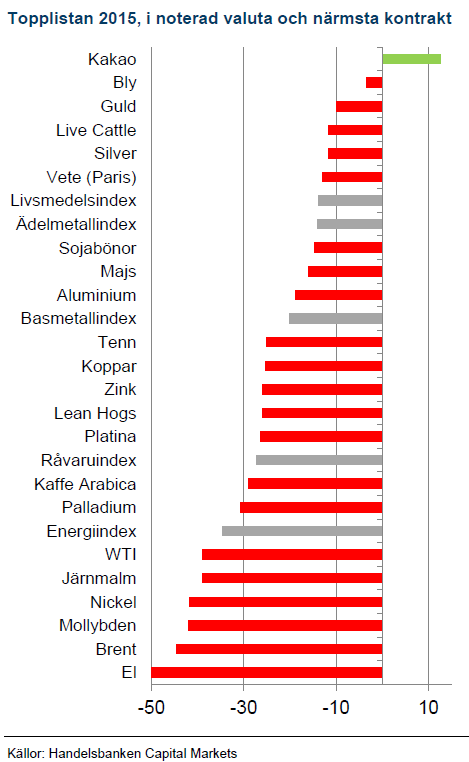 Råvaror har nu avslutat det fjärde året i rad som sämsta tillgångsklass. Blott kakao klarade 2015 på plus. Möjligen är den välsmakande råvaran den sista att ha tillväxthistorien på efterfrågesidan intakt. Kinas inbromsning och framförallt gir till mindre råvarukonsumerade tillväxt är ett av skälen till lägre råvarupriser. Vi ser dock den extrema investeringsvåg i ny produktionskapacitet som helt avgörande bakom 2015 års prisnedgångar. I Fed:s nästan tio år långa jakt på inflation och tillväxt har det obetydliga priset och tillgängligheten på pengar gjort att tidigare ouppnåeliga råvaruprojekt har förverkligats. Samtidigt har Feds tillväxtjakt inte skapat större efterfrågan på råvaror. Resultatet har blivit överproduktion av så gott som alla råvaror, av allt mer skuldsatta producenter.
2015 avslutades med årets största makrohändelsen, USA:s första räntehöjning på nio år. När räntehöjningscykeln nu tar vid förbyts råvaruproducenters jakt på ny produktion till kamp för överlevnad. Om ”Fed hike” var 2015 års modeord så kommer kreditincident bli temat för 2016. I november fanns det fem gånger så många oljebolag i risk för konkurrs mot ett år tidigare.
Olja och järnmalm gjorde det igen
Två av råvaruindustrins starkaste producentkarteller bröt samman under 2014. Mest omskrivet var det faktum att oljekartellen OPEC abdikerade från sin roll som prisgarant. Konsekvensen av detta var att Brentolja föll 48 % och blev årets förlorare, tätt följd av järnmalm som också nära halverades under 2014. Fjolåret, var inte mycket bättre, åter finner vi Brent och järnmalm i botten av listan med -44,5 respektive – 39%. Situationen för våra två största råvaror är slående lika. Lågkostnadsproduktion fortsätter öka (OPEC-olja och Australienmalm) samtidigt som högkostnadsproducenter inte ger vika (skifferolja och kinesisk malmproduktion). Konventionella producenter däremellan sitter med Svarte Petter (Norge och Sverige).
 Breda nedgångar och tunt i toppen
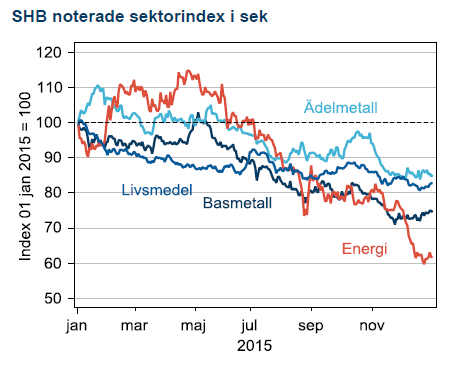
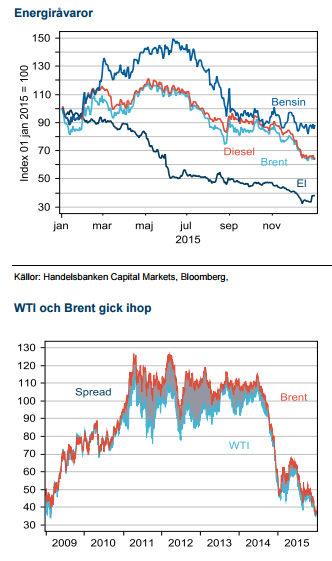
För tredje året i rad slutade samtliga fyra råvarusektorer; livsmedel, energi, basmetaller och ädelmetaller på minus. En förstärkning av USD mot SEK med ytterligare 9,4% efter 2014 års 17,4% hjälpte de SEK-noterade indexen men räckte inte till för positiv avkastning. Årets vinnare var, precis som vanligt, en jordbruksråvara; kakao från Elfenbenskusten och Ghana. Sämsta råvara blev el, som föll 61%, antagligen någon form av rekord.
Olja
Början i dur, final i moll
För oljebolagen var 2015 ett år av tro och hopp på återhämtning i priset. Andan skapades under första halvåret då skifferproducenterna först minskade produktionen och priset började med att stiga 21% till USD 68 i maj. Få trodde då att oljan skulle sluta året under USD 35.
 Kapade capex
Oljebolagens första ansatts var att kapa investeringarna med omkring 25%, det har bidragit till tillfälligt bättre finanser. De stora bolagen har sänkt det oljepris de behöver för att täcka investeringar, räntor och utdelning från USD 81 till 66 under 2015. Med priser omkring USD 35 kommer bolagens skuldsättning att stiga under 2016. Bolagen kan låta skulderna stiga men lär avskräckas från skenande belåning från gruvbolagens skräckexempel under 2015. Ytterligare besparingar och lägre investeringar är alltså att vänt
OPEC var al-Naimi mot Zanganeh
I juli skrev Saudiarabiens ärkefiende, Iran på avtalet med väst som, via vissa hållpunkter, leder fram till att sanktionerna mot Iran sannolikt hävs under början av 2016. Irans utspel om att återta sin förlorade marknadsandel fick oljepriset på fall och Saudiarabien som tagit marknadsandelen med hjälp av sanktionerna visade sig som väntat ovillig att lämna tillbaka den. Situationen kulminerade under fjolårets andra OPEC-möte den 4/12 då OPEC övergav sitt produktionsmål med förklaringen att organisationen ska avvakta och se hur det blir med Iran återkomst under första halvåret 2016. Det är således bäddat för ett nytt laddat möte i Wien den 2/6.
Saudiarabien rustar för låga priser
Strategiarkitekten Saudiarabien är inte immunt mot låga oljepriser. Kungadömet fick ett budgetunderskott på 15% av BNP eller nära 100 miljarder USD under 2015. Landet har tagit lån, använt valutareserven men också infört reformer som vittnar om en förväntan på långsiktigt låga priser. Subventioner trappas ner över kommande fem år som tillsammans med privatiseringar ska stärka statskassan.
Politik väster om Atlanten
USA hävde sitt 40 år gamla exportförbud på råolja under 2015 även om den första lasten från Texas seglade först fyra dagar efter nyårsraketerna hade avfyrats. WTI och Brent gick därmed ihop under slutet av året. Prisspreaden mellan de båda kvalitéerna som toppade på USD 28 för några år sedan när skifferoljan började flöda har vi redan glömt.
Frakt
Kollaps i fraktpriserna
Fraktpriserna i Baltic Dry Index avslutade 2015 på de lägsta nivåerna någonsin. Torrlastflottan växte med 3 % från båtar beställda under 2013-14, huvudsakligen finansierade med private equity, samtidigt som Kinas tillväxt i fraktbehov minskade från 5-6 % till noll under fjolåret. Krisen förvärrades av de låga oljepriserna som gjorde att rederierna körde båtarna med högre hastighet, tankade med billigt bränsle och därmed ökade kapaciteten.
Metaller och jordbruk
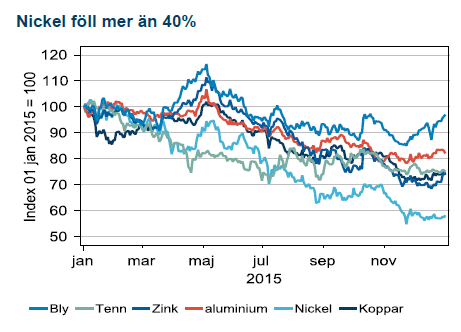 Kinas handlare visade vägen
Marknaden fick en varningsflagga i januari när Kinesiska hedgefonder sålde ut koppar på tron om svag kinesisk makrodata när Londonhandlare fortfarande satt och sov. ”Bear raid” blev namnet på aktionen som sedan färgade mycket av året för basmetallerna. Svag kinesisk makrodata och små justeringar i produktionen från de högt skuldsatta producenterna som värnade om sina kassaflöden blev en missmatch som förde priserna nedåt.
Mörkt i gruvan
När Glencore presenterade sin plan för att minska skuldsättningen fanns nära 1000 lyssnare inloggade på telefonkonferensen. Bolaget blev nidbilden av hur gruvbolagen ska hantera överproduktionen på basmetaller. Först handlades bolag med sämst balansräkning ner men senare under året utkristalliserade sig en andra trend där bolag med en konkret plan framåt handlades med en premie. Anglo American var ett av bolagen som lovade stora förändringar men gjorde få. Bolagets ambition att minska antalet gruvor och anställda med 60 % går dock in i rekordboken för krishantering. Bolagets aktie föll också 75% under 2015 och blev sämsta bolaget i London.
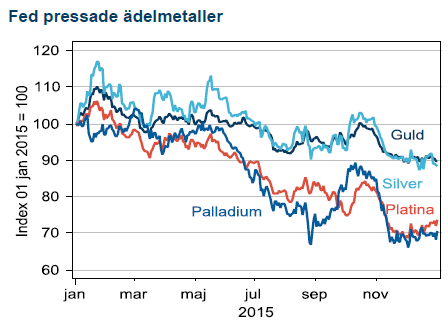 Ryssland passerade USA
Global makro hade ett ovanligt inflytande på jordbruksmarknaden genom urstark USD. Med stark USD går USA:s export mycket trögt och det har lett till att utgående lager i förhållande till årlig konsumtion stigit till höga 45% för vete. Det finns alltså nästan en halv skörd i lager. Högre nivåer har vi inte haft sedan 2010/2011 och vi får före dess gå tillbaka till 1987 för att finna liknande lagersituation. Istället har Ryssland via en oljepressad rubel blivit världens största exportör, något som ökar riskerna då landet har mycket större variation i sin skörd. För soja och majs har en annan råvarupressad valuta, real i Brasilien tagit marknadsandelar från USA.
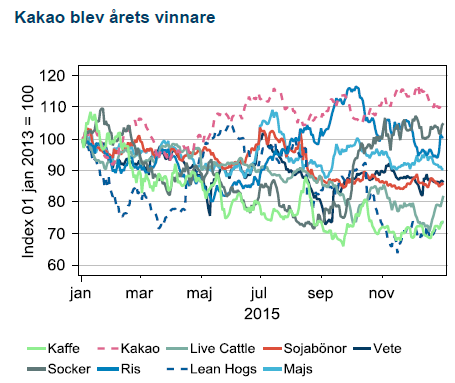 Årets tema: Fed
Årets makrotema; Feds första höjning på nio år blev en uttjatad historia som inte infriades förens på årets sista Fedmöte. Då var inprisningen av guld och silver redan gjord och de ädla metallerna som stigit under år av expansiv penningpolitik tappade drygt 10 %.
[box]SHB Råvarukommentar är producerat av Handelsbanken och publiceras i samarbete och med tillstånd på Råvarumarknaden.se[/box]
Ansvarsbegränsning
Detta material är producerat av Svenska Handelsbanken AB (publ) i fortsättningen kallad Handelsbanken. De som arbetar med innehållet är inte analytiker och materialet är inte oberoende investeringsanalys. Innehållet är uteslutande avsett för kunder i Sverige. Syftet är att ge en allmän information till Handelsbankens kunder och utgör inte ett personligt investeringsråd eller en personlig rekommendation. Informationen ska inte ensamt utgöra underlag för investeringsbeslut. Kunder bör inhämta råd från sina rådgivare och basera sina investeringsbeslut utifrån egen erfarenhet.
Informationen i materialet kan ändras och också avvika från de åsikter som uttrycks i oberoende investeringsanalyser från Handelsbanken. Informationen grundar sig på allmänt tillgänglig information och är hämtad från källor som bedöms som tillförlitliga, men riktigheten kan inte garanteras och informationen kan vara ofullständig eller nedkortad. Ingen del av förslaget får reproduceras eller distribueras till någon annan person utan att Handelsbanken dessförinnan lämnat sitt skriftliga medgivande. Handelsbanken ansvarar inte för att materialet används på ett sätt som strider mot förbudet mot vidarebefordran eller offentliggörs i strid med bankens regler.

Brent is climbing higher. Front-month is at USD 106.3/bl this morning, close to a weekly high and a USD 9/bl jump from Mondays open. This is the move we flagged as a risk earlier in the week: the market shifting from ”a deal is around the corner” to ”this is going to take longer than we thought”.

Analyst Commodities, SEB
During April, rest-of-year Brent remained remarkably stable around USD 90/bl. A stability which rested on one single assumption: the SoH reopens around 1 May. That assumption is now slowly falling apart.
As we highlighted yesterday: every week of delay beyond 1 May adds (theoretically) ish USD 5/bl to the rest-of-year average, as global inventories draw 100 million barrels per week. i.e., a mid-May reopening implies rest-of-year Brent closer to USD 100/bl, and anything pushing into June or July takes us meaningfully higher.
What’s changed in the last 48 hours:
#1: The US military has formally warned that clearing suspected sea mines from SoH could take up to six months. That is a completely different timescale from what the financial market is pricing. Even a political deal tomorrow does not immediately reopen the strait.
#2: Trump has shifted his tone from urgency to ”strategic patience”. In yesterday’s press conference: ”Don’t rush me… I want a great deal.” The market is reading this as a president no longer feeling pressured by timelines, with the naval blockade running in the background.
#3: So far, the military activity is escalating, not de-escalating. Axios reports Iran is laying more mines in SoH. The US 3rd carrier strike group (USS George H.W. Bush) is arriving with two countermine vessels. Trump yesterday ordered the US Navy to destroy any Iranian boats caught laying mines. While CNN reports that the Pentagon is actively drawing up plans to strike Iranian SoH capabilities and individual Iranian military leaders if the ceasefire collapses. i.e., NOT a attitude consistent with an imminent deal!
Spot crude and product prices eased off the early-April highs on a combination of system rerouting and deal optimism. Both now weakening. Goldman estimates April Gulf output is reduced by 14.5 mbl/d, or 57% of pre-war supply, a number that keeps getting worse the longer this drags on.
Demand-side adaptation is ongoing: S. Korea has cut its Middle East crude dependence from 69% to 56% by pulling more from the Americas and Africa, and Japan is kicking off a second round of SPR releases from 1 May. But SPRs are finite.
Ref. to the negotiations, we should not bet on speed. The current Iranian leadership is dominated by genuine hardliners willing to absorb economic pain and run the clock to extract concessions. That is not a setup for a rapid resolution. US/Israeli media briefings keep framing the delay as ”internal Iranian divisions”, the reality is more complicated and points toward weeks and months, not days.
Our point is that the complexity is large, and higher prices have only just started (given a scenario where the negotiations drag out in time). The market spent April leaning on the USD 90/bl rest-of-year assumption; that case is diminishing by the hour. If ”early May reopening” is replaced by ”June, July or later” over the next week or two, both crude and products have meaningful room to reprice higher from here. There is a high risk being short energy and betting on any immediate political resolution(!).
Down on Friday. Up on Monday. The Brent June crude oil contract traded down 5.1% last week to a close of $90.38/b. It reached a high of $103.87/b last Monday and a low of $86.09/b on Friday as Iran announced that the Strait of Hormuz was fully open for transit. That quickly changed over the weekend as the US upheld its blockade of Iranian oil exports while Iran naturally responded by closing the SoH again. The US blew a hole in the engine room of the Iranian ship TOUSKA and took custody of the ship on Sunday. Brent crude is up 5.6% this morning to $95.4/b.

The cease-fire is expiring tomorrow. The US has said it will send a delegation for a second round of negotiations in Islamabad in Pakistan. But Iran has for now rejected a second round of talks as it views US demands as unrealistic and excessive while the US is also blocking the Strait of Hormuz.
While Brent is up 5% this morning, the financial market is still very optimistic that progress will be made. That talks will continue and that the SoH will fully open by the start of May which is consistent with a rest-of-year average Brent crude oil price of around $90/b with the market now trading that balance at around $88/b.
Financial optimism vs. physical deterioration. We have a divergence where the financial market is trading negotiations, improvements and resolution while at the same time the physical market is deteriorating day by day. Physical oil flows remain constrained by disrupted flows, longer voyage times and elevated freight and insurance costs.
Financial markets are betting that a US/Iranian resolution will save us in time from violent shortages down the road. But every day that the SoH remains closed is bringing us closer to a potentially very painful point of shortages and much higher prices.
The US blockade is also a weapon of leverage against its European and Asian allies. When Iran closed the SoH it held the world economy as a hostage against the US. The US blockade of the SoH is of course blocking Iranian oil exports. But it is also an action of disruption directed towards Europe and Asia. The US has called for the rest of the world to engaged in the war with Iran: ”If you want oil from the Persian Gulf, then go and get it”. A risk is that the US plays brinkmanship with the global oil market directed towards its European and Asian allies and maybe even towards China to force them to engage and take part. Maybe unthinkable. But unthinkable has become the norm with Trump in the White House.
Wild moves yesterday. Brent crude traded to a high of $114.43/b and a low of $96.0/b and closed at $99.94/b yesterday.
US – Iran negotiations ongoing or not? What a day. Donald Trump announced that good talks were ongoing between Iran and the US and that the 48 hour deadline before bombing Iranian power plants and energy infrastructure was postponed by five days subject to success of ongoing meetings. Iranian media meanwhile stated that no meetings were ongoing at all.
Today we are scratching our heads trying to figure out what yesterday was all about.
Friends and family playing the market? Was it just Trump and his friends and family who were playing with oil and equity markets with $580m and $1.46bn in bets being placed by someone in oil and equity markets just 15 minutes before Trump’s announcement?
Was Trump pulling a TACO as he reached his political and economic pain point: Brent at $112/b, US Gas at $4/gal, SPX below 200dma and US 10yr above 4.4%?
Different Iranian factions with Trump talking with one of them? Are there real negotiations going on but with the US talking to one faction in Iran while another, the hardliners, are not involved and are denying any such negotiations going on?
Extending the ultimatum to attack and invade Kharg island next weekend? Or, is the five day delay of the deadline a tactical decision to allow US amphibious assault ships and marines to arrive in the Gulf in the upcoming weekend while US and Israeli continues to degrade Iranian military targets till then. And then next weekend a move by the US/Israel to attack and conquer for example the Kharg island?
We do not really know which it is or maybe a combination of these.
We did get some kind of TACO ydy. But markets have been waiting for some kind of TACO to happen and yesterday we got some kind of TACO. And Brent crude is now trading at $101.5/b as a result rather than at $112-114/b as it did no the high yesterday.
But what really matters in our view is the political situation on the ground in Iran. Will hardliners continue to hold power or will a more pragmatic faction gain power?
If the hardliners remain in power then oil pain should extend all the way to US midterm elections. The hardliners were apparently still in charge as of last week. Iran immediately retaliated and damaged LNG infrastructure in Qatar after Israel hit Iranian South Pars. The SoH was still closed and all messages coming out of Iran indicated defiance. Hardliners continues in power has a huge consequence for oil prices going forward. The regime has played its ’oil-weapon’ (closing or chocking the Strait of Hormuz). It is using it to achieve political goals. Deterrence: it needs to be so politically and economically expensive to attack Iran that it won’t happen again in the future. Or at least that the US/Israel thinks 10-times over before they attack again. The highest Brent crude oil closing price since the start of the war is $112.19/b last Friday. In comparison the 20-year inflation adjusted Brent price is $103/b. So Brent crude last Friday at $112.19/b isn’t a shockingly high price. And it is still far below the nominal high of $148/b from 2008 which is $220/b if inflation adjusted. So once in a lifetime Iran activates its most powerful weapon. The oil weapon. It needs to show the power of this weapon and it needs to reap political gains. Getting Brent to $112/b and intraday high of $119.5/b (9 March) isn’t a display of the power of that weapon. And it is not a deterrence against future attacks.
So if the hardliners remain in power in Iran, then the SoH will likely remain chocked all the way to US midterm elections and Brent crude will at a minimum go above the historical nominal high of $148/b from 2008.
Thus the outlook for the oil price for the rest of the year doesn’t depend all that much of whether Trump pulls a TACO or not. Stops bombing or not. It depends more on who is in charge in Iran. If it is the hardliners, then deterrence against future attacks via chocking of the SoH and high oil prices is the likely line of action. It is impacting the world but the Iranian ’oil-weapon’ is directed towards the US president and the the US midterm elections.
If a pragmatic faction gets to power in Iran, then a very prosperous future is possible. However, if power is shifting towards a more pragmatic faction in Iran then a completely different direction could evolve. Such a faction could possibly be open for cooperation with the US and the GCC and possibly put its issues versus Israel aside. Then the prosperity we have seen evolving in Dubai could be a possible future also for Iran.
So far it looks like the hardliners are fully in charge. As far as we can see, the hardliners are still fully in control in Iran. That points towards continued chocking of the SoH and oil prices ticking higher as global inventories (the oil market buffers) are drawn lower. And not just for a few more weeks, but possibly all the way to the US midterm elections.



Brent crude up USD 9/bl on the week… ”deal around the corner” narrative fades
Market Still Betting on Timely Resolution, But Each Day Raises Shortage Risk

Christian Kopfer om läget för oljan

Marknaden måste börja betrakta de höga kopparpriserna som det nya normala

Det fysiska spotpriset på brentolja har slagit nytt rekord

40 minuter med Javier Blas om hur världen verkligen påverkas av energikrisen
Det fysiska spotpriset på brentolja har slagit nytt rekord
Marknaden måste börja betrakta de höga kopparpriserna som det nya normala
Christian Kopfer om läget för oljan

Efter tillväxten: Guldbrev satsar på expansion i Europa
-
 Nyheter3 veckor sedan
40 minuter med Javier Blas om hur världen verkligen påverkas av energikrisen
-
 Nyheter3 veckor sedan
Det fysiska spotpriset på brentolja har slagit nytt rekord
-
 Nyheter3 veckor sedan
Marknaden måste börja betrakta de höga kopparpriserna som det nya normala
-
 Nyheter2 veckor sedan
Christian Kopfer om läget för oljan
-
 Nyheter3 veckor sedan
Efter tillväxten: Guldbrev satsar på expansion i Europa
-
Analys5 dagar sedan
Market Still Betting on Timely Resolution, But Each Day Raises Shortage Risk
-
Analys2 dagar sedan
Brent crude up USD 9/bl on the week… ”deal around the corner” narrative fades