

Analys
SHB Råvarubrevet 23 december 2011

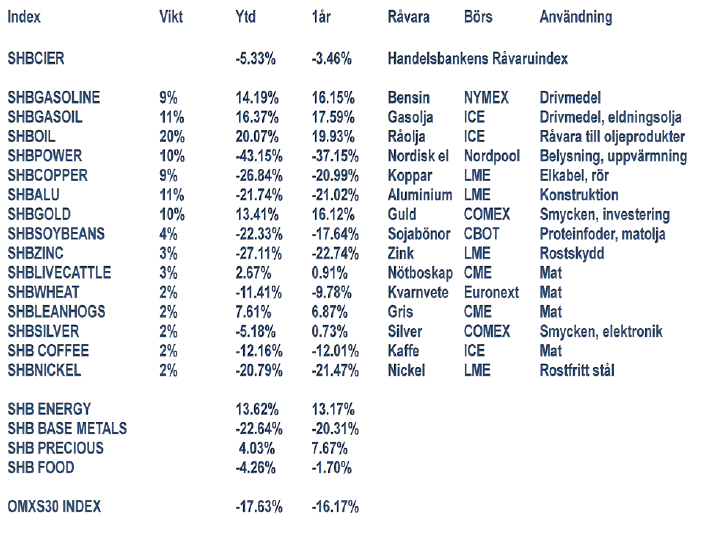
 Råvarorna har återhämtat något av förra veckans fall med stöd från amerikansk statistik, positiva kinesiska importsiffror och en svagare dollar. Handelsbankens Råvaruindex är nu ned 5.33 procent på året (+2 procent sedan förra fredagen) och det är främst oljan som dragit index. Ekonomiska data i USA fortsätter att vara uppmuntrande. Tillväxten reviderades visserligen ned till 1.8 procent för Q3, mest på grund av lager, men ansökningar om arbetslöshetsunderstöd har minskat till tre års lägsta. Vidare signalerar ledande indikatorer att den ekonomiska tillväxten accelererar. Detta är positivt för oljemarknaden eftersom USA förbrukar lite drygt en fjärdedel av alla oljeprodukter, men vi förväntar oss dock att marknaden kommer att agera fortsatt nervöst om man ser till Europa och dess spridningseffekter till exportberoende länder. Riskerna för det finansiella systemet i Europa är oroväckande och det kommer ta tid att återställa marknadens förtroende. Detta gör att vi nog får se sidledes rörelser en bit in på nästa år. Det som ger gott stöd åt hela segmentet är att råvaror överlag dras med en svag balans som ett resultat av höga produktionskostnader, långa ledtider och vikande halter. Prospekteringstakten måste upprätthållas på en hög nivå för att möta efterfrågan från den växande medelklassen i tillväxtländerna. Detta gör att industrier som maskinell utrustning till gruvindustrin och prospektering exempelvis ser väldigt positivt på framtiden. Komatsu som är världens näst största leverantör av gruvutrustning har haft en tillväxt på närmare 23 procent under 2011 och räknar med 10 procents tillväxt under 2012. Ser vi till Livsmedel så har väder och produktion varit gynnsamt den senaste tiden vilket stärkt lager och utsikterna för att möta efterfrågan. Uppgången den senaste veckan får väl därför betecknas som en short-covering inför årsslutet vilket ofta brukar ge goda möjligheter att positionera sig kort när lugnet lagt sig.
Energi
Oljemarknaden stöds utöver positiv amerikansk statistik och lägre lager även av fortsatt politisk anspänning i Mellanöstern. Första stora attacken på länge i mot Iraks huvudstad sedan en kris mellan den shiamuslimsk ledda regeringen och sunni-rivaler brutit ut efter ett tillbakadragande av amerikanska trupper förra helgen. Dessutom finns det risk för gnistbildning och att oljeleveranser från viktiga exportmarknader störs av Irans flotta som manövrerar öster om Hormuzsundet.
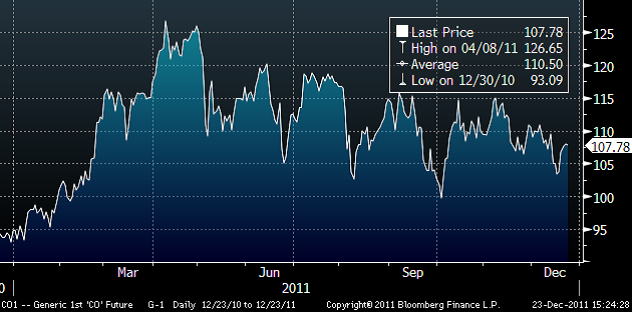
Lagernivåerna i USA sjönk med 10.6 miljoner fat under veckan vilket är den största fallet på tio år och lagren ligger nu på tre års lägsta. Spreaden mellan WTI och Brent har som ett resultat av detta krupit ihop till 9 dollar. Det spekuleras i om de låga siffrorna är ett resultat av ett något större skatteupplägg än tidigare år, dvs raffinaderiers ”gömda” lager inför årsskifte för att undgå skatt. Detta är tydligt eftersom hela 70 procent av lagerfallet är vid mexikanska golfen där råoljan enkelt kan föras tillbaka till oljetankar. Vi kan mao räkna med att dessa siffror som nu ser bullish ut stiger till något mer neutrala efter årsskiftet. I övrigt noteras även i Nordöstra i USA milda temperaturer och en något lägre efterfrågan på heating oil. Vi trodde att Brent oljan successivt skulle tappa mot slutet av året men nere på 103 dollar (se bilden nedan) fanns det tillräckligt med stöd och intressen vilket innebär att vi nu räknar med neutral till positiv utveckling på kort sikt.
Den Nordiska elmarknaden karaktäriseras fortsatt av milt och blött väder där energibalansen stärkts rejält den senaste månaden. De flesta faktorer pekar nedåt där såväl kontinentala priser, energikol, utsläppsrätter, väder och last gör att vi får räkna med låga priser en tid framöver. Ser vi till prognoserna räknar Shepherd Energy med att vi går mot ett energiöverskott i Norden om hela 8.3 TWh i slutet av vecka 52. Den goda balansen har även pressat den längre kurvan vilket innebär att det om inte annat är ett helt klart intressant läge att låsa in längre elavtal.
Livsmedel
Vetet har stigit kraftigt i pris i både Chicago och Paris under den gångna veckan, påverkat inte minst av stigande priser på majs och flera andra råvaror. Det amerikanska vetet har stigit något mer som följd av en försvagad amerikansk dollar. Vädret är klart bättre i Australien, endast längst ner i söder fortsätter regnet att falla. I Argentina råder fortsatt bra skördeväder och skörden väntas kunna gå mot sitt slut under nästa vecka, med goda volymer och goda kvaliteter som resultat. Temperaturerna har fallit i USA och höstvetet har gått in i vintervila. Enda oron direkt kopplat till vete just nu är väderutvecklingen den närmaste tiden i Ukraina – bristande eller inget snötäcke alls gör grödan mycket känslig mot lägre temperaturer. Trots den styrka priserna visat denna vecka, i en handel som visserligen varit låg volymmässigt, är det svårt att se att priserna ska fortsätta stiga. Faktum kvarstår att vi har en god tillgång på vete, med lagernivåer vi inte sett på över tio år. Fortsatt torrt väder i Sydamerika kan pressa upp majspriserna ytterligare något och eventuellt dra med sig vetepriserna lite till, men marknaden bör nu bli lite mer avvaktande och först se om USDA-rapporten den 12 januari innehåller något överraskande.
Majsen har stigit kraftigt i pris sedan förra veckan, påverkat av fortsatt torrt väder i främst Argentina, en försvagad amerikansk dollar samt stigande priser på råolja. Endast små regnskurar väntas under de kommande 10-14 dagarna, vilket inte lär lindra situationen nämnvärt. Grödan är redan eller är på väg in i ett mycket känsligt utvecklingsstadium. Vad som också gett stöd åt priserna är att siffrorna för den amerikanska veckoproduktionen av etanol rapporterades som de näst högsta någonsin – alltså fortsatt stark inhemsk efterfrågan. Men efterfrågan på amerikansk majs globalt är dock fortsatt ovanligt låg som följd av hård konkurrens. Handeln fram tills USDA:s WASDE-rapport den 12 januari väntas bli ganska avvaktande men om inte läget förbättras i Sydamerika kan priserna stiga lite ytterligare. Analytikerföretaget Informa uppskattar den amerikanska majsarealen 2012 till hela 94,39 miljoner acres, den största arealen sedan 1944! Vissa rykten har dock börjat spridas om att det kommer råda brist på utsäde till våren, vilket om det stämmer givetvis försämrar USA:s chanser att kunna återuppbygga låga lagervolymer.
Sojabönorna har stigit i pris under den gångna veckan, till stor del som följd av fortsatt torrt väder i Argentina, södra Brasilien och även i Paraguay. Viss nederbörd väntas falla i helgen men långt ifrån tillräckligt. Totalt för december månad har nederbörden i flera områden varit mindre än hälften av vad som är normalt. Prisuppgången har även fått hjälp av en försvagad amerikansk dollar och stigande priser på råolja. Sojabönorna lär få stöd av torr väderlek i Sydamerika ett tag framöver men vi får nog vänta lite till innan vi ser någon större uppgång. Vi ska även komma ihåg att läget ännu inte är lika kritiskt för sojabönorna som för majsen, på grund av ett senare utvecklingsstadium.
Kakao handlas ner på spekulation om att avgiftstvisten som stört frakten av bönor från Ghana nu närmar sig sitt slut. Transporterna har inte återupptagits men såväl myndigheter som marknad är positiv till att man löser tvisten med fraktföretagen inom kort. Ghanas export har endast varit 33,000 ton per månad sedan oktober vilket är 63 procent lägre än normalt.
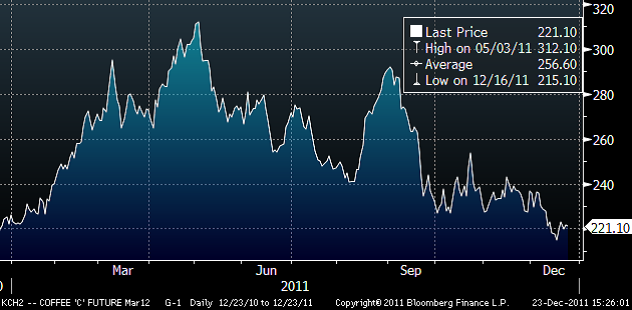
Även Kaffemarknaden ser ut att gå mot balans nästa år efter en längre period av underskott. Kaffe har handlats ned under nio av de senaste tolv handelsdagarna och tappat 8 procent sedan månadsskiftet efter att lågkostnadsproducenter i Centralamerika och Östra Asien dominerat exportmarknaden. Förnyad oro kring produktionen i Colombia efter allt regn har dämpat fallet. I dagsläget osäkert hur mycket stryk plantagen tagit men på flertalet ställen rapporteras om ”Roya” vilket är en svampliknande bildning på bladet som stryper näringen till bönan och minskar avkastningen från trädet. Sett till det stora hela kompenseras ett eventuellt bortfall av goda volymer från Brasilien som förväntas producera 52 miljoner säckar från den kommande skörden vilket är en ökning om 18 procent.
Basmetaller
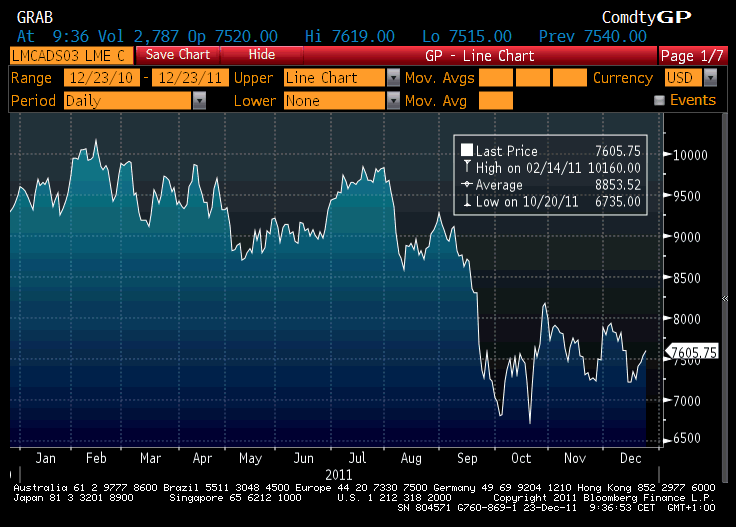
Kopparpriset har under veckan gått upp från drygt 7 300 USD till dagens nivå på drygt 7 600. Anledningen till uppgången är ett dramatiskt fall i lagernivåerna i framförallt Shanghai, vilket indikerar styrka i den kinesiska ekonomin. Dagens lagernivåer är det lägsta sedan oktober 2009. Vi tror framöver på en försiktig uppgång för kopparpriset, framförallt stött av höga produktionskostnader och fortsatt god efterfrågan från USA och Kina. Det som grumlar bilden något är en mycket svag efterfrågan från Europa, den tredje största förbrukaren i världen.
Kopparpriset sedan december 2010
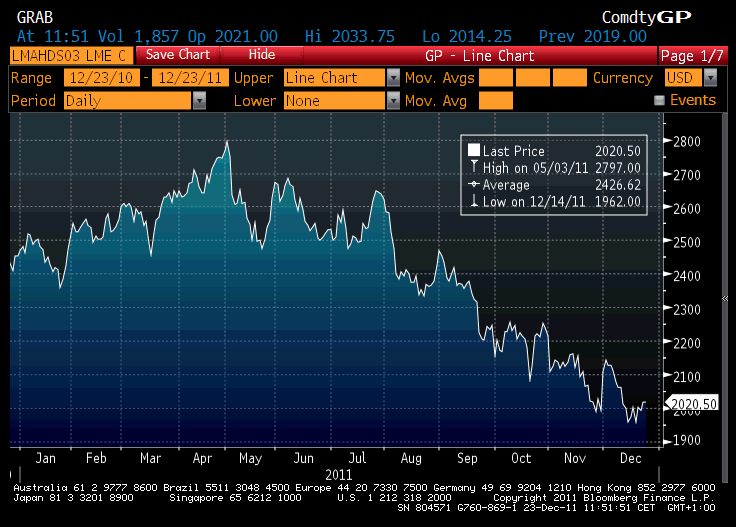
Aluminium har lyckats kravla sig upp över 2 000 USD/ton och handlar just nu på 2 020 USD/ton. Det verkar finnas ett stöd för ett pris runt 1 950 USD/ton, där priset studsat ett par gånger. Priset fick en skjuts uppåt i slutet förra veckan då det gjordes rekordstora uttaget i lagret i Vlissingen, Nederländerna. Vi ser fortsatt positivt på metallen, då halterna i gruvorna blir allt sämre samtidigt som kostnaden för produktionen är svagt stigande. Vid dessa nivåer drar gruvbolagen ned på produktionen vilket gör att det är svårt för priset att falla ytterligare.
Aluminiumpriset sedan december 2010
Ädelmetaller
Efter att ädelmetallerna fallit kraftigt under mitten av december har prisbilden stabiliserats under den gångna veckan. Euron har stärkts något i relation till dollarn samtidigt som ädelmetallerna överlag handlat sidledes. Guldet har stärkts marginellt (0,5 %), silverpriset är oförändrat och platinapriset har stigit med 0,4 %. Palladium sticker dock ut genom en veckouppgång på 4,1 %.
Vi anser att guldpriset för tillfället står inför ett vägskäl. Om priset bryter igenom den tekniskt viktiga nivån på 1500 USD/oz , samtidigt som problematiken i eurozonen ökar, finns det risk för ytterligare prisfall framöver. Om guldpriset istället lyckas hålla sig över 1500 USD/oz, samtidigt som nästa år istället inleds med stigande börser och en starkare euro, finns möjlighet att priset istället stiger.
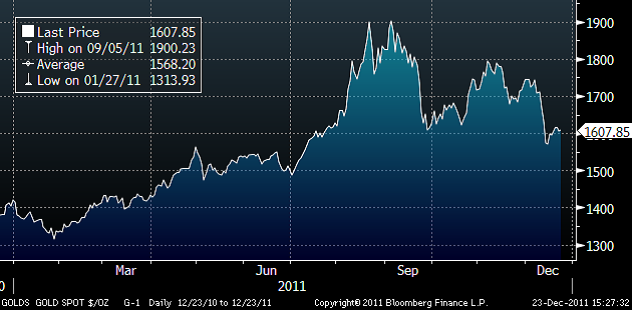
Som vi tidigare tagit upp i råvarubrevet har guldpriset för första gången på 26 år blivit dyrare än platina. Denna trend håller fortsättningsvis i sig. I skrivande stund handlas guldpriset på 1611,54 USD/oz (se ovan) och platina på 1439,75 USD/oz.
Handelsbankens Råvaruindex
[box]SHB Råvarubrevet är producerat av Handelsbanken och publiceras i samarbete och med tillstånd på Råvarumarknaden.se[/box]
Ansvarsbegränsning
Detta material är producerat av Svenska Handelsbanken AB (publ) i fortsättningen kallad Handelsbanken. De som arbetar med innehållet är inte analytiker och materialet är inte oberoende investeringsanalys. Innehållet är uteslutande avsett för kunder i Sverige. Syftet är att ge en allmän information till Handelsbankens kunder och utgör inte ett personligt investeringsråd eller en personlig rekommendation. Informationen ska inte ensamt utgöra underlag för investeringsbeslut. Kunder bör inhämta råd från sina rådgivare och basera sina investeringsbeslut utifrån egen erfarenhet.
Informationen i materialet kan ändras och också avvika från de åsikter som uttrycks i oberoende investeringsanalyser från Handelsbanken. Informationen grundar sig på allmänt tillgänglig information och är hämtad från källor som bedöms som tillförlitliga, men riktigheten kan inte garanteras och informationen kan vara ofullständig eller nedkortad. Ingen del av förslaget får reproduceras eller distribueras till någon annan person utan att Handelsbanken dessförinnan lämnat sitt skriftliga medgivande. Handelsbanken ansvarar inte för att materialet används på ett sätt som strider mot förbudet mot vidarebefordran eller offentliggörs i strid med bankens regler.
Finansiellt instruments historiska avkastning är inte en garanti för framtida avkastning. Värdet på finansiella instrument kan både öka och minska och det är inte säkert att du får tillbaka hela det investerade kapitalet.


Down on Friday. Up on Monday. The Brent June crude oil contract traded down 5.1% last week to a close of $90.38/b. It reached a high of $103.87/b last Monday and a low of $86.09/b on Friday as Iran announced that the Strait of Hormuz was fully open for transit. That quickly changed over the weekend as the US upheld its blockade of Iranian oil exports while Iran naturally responded by closing the SoH again. The US blew a hole in the engine room of the Iranian ship TOUSKA and took custody of the ship on Sunday. Brent crude is up 5.6% this morning to $95.4/b.

The cease-fire is expiring tomorrow. The US has said it will send a delegation for a second round of negotiations in Islamabad in Pakistan. But Iran has for now rejected a second round of talks as it views US demands as unrealistic and excessive while the US is also blocking the Strait of Hormuz.
While Brent is up 5% this morning, the financial market is still very optimistic that progress will be made. That talks will continue and that the SoH will fully open by the start of May which is consistent with a rest-of-year average Brent crude oil price of around $90/b with the market now trading that balance at around $88/b.
Financial optimism vs. physical deterioration. We have a divergence where the financial market is trading negotiations, improvements and resolution while at the same time the physical market is deteriorating day by day. Physical oil flows remain constrained by disrupted flows, longer voyage times and elevated freight and insurance costs.
Financial markets are betting that a US/Iranian resolution will save us in time from violent shortages down the road. But every day that the SoH remains closed is bringing us closer to a potentially very painful point of shortages and much higher prices.
The US blockade is also a weapon of leverage against its European and Asian allies. When Iran closed the SoH it held the world economy as a hostage against the US. The US blockade of the SoH is of course blocking Iranian oil exports. But it is also an action of disruption directed towards Europe and Asia. The US has called for the rest of the world to engaged in the war with Iran: ”If you want oil from the Persian Gulf, then go and get it”. A risk is that the US plays brinkmanship with the global oil market directed towards its European and Asian allies and maybe even towards China to force them to engage and take part. Maybe unthinkable. But unthinkable has become the norm with Trump in the White House.
Wild moves yesterday. Brent crude traded to a high of $114.43/b and a low of $96.0/b and closed at $99.94/b yesterday.
US – Iran negotiations ongoing or not? What a day. Donald Trump announced that good talks were ongoing between Iran and the US and that the 48 hour deadline before bombing Iranian power plants and energy infrastructure was postponed by five days subject to success of ongoing meetings. Iranian media meanwhile stated that no meetings were ongoing at all.
Today we are scratching our heads trying to figure out what yesterday was all about.
Friends and family playing the market? Was it just Trump and his friends and family who were playing with oil and equity markets with $580m and $1.46bn in bets being placed by someone in oil and equity markets just 15 minutes before Trump’s announcement?
Was Trump pulling a TACO as he reached his political and economic pain point: Brent at $112/b, US Gas at $4/gal, SPX below 200dma and US 10yr above 4.4%?
Different Iranian factions with Trump talking with one of them? Are there real negotiations going on but with the US talking to one faction in Iran while another, the hardliners, are not involved and are denying any such negotiations going on?
Extending the ultimatum to attack and invade Kharg island next weekend? Or, is the five day delay of the deadline a tactical decision to allow US amphibious assault ships and marines to arrive in the Gulf in the upcoming weekend while US and Israeli continues to degrade Iranian military targets till then. And then next weekend a move by the US/Israel to attack and conquer for example the Kharg island?
We do not really know which it is or maybe a combination of these.
We did get some kind of TACO ydy. But markets have been waiting for some kind of TACO to happen and yesterday we got some kind of TACO. And Brent crude is now trading at $101.5/b as a result rather than at $112-114/b as it did no the high yesterday.
But what really matters in our view is the political situation on the ground in Iran. Will hardliners continue to hold power or will a more pragmatic faction gain power?
If the hardliners remain in power then oil pain should extend all the way to US midterm elections. The hardliners were apparently still in charge as of last week. Iran immediately retaliated and damaged LNG infrastructure in Qatar after Israel hit Iranian South Pars. The SoH was still closed and all messages coming out of Iran indicated defiance. Hardliners continues in power has a huge consequence for oil prices going forward. The regime has played its ’oil-weapon’ (closing or chocking the Strait of Hormuz). It is using it to achieve political goals. Deterrence: it needs to be so politically and economically expensive to attack Iran that it won’t happen again in the future. Or at least that the US/Israel thinks 10-times over before they attack again. The highest Brent crude oil closing price since the start of the war is $112.19/b last Friday. In comparison the 20-year inflation adjusted Brent price is $103/b. So Brent crude last Friday at $112.19/b isn’t a shockingly high price. And it is still far below the nominal high of $148/b from 2008 which is $220/b if inflation adjusted. So once in a lifetime Iran activates its most powerful weapon. The oil weapon. It needs to show the power of this weapon and it needs to reap political gains. Getting Brent to $112/b and intraday high of $119.5/b (9 March) isn’t a display of the power of that weapon. And it is not a deterrence against future attacks.
So if the hardliners remain in power in Iran, then the SoH will likely remain chocked all the way to US midterm elections and Brent crude will at a minimum go above the historical nominal high of $148/b from 2008.
Thus the outlook for the oil price for the rest of the year doesn’t depend all that much of whether Trump pulls a TACO or not. Stops bombing or not. It depends more on who is in charge in Iran. If it is the hardliners, then deterrence against future attacks via chocking of the SoH and high oil prices is the likely line of action. It is impacting the world but the Iranian ’oil-weapon’ is directed towards the US president and the the US midterm elections.
If a pragmatic faction gets to power in Iran, then a very prosperous future is possible. However, if power is shifting towards a more pragmatic faction in Iran then a completely different direction could evolve. Such a faction could possibly be open for cooperation with the US and the GCC and possibly put its issues versus Israel aside. Then the prosperity we have seen evolving in Dubai could be a possible future also for Iran.
So far it looks like the hardliners are fully in charge. As far as we can see, the hardliners are still fully in control in Iran. That points towards continued chocking of the SoH and oil prices ticking higher as global inventories (the oil market buffers) are drawn lower. And not just for a few more weeks, but possibly all the way to the US midterm elections.
A brief sigh of relief yesterday as oil infra at Kharg wasn’t damaged. But higher today. Brent crude dabbled around a bit yesterday in relief that oil infrastructure at Iran’s Kharg island wasn’t damaged. It traded briefly below the 100-line and in a range of $99.54 – 106.5/b. Its close was near the low at $100.21/b.
No easy victorious way out for Trump. So no end in sight yet. Brent is up 3.2% today to $103.4/b with no signs that the war will end anytime soon. Trump has no easy way to declare victory and mission accomplished as long as Iran is in full control of the Strait of Hormuz while also holding some 440 kg of uranium enriched to 60% and not far from weapons grade at 90%. As long as these two factors are unresolved it is difficult for Trump to pull out of the Middle East. Naturally he gets increasingly frustrated over the situation as the oil price and US retail gas prices keeps ticking higher while the US is tied into the mess in the Middle East. Trying to drag NATO members into his mess but not much luck there.
When commodity prices spike they spike 2x, 3x, 4x or 5x. Supply and demand for commodities are notoriously inflexible. When either of them shifts sharply, the the price can easily go to zero (April 2022) or multiply 2x, 3x, or even 5x of normal. Examples in case cobalt in 2025 where Kongo restricted supply and the price doubled. Global LNG in 2022 where the price went 5x normal for the full year average. Demand for tungsten in ammunition is up strongly along with full war in the middle east. And its price? Up 537%.
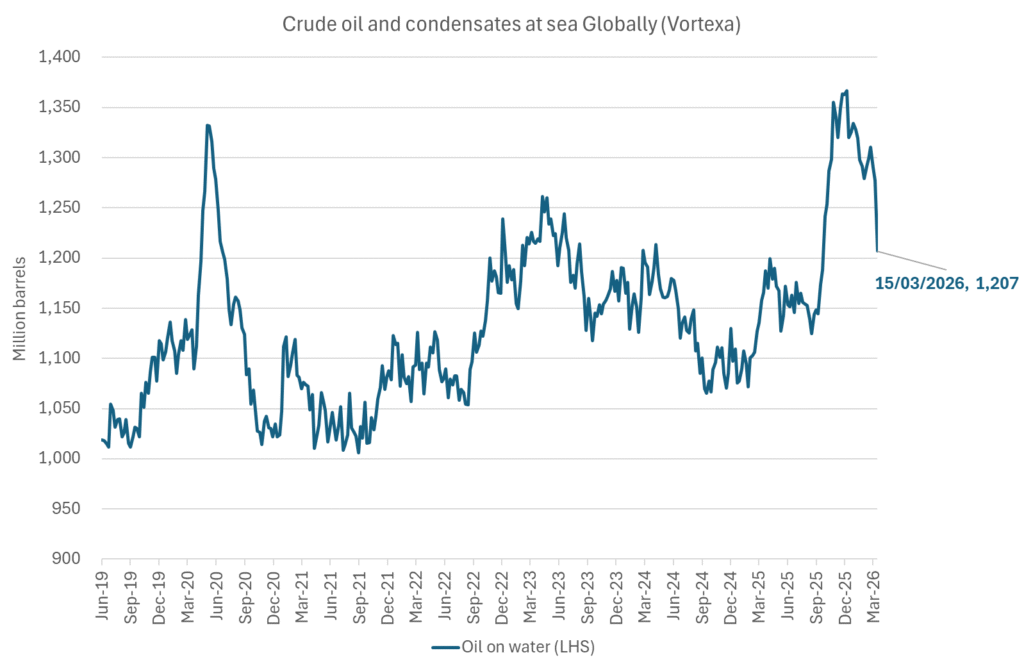
Why hasn’t the Brent crude oil price gone 2x, 3x, 4x or 5x versus its normal of $68/b given close to full stop in the flow of oil of the Strait of Hormuz? We are after all talking about close to 20% of global supply being disrupted. The reason is the buffers. It is fairly easy to store oil. Commercial operators only hold stocks for logistical variations. It is a lot of oil in commercial stocks, but that is predominantly because the whole oil system is so huge. In addition we have Strategic Petroleum Reserves (SPRs) of close to 2500 mb of crude and 1000 mb of oil products. The IEA last week decided to release 400 mb from global SPR. Equal to 20 days of full closure of the Strait of Hormuz. Thus oil in commercial stocks on land, commercial oil in transit at sea and release of oil from SPRs is currently buffering the situation.
But we are running the buffers down day by day. As a result we see gradually increasing stress here and there in the global oil market. Asia is feeling the pinch the most. It has very low self sufficiency of oil and most of the exports from the Gulf normally head to Asia. Availability of propane and butane many places in India (LPG) has dried up very quickly. Local prices have tripled as a result. Local availability of crude, bunker oil, fuel oil, jet fuel, naphtha and other oil products is quickly running down to critical levels many places in Asia with prices shooting up. Oman crude oil is marked at $153/b. Jet fuel in Singapore is marked at $191/b.
Oil at sea originating from Strait of Hormuz from before 28 Feb is rapidly emptied. Oil at sea is a large pool of commercial oil. An inventory of oil in constant move. If we assume that the average journey from the Persian Gulf to its destinations has a volume weighted average of 13.5 days then the amount of oil at sea originating from the Persian Gulf when the the US/Israel attacked on 28 Feb was 13.5 days * 20 mb/d = 269 mb. Since the strait closed, this oil has increasingly been delivered at its destinations. Those closest to the Strait, like Pakistan, felt the emptying of this supply chain the fastest. Propane prices shooting to 3x normal there already last week and restaurants serving cold food this week is a result of that. Some 50-60% of Asia’s imports of Naphtha normally originates from the Persian Gulf. So naphtha is a natural pain point for Asia. The Gulf also a large and important exporter of Jet fuel. That shut in has lifted jet prices above $200/b.
To simplify our calculations we assume that no oil has left the Strait since that date and that there is no increase in Saudi exports from Yanbu. Then the draining of this inventory at sea originated from the Persian Gulf will essentially look like this:
The supply chain of oil at sea originating from the Strait of Hormuz is soon empty. Except for oil allowed through the Strait of Hormuz by Iran and increased exports from Yanbu in the Red Sea. Not included here.
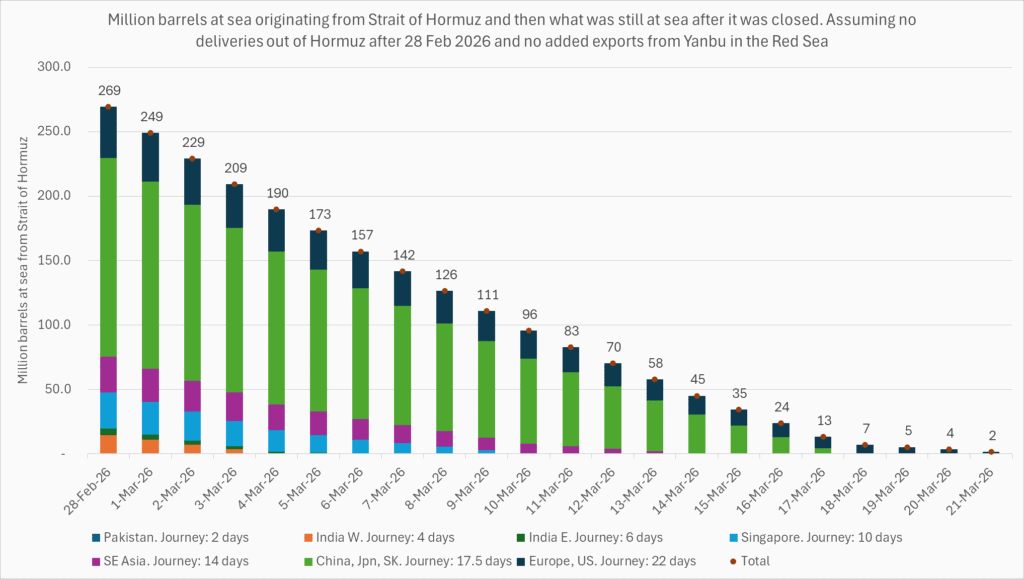
Oil at sea is falling fast as oil is delivered without any new refill in the Persian Gulf. Waivers for Russian crude is also shifting Russian crude to consumers. Brent crude will likely start to feel the pinch much more forcefully when oil at sea is drawn down another 200 mb to around 1000 mb. That is not much more than 10 days from here.
Oil and oil products are starting to become very pricy many places. Brent crude has still been shielded from spiking like the others.
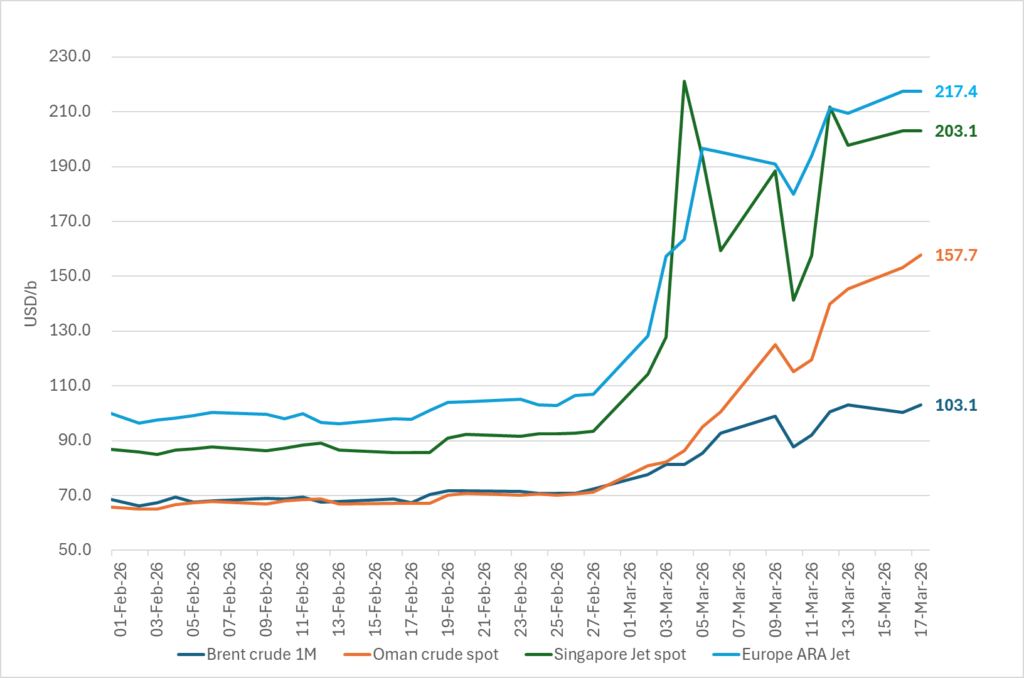



Market Still Betting on Timely Resolution, But Each Day Raises Shortage Risk

Christian Kopfer om läget för oljan

Marknaden måste börja betrakta de höga kopparpriserna som det nya normala

Det fysiska spotpriset på brentolja har slagit nytt rekord

40 minuter med Javier Blas om hur världen verkligen påverkas av energikrisen
40 minuter med Javier Blas om hur världen verkligen påverkas av energikrisen

Elpriserna fördubblas, stor osäkerhet inför sommaren

MP Materials, USA:s svar på Kinas dominans över sällsynta jordartsmetaller
Det fysiska spotpriset på brentolja har slagit nytt rekord

Studsvik har idag ansökt om att få bygga 1200-1600 MW kärnkraft i Valdemarsvik
-
 Nyheter3 veckor sedan
40 minuter med Javier Blas om hur världen verkligen påverkas av energikrisen
-
 Nyheter4 veckor sedan
Elpriserna fördubblas, stor osäkerhet inför sommaren
-
 Nyheter4 veckor sedan
MP Materials, USA:s svar på Kinas dominans över sällsynta jordartsmetaller
-
 Nyheter2 veckor sedan
Det fysiska spotpriset på brentolja har slagit nytt rekord
-
 Nyheter4 veckor sedan
Studsvik har idag ansökt om att få bygga 1200-1600 MW kärnkraft i Valdemarsvik
-
 Nyheter2 veckor sedan
Marknaden måste börja betrakta de höga kopparpriserna som det nya normala
-
Analys4 veckor sedan
TACO (or Whatever It Was) Sends Oil Lower — Iran Keeps Choking Hormuz
-

 Nyheter4 veckor sedan
Matproduktion är beroende av gödsel, Gulfkriget skapar brist