

Analys
SHB Råvarubrevet 21mars 2014

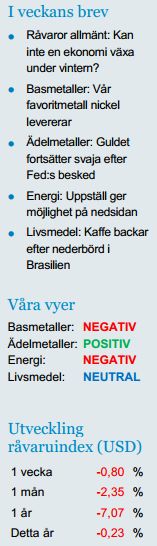
Råvaror allmänt: Kan inte en ekonomi växa under vintern?
 Debatten fortsätter huruvida den senaste data strömmen från USA enbart varit dålig på grund av den kalla vintern. Om så är fallet bör det komma en ketchup effekt i marsdata då ett uppdämt behov av byggande och shoppande nu borde försiggå i USA i den uppiggande vårsolen.
Vi är oroliga för att det också kan ligga ett inslag av sämre konjunktur med i databilden. Den skulle i så fall härstamma från neddragningen av QE och stämma väl överrens med hur marknaden har betett sig de senaste tre åren då amerikanska makrodata har börjat åren dåligt som ett led i hur QE stimulanserna har lanserats. Marknaden fortsätter prisa in en ketchupeffekt och vi konstaterar att när investerare och ekonomer är så entydiga så stiger riskerna. Fed lämnade räntebesked under veckan och med viss dramatik flaggade man för avslutade stimulanser och påbörjad räntehöjning klart tidigare än marknaden väntade sig. Det fick guldet tillfälligt på fall men vi ändrar inte vår nuvarande positiva syn på guld på grund av det.
Situationen i Kina har förbättrats något under veckan då Li har varit ute och pratat om att driva på vissa byggprojekt, klassisk retorik från kinas ledare när tillväxtindikatorer har fallit till farligt låga nivåer. Ytterligare konkurser ligger dock i korten men marknaden hanterar dem bra. Koppar konsolideras under veckan efter raset och letar ny väg beroende på hur kinasituationen utvecklas. Under helgen kommer HSBC preliminära inköpschefsindex för Kina som under 4 av de senaste 4 åren studsat upp under mars och april som är intensiva perioder i Kinas tillverkningsindustri. Om vi inte får en högre siffra än i februari (48,5) är det ett mycket svagt tecken.
Basmetaller: Vår favoritmetall nickel levererar
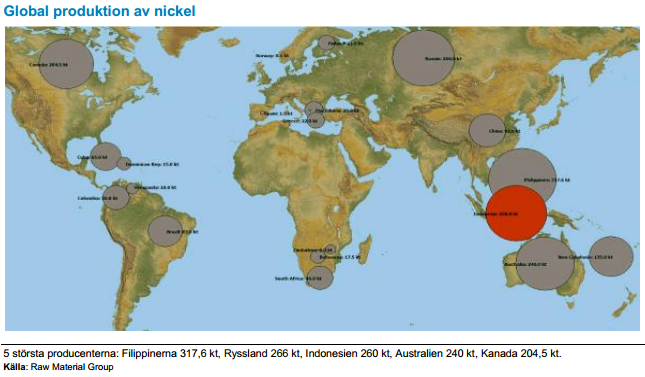
Nickel är den metall som klarat sig klart bäst under året, upp nästan 15 % hittills (10 % under marsmånad) medan koppar, aluminium och zink samtliga backat. Indonesiens exportstopp som trädde i kraft vid årsskiftet är givetvis en bidragande orsak men även senaste tidens oroligheter kring Ryssland sätter sina spår även i nickelpriset. Ryssland står för stor del av den globala produktionen av nickel, 266 000 ton per år och oron stiger nu för eventuella sanktioner vilket skulle slå hårt mot utbudet av metallen. Att priset stiger i en miljö där övriga metaller försvagas tyder på styrka och vi fortsätter att hålla nickel som köpvärd även om vi är negativa till sektorn som helhet.
Koppar å andra sidan fortsätter att se svag ut och kan komma att behöva ett nytt smeknamn – Dr Koppar har tidigare setts som indikator för vart konjunkturen är på väg. Nu faller priset på metallen samtidigt som konjunkturprognoser visar på ljusare tider. De senaste 16 kvartalen har kopparpriset och globala BNP rört sig åt samma håll endast 6 gånger. Koppar är under strukturell press då utbudet växer fortare än efterfrågan och vi tror fortsatt på en svag utveckling.
Låga prisnivåer, exportstopp av oförädlad nickelmalm från Indonesien och det faktum att 40 % av gruvorna går med förlust på dagens prisnivå. Vi tror på: LONG NICKEL H
Ädelmetaller: Guldet fortsätter svaja efter Fed:s besked
Generell brist på reaktioner efter söndagens folkomröstning på Krim satte press på guldet redan i början av veckan, efter att det stängt fredagen på den högsta nivån sedan början av september förra året. Det är rimligt att anta att fredagens starka prisutveckling berodde på oro inför just folkomröstningen och dess resultat. Veckans stora nyhet var annars nya Fed-chefen Janet Yellen hökaktiga besked på onsdagskvällen, något som satte ytterligare press på nedåt på guldet. Just denna effekt är nog att betrakta som viktigare för guldet den närmaste tiden. Amerikanska räntor har stigit rejält sedan Fed-beskedet, och stigande räntor (=stigande alternativkostnad för att äga guld) är en negativ faktor för guldet.
Klarar guldpriset att återta sin upptrend trots stigande amerikanska räntor ser vi det som väldigt positivt. Om vi mäter prisrörelsen rensat för förra fredagens uppgång inför omröstningen på Krim så har guldet tappat drygt två procent (drygt tre procent från fredagens stängning), vilket måste beskrivas som än väldigt modest reaktion. Vi bibehåller därmed vår positiva syn på guld, men observerar den närmaste tidens prisrörelser väldigt noga.
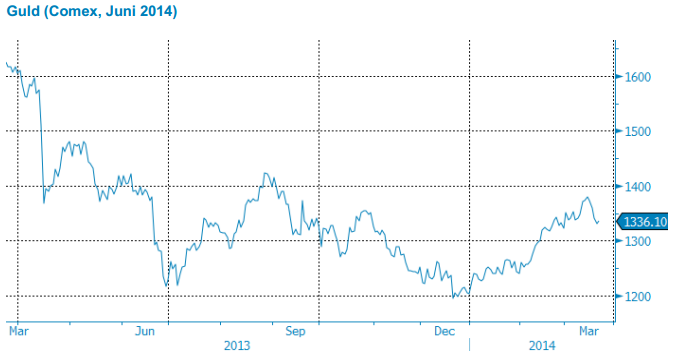
Efter en lång tid av negativ vy för guldet har vi bytt fot och tror på stigande pris. Vi tror på: LONG GULD H
Energi: Uppställ ger möjlighet på nedsidan
Vi har mot slutet av veckan haft en kraftig uppgång på elmarknaden och de korta kontrakten. Kvartalet Q214 (som är underliggande för våra investeringsprodukter på elmarknaden) har stigit närmare 8 procent under veckan som ett resultat av väderomslag och vi är nu tillbaka på de prisnivåer som handlades under början av mars. Efter en period med väldigt mycket nederbörd ser vi nu torrare prognoser som domineras av högtryck från öst. När såväl energikol, utsläppsrätter, och gas handlas relativt oförändrat samtidigt som kärnkraften går som den skall tenderar marknaden bli väldigt väderstyrd. När en prognos som tidigare visat på extremt mycket nederbörd och där de våta dagarna försvinner i framkant, en förändring på 4-5 TWh som i detta fall, ja då är det klart att marknaden reagerar extra mycket.
Det finns väl anledning att tro att en del stoppar nu tagits som vi skrev om i förra brevet då marknaden varit väldigt kort. Vi har sett en del tendenser till lågtrycksintrång och att detta torra scenario inte håller i sig varför vi bör se en fallande trend efter helgen.
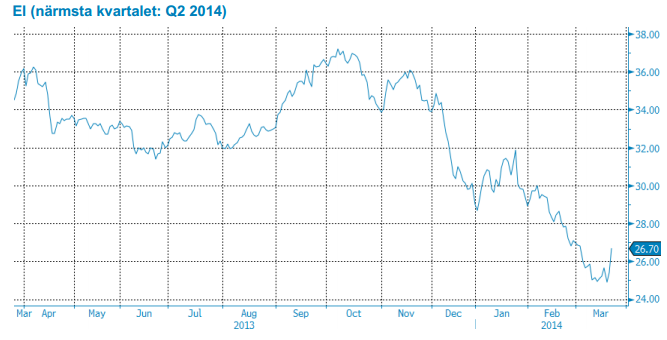
Vi tror att det kommer ges möjligheter till god avkastning i denna range-baserade handel. Vi tror på: SHRT OLJA H
Livsmedel: Kaffe backar efter nederbörd i Brasilien
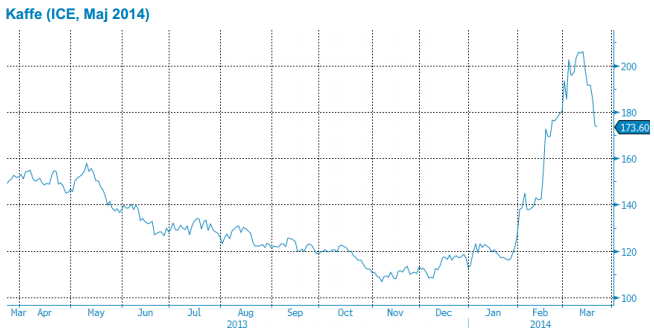
Under veckan har terminspriserna på kaffe backat med hela 15 procent från årshögsta efter vinsthemtagningar och rapporter om regn i de värst drabbade kafferegionerna. Uppgången har varit makalöst, en uppgång på drygt 80 procent i år efter en längre period av uteblivet regn. En kallfront är på väg in och mer nederbörd väntas till helgen i Minas Gerais, Brasiliens viktigaste kafferegion. Kvalitén på skörden ser ut att vara allt från god till mycket god i de södra delarna medan de norra regionerna ser ut att ha drabbats hårdare. Man räknar därför med stora variationer på kvalitén från de olika regionerna. Vi är nöjda med våra prognoser hittills och väljer en neutral vy framöver. Vi tror dock på fortsatt hög volatilitet i råvaran i väntan på estimatsiffror efter regnperioden.
För tillfället påverkas vetepriserna mest av vädret för det amerikanska vetet och situationen i Ukraina. I övrigt finns inga större odlingsrelaterade problem världen över. Vad gäller Ukrainas export så är det främst majsen som kan komma att påverkas, landet har inte mycket mer vete kvar att exportera. Vi är kvar i tron om att uppgången vi sett den senaste tiden bör ses som ett bra säljtillfälle. Prognoserna pekar på stora kommande skördar och mer kortsiktigt bör även en minskad efterfrågan kunna påverka priset negativt – stora importländer som Egypten och Iran startar snart den egna skörden vilket bör minska importbehovet.
Vi tror på kakao då varmare och torrare klimat över normalen väntas i samband med El Nino. Vi tror på: LONG KAKAO H
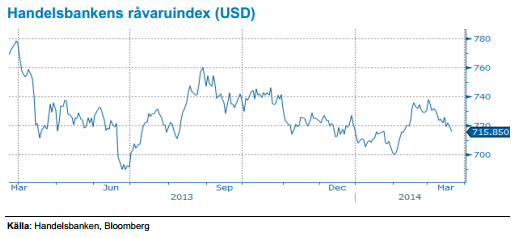
Handelsbankens råvaruindex
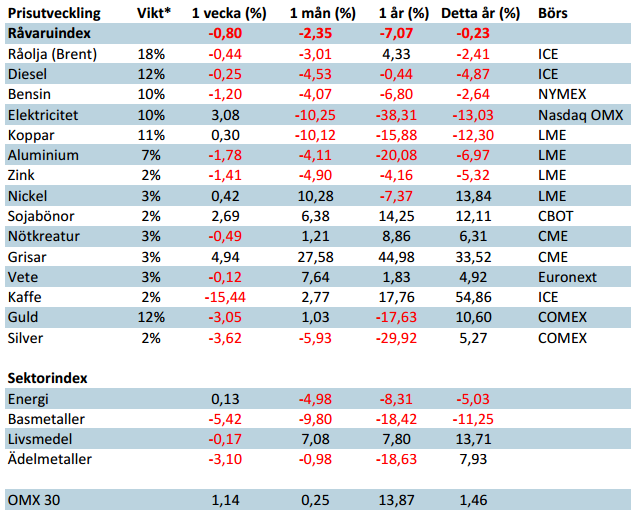
*Uppdaterade vikter från 29 november 2013
Handelsbankens råvaruindex består av de underliggande indexen för respektive råvara. Vikterna är bestämda till hälften från värdet av nordisk produktion (globala produktionen för sektorindex) och till hälften från likviditeten i terminskontrakten.
[box]SHB Råvarubrevet är producerat av Handelsbanken och publiceras i samarbete och med tillstånd på Råvarumarknaden.se[/box]
Ansvarsbegränsning
Detta material är producerat av Svenska Handelsbanken AB (publ) i fortsättningen kallad Handelsbanken. De som arbetar med innehållet är inte analytiker och materialet är inte oberoende investeringsanalys. Innehållet är uteslutande avsett för kunder i Sverige. Syftet är att ge en allmän information till Handelsbankens kunder och utgör inte ett personligt investeringsråd eller en personlig rekommendation. Informationen ska inte ensamt utgöra underlag för investeringsbeslut. Kunder bör inhämta råd från sina rådgivare och basera sina investeringsbeslut utifrån egen erfarenhet.
Informationen i materialet kan ändras och också avvika från de åsikter som uttrycks i oberoende investeringsanalyser från Handelsbanken. Informationen grundar sig på allmänt tillgänglig information och är hämtad från källor som bedöms som tillförlitliga, men riktigheten kan inte garanteras och informationen kan vara ofullständig eller nedkortad. Ingen del av förslaget får reproduceras eller distribueras till någon annan person utan att Handelsbanken dessförinnan lämnat sitt skriftliga medgivande. Handelsbanken ansvarar inte för att materialet används på ett sätt som strider mot förbudet mot vidarebefordran eller offentliggörs i strid med bankens regler.


Brent higher last week and today as fresh attacks by Iran and the Houthis shattered a sense of temporary normality exports from the Persian Gulf. Brent crude traded in a range of $97.06 – 105.92/b and closed the week at $104.72/b. The Brent Dec contract gained $2.47/b on the week. Fresh attacks by Iran on ships in the Gulf and the SoH probably reduced exports of oil through the SoH last week. Exports from the Persian Gulf had reached close to normal levels in the second half of September and into early October. This has led to a large increase in oil on water globally which has helped to ease and reduce November and December prices over the past month. The sense of some kind of normality of exports from the SoH was shattered last week. Fresh attacks by the Houthis on Saudi Arabia added to this and helped to lift prices. It is well known that the US and its allies in the Gulf are running low on defensive rockets. Hard choices over what to defend will increasingly have to be made: Oil infrastructure, military installations, royal palaces, civilian airports or other. The US will also have to decide how many defensive rockets it can provide to its ME allies versus what it needs for its own defenses. Ukraine is at least not getting any of these defensive rockets however much needed for defense against a continuous barrage of Russian attacks on Ukraine. The front-month ICE Gasoil 10ppm (essentially ULSFO Diesel) is down 3.8% this morning (due to Trump’s diesel charade) to $1427/ton ($191/b) which is where it traded last Thursday.

Trump’s diesel charade. The site ”535” now puts the probability for control of the US Congress and Senate following the midterm elections at 99% and 61% respectively. Trump’s war in the Middle East with high or record high gasoline and diesel prices at the pump in the US is largely to blame. Trump’s diesel deal with Russia is clearly Trump trying to shift the blame from his own war in the ME to Ukraine instead. He could of course have placed the blame on Putin and Russia for its war against Ukraine, but no, it is Ukraine who gets the blame and not the least Zelenskyy. Physically it is of course correct that it is Ukraine who is destroying Russian refineries to the point where 45% of Russian refineries are out of operation. The result is that there is too little gasoline for domestic Russian consumption and no diesel, VGO and Jet fuel left over for exports. Russia normally (pre-war 2022) exports some 1.3-1.4 mb/d of diesel products of which a lot used to go to Europe.
Russia/Putin would happily export diesel products to the world, but it can’t because Ukraine is destroying its refineries. Russia implemented export restrictions of diesel already in July this year and the plan was to extend that to early 2027.
The only way that Putin/Russia can start sustained diesel exports, is if Trump is able to discipline and prevent Ukraine from attacking and destroying Russian refineries. Then Russian refineries can be repaired, ramp up, produce more diesel and potentially export what ever is of surplus to the world. Trump has threatened Ukraine that if it doesn’t stop its attacks on Russian refineries, then there will be no more indirect sales of weapons from the US via Europe to Ukraine and the intelligence which US currently is providing to Ukraine will stop.
It is clear that if Russia stops its attacks on Ukraine, then Ukraine is prepared for a energy infrastructure cease-fire.
Trump very well knows that he has himself to blame for the terrible stats for the upcoming midterm elections where Republicans looks set to lose both the Senate and the House. This is a charade for the US public to shift the blame over to something or someone else than himself. His easy choice falls on Ukraine and Zelenskyy for which he has shown little love, affection and support. Nothing of the one way bromance which Trump has shown versus Putin.
At most a three-week holdup in Ukrainian attacks on Russian refineries. Ukraine accepting to play scapegoat. Ukraine’s attacks on Russian refineries and oil infrastructure is a key element of Ukraine fighting back and defending itself against Russia. Ukraine has no choice but to continue its attacks as long as Russia keeps attacking Ukraine. But maybe there can be a three week holdup where Ukraine is forced by the US to step down its attacks on Russian refineries to please Trump until the US midterm elections are behind us. I.e. Ukraine accepting to be the scapegoat for Trump’s missteps in the Middle East for a three week period. Thereafter it will revert back to well thought out strategy of attacking Russian oil and refinery installations.
Trump under increasing pressure as there is increasing probability for Democratic victory in US midterm elections. Desperate times and desperate measures from Trump as a result. More to come

Large increase in oil on water heading for consumers around the world following a sharp increase in exports of oil from the Persian Gulf to close to normal from mid-Sep. Lower exports last week after new hostilities most likely.

Crude, products and natural gas prices in USD/boe. ICE gasoil slightly lower today, but still $195/b

Last week’s oil price action distorted by rolling of the November contract last week. The December Brent crude oil contract rose $4.8/b, or 5% last week. Much of that gain was due to the roll-yield as the November contract rolled off as the M1 contract to be replaced by the Dec-26 contract. The backwardation between the Nov and the Dec contract averaged $6.5/b over the last three days before 1 October and the rolling of contract. The ”gain” over the week was thus not much of a gain at all. If we just look at the M1 contract it instead fell 2% Friday to Friday though that disguises the change in the underlying contract over the week. The Brent M1 contract closed the week at $102.25/b. The announcement of 100 mb of oil from G7 SPR helped to ease prices at the end of last week. Though that effect seems to have faded today.
More barrels from Strategic Petroleum Reserves or really barrels which were supposed to be released previously? Nonetheless, Trump seems to be content and is backing down from diesel export ban. Trump threatened the world, but especially Europe with a US diesel export ban unless Europe agreed to release diesel from strategic reserves. G7 last week decided to release 100 million barrels of oil from strategic reserves. But here the obscurity starts. How much of that will be diesel? ”Substantial release of diesel within 20 days” was the statement. If it happens late in this 20 day period, it would bring us very close to the US midterm elections which of course is what Trump is worried about here. IEA members promised to release 425 mb of oil from strategic reserves of which 125 mb was to be oil products. But a significant portion of that was never really released. The question is thus whether these ”new” 100 mb release will really be new or if the lion’s share of the ”new” 100 mb is really just part of the old 425 not yet fully released. Well, it looks like the promise, irrespectively what it really is, has averted a US diesel export ban for now. And it did also help to ease prices a bit at the end of last week. An effect which looks like it has mostly faded this Monday.
$140/b is the price of crude oil in Europe today. Back to the complete distortion of oil and product prices in time and geography. The Dated Brent ”spot” price averaged $123.3/b last week. But that is really the average Day_10 to Day_20 of the ”daily Dated Brent” forward curve. But since this curve is in very steep backwardation, the real prices for physical oil cargoes at the very front-end of this daily curve sits well above the average of this daily curve. The physical premiums for Oseberg and for Fortis crude takes this steep backwardation into account. The full price average for Oseberg and Fortis last week were thus $142.5/b and $140.2/b. That is way, way higher than both the Dated Brent ”spot” price last week and the average of the Brent futures price, the M1 contract, which averaged $103.2/b last week and is trading at $102.4/b
Extreme prompt tightness may fade or get much worse. The extreme prompt tightness and backwardation we see in the market today is a display of today’s prompt situation and not necessarily a guide for the future. The much more relaxed Brent M1 contract (today December) at $102.4/b is maybe a reflection of an oil market either betting or expecting that today’s problems will be resolved somehow over the coming three months. Or, that the current flow of oil out of the SoH at 17.5 mb/d (close to normal) will be sustained or even increase over time. But we don’t know exactly why the flow of crude, products and LNG out of the SoH has been able to sustain at around 17.5 mb/d since mid-September (it seems). Is it because shippers are better at managing the risk or more willing to take the risk of transiting? Is it because the US military assistance is better? Or is it because Iran is paid by exporters and is allowing exports out through the SoH? It seems plausible that Iran expects the US to attack again after the US midterm elections. If so, then Iran may engage with fresh attacks before that date. Physical crude in Europe today is $140/b, or 2x the ”normal” price of $70/b. But if tightness escalates further, then price of crude in Europe could go to 3x, 4x or even 5x the normal level. Let’s hope that the US is able to keep the SoH ”open” at a rate of 17.5 mb/d and that another 100 mb of oil from G7 helps to shield against that upside risk.
The global oil-stock cushion is getting ”scarily thin”. Looking at the Brent M1 Dec-26 contract, one gets the impression that risks may be fairly contained. Looking at physical spot prices in Europe however of around $140/b, the sense of stress rises substantially. The latter better reflects Amin Nasser, CEO of Saudi Aramco, when he recently said that the cushion capacity of global oil stocks are getting ”scarily thin”.
Some key questions helping to keep the Brent M1 price above $100/b: Will Iran initiate fresh attacks before the US midterm elections? Will the US attack Iran after the elections? Will the US be able to keep the SoH close to open at 17.5 mb/d? Will the Houthis re-attack the Saudi east-west pipeline and ships trying to traverse the Bab-el Mandeb Strait as the Saudi-backed Yemen government tries to retake areas along the Red Sea recently taken by the Houthis? How far will this have to go before China finally decides to step in as a peacemaker in ME negotiations?
ARA Crude oil, diesel and nat gas prices in USD/boe

Physical crude oil premiums for Fortis and Oseberg in the NSea in USD/b premium over the Dated Brent index

Spot crude oil prices at very high levels. The Brent 1M (November) contract yesterday traded between $103.76 – 108.83/b before settling the day at $105.28/b. This morning it is trading up 1.4% to $106.8/b. That is not much of a price given that the ME crisis has been ongoing since 28 February. The Dated Brent spot price however settled yesterday at $123.78/b and averaged $120.6/b last week. Even stronger were the individual North Sea spot crude prices where Johan Sverdrup crude averaged $144/b from 21 to 24 September. And Johan Castberg was said to have traded at a premium of $32/b to the Dated Brent price last week which potentially would have placed it closer to $150/b.
A steady trend higher since $70/b in early July. Crude oil prices have been on a steady trend upwards since they bottomed out at around $70/b in early July following the discharge of some 200 million barrels of crude, products and liquids from the Persian Gulf during a two week MoU window. from 20 June to 7 July when hostilities again resumed.
The oil market today is split apart in time, space and molecules. Financial crude oil prices for November delivery are trading at $106/b (Brent) and $93.3/b (US WTI) and $107/b (Oman). But spot crude oil prices are much higher at $120-150/b as described above. But consumers do not consume crude oil, they consume diesel and gasoline and other products. And diesel prices are closer to $200/b in ARA due to destruction of Russian refineries and locked-in refineries in the Persian Gulf. Oil markets are very stressed with respect to products, but not so stressed with respect to crude oil. But refineries are eager to pay up for crude deliveries right here and now so they can convert that crude to products and make a killing profit. They are not willing to pay up for November crude deliveries in the same way as uncertainties on the Middle East situation is so high. Exorbitantly expensive VLCC freight rates is also driving prices apart. VLCC freight rates are today running at 500,000 to 1,000,000 dollar a day rather than the normal 20,000 a day. This typically adds $10-20/b for crude oil between the point of origin and the point of delivery some 30-50 days out in time when the crude is delivered. This creates a lot of confusion of what really is the price of crude oil these days. Prices are very different in time and space.
Bonds and equity markets are starting to feel the heat. The Middle East crisis is starting to feed risk and pain into financial markets where the US 10-year rate is rising along with crude and product prices with equity market indices starting to pull back in response.
The risk is rising that the ”Trump war” in the Middle East may lead to the ”Trump recession”. A legacy Trump would not likely want to have. Feed-through to financial markets, rising risks for US financial and economic recession, rising risk to Trump’s legacy, declining US stocks of Patriot and THAAD rockets could be forcing mechanisms towards a resolution of the Middle East crisis.
A picture of the future Middle East order is starting to emerge. There seems to be a lot of discussions between different parties going on and a picture of a new Middle East order is starting to emerge. A post Middle East pax Americana order. Where the different countries in the Middle East are taking much more responsibility for the security order in the region. The US provides intelligence and sell weapons to the region but is reducing its military presence. Iran is recognized as a regional power, but not the dominant one and is part of the security order in some ways. Trump can say that he reshaped the Middle East order. Exports of oil restored. The region now paying for its own defense. US soldiers pulled out to a minimum. China part of the diplomatic solution and taking some responsibility for keeping Iran in check.
Time to some kind of ME resolution? Forcing mechanisms: Declining stocks of defensive US rockets + rising crude and product prices + rising economic and financial pain and rising risk to Trump’s legacy. A window of resolution could be November to January maybe. Markets will likely increasingly price in a resolution as the picture of the future security order in the Middle East emerges further.
Crude and diesel prices in USD/b

European M1 refinery margins at record high.





The Trump diesel charade

Viscariagruvan får strategisk status av EU

Miljöpartiet i England slutar vara motståndare till kärnkraft
The price of crude oil in Europe today is $140/b

Kanada vill få fart på oljesanden igen

År 2035 kan datacenter i USA förbruka mer naturgas än Japan och Tyskland tillsammans

Varför det en gång så mäktiga OPEC förlorar inflytande
Kanada vill få fart på oljesanden igen
Oil prices are rising, but a picture of the future ME order may start to emerge
Viscariagruvan får strategisk status av EU
-
 Nyheter3 veckor sedan
År 2035 kan datacenter i USA förbruka mer naturgas än Japan och Tyskland tillsammans
-
 Nyheter4 veckor sedan
Varför det en gång så mäktiga OPEC förlorar inflytande
-
 Nyheter2 veckor sedan
Kanada vill få fart på oljesanden igen
-
Analys2 veckor sedan
Oil prices are rising, but a picture of the future ME order may start to emerge
-
 Nyheter5 dagar sedan
Viscariagruvan får strategisk status av EU
-
 Nyheter1 vecka sedan
Miljöpartiet i England slutar vara motståndare till kärnkraft
-
Analys1 vecka sedan
The price of crude oil in Europe today is $140/b
-
Analys1 dag sedan
The Trump diesel charade