

Nyheter
David Hargreaves on precious metals, week 47 2011

David Hargreaves
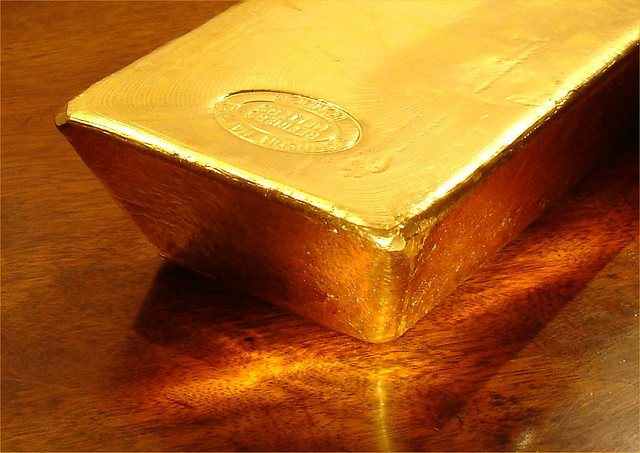
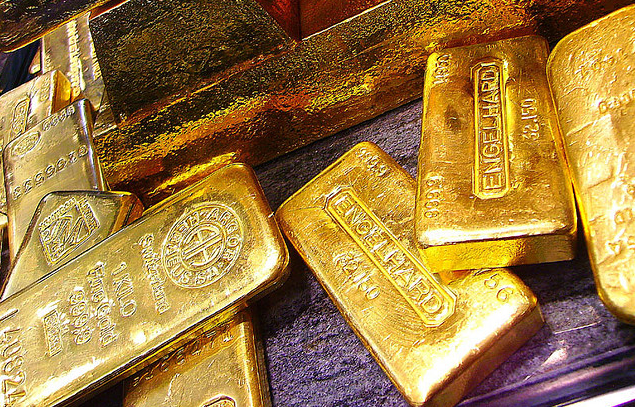
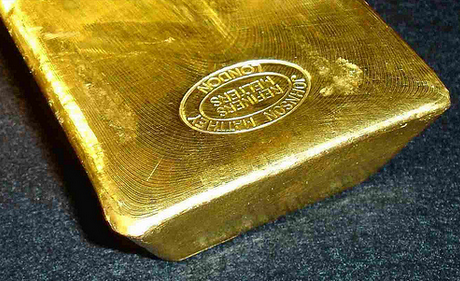
Can demand rise yet the price fall? Sure can. We have been warning for some time that in a severe recession the flight into tangibles will be halted because people will not be able to afford them. So platinum and silver, very much the industrial components of the precious metals trio, are already feeling the strain.
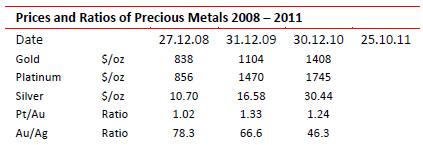
What does it signify? That what goes up might just come down. All three metals are already well below their 2011 highs and platinum is in surplus. The flight from currencies has been the driver for all three above, but a realisation is surely dawning: there is no alternative to the US dollar in volume. We have:

Whilst the EU/Eurozone one is normally the strongest bloc, it is currently struggling to stay alive and would hardly put itself up as the world reserve currency right now. China is wisely content to maintain a fixed parity to the dollar. The others do not have the volume singly and the possibility of their combining is non-existent. So George Washington it is. Now a strong dollar rarely betokens strong gold. So let’s beware the runaway prophets. Not that this will necessarily stop them, GFMS, no less, says investment demand will push silver over $50/oz by late 2012. So far this year it has been a not-soshabby $36. It admits there will be a production – to – consumption surplus, but investment will take up the slack. It forecasts 278Moz from that sector in 2011. Other commentators warn that silver’s very volatility holds its back. It topped $50/oz earlier this year yet slid over $20 in one trading hit. Not good for the digestion.
India should buy more gold. The inhabitants of the world’s second most populous country (it will overtake China soon) are very fond of gold. They took $11bn worth in Q3 2011, level with China and 27% of world total. But not so it’s Central Bank. It has told the Government to buy more. There is certainly scope. To perspectivise it: National stocks stand at 558 tonnes, less than 2% of world bank holdings. For almost 20% of the world’s population that is hardly flying the flag now is it? Even China has almost double that whilst the USA wallows in over 8000 tonnes. Meanwhile India’s Rupee has fallen massively against the dollar and it now at its lowest for 32 months.
Europe and Gold. Is it indicative that Europe bought more gold than either the US or China last year? It is hard to lay that at the doorstop of anything other than the Euro crisis. But with belt tightening its only choice we cannot see the trend continuing; bar a currency collapse, of course.
Shares versus Bullion? Only the market will answer the plaintive call for a rerating of gold shares relative to the gold price. So heavyweights like Soros and John Poulson are buying the stocks. Just one teensy problem, would you buy a share when its underlying commodity might go down as easily as go up? Historically, the boys have a case.
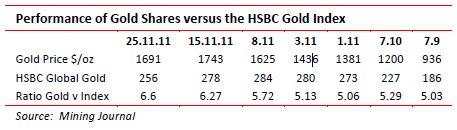
The trend is not dramatic but obvious. The current price level for gold is not trusted. Dividend growth is not keeping pace with earnings and even learner ore grades are being pursued.
Central Bank Buying. WGC tells us the national banks bought c. 150 tonnes of gold in Q3 2011 but nobody knows which ones. Clearly only those who can afford it, by virtue of their FOREX reserves. Top of the pops is China, with $3.2 x 10¹².
Before we get excited, that would buy them about 600 tonnes, to bring their total to c. 1700 tonnes, or a half of what Germany holds and about a fifth of Fort Knox levels. It would also curtail their shopping trips to Africa. Nor might it provide the insurance cover many think that brings. Portugal (the P in P11GS) has 82% of its foreign reserves in gold but has just had its government bonds reduced to junk status. Christmas has come early to India. Beside ATMA dispersing little bars of bullion they now throw out diamond jewellery. It will be interesting to learn what the buyback arrangements are.
[hr]
About David Hargreaves
David Hargreaves is a mining engineer with over forty years of senior experience in the industry. After qualifying in coal mining he worked in the iron ore mines of Quebec and Northwest Ontario before diversifying into other bulk minerals including bauxite. He was Head of Research for stockbrokers James Capel in London from 1974 to 1977 and voted Mining Analyst of the year on three successive occasions.
Since forming his own metals broking and research company in 1977, he has successfully promoted and been a director of several public companies. He currently writes “The Week in Mining”, an incisive review of world mining events, for stockbrokers WH Ireland. David’s research pays particular attention to steel via the iron ore and coal supply industries. He is a Chartered Mining Engineer, Fellow of the Geological Society and the Institute of Mining, Minerals and Materials, and a Member of the Royal Institution. His textbook, “The World Index of Resources and Population” accurately predicted the exponential rise in demand for steel industry products.


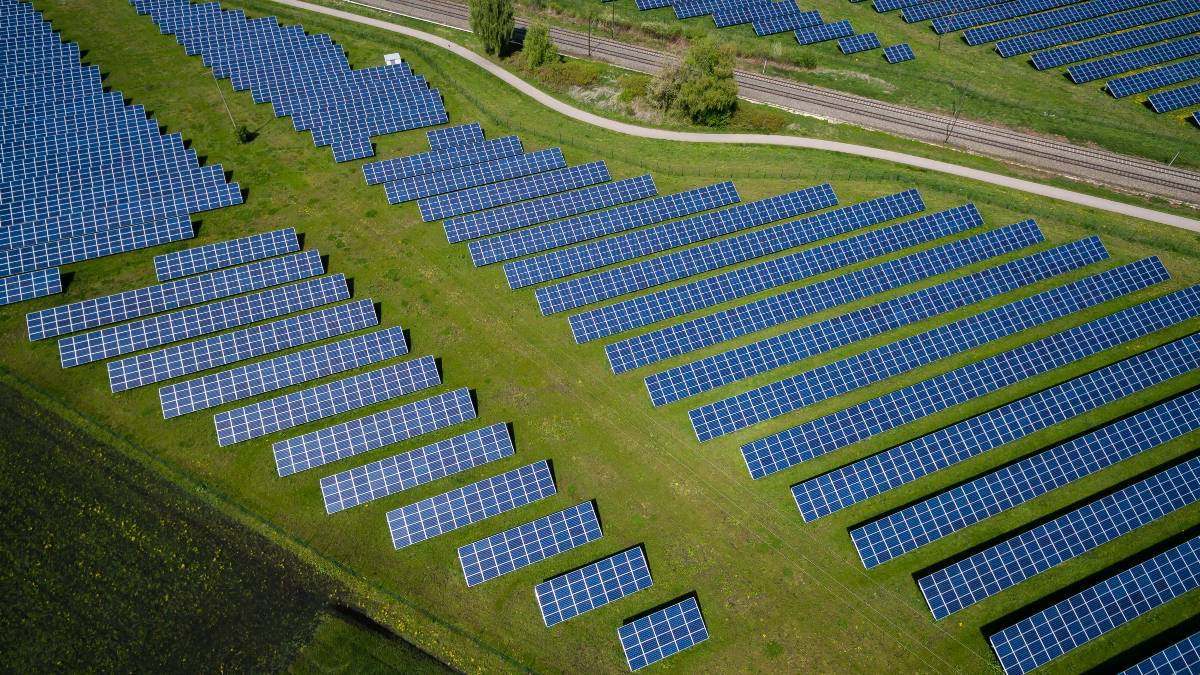
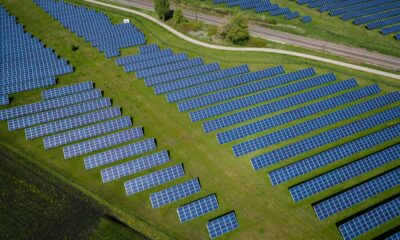
Snabba väderomslag har präglat elmarknaden i april, med både prisfall och pristoppar som följd. Samtidigt får solkraften allt större påverkan och pressar ner elpriserna, särskilt i södra Sverige.
Månadsmedelpriset för april på den nordiska elbörsen Nord Pool utan påslag och exklusive moms blev 58,66 öre/kWh i elområde 3, södra Mellansverige, och 22,75 öre/kWh i elområde 1, norra Sverige. På kontinenten syns den så kallade ankkurvan tydligt.
– Nu är solen helt klart på gång. I Tyskland har solen under april producerat nästan 2 TWh mer än ifjol vilket även gynnar oss i Sverige. Ankkurvefenomenet innebär att elpriset är lågt mitt på dagen och stiger raskt mot kvällen. Under perioder med soligt och varmare vårväder är solen ett välkommet inslag här hemma och det påverkar elpriserna nedåt. Den ökar produktionen och minskar konsumtionen, säger Jonas Stenbeck, privatkundschef på Vattenfall Försäljning.
De årliga, planerade underhållsarbetena på kärnkraftverken pågår, vilket innebär att den tillgängliga kapaciteten just nu är cirka 60 procent. Vinden var varierande under april, med snabba skiften mellan stilla och blåsiga perioder, vilket märktes på elpriset.
Den hydrologiska balansen i Norden, alltså det sammanlagda vatteninnehållet i snö, mark och magasin, är svag med betydande underskott i södra Norge. Men magasinsnivåerna i Sverige ligger kring normala nivåer för årstiden och har börjat fyllas på.
– Dock förväntas årets vårflod att, givet dagens förutsättningar, bli lägre än normalt då snötäcket är avsevärt mindre än vanliga nivåer. Vädret kommer avgöra hur väl vårfloden fyller magasinen inför sommaren, säger Jonas Stenbeck.
De höga gaspriserna har fallit något, samtidigt som stigande temperaturer på kontinenten och den stora andelen solkraft haft en stabiliserande effekt. Det geopolitiska läget är dock fortsatt ett orosmoment.
– Det vi sett är att marknaden är väldigt nyhetsdriven. Beroende av vad som rapporteras så reagerar marknaden direkt. Det gör att vi befinner oss i en väldigt speciell situation eftersom denna osäkerhet skapar svängiga och oförutsägbara bränslepriser, vilket i slutändan påverkar elpriset. Jag förstår att många känner en oro men i och med att det blir varmare så kommer man inte att behöva lika mycket el, vilket ger en lägre elkostnad, säger Jonas Stenbeck.
| Medelspotpris | April 2025 | April 2026 |
| Elområde 1, Norra Sverige | 14,39 öre/kWh | 26,09 öre/kWh |
| Elområde 2, Norra Mellansverige | 14,21 öre/kWh | 26,85 öre/kWh |
| Elområde 3, Södra Mellansverige | 37,61 öre/kWh | 56,08 öre/kWh |
| Elområde 4, Södra Sverige | 58,35 öre/kWh | 66,55 öre/kWh |
*Ankkurva: Ankkurvan beskriver hur elproduktionen från förnybara energikällor, som solenergi, påverkar elnätet och elanvändningen över en dag. Kurvan har fått sitt namn eftersom grafen under en dag liknar profilen av en anka.
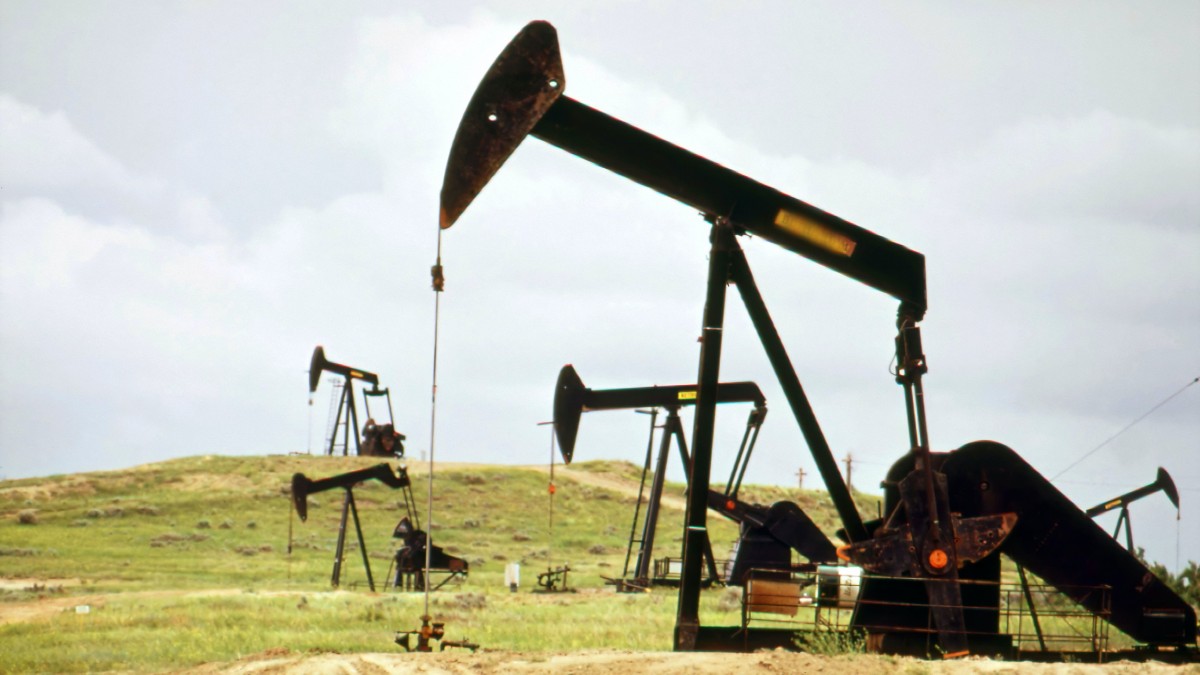
Råvaran olja handlas fortsatt över 100 USD per fat och det är något stökigt med prissättningen. Michel Gubel ger sin syn på läget för oljan, att priskurvan kan vara i contango och backwardation, samt vad som kan hända med olja på längre sikt.

Den norrländska vårfloden väntas dra igång den här veckan och pågå fram till slutet av maj. Att den är ovanligt svag i år bidrar till att elpriset i system fram till midsommar blir ungefär dubbelt så högt som under samma period i fjol. Det visar Bixias elprognos för maj och juni.

Efter en relativt dyr april väntas systempriset landa på 55 öre per kilowattimme i maj och 50 öre i juni, att jämföra med 31 respektive 21 öre förra året.
– Vi har inte haft så lite snö någon vinter sedan 2019 och det syns tydligt i vårfloden. Den prispress vi normalt sett räknar med den här tiden på året blir betydligt svagare än vanligt. Dessutom ligger bränslepriserna på en högre nivå än i fjol på grund av oron i Mellanöstern, vilket spiller över på de svenska elpriserna, säger Johan Sigvardsson, elprisanalytiker på Bixia.
Den hydrologiska balansen ligger på minus 20 terawattimmar, jämfört med ett överskott på 5–10 terawattimmar vid samma tidpunkt i fjol. Tillrinningen väntas kulminera på ungefär 7 terawattimmar per vecka i slutet av maj, långt under ett normalår.
Hur elpriserna utvecklas under resten av 2026 beror i hög grad på hur blöt sommaren blir. Terminspriset för fjärde kvartalet ligger på runt 70 öre per kilowattimme, vilket speglar marknadens oro inför hösten.
– Det krävs fyra till fem blöta veckor för att ta igen underskottet och fylla på vattenmagasinen. Det finns indikationer på att sommaren kan bli torr i mellersta och södra Skandinavien, men osäkerheten är stor. Om det blir så lär priserna stiga ytterligare, säger Johan Sigvardsson.
Elpris april–juni 2026 jämfört med utfall 2025 (öre/kWh)
| Område | Apr 2026 | Apr 2025 | Maj 2026 | Maj 2025 | Juni 2026 | Juni 2025 |
| System | 70 | 35 | 55 | 31 | 50 | 21 |
| SE1 | 27 | 14 | 27 | 14 | 23 | 3 |
| SE2 | 28 | 14 | 29 | 15 | 24 | 5 |
| SE3 | 50 | 38 | 57 | 43 | 47 | 23 |
| SE4 | 62 | 58 | 66 | 60 | 59 | 41 |



Solkraften pressar elpriserna dagtid

Michel Gubel ger sin syn på oljemarknaden
Svag vårflod dubblar elpriserna
Brent crude up USD 9/bl on the week… ”deal around the corner” narrative fades
Market Still Betting on Timely Resolution, But Each Day Raises Shortage Risk

Christian Kopfer om läget för oljan
Market Still Betting on Timely Resolution, But Each Day Raises Shortage Risk
Brent crude up USD 9/bl on the week… ”deal around the corner” narrative fades
Michel Gubel ger sin syn på oljemarknaden
Solkraften pressar elpriserna dagtid
-
 Nyheter4 veckor sedan
Christian Kopfer om läget för oljan
-
Analys3 veckor sedan
Market Still Betting on Timely Resolution, But Each Day Raises Shortage Risk
-
Analys3 veckor sedan
Brent crude up USD 9/bl on the week… ”deal around the corner” narrative fades
-
 Nyheter2 veckor sedan
Michel Gubel ger sin syn på oljemarknaden
-
 Nyheter2 veckor sedan
Solkraften pressar elpriserna dagtid
-
Nyheter2 veckor sedan
Svag vårflod dubblar elpriserna