

Analys
SHB Råvarubrevet 18 november 2011

 Ytterligare upptrappning av skuldkrisen i Europa har lett till en kraftig av riskaversion vilket pressat råvarupriserna på bred front denna vecka. Brentolja exempelvis tappade 5 procent för att mot slutet av veckan återhämta sig något. Vikande lager på oljeprodukter, amerikanska destillatlager föll för 8e veckan i rad och är nu under historiskt snitt, har varit bidragande till en kraftig riskpremie på olja men vi ser nu att efterfrågan minskar i snabbare takt än lagernivåerna och det är inte omöjligt att vi sakta rör oss ned och testar 100 dollar nivån på brent innan årsskiftet. Vårt råvaruindex har tappat lite drygt 1.5 procent och är nu ned 0.66 procent på året.
På elmarknaden har de flesta faktorer verkat för nedsidan de senaste dagarna och närmaste kvartalet Q1 2012 har tappat 4.7 procent. Såväl fossila bränslen som väderlek har givit stöd åt säljarna och ser vi till väderprognoserna förväntas det vara blött och milt även under den kommande veckan. Senaste 10-dagars prognoser visar på nederbörd om upp till hela 9 TWh och ett temperaturöverskott om 3.3 grader. Det är för perioden bearish och spotpriset kan under dessa premisser inte stiga. Däremot tror vi att det mesta av överskottet nu skall vara diskonterat för så ett eventuellt väderomslag (även om det inför helgen inte verkar sannolikt i någon av de väderkörningar vi sett) kan ge en intressant öppning på uppsidan.
Metaller
LME index föll tillbaka 3 procent och en stark dollar bidrar till nedgången. Koppar finner nu stöd från ett starkt köpintresse på den fysiska marknaden. Lagren fortsätter att minska där LME lagren fallit med närmare 15 procent de senaste sex veckorna, även Shanghai lagren är ned. Intressanta dagar framöver vad gäller de fysiska premierna då de ledande gruvbolagen är i Asien för att förhandla premierna på den fysiska marknaden. Zink är en metall som kan komma att stiga nästa år. Kinesiska analyshuset Antaike räknar med att vi går från ett överskott till underskott av Zink under 2012 varpå Kina måste importera mer och ta från dagens höga lager. På kort sikt ser det dock ut som vi får räkna med sidledes rörelser på zinkmarknaden.
Gapet mellan marginalkostnaden för produktion och marknadspris är alltid intressant att följa på råvaror. Om vi tittar på Koppar och Aluminium tex så handlas Koppar på 7600 dollar och, aluminium runt 2100 dollar. Det innebär att Koppar handlas ca 90 procent över marginalkostnad för produktion, medan aluminium handlas ca 16 procent under marginalkostnad. Trots detta ökar efterfrågan på aluminium ungefär dubbelt så fort. Skillnaden är en stram utbudssituation på koppar. För att kopparskall ska handla kvar på nuvarande nivåer krävs därför fortsatt höga Kinesiska importsiffror och de som tror på Kinesisk inbromsning kanske hellre väljer att hålla aluminium och liknande metaller (där olönsam högkostnadsproduktion faller bort). De som har en något mer optimistisk syn på tillväxtmarknaden föredrar istället koppar eftersom en råvara med ett stramt utbud ger en större potential. Detta gäller även för olja och gas där oljepriset drivs av en stram balans där efterfrågan viker på högre nivåer medan gasefterfrågan växer snabbare och där utbudet mer än väl matchar denna tillväxt på efterfrågan.
Annars har det varit mest fokus på järnmalm som nu återhämtat lite av höstens kraftiga fall. En tillfällig rekyl på asiatiska stålpriser under veckan har förbättrat vinstmarginalerna något för de lokala stålverken och således stabiliserat insatsråvarorna. Spotpriset på järnmalm som föll 30 procent under september och oktober har sedan början av november stigit med 25 procent igen vilket återigen visar på ett intresse att säkra upp råvaror strategiskt så fort marknaden faller för mycket (även om bortfall av indiskt material på marknaden just i det är fallet varit starkt bidragande till uppgången). Kinesiska verk som dragit ner kapacitetsutnyttjande från 715 ton (juli) till 625 ton per år annualiserat, verkar finna lönsamhet på dessa nivåer men vi tror att effekterna av de senaste månadernas överkapacitet kommer att vara kännbara för stålpriserna, framför allt i Europa, en bra bit in på nästa år. Intressant att notera att Bank of China sätter upp en enhet för finansiell järnmalmshandel inom kort vilket är positivt eftersom det starkt kommer att bidra till likviditeten och utvecklingen av denna marknad. Vår förhoppning är naturligtvis att på sikt kunna erbjuda sparprodukter kopplade till stålsektorn (stål, järnmalm, frakt och kanske tom stenkol även om det senare är på mycket längre sikt) så fort marknaden är mogen och dessa går att handla kostnadseffektivt.
I Sverige och Finland råder en gruvboom tack vare den stora efterfrågan på järnmalm och metaller och under RMGs gruvkonferens i veckan fick vi en uppdatering kring några av alla de projekt som är på gång i regionen. Aldrig tidigare har det brutis så mycket malm i Sverige vilket ger effekter på sysselsättningen i Norr. I Pajala har gruvindustrins uppgång inneburit att kommunen som tidigare haft problem med avfolkning nu drabbats av bostadsbrist. Sammanlagt investerades 675 miljoner kronor 2010 i sökandet efter metaller och mineral i Sverige och under första halvan av 2011 ökade antalet ansökningar om undersökningstillstånd med 40 procent.
I runda tal brukar man säga att bara ett av 200 undersökningstillstånd leder till en ny gruva men det visar ändå på ett fortsatt stort intresse och idag letar cirka 100 bolag malm i Sverige. Kanske också är värt att notera att det tar ca 10 år från prospektering till färdig gruva (ytterligare 1-2 år för basmetaller) så det är en enorm utmaning att få till ny kapacitet för att möta den kraftiga tillväxten på efterfrågan (Kanada har exempelvis ett underskott på 100,000 kvalificerade gruvarbetare idag). Nedan finner ni några alla de gruvprojekt som är på gång i Norden:
Järnmalm
-Northland, LKAB, Northern Iron, Rana Gruber, Beowulf, Grängesberg, Scandinavian Resources, Nordic Iron, Dannemora
Koppar
-Avalon, Boliden, Kopparberg Mineral, Altona, Nussir
Guld
-Agnico-Eagle, Dragon Mines, Gold-Ore Resources, Lappland Goldminers, Endomines, Nordic Mines, Botnia Exploration, Store Norske, Arctic Gold, Blackstone
Övriga
-Talvivaara (Nickel), Continental Precious (Vanadium, Molybden, Uran, Nickel Mountain, Blackstone (Nickel, Koppar, Zink), Belvedere (Nickel), First Quantum (Nickel, Koppar), Anglo American (koppar, nickel, platina), Nordic Mining, Outokumpu, Tertiary Minerals, Gold Fields, Sotkamo Silver, Tasman Metals
Ädelmetaller
Guldet har inte undgått den nedåtgående trenden på råvarumarknaden utan har fallit närmare 3 procent. Flera påtvingade likvidationer på terminsmarknaden har bidragit till nedgången. Den fysiska efterfrågan är å andra sidan fortsatt stark. Världens största guld ETF, SPDR Gold trust, har registrerat inflöden och det verkar således som långsiktiga investerare ser detta som ett köptillfälle. Guldtackor och guldmynt blir alltmer populära där efterfrågan under tredje kvartalet nådde rekordnivåer enligt World Gold Council. Vi tror fortsatt att investerare väljer att söka skydd i guld vilket ger stöd åt prisbilden. Vidare meddelade Ben Bernanke förra veckan att nuvarande klimat sannolikt kommer att ”motivera exceptionellt låga nivåer för styrräntan åtminstone genom mitten av 2013”. Detta kommer troligtvis innebära att den reala räntan (räntan en investerare får på en amerikansk statsskuldväxel efter inflationen) är fortsatt negativ de kommande 12-18 månaderna. Guldinvesterare har historiskt gynnats av låg till negativ ränta. Ser vi tillbaka till 1970-talet har guldet haft en positiv avkastning YoY när realräntan fallit under 2 procent, och ju lägre desto bättre för guld.
Livsmedel
Kaffepriset har återhämtat sig och handlas nu strax under 235 cent (+5 procent i november). Nederbörd lång under normalen i de kafferika delarna av Braslien är den främsta orsaken till prisuppgången. International Coffee Organisation hade redan sedan tidigare reviderat ned sin prognos för 2011/2012 från 129.5 miljoner bags till (1 bag= 60 kg) till 127.4 miljoner bags. I centralamerika har man problem med för mycket regn där skörden under oktober var 19% lägre YoY. Vidare har Colombianska kaffeförbundet nyligen reviderat ned skördeprognoserna för 2012 med 23 procent. Det som balanserar prisbilden något är att de nya högavkastande Brasilianska bönorna är av god kvalite (2-års cykler) så svårt att se at priset springer i väg upp till tidigare höga strax under 300 cent men risken är helt klart på uppsidan.
Terminspriser på vete stängde ned för veckan som helhet i både Chicago och Paris. Nedgången är starkt påverkad av ökad oro för både den amerikanska och den europeiska exporten. Brittiskt fodervete lär ha exporterats till USA vilket ytterligare bevisar det amerikanska vetets dåliga konkurrenskraft. Oroande för Frankrike är att deras annars väldigt lojala köpare Algeriet i veckan köpt 500.000 ton sydamerikanskt vete. Fortsatt uppjusterade förväntningar för den australiensiska veteskörden, med eventuell rekordhög export, har även det bidragit till nedgången. Ryska höstvetet har gått in i vintervila utan ett skyddande snölager, men det finns än så länge inga skäl till oro. Med fortsatt god tillgång på vete, ökad konkurrens på exportmarknaden samt minskat stöd från majsen kan vetet fortsätta ned.
Majsen i Chicago har gått ned kraftigt i veckan, inte minst på grund av usla amerikanska exportsiffror för tredje veckan i rad – konkurrensen är hård från både majs och fodervete från främst Ukraina och Australien. Fokus kommer ligga på den fortsatta utvecklingen för den amerikanska exporten och väderutvecklingen i Sydamerika fram tills januari då nästa stora USDA-rapport publiceras. Med nuvarande goda väderutveckling i Sydamerika och hård konkurrens från andra länder bör majsen kunna fortsätta nedåt – nedgången kommer dock begränsas av fortsatt osäkerhet kring den amerikanska avkastningsnivån, låga amerikanska lagernivåer och även i fortsättningen påverkas av utvecklingen för den globala ekonomin.
Sojapriserna i Chicago är i stort sett oförändrade sedan förra torsdagen. Priserna har pressats nedåt av lägre majspriser och lägre priser på råolja men har fått stöd av ökat köpintresse från Kina – som i veckan köpt 420.000 ton sojabönor från USA. Förväntningarna på Kinas totala import av sojabönor säsongen 2011/12 har dessutom justerats upp till rekordhöga 58,5 miljoner ton. Fokus kommer framöver läggas på den fortsatta efterfrågan från Kina och väderutvecklingen i Sydamerika. Förväntningarna är väldigt höga på den sydamerikanska skörden och minsta lilla försämring kan få priserna att stiga igen. Den brasilianska sådden är till 66 procent klar och den argentinska till 30 procent. Prisutvecklingen kommer dock fortsätta påverkas av utvecklingen av skuldkrisen i EU.
Handelsbankens Råvaruindex
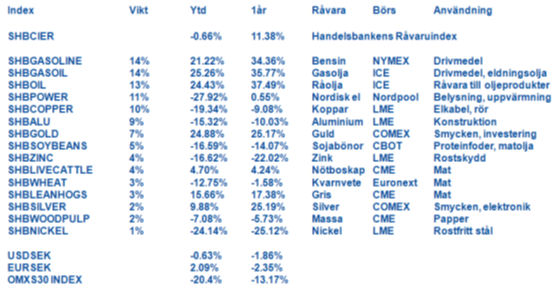
Handelsbankens råvaruindex består av de underliggande indexen för respektive råvara. Vikterna är bestämda till hälften från värdet av global produktion och till hälften från likviditeten i terminskontrakten.
[box]SHB Råvarubrevet är producerat av Handelsbanken och publiceras i samarbete och med tillstånd på Råvarumarknaden.se[/box]
Ansvarsbegränsning
Detta material är producerat av Svenska Handelsbanken AB (publ) i fortsättningen kallad Handelsbanken. De som arbetar med innehållet är inte analytiker och materialet är inte oberoende investeringsanalys. Innehållet är uteslutande avsett för kunder i Sverige. Syftet är att ge en allmän information till Handelsbankens kunder och utgör inte ett personligt investeringsråd eller en personlig rekommendation. Informationen ska inte ensamt utgöra underlag för investeringsbeslut. Kunder bör inhämta råd från sina rådgivare och basera sina investeringsbeslut utifrån egen erfarenhet.
Informationen i materialet kan ändras och också avvika från de åsikter som uttrycks i oberoende investeringsanalyser från Handelsbanken. Informationen grundar sig på allmänt tillgänglig information och är hämtad från källor som bedöms som tillförlitliga, men riktigheten kan inte garanteras och informationen kan vara ofullständig eller nedkortad. Ingen del av förslaget får reproduceras eller distribueras till någon annan person utan att Handelsbanken dessförinnan lämnat sitt skriftliga medgivande. Handelsbanken ansvarar inte för att materialet används på ett sätt som strider mot förbudet mot vidarebefordran eller offentliggörs i strid med bankens regler.
Finansiellt instruments historiska avkastning är inte en garanti för framtida avkastning. Värdet på finansiella instrument kan både öka och minska och det är inte säkert att du får tillbaka hela det investerade kapitalet.



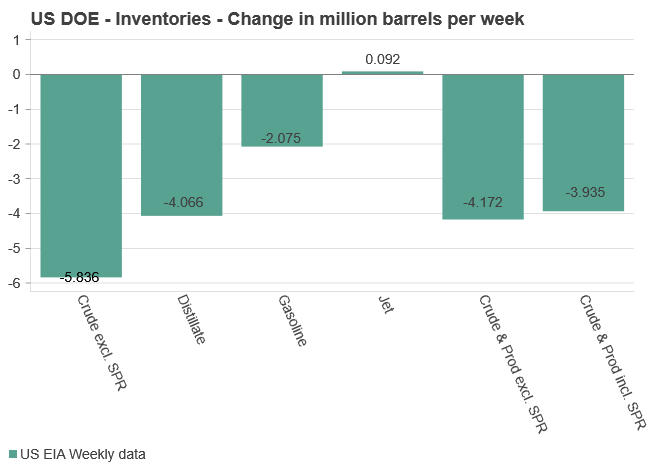
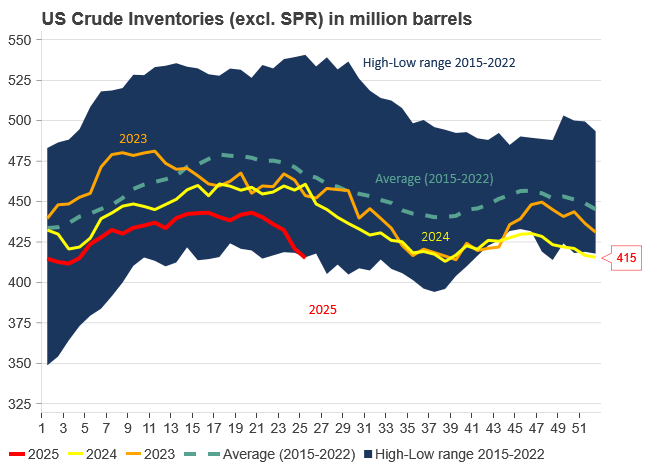
The latest weekly report from the US DOE showed a substantial drawdown across key petroleum categories, adding more upside potential to the fundamental picture.

Commercial crude inventories (excl. SPR) fell by 5.8 million barrels, bringing total inventories down to 415.1 million barrels. Now sitting 11% below the five-year seasonal norm and placed in the lowest 2015-2022 range (see picture below).
Product inventories also tightened further last week. Gasoline inventories declined by 2.1 million barrels, with reductions seen in both finished gasoline and blending components. Current gasoline levels are about 3% below the five-year average for this time of year.
Among products, the most notable move came in diesel, where inventories dropped by almost 4.1 million barrels, deepening the deficit to around 20% below seasonal norms – continuing to underscore the persistent supply tightness in diesel markets.
The only area of inventory growth was in propane/propylene, which posted a significant 5.1-million-barrel build and now stands 9% above the five-year average.
Total commercial petroleum inventories (crude plus refined products) declined by 4.2 million barrels on the week, reinforcing the overall tightening of US crude and products.
A classic case of “buy the rumor, sell the news” played out in oil markets, as Brent crude has dropped sharply – down nearly USD 10 per barrel since yesterday evening – following Iran’s retaliatory strike on a U.S. air base in Qatar. The immediate reaction was: “That was it?” The strike followed a carefully calibrated, non-escalatory playbook, avoiding direct threats to energy infrastructure or disruption of shipping through the Strait of Hormuz – thus calming worst-case fears.
After Monday morning’s sharp spike to USD 81.4 per barrel, triggered by the U.S. bombing of Iranian nuclear facilities, oil prices drifted sideways in anticipation of a potential Iranian response. That response came with advance warning and caused limited physical damage. Early this morning, both the U.S. President and Iranian state media announced a ceasefire, effectively placing a lid on the immediate conflict risk – at least for now.
As a result, Brent crude has now fallen by a total of USD 12 from Monday’s peak, currently trading around USD 69 per barrel.
Looking beyond geopolitics, the market will now shift its focus to the upcoming OPEC+ meeting in early July. Saudi Arabia’s decision to increase output earlier this year – despite falling prices – has drawn renewed attention considering recent developments. Some suggest this was a response to U.S. pressure to offset potential Iranian supply losses.
However, consensus is that the move was driven more by internal OPEC+ dynamics. After years of curbing production to support prices, Riyadh had grown frustrated with quota-busting by several members (notably Kazakhstan). With Saudi Arabia cutting up to 2 million barrels per day – roughly 2% of global supply – returns were diminishing, and the risk of losing market share was rising. The production increase is widely seen as an effort to reassert leadership and restore discipline within the group.
That said, the FT recently stated that, the Saudis remain wary of past missteps. In 2018, Riyadh ramped up output at Trump’s request ahead of Iran sanctions, only to see prices collapse when the U.S. granted broad waivers – triggering oversupply. Officials have reportedly made it clear they don’t intend to repeat that mistake.
The recent visit by President Trump to Saudi Arabia, which included agreements on AI, defense, and nuclear cooperation, suggests a broader strategic alignment. This has fueled speculation about a quiet “pump-for-politics” deal behind recent production moves.
Looking ahead, oil prices have now retraced the entire rally sparked by the June 13 Israel–Iran escalation. This retreat provides more political and policy space for both the U.S. and Saudi Arabia. Specifically, it makes it easier for Riyadh to scale back its three recent production hikes of 411,000 barrels each, potentially returning to more moderate increases of 137,000 barrels for August and September.
In short: with no major loss of Iranian supply to the market, OPEC+ – led by Saudi Arabia – no longer needs to compensate for a disruption that hasn’t materialized, especially not to please the U.S. at the cost of its own market strategy. As the Saudis themselves have signaled, they are unlikely to repeat previous mistakes.
Conclusion: With Brent now in the high USD 60s, buying oil looks fundamentally justified. The geopolitical premium has deflated, but tensions between Israel and Iran remain unresolved – and the risk of missteps and renewed escalation still lingers. In fact, even this morning, reports have emerged of renewed missile fire despite the declared “truce.” The path forward may be calmer – but it is far from stable.
Analys
A muted price reaction. Market looks relaxed, but it is still on edge waiting for what Iran will do
Brent crossed the 80-line this morning but quickly fell back assigning limited probability for Iran choosing to close the Strait of Hormuz. Brent traded in a range of USD 70.56 – 79.04/b last week as the market fluctuated between ”Iran wants a deal” and ”US is about to attack Iran”. At the end of the week though, Donald Trump managed to convince markets (and probably also Iran) that he would make a decision within two weeks. I.e. no imminent attack. Previously when when he has talked about ”making a decision within two weeks” he has often ended up doing nothing in the end. The oil market relaxed as a result and the week ended at USD 77.01/b which is just USD 6/b above the year to date average of USD 71/b.

Brent jumped to USD 81.4/b this morning, the highest since mid-January, but then quickly fell back to a current price of USD 78.2/b which is only up 1.5% versus the close on Friday. As such the market is pricing a fairly low probability that Iran will actually close the Strait of Hormuz. Probably because it will hurt Iranian oil exports as well as the global oil market.
It was however all smoke and mirrors. Deception. The US attacked Iran on Saturday. The attack involved 125 warplanes, submarines and surface warships and 14 bunker buster bombs were dropped on Iranian nuclear sites including Fordow, Natanz and Isfahan. In response the Iranian Parliament voted in support of closing the Strait of Hormuz where some 17 mb of crude and products is transported to the global market every day plus significant volumes of LNG. This is however merely an advise to the Supreme leader Ayatollah Ali Khamenei and the Supreme National Security Council which sits with the final and actual decision.
No supply of oil is lost yet. It is about the risk of Iran closing the Strait of Hormuz or not. So far not a single drop of oil supply has been lost to the global market. The price at the moment is all about the assessed risk of loss of supply. Will Iran choose to choke of the Strait of Hormuz or not? That is the big question. It would be painful for US consumers, for Donald Trump’s voter base, for the global economy but also for Iran and its population which relies on oil exports and income from selling oil out of that Strait as well. As such it is not a no-brainer choice for Iran to close the Strait for oil exports. And looking at the il price this morning it is clear that the oil market doesn’t assign a very high probability of it happening. It is however probably well within the capability of Iran to close the Strait off with rockets, mines, air-drones and possibly sea-drones. Just look at how Ukraine has been able to control and damage the Russian Black Sea fleet.
What to do about the highly enriched uranium which has gone missing? While the US and Israel can celebrate their destruction of Iranian nuclear facilities they are also scratching their heads over what to do with the lost Iranian nuclear material. Iran had 408 kg of highly enriched uranium (IAEA). Almost weapons grade. Enough for some 10 nuclear warheads. It seems to have been transported out of Fordow before the attack this weekend.
The market is still on edge. USD 80-something/b seems sensible while we wait. The oil market reaction to this weekend’s events is very muted so far. The market is still on edge awaiting what Iran will do. Because Iran will do something. But what and when? An oil price of 80-something seems like a sensible level until something do happen.



Sommarvädret styr elpriset i Sverige

Samtal om flera delar av råvarumarknaden
Tightening fundamentals – bullish inventories from DOE

Jonas Lindvall är tillbaka med ett nytt oljebolag, Perthro, som ska börsnoteras

Oljan, guldet och marknadens oroande tystnad

Stor uppsida i Lappland Guldprospekterings aktie enligt analys

Brookfield ska bygga ett AI-datacenter på hela 750 MW i Strängnäs
Silverpriset släpar efter guldets utveckling, har mer uppsida

Tradingfirman XTX Markets bygger datacenter i finska Kajana för 1 miljard euro

Uppgången i oljepriset planade ut under helgen
-
 Nyheter3 veckor sedan
Stor uppsida i Lappland Guldprospekterings aktie enligt analys
-
 Nyheter4 veckor sedan
Brookfield ska bygga ett AI-datacenter på hela 750 MW i Strängnäs
-
 Nyheter3 veckor sedan
Silverpriset släpar efter guldets utveckling, har mer uppsida
-
 Nyheter4 veckor sedan
Tradingfirman XTX Markets bygger datacenter i finska Kajana för 1 miljard euro
-
 Nyheter2 veckor sedan
Uppgången i oljepriset planade ut under helgen
-

 Nyheter2 veckor sedan
Låga elpriser i sommar – men mellersta Sverige får en ökning
-
Analys2 veckor sedan
Very relaxed at USD 75/b. Risk barometer will likely fluctuate to higher levels with Brent into the 80ies or higher coming 2-3 weeks
-

 Nyheter1 vecka sedan
Mahvie Minerals växlar spår – satsar fullt ut på guld