

Nyheter
David Hargreaves on Precious Metals, week 46 2013

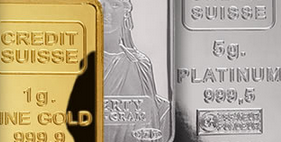
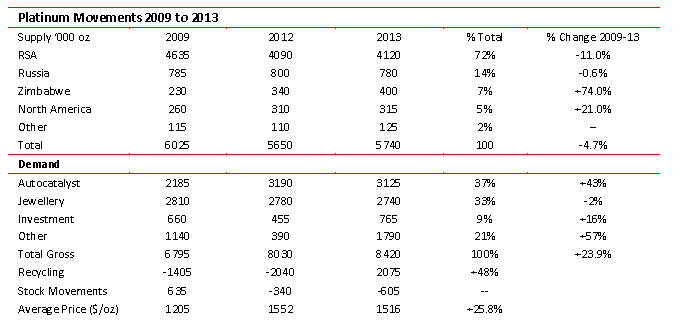
The gold bulls continue to fight a rearguard action despite the price looking to have waved goodbye to $1300/oz and the looser end forecasters muttering about $1000 next stop. The Platinum premium widens and Johnson-Matthey’s 2013 interim review, just published, tells us why. It deals with all six PGMs but as Pt and Pd represent over 85% of supply we dwell on these:
Summary
Whilst the deficit is forecast to increase, supplies will rise, mostly from Zimbabwe. Gross demand will thus increase, by 4.9% to 8.42Moz. South African supplies will at best be level with 2012 as a result of industrial disruption. Autocatalyst demand will fall (2% to 3.13Moz) because of weakness in the two largest diesel markets, Europe and India. Industrial demand, much in the chemical catalyst sector, will rise a hefty 1.5% to 1.79Moz. Demand from jewellery will slip 1.4% to 2.74Moz. That from jewellery will slip 1.4% to 2.74Moz. Recycling from spent autocatalysts will rise 12.8% to 1.28Moz.
The ETF sector has been a success, largely thanks to the offtake in RSA of a record 765,000 oz. Palladium presents a marginally different picture. Primary supplies are forecast to decline a little to 6.43Moz in 2013 mainly due to a drop in sales from the Russian stockpile, much offset by recycling. The Chinese car market is set to boom, again being the major user of the metal in exhaust catalysts.
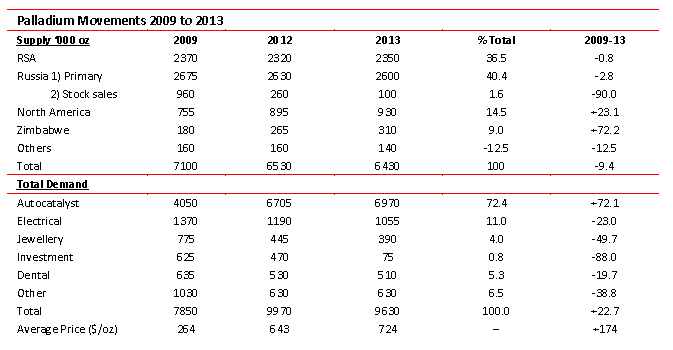
Sector Specifics
We have chosen to compare the years above because 2009 was when the economic collapse started, 2012 a time of pseudo recovery and 2013 perhaps one of reality. The long term demand for PGMs cannot be in doubt and we have constants and variables moreso than in most minerals. Geographically, mined supply is largely locked in three countries with two, RSA and Zimbabwe, suffering political palsy. It does leave investors some safer opportunities such as Stillwater (USA) and Eurasia Mining, not to be confused with ENRC, soon to delist. Demand is dictated by the autocatalyst industry moreso for Pt than Pd whilst investment is becoming a conundrum. As industrial metals, with precious qualities, Pt and Pd have a perversely double investment appeal. But that slice (about 850,000 oz or 25 tpa) sits accumulating as surface stocks, ready to come out on a price hike. The investor appetite for Pd is much reduced and we see its ratio to Pt widening. Also with our gold price barometer falling fast, the Pt/Au ratio looks set to widen. Finally, congratulations to J-M on an as-ever comprehensive and professional review. Sadly, it will be their last.
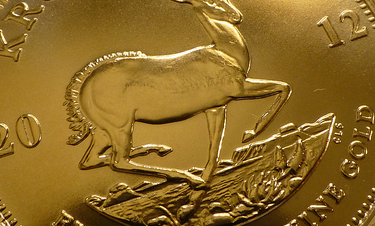
The gold bulls will not like this, but at $1282/oz at the close Friday 15th November, the price is down and showing no inclination to rise back above the $1300 threshold. This metal, which has few industrial outlets, relies on sentiment and fear, both of which channel it into investment mediums, usually short term. A growing one is the exchange traded fund (ETF). Now that authority, the World Gold Council or WGC, says in its Q3 2013 review that:
- Overall demand fell 21% year-on-year, via outflows from ETF positions, mostly.
- Eastern markets remained resilient (the buying balance is shifting from West to East).
- Bar and coin demand was up a bit, but investment demand took the big hit. It went like this:
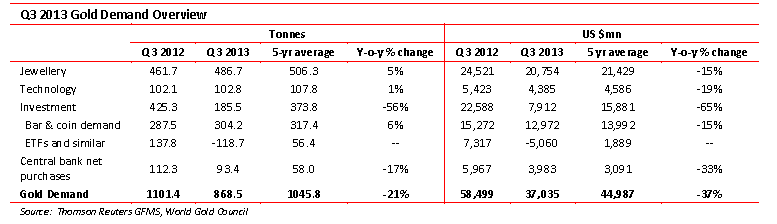
Two features stand out: the rising level of consumer demand and the market shift from West to East.
Central Banks. News seekers are trying to tell us that Russia is trying to build up its corporate stocks. It added 18.7t in Q3 to total 1,015t, now breaching the 1000t mark for the first time. That makes it 7th in the world; a long way to go. The USA has 8134t and even Switzerland 1040t.
[hr]
About David Hargreaves
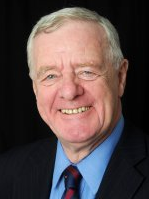
David Hargreaves
David Hargreaves is a mining engineer with over forty years of senior experience in the industry. After qualifying in coal mining he worked in the iron ore mines of Quebec and Northwest Ontario before diversifying into other bulk minerals including bauxite. He was Head of Research for stockbrokers James Capel in London from 1974 to 1977 and voted Mining Analyst of the year on three successive occasions.
Since forming his own metals broking and research company in 1977, he has successfully promoted and been a director of several public companies. He currently writes “The Week in Mining”, an incisive review of world mining events, for stockbrokers WH Ireland. David’s research pays particular attention to steel via the iron ore and coal supply industries. He is a Chartered Mining Engineer, Fellow of the Geological Society and the Institute of Mining, Minerals and Materials, and a Member of the Royal Institution. His textbook, “The World Index of Resources and Population” accurately predicted the exponential rise in demand for steel industry products.

Det råder speciella förutsättningar på elmarknaden just nu och allt styrs till största delen av vädret. Sol och bitvis god vindkraftsproduktion under maj, i kombination med svag hydrologi och begränsad kärnkraft har lett till stora svängningar i elpriset. Juni inleds liknande och idag tangerar elpriserna nivåer från krisåret 2022. Dock förväntas elpriserna gå ner då kärnkraften ökar.
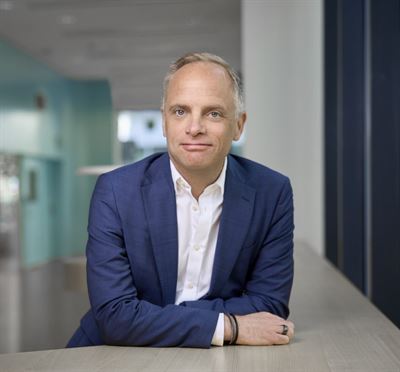
Juni börjar med höga elpriser och orsakerna är brist på vindkraft, torra väderprognoser och mindre kärnkraft. Prisuppgången i maj var särskilt tydlig i norra Sverige, elområde 1 och 2, och ligger just nu nära en krona per kWh. I elområdena 3 och 4, södra Sverige, blev månadsmedelspotpriset för maj 35–40 procent högre jämfört med april men har rusat idag till nivåer på mellan 130–160 öre/kWh.
– Dagens höga priser visar tydligt på hur snabbt förändrade väderprognoser får genomslag på elpriset. Sommarens väder påverkar även priserna inför hösten och vintern. Ska det bli mer stabila elpriser behövs ett typiskt svenskt sommarväder, dvs. en blandning av regn, vind och sol, snarare än extremvärme och högtryck. Särskilt viktig är nederbörden i Norge och norra Sverige där vattenkraften dominerar, säger Jonas Stenbeck, privatkundschef på Vattenfall Försäljning.
Den hydrologiska balansen, dvs. det sammanlagda vatteninnehållet i snö, mark och magasin, är väldigt ansträngt efter en snöfattig vinter. Det stora underskottet håller i sig och är starkt beroende av mer nederbörd i närtid. På grund av pågående revisioner, bland annat Ringhals 3 och Forsmark 2, är elproduktionen från svensk kärnkraft begränsad just nu. Oskarshamn 3 har planerad återstart den 10 juni och Ringhals 4, som för närvarande producerar med halv effekt, går upp till full effekt den 12 juni. Det innebär att den installerade effekten då kommer att stiga från 40 till 60 procent i Sverige.
Det geopolitiska läget är fortsatt ett orosmoment men ryktet om ett fredsförslag har lugnat marknaden något. Gas- och oljepriserna fortsätter att falla och de stigande temperaturerna på kontinenten och den stora andelen solkraft kan ha en stabiliserande effekt.
| Medelspotpris | Elområde 1, Norra Sverige | Elområde 2, Norra Mellansverige | Elområde 3, Södra Mellansverige | Elområde 4, Södra Sverige |
| Maj 2026 | 46,36 öre/kWh | 48,95 öre/kWh | 70,86 öre/kWh | 87,05 öre/kWh |
| Maj 2025 | 14,09 öre/kWh | 15,09 öre/kWh | 42,94 öre/kWh | 60,01 öre/kWh |
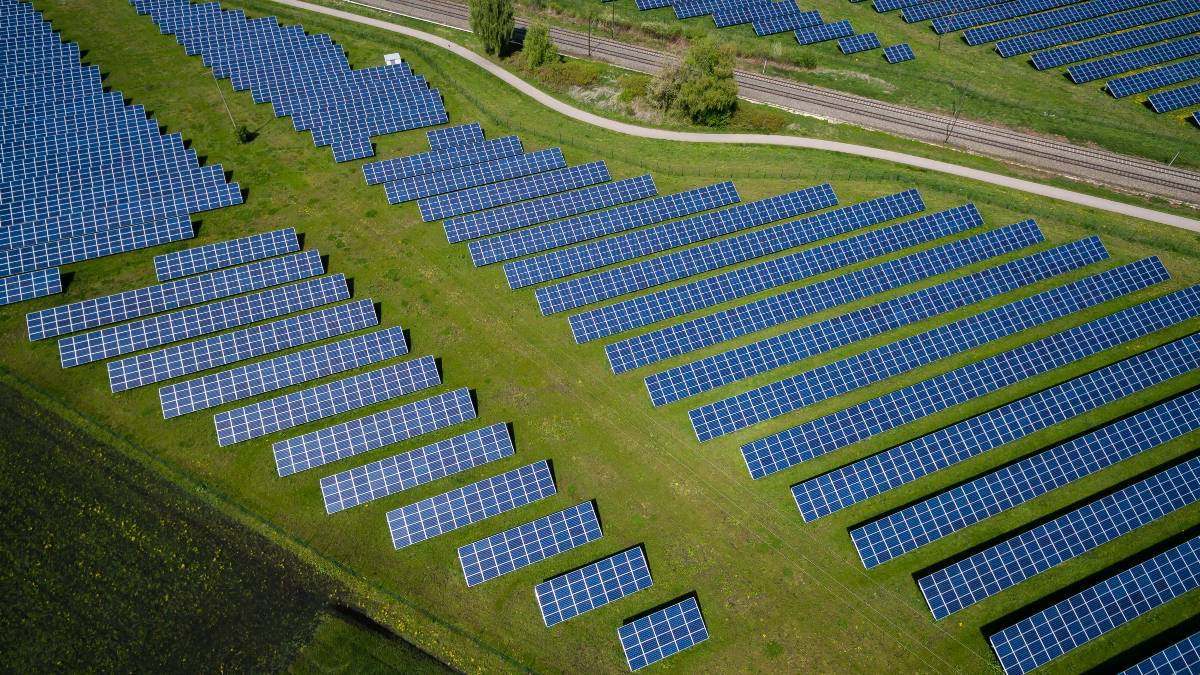
Snabba väderomslag har präglat elmarknaden i april, med både prisfall och pristoppar som följd. Samtidigt får solkraften allt större påverkan och pressar ner elpriserna, särskilt i södra Sverige.
Månadsmedelpriset för april på den nordiska elbörsen Nord Pool utan påslag och exklusive moms blev 58,66 öre/kWh i elområde 3, södra Mellansverige, och 22,75 öre/kWh i elområde 1, norra Sverige. På kontinenten syns den så kallade ankkurvan tydligt.
– Nu är solen helt klart på gång. I Tyskland har solen under april producerat nästan 2 TWh mer än ifjol vilket även gynnar oss i Sverige. Ankkurvefenomenet innebär att elpriset är lågt mitt på dagen och stiger raskt mot kvällen. Under perioder med soligt och varmare vårväder är solen ett välkommet inslag här hemma och det påverkar elpriserna nedåt. Den ökar produktionen och minskar konsumtionen, säger Jonas Stenbeck, privatkundschef på Vattenfall Försäljning.
De årliga, planerade underhållsarbetena på kärnkraftverken pågår, vilket innebär att den tillgängliga kapaciteten just nu är cirka 60 procent. Vinden var varierande under april, med snabba skiften mellan stilla och blåsiga perioder, vilket märktes på elpriset.
Den hydrologiska balansen i Norden, alltså det sammanlagda vatteninnehållet i snö, mark och magasin, är svag med betydande underskott i södra Norge. Men magasinsnivåerna i Sverige ligger kring normala nivåer för årstiden och har börjat fyllas på.
– Dock förväntas årets vårflod att, givet dagens förutsättningar, bli lägre än normalt då snötäcket är avsevärt mindre än vanliga nivåer. Vädret kommer avgöra hur väl vårfloden fyller magasinen inför sommaren, säger Jonas Stenbeck.
De höga gaspriserna har fallit något, samtidigt som stigande temperaturer på kontinenten och den stora andelen solkraft haft en stabiliserande effekt. Det geopolitiska läget är dock fortsatt ett orosmoment.
– Det vi sett är att marknaden är väldigt nyhetsdriven. Beroende av vad som rapporteras så reagerar marknaden direkt. Det gör att vi befinner oss i en väldigt speciell situation eftersom denna osäkerhet skapar svängiga och oförutsägbara bränslepriser, vilket i slutändan påverkar elpriset. Jag förstår att många känner en oro men i och med att det blir varmare så kommer man inte att behöva lika mycket el, vilket ger en lägre elkostnad, säger Jonas Stenbeck.
| Medelspotpris | April 2025 | April 2026 |
| Elområde 1, Norra Sverige | 14,39 öre/kWh | 26,09 öre/kWh |
| Elområde 2, Norra Mellansverige | 14,21 öre/kWh | 26,85 öre/kWh |
| Elområde 3, Södra Mellansverige | 37,61 öre/kWh | 56,08 öre/kWh |
| Elområde 4, Södra Sverige | 58,35 öre/kWh | 66,55 öre/kWh |
*Ankkurva: Ankkurvan beskriver hur elproduktionen från förnybara energikällor, som solenergi, påverkar elnätet och elanvändningen över en dag. Kurvan har fått sitt namn eftersom grafen under en dag liknar profilen av en anka.
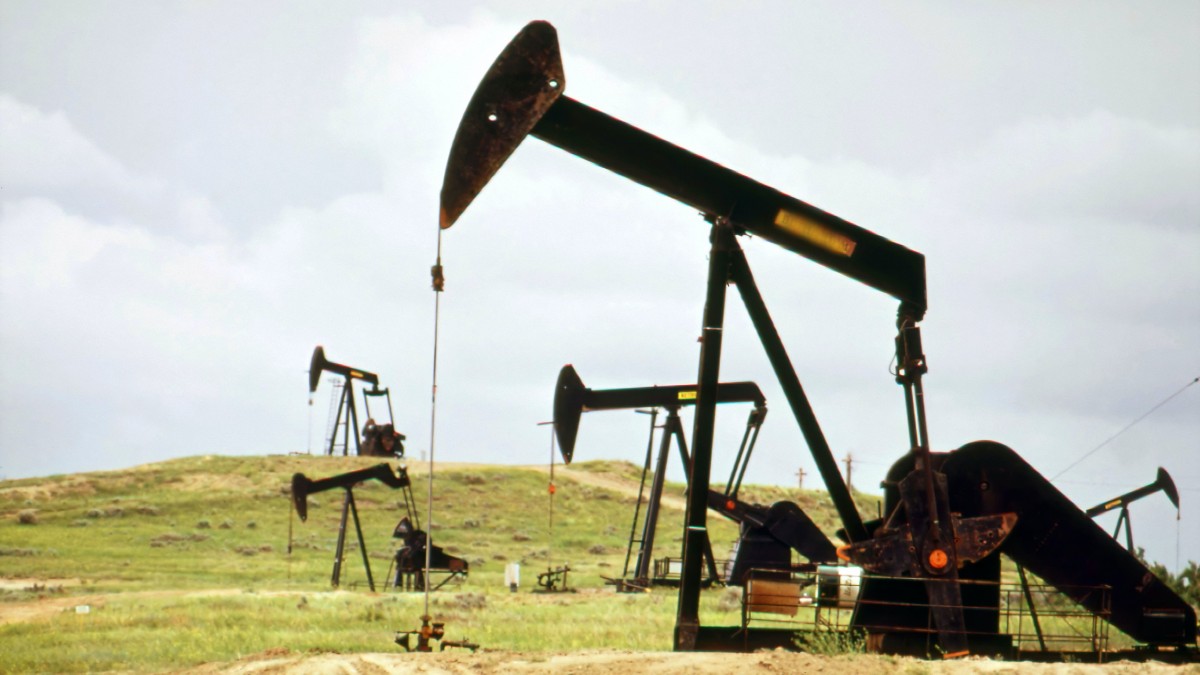
Råvaran olja handlas fortsatt över 100 USD per fat och det är något stökigt med prissättningen. Michel Gubel ger sin syn på läget för oljan, att priskurvan kan vara i contango och backwardation, samt vad som kan hända med olja på längre sikt.


Sommarväder skapar prisrally på elbörsen
Oil product price pain is set to rise as the Strait of Hormuz stays closed into summer

Solkraften pressar elpriserna dagtid

Michel Gubel ger sin syn på oljemarknaden