

Analys
SEB – Råvarukommentarer vecka 20 2012

Sammanfattning: Föregående vecka
 Brett råvaruindex: – 2%
UBS Bloomberg CMCI TR Index- Energi: – 0,34%
UBS Bloomberg CMCI Energy TR Index - Ädelmetaller: – 3,96%
UBS Bloomberg CMCI Precious Metals TR Index - Industrimetaller: – 1,81%
UBS Bloomberg CMCI Industrial Metals TR Index - Jordbruk: – 3,35%
UBS Bloomberg CMCI Agriculture TR Index
Kortsiktig marknadsvy:
- Guld: Neutral/köp
- Olja: Neutral/sälj
- Koppar: Neutral
- Majs: Sälj
- Vete: Sälj
Guld
- Valet i Grekland skapade turbulens. Försöken att bilda regering har misslyckats. Mycket talar för nyval i juni. I slutet av juni är Grekland i behov av nya utbetalningar, men det kräver politiska beslut om nya besparingar för 2013 och 2014.
- Oro över utvecklingen i Grekland och eventuella spridningseffekter har tyngt marknaderna. Spanska 10-åriga obligationer ligger över 6 procent och oron för Spaniens ekonomi är påtaglig. Även i Tyskland ser man nu ett utbrett missnöje med åtstramningar.
- Tyska Bundesbank är villig att acceptera högre tysk inflation i relation till andra euroländers inflation. Detta för att undvika deflation i södra Europa och för att komma till rätta med eurozonens obalanser.
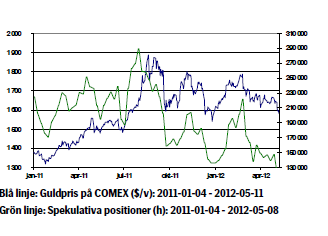
- Guldet föll 3,4 procent och det är uppenbart att guldet inte finner stöd i den systemrisk vi ser i Europa eller i möjligheten till ökad stimulans i form av ökad likviditet. En starkare dollar kan förklara en del av guldets ras men det räcker inte som den enda förklaringen. Vi har sett att utflödet ur guldpositioner skedde i terminsmarknaden medan vi inte såg större utflöden ur fysiska guld ETF: er.
- Korrelationen med andra risktillgångar som råvaror och aktier är hög. Vi tror att vi kan komma att se ytterligare prisfall i denna osäkra makroekonomiska miljö men är benägna att köpa vid större prisfall. Denna vecka är vi neutrala till försiktigt positiva till guldet.
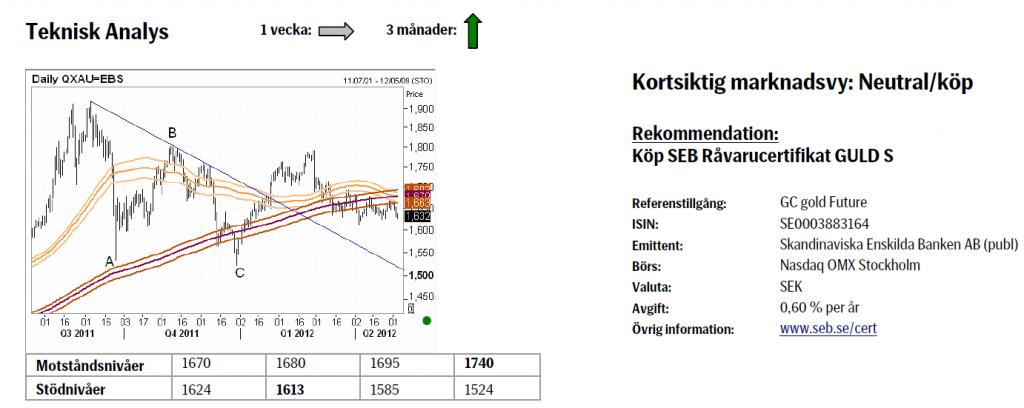
- Teknisk Analys: Fortsatt endast marginella rörelser noterade inom ett redan ganska väl utstakat intervall där under $1620 verkar ”för lågt” och over $1690 ”för högt”. Priset håller sig under ett rullande 55-dagars genomsinittsband. Bandet är svagt i fallande och är på marginalen ett uttryck för visst nedåttryck, men marknaden svarar samtidigt bra på nedställ och i en större positiv bild ser eventuell svaghet ut at vara temporär. Över $1670 & $1695 skulle påvisa efterfrågan och ses som positivt.
Olja
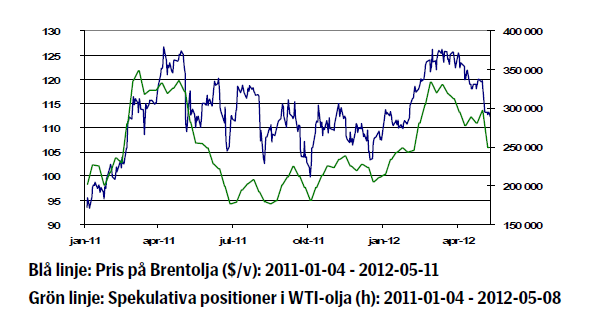
- Oljepriset föll 5,3 Saudiarabiens oljeminister poängterade precis som Opecchefen att man önskar se ett lägre oljepris och att man eventuellt kommer att diskutera en höjning av medlemsländernas produktionskvoter på Opec mötet i juni.
- Saudiarabien kommer att garantera oljeimport till Japan. Japan har starkt behov av oljeimporten eftersom man nu stängt landets alla kärnkraftsverk.
- Även Indien kommer att minska oljeimporten från Iran för att undgå de sanktioner som USA inför i juni. Importen kommer efter ett år att ha minskat med 65 000 fat per dag vilket motsvarar ungefär tre procent av Irans oljeexport.
- Enligt American Petroleum Institute (API) steg råoljelager med 7,8 miljoner fat. Samtidigt bör noteras att lager av oljeprodukter minskade i samma proportion. Även Department of Energy (DOE) visare på onsdagen att råoljelager steg med 3,6 miljoner fat.
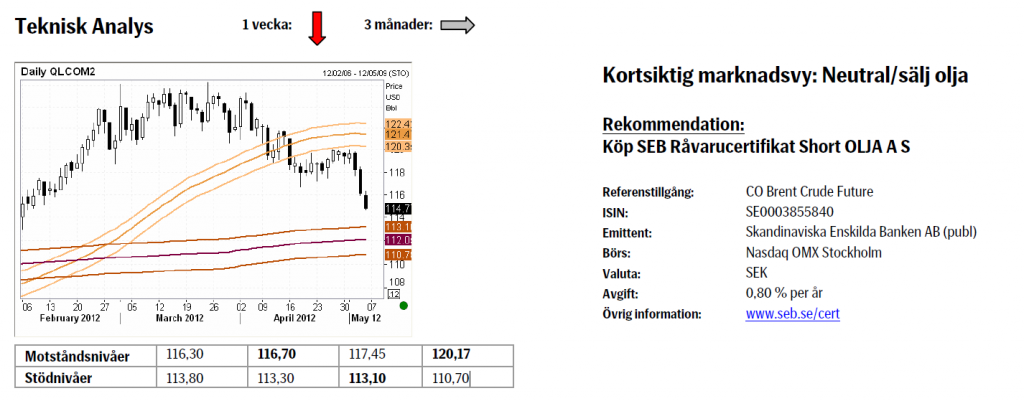
- Det dåliga makroekonomiska sentimentet i takt med att situationen i Europa försämras samtidigt som utbudet av olja i marknaden är stort bidrog till oljeprisets fall. Priset verkar ha stabiliserats vid 112 dollar per fat och vi tycker det är svårt att vara positiva på kort sikt.
- Teknisk Analys: Undersidan av 55-dagars bandet (som efter kraftigt nedställ denna vecka är satt i fallande) agerar som dynamisk motstånd (borde inte återtestas under de kommande veckorna). Rörelsen ner är som sagt hård och ska väntas fortsätta för att testa 233-dagars bandet som just nu börjar vid $113.
Koppar
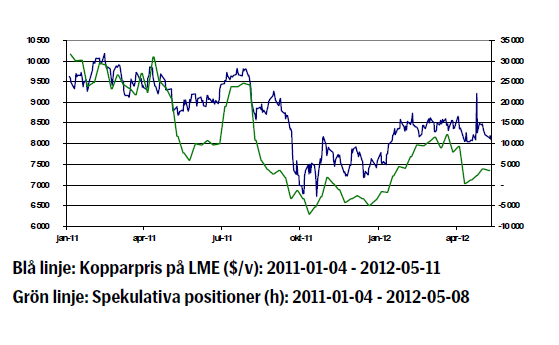
- Kina sänkte i lördags reservkraven för sina största banker med en halv procentenhet till 20 %. Detta var den tredje sänkningen på 6 månader. Denna stimulans väntas öka likviditeten i systemet och kan ge stöd åt kopparpriset. Kinesisk inflationstakt dämpades till 3.4 procent i april från 3.6 procent i mars. Pristrycket är lågt för närvarande och tillväxttakten låg under första kvartalet på den lägsta nivån sedan början av 2009. Kopparpriset föll med 0,8 procent veckan som gick och handlade kort under den viktiga 8000 dollar nivån.
- Kinas handelsstatistik för april var svag. Handelsbalansen steg förvisso men både export och framförallt import föll långt mer än förväntat. Exporten ökade med 4,9 procent jämfört med samma månad året före, väntat var en ökning med 8,5 procent. Importen ökade samtidigt med 0,3 procent, väntat var en ökning med 10,9 procent.
- Industriproduktionen för april steg 9,3 procent jämfört med samma period föregående år. Den var en inbromsning från uppgången om 11,9 procent som noterades i mars, och betydligt under förväntningarna om en uppgång med 12,2 procent.
- Kinas kopparlager föll för femte månaden i rad och föll med 9178 ton till 187449 ton, den lägsta nivån sedan februari. Istället för att importera använder man koppar som finns i lager i landet. Utanför Kina är koppartillgången däremot begränsad och de höga lagernivåerna i Shanghai är en osäkerhetsfaktor.
- Kopparpriset kan fortsätta att pressas eftersom hög kinesisk import tidigare gett stöd åt priset men nu uteblir. Samtidigt kan priset stiga om vi ser att Kina behåller all koppar i landet och den globala marknaden uppvisar en minskad tillgång.
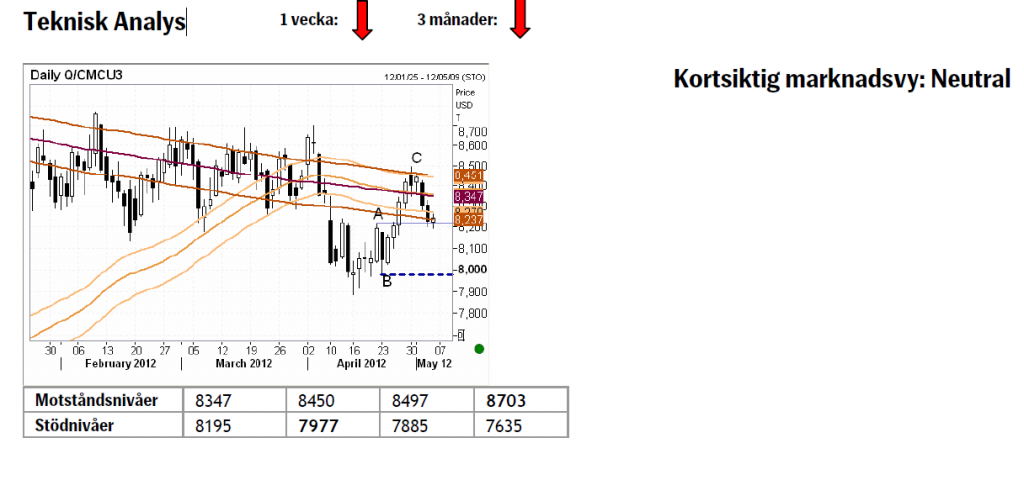
- Teknisk Analys: Rörelsen högre gick något längre än vad som tidigare var trott, men uppsidan av 55-, & 233-dagars ”banden” höll köpare över $8500 nivån borta. Den nuvarande överlappningen under 20 april toppen vid $8218 har ökat sannolikheten att apr/maj rörelsen verkligen är den korrektion vi antagit att den är. Under $$7977 skulle helt bekräfta detta och starkt argumentera för fortsatt rörelse under apr botten vid 7885.
Majs
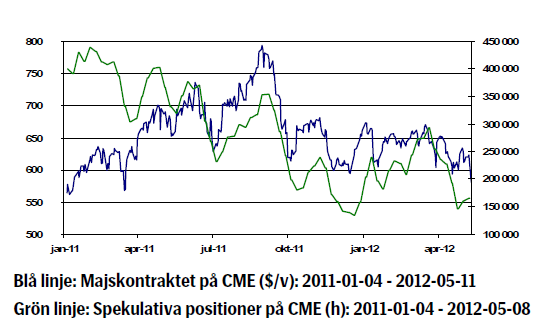
- Efter att ha handlats över 6 USD/bushel de senaste veckorna föll julikontraktet kraftigt under veckan för att slutligen stänga på 5,81 USD/bushel, en nedgång med 6,33 procent.
- Som vi nämnt i tidigare veckobrev har särskilt den goda efterfrågan från kinesiska boskapsuppfödare agerat stöd den senaste tiden. Torsdagens WASDErapport från det amerikanska jordbruksdepartementet (USDA) fick dock även detta stöd att ge vika.
- I sin rapport justerade USDA upp sin prognos rejält för den amerikanska skörden, där prognosen för landets lagernivå avseende innevarande skördeår justerades upp med över 6 procent jämfört med april månads estimat. Då marknaden förväntade sig en minskning blev följaktligen effekten av rapporten ett rejält prisfall för majsen.
- Fundamentalt ser vi fortsatt ingen anledning att tro på en uppgång för majspriset. Oron i Sydeuropa ökar riskaversionen från investerarkollektivet samtidigt som den goda produktionen minskar intresset från konsumenterna. Vi behåller med detta vår säljrekommendation för majsen.
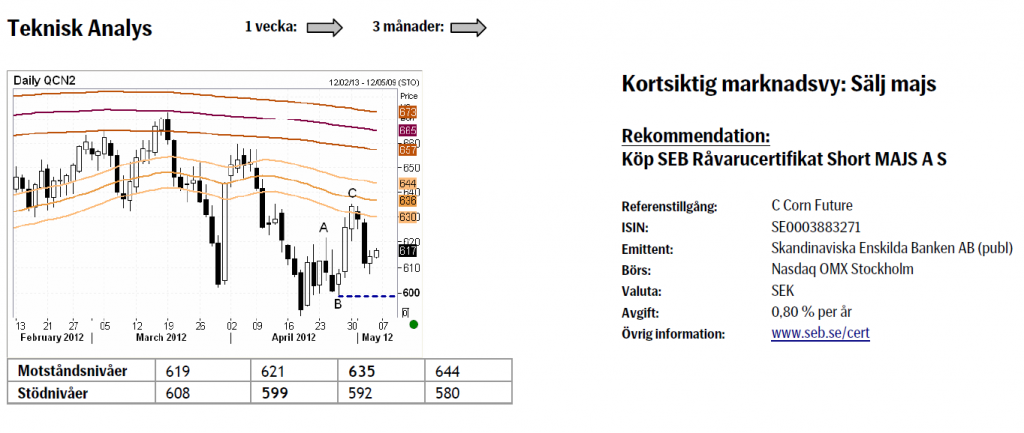
- Teknisk Analys: Rörelsen upp från apr botten har kommit av sig och börjat se ut som en korrektiv ”3-vågs” rörelse där A-, & C-vågorna nu är symmetriska i storlek och hastighet. Tillbaka under 599 skulle till fullo bekräfta detta och den lätt negativa lutningen på 55-dagars bandet och då argumentera för rörelse under 592, möjligtvis ner mot 580-området.
Vete
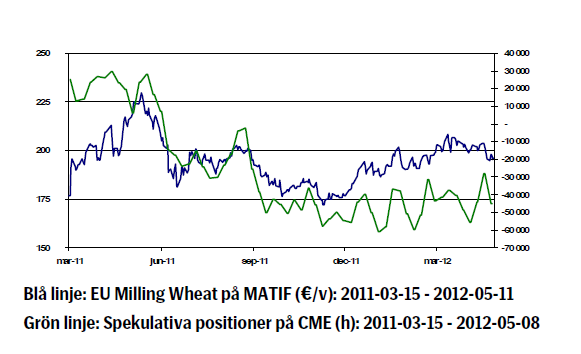
- Till skillnad mot sin amerikanska motsvarighet gick vetet i Europa upp något under förra veckan. Detta till stor del baserat på USDA:s jordbruksrapport, i vilken man bedömer att framförallt produktionen i Europa kommer att vara svag under 2012. Det land som kommer att ha störst bortfall är Ukraina, där skörden väntas minska med över 40 procent jämfört med föregående skördeår. Den köldknäpp som drabbade Europa under början av 2012 har fått omfattande konsekvenser och priset på MATIF-vete har sedan årsskiftet gått upp med 1,5 procent. Under samma period har vetepriset i Chicago minskat med nästan 14 procent.
- De senaste veckornas positiva skördeutveckling i USA verkar hålla i sig och det amerikanska jordbruksdepartementet prognostiserar en produktionsökning med 13 procent för landets vintervetesskörd 2012.
- Nu bedömer vi att de största bortfallen avseende den europeiska produktionen är inprisade och ser det som mer troligt att priset kommer att gå ned de kommande veckorna.
- Teknisk Analys: Fallande top Fallande toppar indikerar ett något höjt säljtryck. Skulle stödet just under €200-nivån (& nedsidan på 55-dagars bandet) sluta att attrahera köpare så väntas snabb rörelse tillbaka ner mot stödet vid 233- dagars bandet (som är i fallande) och som börjar vid €193. Över €206 skulle åter minska risken för brott lägre och i stället tas som efterfrågan vid nivåer som tidigare ansågs säljvärda.
[box]SEB Veckobrev Veckans råvarukommentar är producerat av SEB Merchant Banking och publiceras i samarbete och med tillstånd på Råvarumarknaden.se[/box]
Disclaimer
The information in this document has been compiled by SEB Merchant Banking, a division within Skandinaviska Enskilda Banken AB (publ) (“SEB”).
Opinions contained in this report represent the bank’s present opinion only and are subject to change without notice. All information contained in this report has been compiled in good faith from sources believed to be reliable. However, no representation or warranty, expressed or implied, is made with respect to the completeness or accuracy of its contents and the information is not to be relied upon as authoritative. Anyone considering taking actions based upon the content of this document is urged to base his or her investment decisions upon such investigations as he or she deems necessary. This document is being provided as information only, and no specific actions are being solicited as a result of it; to the extent permitted by law, no liability whatsoever is accepted for any direct or consequential loss arising from use of this document or its contents.
About SEB
SEB is a public company incorporated in Stockholm, Sweden, with limited liability. It is a participant at major Nordic and other European Regulated Markets and Multilateral Trading Facilities (as well as some non-European equivalent markets) for trading in financial instruments, such as markets operated by NASDAQ OMX, NYSE Euronext, London Stock Exchange, Deutsche Börse, Swiss Exchanges, Turquoise and Chi-X. SEB is authorized and regulated by Finansinspektionen in Sweden; it is authorized and subject to limited regulation by the Financial Services Authority for the conduct of designated investment business in the UK, and is subject to the provisions of relevant regulators in all other jurisdictions where SEB conducts operations. SEB Merchant Banking. All rights reserved.

Brent is climbing higher. Front-month is at USD 106.3/bl this morning, close to a weekly high and a USD 9/bl jump from Mondays open. This is the move we flagged as a risk earlier in the week: the market shifting from ”a deal is around the corner” to ”this is going to take longer than we thought”.

Analyst Commodities, SEB
During April, rest-of-year Brent remained remarkably stable around USD 90/bl. A stability which rested on one single assumption: the SoH reopens around 1 May. That assumption is now slowly falling apart.
As we highlighted yesterday: every week of delay beyond 1 May adds (theoretically) ish USD 5/bl to the rest-of-year average, as global inventories draw 100 million barrels per week. i.e., a mid-May reopening implies rest-of-year Brent closer to USD 100/bl, and anything pushing into June or July takes us meaningfully higher.
What’s changed in the last 48 hours:
#1: The US military has formally warned that clearing suspected sea mines from SoH could take up to six months. That is a completely different timescale from what the financial market is pricing. Even a political deal tomorrow does not immediately reopen the strait.
#2: Trump has shifted his tone from urgency to ”strategic patience”. In yesterday’s press conference: ”Don’t rush me… I want a great deal.” The market is reading this as a president no longer feeling pressured by timelines, with the naval blockade running in the background.
#3: So far, the military activity is escalating, not de-escalating. Axios reports Iran is laying more mines in SoH. The US 3rd carrier strike group (USS George H.W. Bush) is arriving with two countermine vessels. Trump yesterday ordered the US Navy to destroy any Iranian boats caught laying mines. While CNN reports that the Pentagon is actively drawing up plans to strike Iranian SoH capabilities and individual Iranian military leaders if the ceasefire collapses. i.e., NOT a attitude consistent with an imminent deal!
Spot crude and product prices eased off the early-April highs on a combination of system rerouting and deal optimism. Both now weakening. Goldman estimates April Gulf output is reduced by 14.5 mbl/d, or 57% of pre-war supply, a number that keeps getting worse the longer this drags on.
Demand-side adaptation is ongoing: S. Korea has cut its Middle East crude dependence from 69% to 56% by pulling more from the Americas and Africa, and Japan is kicking off a second round of SPR releases from 1 May. But SPRs are finite.
Ref. to the negotiations, we should not bet on speed. The current Iranian leadership is dominated by genuine hardliners willing to absorb economic pain and run the clock to extract concessions. That is not a setup for a rapid resolution. US/Israeli media briefings keep framing the delay as ”internal Iranian divisions”, the reality is more complicated and points toward weeks and months, not days.
Our point is that the complexity is large, and higher prices have only just started (given a scenario where the negotiations drag out in time). The market spent April leaning on the USD 90/bl rest-of-year assumption; that case is diminishing by the hour. If ”early May reopening” is replaced by ”June, July or later” over the next week or two, both crude and products have meaningful room to reprice higher from here. There is a high risk being short energy and betting on any immediate political resolution(!).
Down on Friday. Up on Monday. The Brent June crude oil contract traded down 5.1% last week to a close of $90.38/b. It reached a high of $103.87/b last Monday and a low of $86.09/b on Friday as Iran announced that the Strait of Hormuz was fully open for transit. That quickly changed over the weekend as the US upheld its blockade of Iranian oil exports while Iran naturally responded by closing the SoH again. The US blew a hole in the engine room of the Iranian ship TOUSKA and took custody of the ship on Sunday. Brent crude is up 5.6% this morning to $95.4/b.

The cease-fire is expiring tomorrow. The US has said it will send a delegation for a second round of negotiations in Islamabad in Pakistan. But Iran has for now rejected a second round of talks as it views US demands as unrealistic and excessive while the US is also blocking the Strait of Hormuz.
While Brent is up 5% this morning, the financial market is still very optimistic that progress will be made. That talks will continue and that the SoH will fully open by the start of May which is consistent with a rest-of-year average Brent crude oil price of around $90/b with the market now trading that balance at around $88/b.
Financial optimism vs. physical deterioration. We have a divergence where the financial market is trading negotiations, improvements and resolution while at the same time the physical market is deteriorating day by day. Physical oil flows remain constrained by disrupted flows, longer voyage times and elevated freight and insurance costs.
Financial markets are betting that a US/Iranian resolution will save us in time from violent shortages down the road. But every day that the SoH remains closed is bringing us closer to a potentially very painful point of shortages and much higher prices.
The US blockade is also a weapon of leverage against its European and Asian allies. When Iran closed the SoH it held the world economy as a hostage against the US. The US blockade of the SoH is of course blocking Iranian oil exports. But it is also an action of disruption directed towards Europe and Asia. The US has called for the rest of the world to engaged in the war with Iran: ”If you want oil from the Persian Gulf, then go and get it”. A risk is that the US plays brinkmanship with the global oil market directed towards its European and Asian allies and maybe even towards China to force them to engage and take part. Maybe unthinkable. But unthinkable has become the norm with Trump in the White House.
Wild moves yesterday. Brent crude traded to a high of $114.43/b and a low of $96.0/b and closed at $99.94/b yesterday.
US – Iran negotiations ongoing or not? What a day. Donald Trump announced that good talks were ongoing between Iran and the US and that the 48 hour deadline before bombing Iranian power plants and energy infrastructure was postponed by five days subject to success of ongoing meetings. Iranian media meanwhile stated that no meetings were ongoing at all.
Today we are scratching our heads trying to figure out what yesterday was all about.
Friends and family playing the market? Was it just Trump and his friends and family who were playing with oil and equity markets with $580m and $1.46bn in bets being placed by someone in oil and equity markets just 15 minutes before Trump’s announcement?
Was Trump pulling a TACO as he reached his political and economic pain point: Brent at $112/b, US Gas at $4/gal, SPX below 200dma and US 10yr above 4.4%?
Different Iranian factions with Trump talking with one of them? Are there real negotiations going on but with the US talking to one faction in Iran while another, the hardliners, are not involved and are denying any such negotiations going on?
Extending the ultimatum to attack and invade Kharg island next weekend? Or, is the five day delay of the deadline a tactical decision to allow US amphibious assault ships and marines to arrive in the Gulf in the upcoming weekend while US and Israeli continues to degrade Iranian military targets till then. And then next weekend a move by the US/Israel to attack and conquer for example the Kharg island?
We do not really know which it is or maybe a combination of these.
We did get some kind of TACO ydy. But markets have been waiting for some kind of TACO to happen and yesterday we got some kind of TACO. And Brent crude is now trading at $101.5/b as a result rather than at $112-114/b as it did no the high yesterday.
But what really matters in our view is the political situation on the ground in Iran. Will hardliners continue to hold power or will a more pragmatic faction gain power?
If the hardliners remain in power then oil pain should extend all the way to US midterm elections. The hardliners were apparently still in charge as of last week. Iran immediately retaliated and damaged LNG infrastructure in Qatar after Israel hit Iranian South Pars. The SoH was still closed and all messages coming out of Iran indicated defiance. Hardliners continues in power has a huge consequence for oil prices going forward. The regime has played its ’oil-weapon’ (closing or chocking the Strait of Hormuz). It is using it to achieve political goals. Deterrence: it needs to be so politically and economically expensive to attack Iran that it won’t happen again in the future. Or at least that the US/Israel thinks 10-times over before they attack again. The highest Brent crude oil closing price since the start of the war is $112.19/b last Friday. In comparison the 20-year inflation adjusted Brent price is $103/b. So Brent crude last Friday at $112.19/b isn’t a shockingly high price. And it is still far below the nominal high of $148/b from 2008 which is $220/b if inflation adjusted. So once in a lifetime Iran activates its most powerful weapon. The oil weapon. It needs to show the power of this weapon and it needs to reap political gains. Getting Brent to $112/b and intraday high of $119.5/b (9 March) isn’t a display of the power of that weapon. And it is not a deterrence against future attacks.
So if the hardliners remain in power in Iran, then the SoH will likely remain chocked all the way to US midterm elections and Brent crude will at a minimum go above the historical nominal high of $148/b from 2008.
Thus the outlook for the oil price for the rest of the year doesn’t depend all that much of whether Trump pulls a TACO or not. Stops bombing or not. It depends more on who is in charge in Iran. If it is the hardliners, then deterrence against future attacks via chocking of the SoH and high oil prices is the likely line of action. It is impacting the world but the Iranian ’oil-weapon’ is directed towards the US president and the the US midterm elections.
If a pragmatic faction gets to power in Iran, then a very prosperous future is possible. However, if power is shifting towards a more pragmatic faction in Iran then a completely different direction could evolve. Such a faction could possibly be open for cooperation with the US and the GCC and possibly put its issues versus Israel aside. Then the prosperity we have seen evolving in Dubai could be a possible future also for Iran.
So far it looks like the hardliners are fully in charge. As far as we can see, the hardliners are still fully in control in Iran. That points towards continued chocking of the SoH and oil prices ticking higher as global inventories (the oil market buffers) are drawn lower. And not just for a few more weeks, but possibly all the way to the US midterm elections.



Solkraften pressar elpriserna dagtid

Michel Gubel ger sin syn på oljemarknaden

Svag vårflod dubblar elpriserna
Brent crude up USD 9/bl on the week… ”deal around the corner” narrative fades
Market Still Betting on Timely Resolution, But Each Day Raises Shortage Risk

Det fysiska spotpriset på brentolja har slagit nytt rekord

Marknaden måste börja betrakta de höga kopparpriserna som det nya normala

Christian Kopfer om läget för oljan
Market Still Betting on Timely Resolution, But Each Day Raises Shortage Risk
Brent crude up USD 9/bl on the week… ”deal around the corner” narrative fades
-
 Nyheter4 veckor sedan
Det fysiska spotpriset på brentolja har slagit nytt rekord
-
 Nyheter4 veckor sedan
Marknaden måste börja betrakta de höga kopparpriserna som det nya normala
-
 Nyheter3 veckor sedan
Christian Kopfer om läget för oljan
-
Analys2 veckor sedan
Market Still Betting on Timely Resolution, But Each Day Raises Shortage Risk
-
Analys1 vecka sedan
Brent crude up USD 9/bl on the week… ”deal around the corner” narrative fades
-
 Nyheter5 dagar sedan
Michel Gubel ger sin syn på oljemarknaden
-
Nyheter5 dagar sedan
Svag vårflod dubblar elpriserna
-
 Nyheter3 dagar sedan
Solkraften pressar elpriserna dagtid