

Analys
SEB – Råvarukommentarer, 21 september 2012


Sammanfattning av rekommendationer
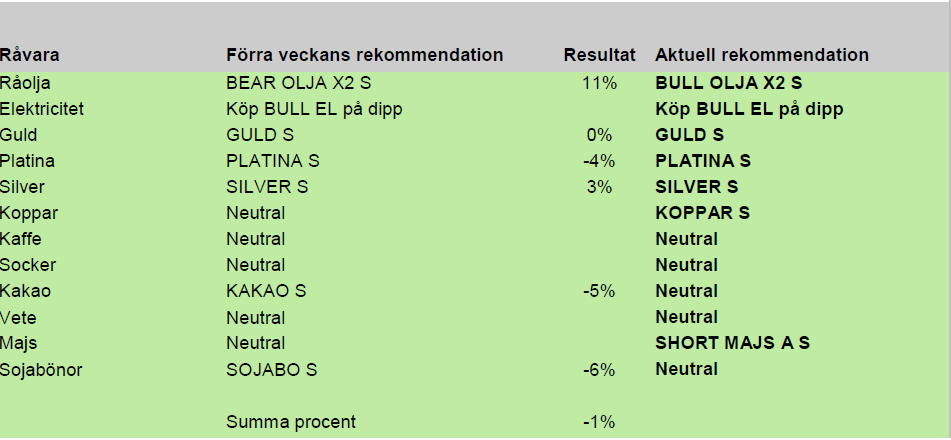
Summan av resultatet blev en liten förlust i veckan på -1%. Vi börjar bli något mer positiva till el jämfört med förra veckan. Efter rekylen i oljepriset är vi positiva till den också. Jordbruksprodukterna har successivt glidit över från köp- till neutral och nu sälj på majs. Möjligtvis kan det komma en rekyl upp på majs, vilket då blir ett säljtillfälle. För ädelmetaller är vi positiva. De gynnas på ett uppenbart sätt av monetär stimulans (“utan begränsning”) i USA, i Europa och i Japan.
Råolja – Brent
Brentkontraktet har, under en månads tid, fram till i måndags, handlats mellan 112 och 117 usd. Trots massiva stimulanser från FED och framgångarna i det europeiska arbetet mot en bankunion, har inte oljemarknaden lyckats bryta ur intervallet. Stundtals sökte sig priset ovan 117 men trycktes genast ned igen.
Vi har under en tid ansett att råoljan varit för högt prissatt. Det som mest drivit priset högre är utbudsstörningar i Nordsjön, stormen Isaac samt geopolitisk oro i Mellanöstern med sanktionerna mot Iran som största bidragare. Nu senast har ny oro tillkommit med de starka reaktionerna på Mohammed filmen. Samtidigt har Saudiarabien och bland annat Irak, producerat olja som mer än väl kompenserat bortfallet från Iran.
I förra veckan var all fokus på Federal Reserve, som också levererade, i linje med- eller mer än vad marknaden förväntat sig. Många tillgångsslag, inte minst metaller gick mycket starkt, både inför och efter FED beskedet. Oljan däremot var mer återhållen. Visserligen handlade man i en den övre delen av intervallet.
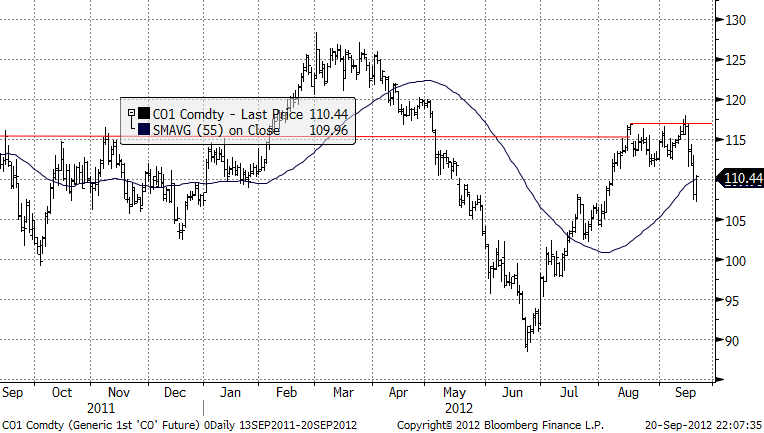
Därefter har dramatiken varit mycket stor. Det började med att amerikansk WTI olja på bara några minuter föll handlöst med 3-4 usd under extremt hög omsättning, se graf nedan. Teorierna kring vad som skedde är många, bland annat anges robothandel, ”fat fingers” och optionslösen som möjliga utlösande faktorer. Nymex ska ha inlett en undersökning. När den värsta röken lagt sig, så verkar det ändå som att även uttalanden och åtgärder från Saudiarabien, vilken länge agerat och argumenterat för lägre pris bidragit samt att marknaden, länge, faktiskt, negligerat negativ information. Kinesisk statistik visar bland annat på en svag utveckling i världens fabrik. I onsdags tilltog fallet då amerikansk oljelagerstatistik visade en mycket stor uppgång, +8.5 miljoner fat (mot förväntade +1.0) för råolja. Brent föll ned mot 107 men har sedan dess återhämtats och noteras senast på 109 usd.
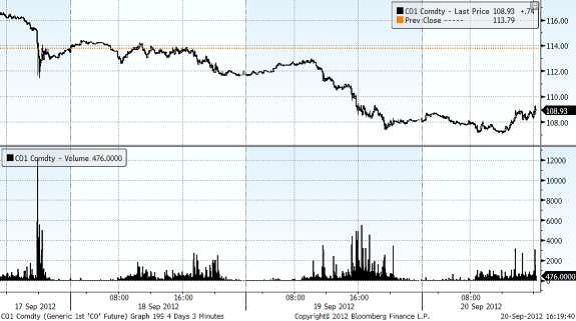
I nuläget förhåller vi oss neutral men ser nivåer kring 105 USD som en mycket attraktiv nivå för en lång position.
Elektricitet
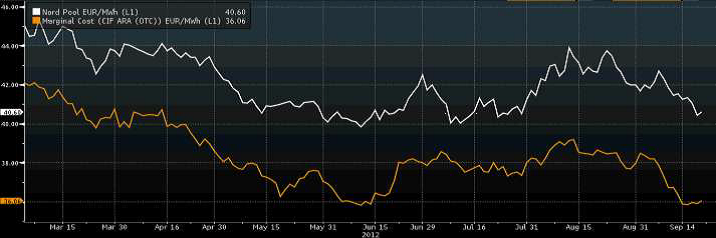
Elmarknaden har fortsatt nedåt och vi börjar närma oss nivåer för att börja bygga längd. Q1-13 terminen är senast omsatt på 40.70 EUR/MWh (tidigare kommunicerad target-nivå 40.00). Nedsidan börjar bli begränsad och vi står beredda på att köpa.
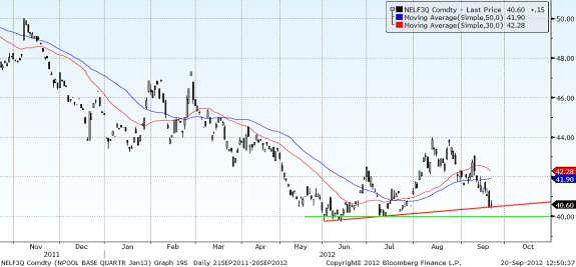
Väderprognoserna indikerar nu kallare och torrare väder och marginalkostnaden för koleldad elproduktion (MC kol), se graf nedan, vilken är en mycket viktig prisinput för de längre terminerna, har planat ut.
Just väderskifte och uppgång i MC kol är två viktiga ”triggers” för en prisuppgång. Q1-13 terminen på börsen har ännu inte stigit eller ens planat ut. Oftast brukar marknaden vara mycket snabb att ta till sig förändringar som dessa men än så länge är reaktionen väldigt försiktig. Vi räknar ändå med att uppsidan kan komma att bli explosiv, om än kanske kortvarig, varför en eventuell vinst bör tas hem relativt snabbt. En återgång till våtare/varmare väder kommer resultera i snabb korrektion ned igen. Brott av 40.00 nivån kan också öppna upp för större prisfall.
Vi håller fortsatt en neutral rekommendation men gör oss beredda att köpa.
Guld och Silver
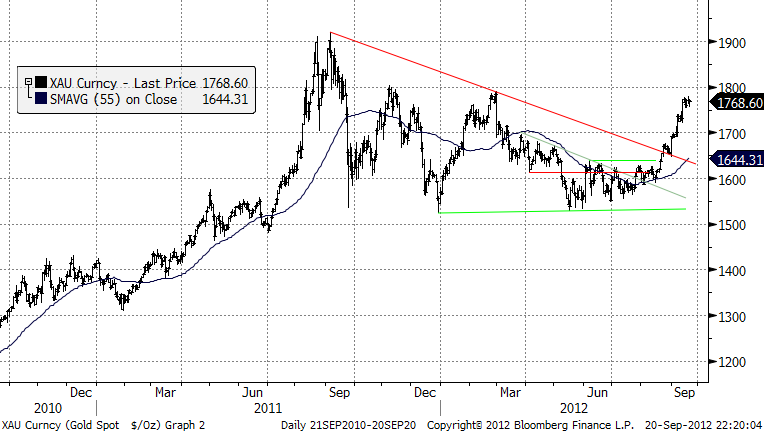
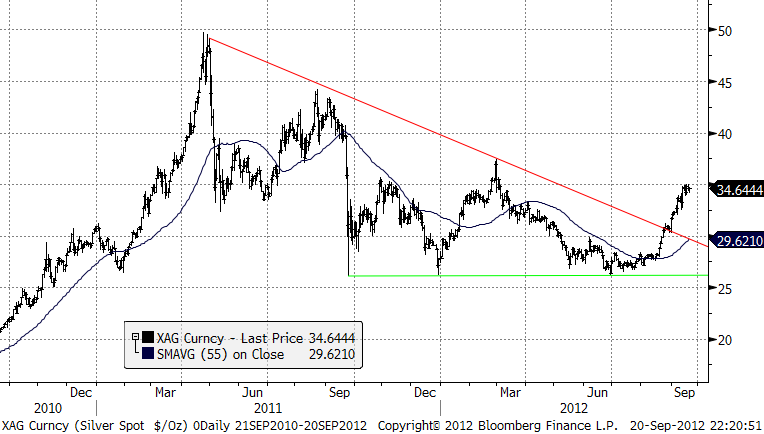
Efter den initiala reaktionen efter FED har guld och silver inte orkat klättra vidare. Många aktörer som köpt på förväntningar om ytterligare stimulanser har legat beredda att ta hem vinster. Det gamla ordspråket ”buy the rumour and sell the fact” verkar gälla den har veckan. Undertonen är ändå stark och rekylerna endast marginella. Vi bedömer att priserna har fortsatt mer att ge med nivån $1800 inom räckhåll för guld (spot i London handlas kring $1862 i skrivandes stund). En tänkbar strategi (för den som inte redan köpt) är att bevaka den tidigare högsta nivån $1780 och agera på ett genombrott. Scenariot är likartat för silver med rekommenderad bevakning av förra veckans toppnivå på $35/oz ($34,50 i skrivandes stund).
Nedan ser vi kursdiagrammet för guld i dollar per troy ounce.
Nedan ser vi kursdiagrammet för silver i dollar per troy ounce.
Platina
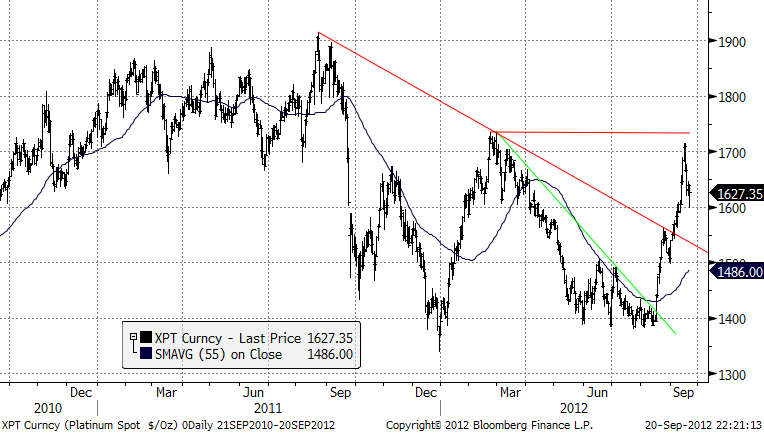
Nyheten att Strejken vid Lonmins gruva i Sydafrika avblåstes i början av veckan ledde till en massiv våg av vinsthemtagningar i platina. Priset har rekylerat ner ca 6 % sen toppen i förra veckan – detta efter en oavbruten uppgång sen mitten av augusti med mer än 20 % över perioden. Vi bedömer dagens nivå, strax över $1600, som klart köpvärd. Oroligheterna i Sydafrika, som står för 75 % av världsutbudet, är inte över, och strejkhoten hänger över fler gruvor efter Lonmins uppgörelse. Gruvorna har redan lönsamhetsproblem (går med förlust) och risken för fortsatt minskat utbud i landet är stor. Vi ser den här rekylen som ett köptillfälle.
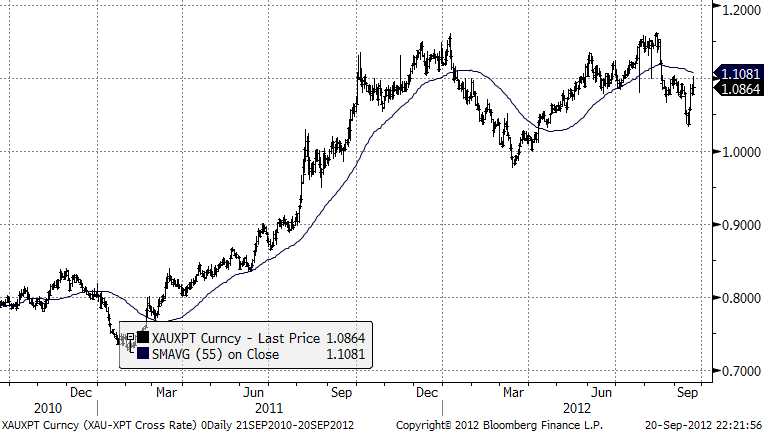
Nedan ser vi priset på guld dividerat med priset på platina. Vi ser att guld har utvecklats sämre än platina sedan mitten av augusti. Tekniskt ser den här trenden stark ut och har potential att gå från 1.05 till 1, dvs en outperformance på ytterligare 5% till platinas fördel. Det mesta av rörelsen från 1.15 är dock avklarad och platina har inte lång tid kvar att vara vår favorit bland ädelmetallerna.
Koppar
Effekten av FED:s penningpolitiska stimulanspaket slog igenom fullt ut förra fredagen med kraftiga prisuppgångar för både bas- och ädelmetaller. Veckan stängde på toppnivåer över hela linjen.
Efter en helg med eftertänksamhet och i viss mån ett uppvaknande med en industriell aktivitet globalt, som faktiskt är under avmattning, var stämningsläget mer avvaktande under denna vecka. Bank of Japan följde upp med ett paket natten mellan tisdag och onsdag, vilket ingav visst mod igen. Oljemarknaden har förbryllat många aktörer och går mot strömmen. Måndagskvällens något oförklarliga ras (oljan föll 4 % inom loppet av ett par minuter), följdes upp av ett kraftigt prisfall på onsdagskvällen, bl.a. efter större lagerökningar i USA än väntat. Oljefallet spred sig till metallerna som dessutom tappade mark efter en svag inköpschefsindex från Kina.
Priserna har nu överlag kommit tillbaka 1-4 % efter uppgångar i storleksordningen 10 % de senaste två veckorna. Undertonen är fortsatt stark med stöd av stimulanser. Nu måste den verkliga fysiska efterfrågan också komma ifatt. Än så länge är det lite tveksamt och marknaden kommer stå och väga för och emot de närmsta dagarna. Koppar är faktiskt upp sedan förra brevet och handlas idag torsdag till $8278 ($3,75(Lbs).
Toppnoteringen förra fredagen noterades till $8422. Marknaden har således endast fallit marginellt. Vi bedömer att finansiella aktörer som tidigare spekulerat i nedgång, nu har återköpt positioner. Tekniska fonder har börjat gå långa.
Industrin är än så länge avvaktande och brottas med en prisuppgång som inte riktigt speglar den
fundamentala situationen, och i många fall överstiger lagda budgetnivåer. Frågan är när (och om) industrin tvingas ”bita i det sura äpplet” och täcka in framtida behov. Centralbankerna visar att de menar allvar och stimulanserna fortsätter. Aktörerna väntar på mer från Kina. Mycket talar för en fortsatt stark trend i nästa vecka med test av nivåer upp mot $8500.
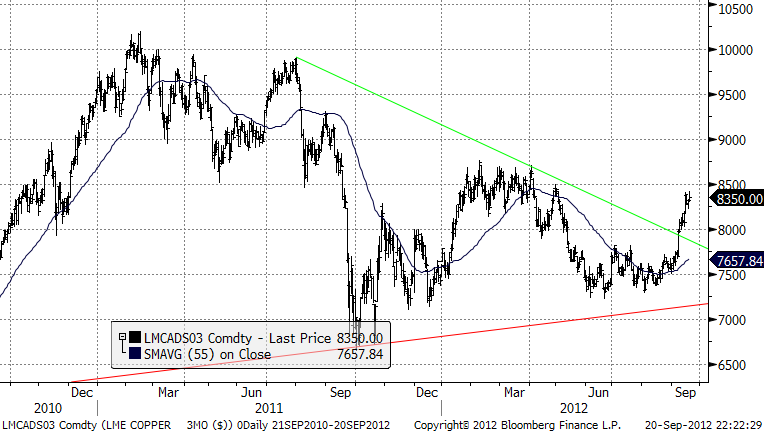
Vi väljer att på kort sikt rekommendera en lång position i koppar.
Kaffe
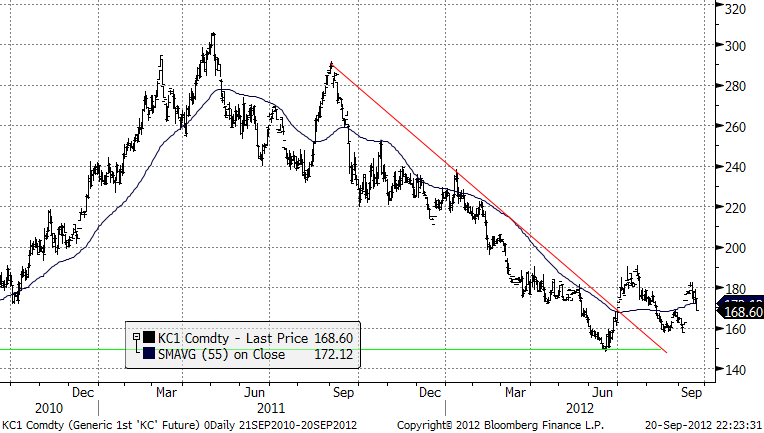
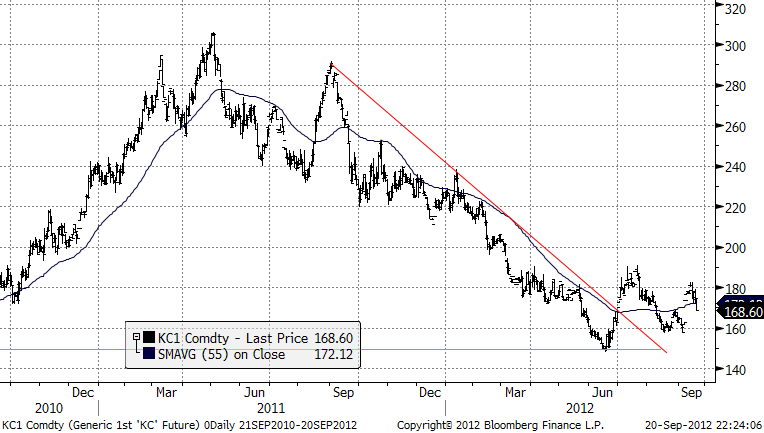
Kaffepriset har fortsatt att falla vilket till största del beror på att världens största kaffeproducent Brasilien har valt att gradvis sälja landets överskott av kaffe efter den senaste tidens prisuppgång. Som världens största kaffeodlande land står Brasilien för hela 25 procent av världens kaffeproduktion och ungefär 80 procent av landets produktion utgörs av arabicabönan.
Enligt Agriculture Ministry i Brasilien förväntas årets skörd motsvara 50,5 miljoner bags jämfört med 43,5 miljoner bags för samma period föregående år, en bag kaffe motsvarar cirka 60 kg. Skörden i Brasilien sträcker sig från april till september. En ökad export från Brasilien som en följd av försvagningen av landets valuta har bidragit till det lägre priset. Den ekonomiska osäkerhet som råder globalt väger också tungt på kaffemarknaden.
Socker
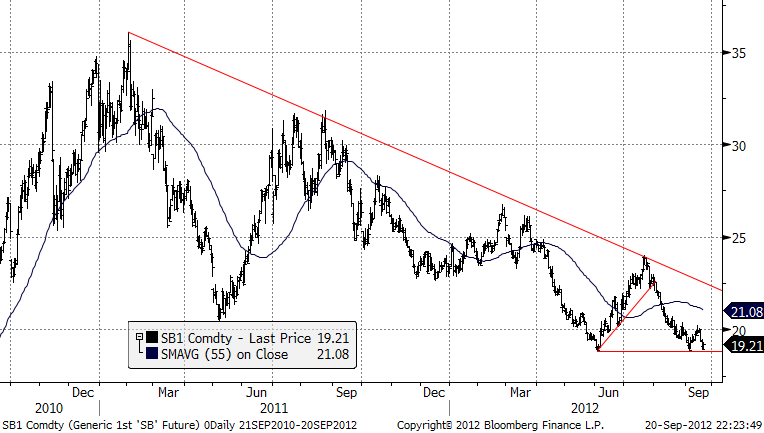
Priset på socker har fallit 3 procent under veckan som gått och handlar nu strax över 20 US cents per pound.
Som vi nämnt ovan så förväntas El Niño bli mild och således inte att medföra större produktionsstörningar i sockerproducerande länder. Terminskontrakt på socker i New York föll till tvåårslägsta efter att torrt väder och lagom mycket regn i Brasilien, världens största sockerproducent, gynnat utvinning av socker från sockerrör. Monsunregn i Indien, världens andra största sockerproducent, ökade förväntningarna på kommande skörd. Den förväntade utbudsökning har pressat ned priset på socker. Förra årets rekordhöga priser ledde till att Kina kraftigt ökade sockerproduktionen. Landet är världens största sockerimportör men kommer efter årets förväntade rekordskörd att minska importen och istället bli en nettoexportör. Sockerskörden i Kina inleds under oktober månad.
För 2012/13 spår International Sugar Organization ett globalt utbudsöverskott på 5,9 miljoner ton, något som begränsar uppsidepotentialen på socker.
Kakao
Kakaopriset fortsatte att falla efter förväntat regn i Elfenbenskusten och Ghana, världens största kakaoproducenter, vilket ökat förhoppningarna om skörden. Väderutsikterna i länderna de närmaste månaderna är avgörande för prisutvecklingen. Historiskt ser vi höga priser och stora investeringar har gjorts i Ghana vilket kan begränsa uppsidan.
Kakaomarknaden är en mycket oförutsägbar och känslig marknad där åtskilliga faktorer påverkar priset.
Flera av de kakaoproducerande länderna lider av inhemska oroligheter och det krävs stora investeringar och långsiktighet för att ett kakaoträd ska bära frukt. Produktionen är ofta kantad av protester och strejker om bättre arbetsförhållanden och träden är dessutom känsliga för sjukdomar.
Kakaopriset finner visst stöd från de diskussioner som förs mellan IMF och Elfenbenskustens Coffee and Cocoa Council, där det råder viss oenighet kring frakt av kakao. Exportörer som köpt kakao på landets elektroniska börs är inte säkra på att de verkligen får kakaon levererad.
Vi väljer att vara neutrala i kakao till nästa vecka.
Politik på agrimarknaden
Frankrike har kallat till ett krismöte med G20’s jordbruksministrar i mitten av oktober i Rom på för att diskutera hur man ska kunna bromsa de kraftiga prissvängningarna i spannmålsmarknaden, efter att årets torka och rekordhöga priser har skapat nya farhågor om en global matkris. Uttalandet kom efter samtal mellan Frankrikes president Francois Hollande och Jose Graziano da Silva, generaldirektör för FN:s livsmedels- och jordbruksorganisation (FAO). Flera förslag har lagts fram under de senaste dagarna, bland annat utveckling av strategiska lager och ett stopp i expanderingen av biobränsle som tillverkas av matgrödor.
För spannmål och övriga jordbruksprodukter hänvisas till gårdagens nyhetsbrev om jordruksprodukter.
[box]SEB Veckobrev Veckans råvarukommentar är producerat av SEB Merchant Banking och publiceras i samarbete och med tillstånd på Råvarumarknaden.se[/box]
Disclaimer
The information in this document has been compiled by SEB Merchant Banking, a division within Skandinaviska Enskilda Banken AB (publ) (“SEB”).
Opinions contained in this report represent the bank’s present opinion only and are subject to change without notice. All information contained in this report has been compiled in good faith from sources believed to be reliable. However, no representation or warranty, expressed or implied, is made with respect to the completeness or accuracy of its contents and the information is not to be relied upon as authoritative. Anyone considering taking actions based upon the content of this document is urged to base his or her investment decisions upon such investigations as he or she deems necessary. This document is being provided as information only, and no specific actions are being solicited as a result of it; to the extent permitted by law, no liability whatsoever is accepted for any direct or consequential loss arising from use of this document or its contents.
About SEB
SEB is a public company incorporated in Stockholm, Sweden, with limited liability. It is a participant at major Nordic and other European Regulated Markets and Multilateral Trading Facilities (as well as some non-European equivalent markets) for trading in financial instruments, such as markets operated by NASDAQ OMX, NYSE Euronext, London Stock Exchange, Deutsche Börse, Swiss Exchanges, Turquoise and Chi-X. SEB is authorized and regulated by Finansinspektionen in Sweden; it is authorized and subject to limited regulation by the Financial Services Authority for the conduct of designated investment business in the UK, and is subject to the provisions of relevant regulators in all other jurisdictions where SEB conducts operations. SEB Merchant Banking. All rights reserved.

Down on Friday. Up on Monday. The Brent June crude oil contract traded down 5.1% last week to a close of $90.38/b. It reached a high of $103.87/b last Monday and a low of $86.09/b on Friday as Iran announced that the Strait of Hormuz was fully open for transit. That quickly changed over the weekend as the US upheld its blockade of Iranian oil exports while Iran naturally responded by closing the SoH again. The US blew a hole in the engine room of the Iranian ship TOUSKA and took custody of the ship on Sunday. Brent crude is up 5.6% this morning to $95.4/b.

The cease-fire is expiring tomorrow. The US has said it will send a delegation for a second round of negotiations in Islamabad in Pakistan. But Iran has for now rejected a second round of talks as it views US demands as unrealistic and excessive while the US is also blocking the Strait of Hormuz.
While Brent is up 5% this morning, the financial market is still very optimistic that progress will be made. That talks will continue and that the SoH will fully open by the start of May which is consistent with a rest-of-year average Brent crude oil price of around $90/b with the market now trading that balance at around $88/b.
Financial optimism vs. physical deterioration. We have a divergence where the financial market is trading negotiations, improvements and resolution while at the same time the physical market is deteriorating day by day. Physical oil flows remain constrained by disrupted flows, longer voyage times and elevated freight and insurance costs.
Financial markets are betting that a US/Iranian resolution will save us in time from violent shortages down the road. But every day that the SoH remains closed is bringing us closer to a potentially very painful point of shortages and much higher prices.
The US blockade is also a weapon of leverage against its European and Asian allies. When Iran closed the SoH it held the world economy as a hostage against the US. The US blockade of the SoH is of course blocking Iranian oil exports. But it is also an action of disruption directed towards Europe and Asia. The US has called for the rest of the world to engaged in the war with Iran: ”If you want oil from the Persian Gulf, then go and get it”. A risk is that the US plays brinkmanship with the global oil market directed towards its European and Asian allies and maybe even towards China to force them to engage and take part. Maybe unthinkable. But unthinkable has become the norm with Trump in the White House.
Wild moves yesterday. Brent crude traded to a high of $114.43/b and a low of $96.0/b and closed at $99.94/b yesterday.
US – Iran negotiations ongoing or not? What a day. Donald Trump announced that good talks were ongoing between Iran and the US and that the 48 hour deadline before bombing Iranian power plants and energy infrastructure was postponed by five days subject to success of ongoing meetings. Iranian media meanwhile stated that no meetings were ongoing at all.
Today we are scratching our heads trying to figure out what yesterday was all about.
Friends and family playing the market? Was it just Trump and his friends and family who were playing with oil and equity markets with $580m and $1.46bn in bets being placed by someone in oil and equity markets just 15 minutes before Trump’s announcement?
Was Trump pulling a TACO as he reached his political and economic pain point: Brent at $112/b, US Gas at $4/gal, SPX below 200dma and US 10yr above 4.4%?
Different Iranian factions with Trump talking with one of them? Are there real negotiations going on but with the US talking to one faction in Iran while another, the hardliners, are not involved and are denying any such negotiations going on?
Extending the ultimatum to attack and invade Kharg island next weekend? Or, is the five day delay of the deadline a tactical decision to allow US amphibious assault ships and marines to arrive in the Gulf in the upcoming weekend while US and Israeli continues to degrade Iranian military targets till then. And then next weekend a move by the US/Israel to attack and conquer for example the Kharg island?
We do not really know which it is or maybe a combination of these.
We did get some kind of TACO ydy. But markets have been waiting for some kind of TACO to happen and yesterday we got some kind of TACO. And Brent crude is now trading at $101.5/b as a result rather than at $112-114/b as it did no the high yesterday.
But what really matters in our view is the political situation on the ground in Iran. Will hardliners continue to hold power or will a more pragmatic faction gain power?
If the hardliners remain in power then oil pain should extend all the way to US midterm elections. The hardliners were apparently still in charge as of last week. Iran immediately retaliated and damaged LNG infrastructure in Qatar after Israel hit Iranian South Pars. The SoH was still closed and all messages coming out of Iran indicated defiance. Hardliners continues in power has a huge consequence for oil prices going forward. The regime has played its ’oil-weapon’ (closing or chocking the Strait of Hormuz). It is using it to achieve political goals. Deterrence: it needs to be so politically and economically expensive to attack Iran that it won’t happen again in the future. Or at least that the US/Israel thinks 10-times over before they attack again. The highest Brent crude oil closing price since the start of the war is $112.19/b last Friday. In comparison the 20-year inflation adjusted Brent price is $103/b. So Brent crude last Friday at $112.19/b isn’t a shockingly high price. And it is still far below the nominal high of $148/b from 2008 which is $220/b if inflation adjusted. So once in a lifetime Iran activates its most powerful weapon. The oil weapon. It needs to show the power of this weapon and it needs to reap political gains. Getting Brent to $112/b and intraday high of $119.5/b (9 March) isn’t a display of the power of that weapon. And it is not a deterrence against future attacks.
So if the hardliners remain in power in Iran, then the SoH will likely remain chocked all the way to US midterm elections and Brent crude will at a minimum go above the historical nominal high of $148/b from 2008.
Thus the outlook for the oil price for the rest of the year doesn’t depend all that much of whether Trump pulls a TACO or not. Stops bombing or not. It depends more on who is in charge in Iran. If it is the hardliners, then deterrence against future attacks via chocking of the SoH and high oil prices is the likely line of action. It is impacting the world but the Iranian ’oil-weapon’ is directed towards the US president and the the US midterm elections.
If a pragmatic faction gets to power in Iran, then a very prosperous future is possible. However, if power is shifting towards a more pragmatic faction in Iran then a completely different direction could evolve. Such a faction could possibly be open for cooperation with the US and the GCC and possibly put its issues versus Israel aside. Then the prosperity we have seen evolving in Dubai could be a possible future also for Iran.
So far it looks like the hardliners are fully in charge. As far as we can see, the hardliners are still fully in control in Iran. That points towards continued chocking of the SoH and oil prices ticking higher as global inventories (the oil market buffers) are drawn lower. And not just for a few more weeks, but possibly all the way to the US midterm elections.
A brief sigh of relief yesterday as oil infra at Kharg wasn’t damaged. But higher today. Brent crude dabbled around a bit yesterday in relief that oil infrastructure at Iran’s Kharg island wasn’t damaged. It traded briefly below the 100-line and in a range of $99.54 – 106.5/b. Its close was near the low at $100.21/b.
No easy victorious way out for Trump. So no end in sight yet. Brent is up 3.2% today to $103.4/b with no signs that the war will end anytime soon. Trump has no easy way to declare victory and mission accomplished as long as Iran is in full control of the Strait of Hormuz while also holding some 440 kg of uranium enriched to 60% and not far from weapons grade at 90%. As long as these two factors are unresolved it is difficult for Trump to pull out of the Middle East. Naturally he gets increasingly frustrated over the situation as the oil price and US retail gas prices keeps ticking higher while the US is tied into the mess in the Middle East. Trying to drag NATO members into his mess but not much luck there.
When commodity prices spike they spike 2x, 3x, 4x or 5x. Supply and demand for commodities are notoriously inflexible. When either of them shifts sharply, the the price can easily go to zero (April 2022) or multiply 2x, 3x, or even 5x of normal. Examples in case cobalt in 2025 where Kongo restricted supply and the price doubled. Global LNG in 2022 where the price went 5x normal for the full year average. Demand for tungsten in ammunition is up strongly along with full war in the middle east. And its price? Up 537%.
Why hasn’t the Brent crude oil price gone 2x, 3x, 4x or 5x versus its normal of $68/b given close to full stop in the flow of oil of the Strait of Hormuz? We are after all talking about close to 20% of global supply being disrupted. The reason is the buffers. It is fairly easy to store oil. Commercial operators only hold stocks for logistical variations. It is a lot of oil in commercial stocks, but that is predominantly because the whole oil system is so huge. In addition we have Strategic Petroleum Reserves (SPRs) of close to 2500 mb of crude and 1000 mb of oil products. The IEA last week decided to release 400 mb from global SPR. Equal to 20 days of full closure of the Strait of Hormuz. Thus oil in commercial stocks on land, commercial oil in transit at sea and release of oil from SPRs is currently buffering the situation.
But we are running the buffers down day by day. As a result we see gradually increasing stress here and there in the global oil market. Asia is feeling the pinch the most. It has very low self sufficiency of oil and most of the exports from the Gulf normally head to Asia. Availability of propane and butane many places in India (LPG) has dried up very quickly. Local prices have tripled as a result. Local availability of crude, bunker oil, fuel oil, jet fuel, naphtha and other oil products is quickly running down to critical levels many places in Asia with prices shooting up. Oman crude oil is marked at $153/b. Jet fuel in Singapore is marked at $191/b.
Oil at sea originating from Strait of Hormuz from before 28 Feb is rapidly emptied. Oil at sea is a large pool of commercial oil. An inventory of oil in constant move. If we assume that the average journey from the Persian Gulf to its destinations has a volume weighted average of 13.5 days then the amount of oil at sea originating from the Persian Gulf when the the US/Israel attacked on 28 Feb was 13.5 days * 20 mb/d = 269 mb. Since the strait closed, this oil has increasingly been delivered at its destinations. Those closest to the Strait, like Pakistan, felt the emptying of this supply chain the fastest. Propane prices shooting to 3x normal there already last week and restaurants serving cold food this week is a result of that. Some 50-60% of Asia’s imports of Naphtha normally originates from the Persian Gulf. So naphtha is a natural pain point for Asia. The Gulf also a large and important exporter of Jet fuel. That shut in has lifted jet prices above $200/b.
To simplify our calculations we assume that no oil has left the Strait since that date and that there is no increase in Saudi exports from Yanbu. Then the draining of this inventory at sea originated from the Persian Gulf will essentially look like this:
The supply chain of oil at sea originating from the Strait of Hormuz is soon empty. Except for oil allowed through the Strait of Hormuz by Iran and increased exports from Yanbu in the Red Sea. Not included here.
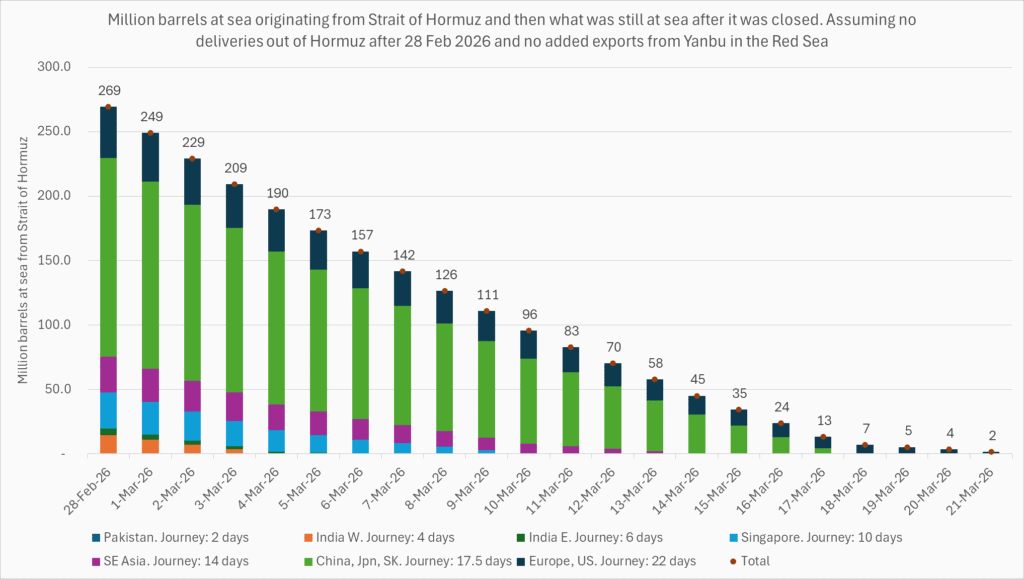
Oil at sea is falling fast as oil is delivered without any new refill in the Persian Gulf. Waivers for Russian crude is also shifting Russian crude to consumers. Brent crude will likely start to feel the pinch much more forcefully when oil at sea is drawn down another 200 mb to around 1000 mb. That is not much more than 10 days from here.
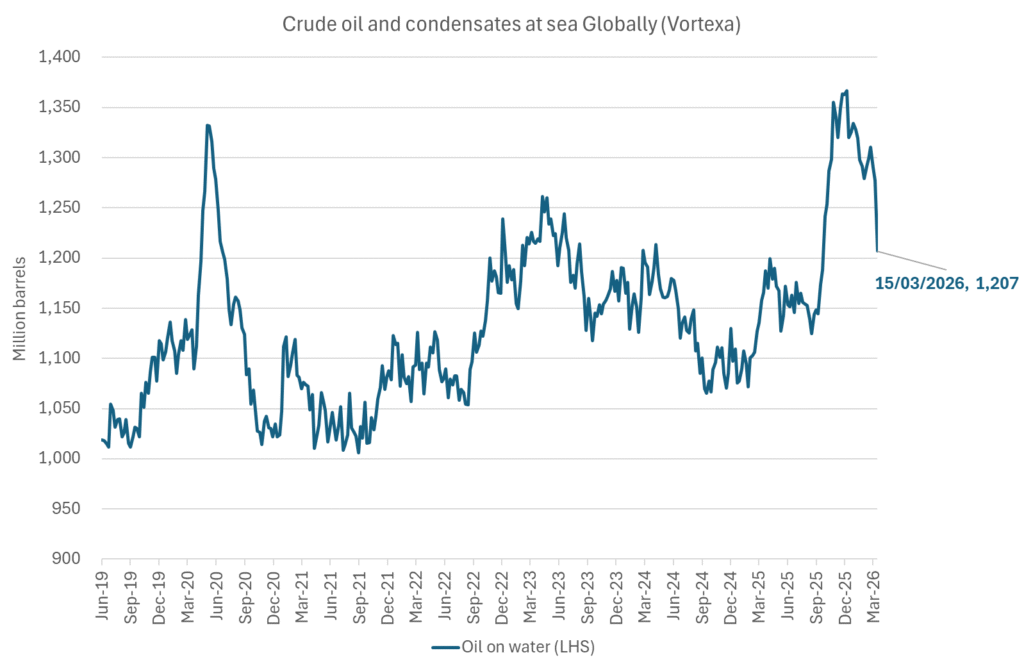
Oil and oil products are starting to become very pricy many places. Brent crude has still been shielded from spiking like the others.
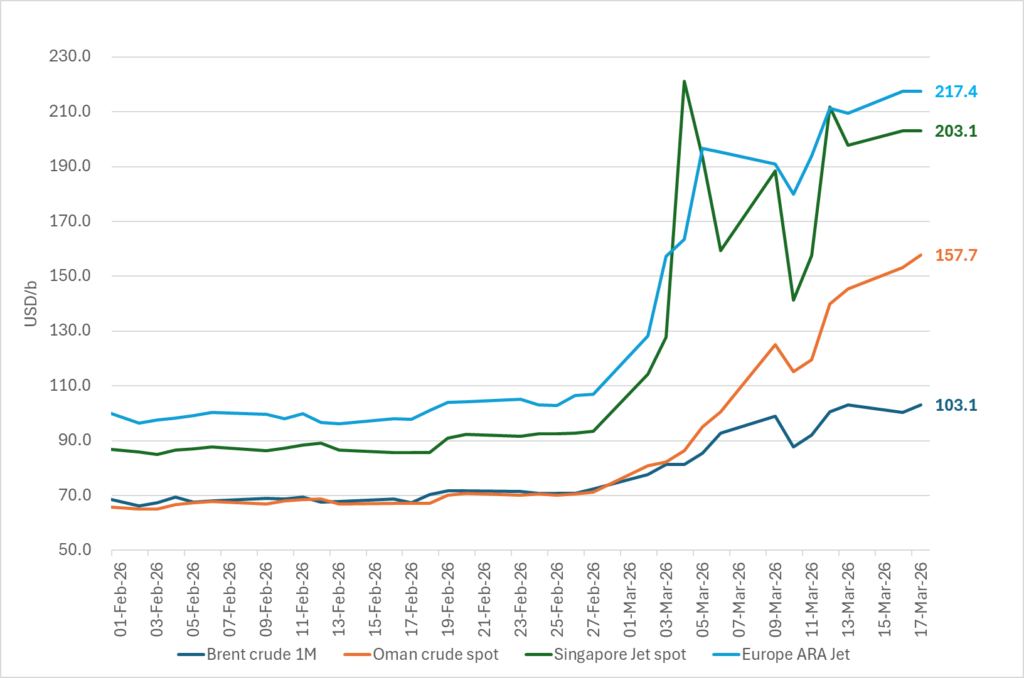



Market Still Betting on Timely Resolution, But Each Day Raises Shortage Risk

Christian Kopfer om läget för oljan

Marknaden måste börja betrakta de höga kopparpriserna som det nya normala

Det fysiska spotpriset på brentolja har slagit nytt rekord

40 minuter med Javier Blas om hur världen verkligen påverkas av energikrisen
40 minuter med Javier Blas om hur världen verkligen påverkas av energikrisen

Elpriserna fördubblas, stor osäkerhet inför sommaren

MP Materials, USA:s svar på Kinas dominans över sällsynta jordartsmetaller
Det fysiska spotpriset på brentolja har slagit nytt rekord

Studsvik har idag ansökt om att få bygga 1200-1600 MW kärnkraft i Valdemarsvik
-
 Nyheter3 veckor sedan
40 minuter med Javier Blas om hur världen verkligen påverkas av energikrisen
-
 Nyheter4 veckor sedan
Elpriserna fördubblas, stor osäkerhet inför sommaren
-
 Nyheter4 veckor sedan
MP Materials, USA:s svar på Kinas dominans över sällsynta jordartsmetaller
-
 Nyheter2 veckor sedan
Det fysiska spotpriset på brentolja har slagit nytt rekord
-
 Nyheter4 veckor sedan
Studsvik har idag ansökt om att få bygga 1200-1600 MW kärnkraft i Valdemarsvik
-
 Nyheter2 veckor sedan
Marknaden måste börja betrakta de höga kopparpriserna som det nya normala
-
Analys4 veckor sedan
TACO (or Whatever It Was) Sends Oil Lower — Iran Keeps Choking Hormuz
-

 Nyheter4 veckor sedan
Matproduktion är beroende av gödsel, Gulfkriget skapar brist