

Analys
SEB Råvarubrev 16 februari 2016

 Ökad riskaptit?
MARKNADEN I KORTHET
Förra veckan gick i volatilitetens tecken med stora slag fram och tillbaka i de flesta tillgångsslag. Veckan avslutades dock i dur med solida uppgångar på börserna såväl som i ett antal råvaror, men nervositeten är fortsatt stor. Kina har firat nyår hela förra veckan och således bör måndagens nedgång ses som en reaktion på förra veckans globala nedgång. Geopolitiskt så bör hotet om ett turkiskt/saudiskt ingripande i Syrien bevakas noga då en sådan utveckling riskerar att leda till en icke önskvärd eskalering.
Råvaror: Större delen av veckan karakteriserades av fallande priser vilka dock till viss del reverserades under fredagen. Eventuellt spelade täckning av korta positioner inför den amerikanska långhelgen (måndag = President’s Day) en viss roll. Dock bör beteendet bevakas noga då det finns en tendens till att en marknad som är kort och som börjar minska risk på fredagar ofta befinner sig i ett förstadium till en större korrektion. Nymex lättolja skapade ett falskt veckobrott på nedsidan, koppar har skapat en möjlig, men inte bekräftad, bottenformation och soja ser ut att närma sig ett kommande utbrott på nedsidan.
Valuta: Riksbankens reporäntesänkning blev större än förväntat vilket initialt försvagade kronan som dock sedan dess återhämtat sig något. Dollarn var fortsatt svag under större delen av veckan men tog tillbaka en del styrka under fredagen (är rekylbotten nu nådd?). Yen-förstärkningen utlöste en våg av stoppar då USD/JPY bröt under 116.
Börser: Måndagensfall i Kina (som ju var stängda förra veckan) bör inte ses som något annat än en anpassning till omvärldens utveckling förra veckan. Lättnadsrallyt som började i fredags ser ut att ha mer att ge i mina ögon, givet det extremt negativa sentimentet (”när alla tänker lika, tänker inte någon särskilt mycket” – W.J. Lippman).
Räntor: Utvecklingen i den tyska 10-åringen (%) väcker i alla fall en berättigad fråga huruvida en dubbelbotten är i görningen. – 0,50 % är den nya reporäntan i Sverige.
TRENDER I SAMMANDRAG
- Divergens mellan Nymex och Brentoljorna då den förstnämnda nådde en ny men ytterst temporär botten medan den andra skapat en möjlig högre botten. Båda beteendena pekar på mer rekylpotential i närtid.
- Kaffe ser fortsatt svagt ut (vi behåller förra veckans säljrekommendation).
- USD nådde eventuellt sin korrektionsbotten förra veckan.
- Guldkorrektionen ger ett nytt köpläge.
VECKANS REKOMMENDATIONER

En placering i certifikat och warranter är förknippat med risker. Du kan förlora hela ditt investerade kapital. Läs mer om riskerna i SEB:s offentliggjorda Grundprospekt för certifikat- och warrantprogram på www.seb.se/cert eller www.seb.se/mini
OLJA BRENT
 TREND
TREND
- EIAs rapport pekade på lägre efterfrågetillväxt 2016 än 2015
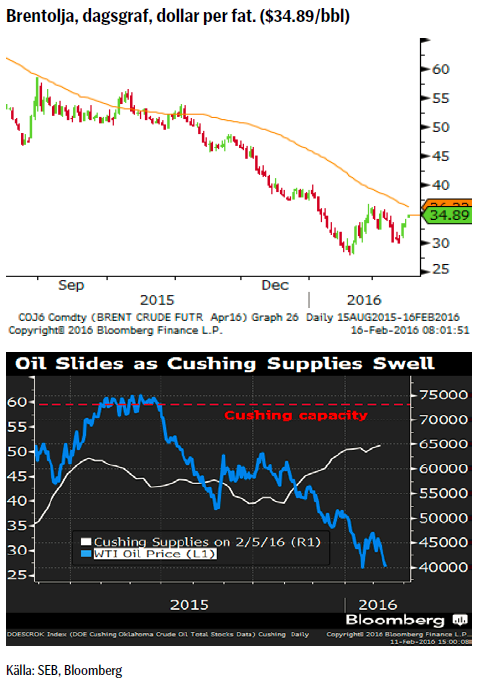
- Oljelagren minskade något förra veckan men ligger fortfarande på historiskt väldigt höga nivåer. Svagare ekonomi, motståndskraftigare skiffer- oljeproduktion eller en mix av båda? Lagren i Cushing närmar sig sin maxkapacitet (se nedan)
- OPECs februarirapport signalerade ytterligare något ökad produktion.
- Antalet borriggar fortsatte ned från 467 till 439 (avser perioden t.o.m. 12:e februari).
- Rykten om Ryssland/Saudimöte avseende produktionsneddragningar (vilka inte bör ge några långsiktigare återverkningar).
- Givet den svagare efterfrågeökningen och långsammare produktionsnedgången ser vi fortfarande nedåtpotential (dock avtagande nedgångstakt) för oljan varför vi rekommenderar att sälja rekyler.
- Håll ögonen på utvecklingen i Syrien. Sätts Turkisk/Saudisk trupp in riskerar vi en eskalering av konflikten.
REKOMMENDATION
- Vi rekommenderar fortfarande en strategi bestående av att sälja in i korrektioner (idealmål = $39/bbl)
EL
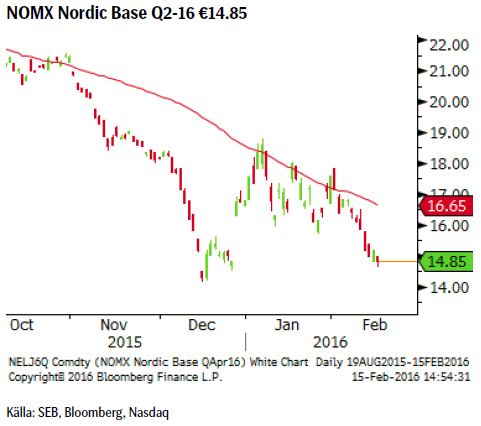 Så börjar vintern så sakteliga gå mot sitt slut och slutet verkar enligt prognoserna bli både mildare och med något mer nederbörd än normalt. Följaktligen så ser vi inte någon större potential för elpriset att i närtid röra sig uppåt (och skulle det göra det så bör det snarare ses som ett säljläge). Det mest troliga är att vi fortsätter handla i den lägre delen av det intervall som utvecklats sedan mitten av december, €14 – 18.
TREND
- Trenden är fortsatt i fallande och marknaden har fortsatt att sälja så fort priset tagit sig över 55dagars medelvärdet.
- Hydrobalansen ligger över sitt historiska snitt.
- 10-dagars prognos pekar mot en mildare och nederbördsrikare än normalt.
- Kärnkraften levererar för närvarande 94 % av kapacitet och inga driftstopp är planerade.
REKOMMENDATION
- BEAR EL X4 S om priset når 55dagars medelvärdet (just nu = €16.65).
KOPPAR (LME 3M)
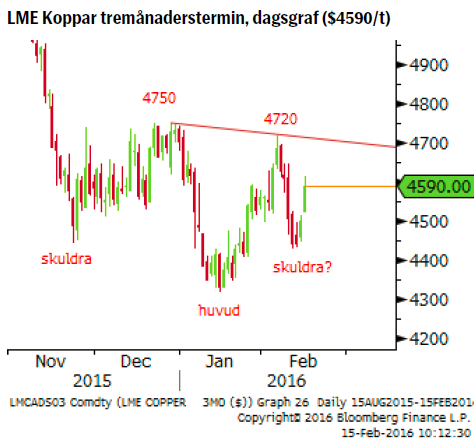 Koppar avslutade förra veckan med att stiga tillsammans med ett något förbättrat risksentiment. Än så länge så ser korrektionen ut som att den har kraft kvar varför vi tror på en fortsatt uppgång mot det väldigt intressanta området 4,720 – 4,750, där samtliga rekyler sedan november vänt.
TREND
- Sentiment fortsätter att vara svagt med pristrenden obrutet fallande (lägre toppar).
- Indonesien har förlängt PT Freeports exportlicens med ytterligare sex månader.
- Samtidigt planeras minst en Kanadensisk gruva att läggas i malpåse (beslut dock ej taget än). Glencore’s produktion minskade med 6 % under 2015.
- Dessutom rapporterade Glencore förra veckan att de ser produktionen i år falla till 1,390 kiloton (ned från 1,502 under 2015).
- En möjlig men ännu obekräftad bottenformation (inverterad huvud/skuldrabotten) i prisgrafen bör bevakas noga (bekräftas vid ett pris över 4,720).
REKOMMENDATION
- Den som är kort koppar bör överväga att stänga en sådan position om 4720/4750 nivån passeras då troligen en mer betydande korrektion är på väg.
USD/SEK
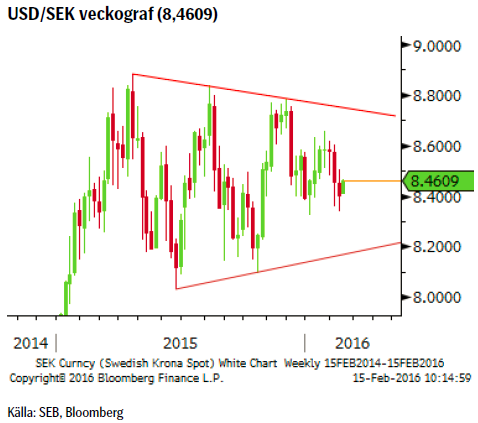 Börjar det nu bli dags för marknaden att ta nästa steg i uppåttrenden? Vi tror så och förbereder oss följaktligen inför ett förväntat brott upp ur den årslånga konsolideringen.
TREND
- Vi befinner oss sedan mars 2015 i en stor (8.03 – 8.88) kontrakterande konsolideringsfas vilken vi nu tror befinner sig i sin slutfas.
- Triangulära konsolideringar (i en uppåttrend) är normalt sett ett fortsättningsmönster för vidare uppgång.
- Även om marknaden tvivlar på takten av Feds förväntade räntehöjningar så bör vi ändå räkna med en gradvis ökad ränteskillnad mellan FED och Riksbanken.
REKOMMENDATION
- BULL USD/SEK X4 S (vi söker ett brott upp ur triangeln)
GULD
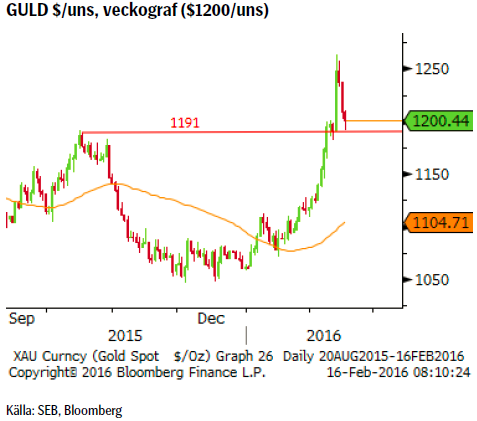 Guldet (och guldgruveaktier) har sedan förra veckan fortsatt att utvecklats positivt, dock avslutades veckan med fallande priser. Innevarande vecka har också börjat negativt men vi förväntar oss att sentimentet snart vänder tillbaka till ett mer positivt. Det är ju inte ovanligt att efter en så stark uppgång som vi haft de senaste veckorna att marknaden behöver hämta andan. Vi upprepar förra veckans ide om en uppgång till initialt 1300/1350 området varför nuvarande reaktion bör ses som ett köptillfälle.
TREND
- Prisuppgången under året har skett i en allt mer parabolisk prisbana vilket antagligen inte är uthålligt på kort sikt.
- En mjukare hållning från FED har gjort dollarköparna något mer osäkra.
- Vår rekommendation från förra veckan att köpa vid en sättning till 1146 har inte utlösts då priset fortsatt högre utan någon korrektion.
- Efter att ha passerat en tidigare rekyltopp finns det en tendens att återtesta och validera detta brott. Följaktligen borde det finnas utrymme för priset att falla ned mot 1190 – 1180 området innan en ny uppgångsfas borde ta sin början.
- Statistiken (Commitment of Traders report) från US CFTC visar på en kraftig uppbyggnad av långa futureskontrakt.
REKOMMENDATION
- BULL GULD X2S vid ett återtest under utbrottet (1191) idealt 1181/82.
SOJABÖNOR
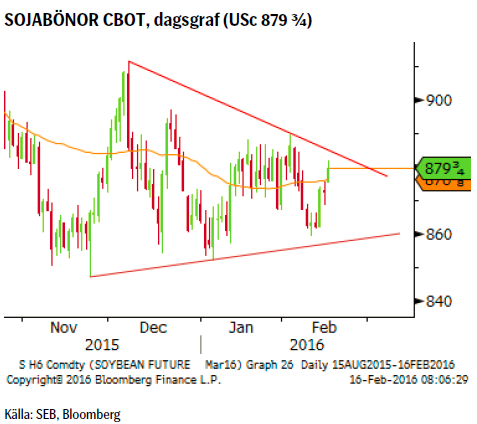 Det mesta talar för att sojamarknaden är på väg in i vad som kan vara en turbulent tid. Ett Argentina (världens tredje största producent) på stereoider (devalvering, sänkta skatter och ökad produktionsareal 2016) utgör en stor risk för ytterligare utbud med påföljande prisnedgångar.
TREND
- I princip har priset befunnit sig i en konsolidering sedan den senaste bottennoteringen i november. Det finns nu tecken på att denna nu är på väg att ebba ut och att den underliggande björntrenden snart ska fortsätta.
- Den senaste jordbruksrapporten (WASDE) från det amerikanska jordbruksdepartementet visar på fortsatt ökande lager samt förväntan om ökad konkurrens från Argentina.
- Argentinska odlare har också byggt upp sina lager och lagt mark i träda i protest mot den tidigare presidentens politik (bl.a. exportskatter) vilket nu förväntas förändras.
- Den argentinska peson har fallit med cirka 40 % sedan december vilket ger en extra skjuts åt argentinsk export.
- Vi förväntar oss att priset vänder ned senast från 890 US cent/bushel.
REKOMMENDATION
- BEAR SOJABÖNOR X4 S
AKTUELLA REKOMMENDATIONER

[box]SEB Veckobrev Veckans råvarukommentar är producerat av SEB:s Commodities Sales desk och publiceras i samarbete och med tillstånd på Råvarumarknaden.se[/box]
KÄLLOR
Bloomberg, Reuters, SEB
VILLKOR
För varje enskilt certifikat/mini future finns Slutliga Villkor som anger de fullständiga villkoren. Slutliga Villkor finns tillgängligt på kurssidan för respektive certifikat/mini future på www.seb.se, Börs & finans, fliken Strukturerade placeringar.
RISKER
En sammanfattning av de risker som är förknippade med Börshandlade certifikat generellt finns i Produktbroschyren för respektive certifikat eller mini future som är tillgängligt på seb.se/cert respektive seb.se/mini. För en fullständig bild av riskerna behöver du ta del av SEB:s offentliggjorda Grundprospekt för Certifikat- och Warrantprogram som är publicerat på www.seb.se/cert respektive seb.se/mini.
DISCLAIMER
Detta marknadsföringsmaterial, framtaget av SEB:s Commodities Sales desk, har upprättats enbart i informationssyfte.
Även om innehållet är baserat på källor som SEB bedömt som tillförlitliga ansvarar SEB inte för fel eller brister i informationen. Den utgör inte oberoende, objektiv investeringsanalys och skyddas därför inte av de bestämmelser som SEB har infört för att förebygga potentiella intressekonflikter. Yttranden från SEB:s Commodities Sales desk kan vara oförenliga med tidigare publicerat material från SEB, då den senare hänvisas uppmanas du att läsa den fullständiga rapporten innan någon åtgärd vidtas.
Dokumentationen utgör inte någon investeringsrådgivning och tillhandahålls till dig utan hänsyn till dina investeringsmål. Du uppmanas att självständigt bedöma och komplettera uppgifterna i denna dokumentation och att basera dina investeringsbeslut på material som bedöms erforderligt. Alla framåtblickande uttalanden, åsikter och förväntningar är föremål för risker, osäkerheter och andra faktorer och kan orsaka att det faktiska resultatet avviker väsentligt från det förväntade. Historisk avkastning är ingen garanti för framtida resultat. Detta dokument utgör inte ett erbjudande att teckna några värdepapper eller andra finansiella instrument. SEB svarar inte för förlust eller skada – direkt eller indirekt, eller av vad slag det vara må – som kan uppkomma till följd av användandet av detta material eller dess innehåll.
Observera att det kan förekomma att SEB, dess ledamöter, dess anställda eller dess moder- och/eller dotterbolag vid olika tillfällen innehar, har innehaft eller kommer att inneha aktier, positioner, rådgivningsuppdrag i samband med corporate finance-transaktioner, investment- eller merchantbanking-uppdrag och/eller lån i de bolag/finansiella instrument som nämns i materialet.
Materialet är avsett för mottagaren, all spridning, distribuering mångfaldigande eller annan användning av detta meddelande får inte ske utan SEB:s medgivande. Materialet riktar sig inte till personer vars medverkan kräver ytterligare prospekt, registrerings- eller andra åtgärder än vad som följer av svensk rätt. Det åligger var och en att iaktta sådana restriktioner. Materialet får inte distribueras i eller till land där distribution kräver ovan nämnda åtgärder eller strider mot reglering i sådant land. Materialet riktar sig således inte till fysiska eller juridiska personer hemmahörande i USA eller i något annat land där publicering eller tillhandahållande av materialet är förbjudet eller strider mot tillämpliga bestämmelser i landet.
Oaktat detta får SEB tillåta omfördelning av materialet till utvald tredje part i enlighet med gällande avtal. Materialet får inte spridas till fysiska eller juridiska personer som är medborgare eller har hemvist i ett land där sådan spridning är otillåten enligt tillämplig lag eller annan bestämmelse.
Skandinaviska Enskilda Banken AB (publ) är ett publikt aktiebolag och står under tillsyn av Finansinspektionen samt de lokala finansiella tillsynsmyndigheter i varje jurisdiktionen där SEB har filial eller dotterbolag.

Down on Friday. Up on Monday. The Brent June crude oil contract traded down 5.1% last week to a close of $90.38/b. It reached a high of $103.87/b last Monday and a low of $86.09/b on Friday as Iran announced that the Strait of Hormuz was fully open for transit. That quickly changed over the weekend as the US upheld its blockade of Iranian oil exports while Iran naturally responded by closing the SoH again. The US blew a hole in the engine room of the Iranian ship TOUSKA and took custody of the ship on Sunday. Brent crude is up 5.6% this morning to $95.4/b.

The cease-fire is expiring tomorrow. The US has said it will send a delegation for a second round of negotiations in Islamabad in Pakistan. But Iran has for now rejected a second round of talks as it views US demands as unrealistic and excessive while the US is also blocking the Strait of Hormuz.
While Brent is up 5% this morning, the financial market is still very optimistic that progress will be made. That talks will continue and that the SoH will fully open by the start of May which is consistent with a rest-of-year average Brent crude oil price of around $90/b with the market now trading that balance at around $88/b.
Financial optimism vs. physical deterioration. We have a divergence where the financial market is trading negotiations, improvements and resolution while at the same time the physical market is deteriorating day by day. Physical oil flows remain constrained by disrupted flows, longer voyage times and elevated freight and insurance costs.
Financial markets are betting that a US/Iranian resolution will save us in time from violent shortages down the road. But every day that the SoH remains closed is bringing us closer to a potentially very painful point of shortages and much higher prices.
The US blockade is also a weapon of leverage against its European and Asian allies. When Iran closed the SoH it held the world economy as a hostage against the US. The US blockade of the SoH is of course blocking Iranian oil exports. But it is also an action of disruption directed towards Europe and Asia. The US has called for the rest of the world to engaged in the war with Iran: ”If you want oil from the Persian Gulf, then go and get it”. A risk is that the US plays brinkmanship with the global oil market directed towards its European and Asian allies and maybe even towards China to force them to engage and take part. Maybe unthinkable. But unthinkable has become the norm with Trump in the White House.
Wild moves yesterday. Brent crude traded to a high of $114.43/b and a low of $96.0/b and closed at $99.94/b yesterday.
US – Iran negotiations ongoing or not? What a day. Donald Trump announced that good talks were ongoing between Iran and the US and that the 48 hour deadline before bombing Iranian power plants and energy infrastructure was postponed by five days subject to success of ongoing meetings. Iranian media meanwhile stated that no meetings were ongoing at all.
Today we are scratching our heads trying to figure out what yesterday was all about.
Friends and family playing the market? Was it just Trump and his friends and family who were playing with oil and equity markets with $580m and $1.46bn in bets being placed by someone in oil and equity markets just 15 minutes before Trump’s announcement?
Was Trump pulling a TACO as he reached his political and economic pain point: Brent at $112/b, US Gas at $4/gal, SPX below 200dma and US 10yr above 4.4%?
Different Iranian factions with Trump talking with one of them? Are there real negotiations going on but with the US talking to one faction in Iran while another, the hardliners, are not involved and are denying any such negotiations going on?
Extending the ultimatum to attack and invade Kharg island next weekend? Or, is the five day delay of the deadline a tactical decision to allow US amphibious assault ships and marines to arrive in the Gulf in the upcoming weekend while US and Israeli continues to degrade Iranian military targets till then. And then next weekend a move by the US/Israel to attack and conquer for example the Kharg island?
We do not really know which it is or maybe a combination of these.
We did get some kind of TACO ydy. But markets have been waiting for some kind of TACO to happen and yesterday we got some kind of TACO. And Brent crude is now trading at $101.5/b as a result rather than at $112-114/b as it did no the high yesterday.
But what really matters in our view is the political situation on the ground in Iran. Will hardliners continue to hold power or will a more pragmatic faction gain power?
If the hardliners remain in power then oil pain should extend all the way to US midterm elections. The hardliners were apparently still in charge as of last week. Iran immediately retaliated and damaged LNG infrastructure in Qatar after Israel hit Iranian South Pars. The SoH was still closed and all messages coming out of Iran indicated defiance. Hardliners continues in power has a huge consequence for oil prices going forward. The regime has played its ’oil-weapon’ (closing or chocking the Strait of Hormuz). It is using it to achieve political goals. Deterrence: it needs to be so politically and economically expensive to attack Iran that it won’t happen again in the future. Or at least that the US/Israel thinks 10-times over before they attack again. The highest Brent crude oil closing price since the start of the war is $112.19/b last Friday. In comparison the 20-year inflation adjusted Brent price is $103/b. So Brent crude last Friday at $112.19/b isn’t a shockingly high price. And it is still far below the nominal high of $148/b from 2008 which is $220/b if inflation adjusted. So once in a lifetime Iran activates its most powerful weapon. The oil weapon. It needs to show the power of this weapon and it needs to reap political gains. Getting Brent to $112/b and intraday high of $119.5/b (9 March) isn’t a display of the power of that weapon. And it is not a deterrence against future attacks.
So if the hardliners remain in power in Iran, then the SoH will likely remain chocked all the way to US midterm elections and Brent crude will at a minimum go above the historical nominal high of $148/b from 2008.
Thus the outlook for the oil price for the rest of the year doesn’t depend all that much of whether Trump pulls a TACO or not. Stops bombing or not. It depends more on who is in charge in Iran. If it is the hardliners, then deterrence against future attacks via chocking of the SoH and high oil prices is the likely line of action. It is impacting the world but the Iranian ’oil-weapon’ is directed towards the US president and the the US midterm elections.
If a pragmatic faction gets to power in Iran, then a very prosperous future is possible. However, if power is shifting towards a more pragmatic faction in Iran then a completely different direction could evolve. Such a faction could possibly be open for cooperation with the US and the GCC and possibly put its issues versus Israel aside. Then the prosperity we have seen evolving in Dubai could be a possible future also for Iran.
So far it looks like the hardliners are fully in charge. As far as we can see, the hardliners are still fully in control in Iran. That points towards continued chocking of the SoH and oil prices ticking higher as global inventories (the oil market buffers) are drawn lower. And not just for a few more weeks, but possibly all the way to the US midterm elections.
A brief sigh of relief yesterday as oil infra at Kharg wasn’t damaged. But higher today. Brent crude dabbled around a bit yesterday in relief that oil infrastructure at Iran’s Kharg island wasn’t damaged. It traded briefly below the 100-line and in a range of $99.54 – 106.5/b. Its close was near the low at $100.21/b.
No easy victorious way out for Trump. So no end in sight yet. Brent is up 3.2% today to $103.4/b with no signs that the war will end anytime soon. Trump has no easy way to declare victory and mission accomplished as long as Iran is in full control of the Strait of Hormuz while also holding some 440 kg of uranium enriched to 60% and not far from weapons grade at 90%. As long as these two factors are unresolved it is difficult for Trump to pull out of the Middle East. Naturally he gets increasingly frustrated over the situation as the oil price and US retail gas prices keeps ticking higher while the US is tied into the mess in the Middle East. Trying to drag NATO members into his mess but not much luck there.
When commodity prices spike they spike 2x, 3x, 4x or 5x. Supply and demand for commodities are notoriously inflexible. When either of them shifts sharply, the the price can easily go to zero (April 2022) or multiply 2x, 3x, or even 5x of normal. Examples in case cobalt in 2025 where Kongo restricted supply and the price doubled. Global LNG in 2022 where the price went 5x normal for the full year average. Demand for tungsten in ammunition is up strongly along with full war in the middle east. And its price? Up 537%.
Why hasn’t the Brent crude oil price gone 2x, 3x, 4x or 5x versus its normal of $68/b given close to full stop in the flow of oil of the Strait of Hormuz? We are after all talking about close to 20% of global supply being disrupted. The reason is the buffers. It is fairly easy to store oil. Commercial operators only hold stocks for logistical variations. It is a lot of oil in commercial stocks, but that is predominantly because the whole oil system is so huge. In addition we have Strategic Petroleum Reserves (SPRs) of close to 2500 mb of crude and 1000 mb of oil products. The IEA last week decided to release 400 mb from global SPR. Equal to 20 days of full closure of the Strait of Hormuz. Thus oil in commercial stocks on land, commercial oil in transit at sea and release of oil from SPRs is currently buffering the situation.
But we are running the buffers down day by day. As a result we see gradually increasing stress here and there in the global oil market. Asia is feeling the pinch the most. It has very low self sufficiency of oil and most of the exports from the Gulf normally head to Asia. Availability of propane and butane many places in India (LPG) has dried up very quickly. Local prices have tripled as a result. Local availability of crude, bunker oil, fuel oil, jet fuel, naphtha and other oil products is quickly running down to critical levels many places in Asia with prices shooting up. Oman crude oil is marked at $153/b. Jet fuel in Singapore is marked at $191/b.
Oil at sea originating from Strait of Hormuz from before 28 Feb is rapidly emptied. Oil at sea is a large pool of commercial oil. An inventory of oil in constant move. If we assume that the average journey from the Persian Gulf to its destinations has a volume weighted average of 13.5 days then the amount of oil at sea originating from the Persian Gulf when the the US/Israel attacked on 28 Feb was 13.5 days * 20 mb/d = 269 mb. Since the strait closed, this oil has increasingly been delivered at its destinations. Those closest to the Strait, like Pakistan, felt the emptying of this supply chain the fastest. Propane prices shooting to 3x normal there already last week and restaurants serving cold food this week is a result of that. Some 50-60% of Asia’s imports of Naphtha normally originates from the Persian Gulf. So naphtha is a natural pain point for Asia. The Gulf also a large and important exporter of Jet fuel. That shut in has lifted jet prices above $200/b.
To simplify our calculations we assume that no oil has left the Strait since that date and that there is no increase in Saudi exports from Yanbu. Then the draining of this inventory at sea originated from the Persian Gulf will essentially look like this:
The supply chain of oil at sea originating from the Strait of Hormuz is soon empty. Except for oil allowed through the Strait of Hormuz by Iran and increased exports from Yanbu in the Red Sea. Not included here.
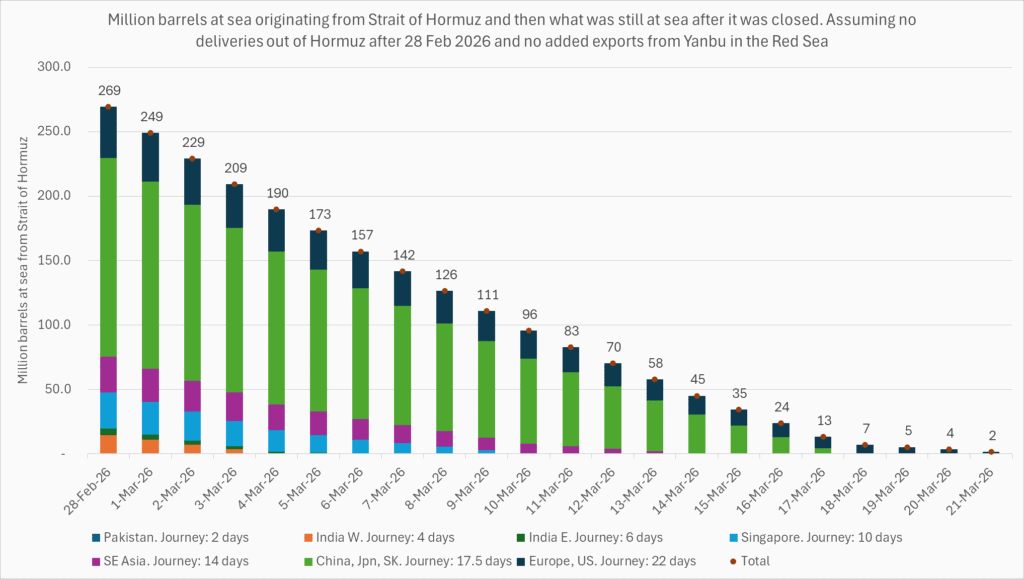
Oil at sea is falling fast as oil is delivered without any new refill in the Persian Gulf. Waivers for Russian crude is also shifting Russian crude to consumers. Brent crude will likely start to feel the pinch much more forcefully when oil at sea is drawn down another 200 mb to around 1000 mb. That is not much more than 10 days from here.
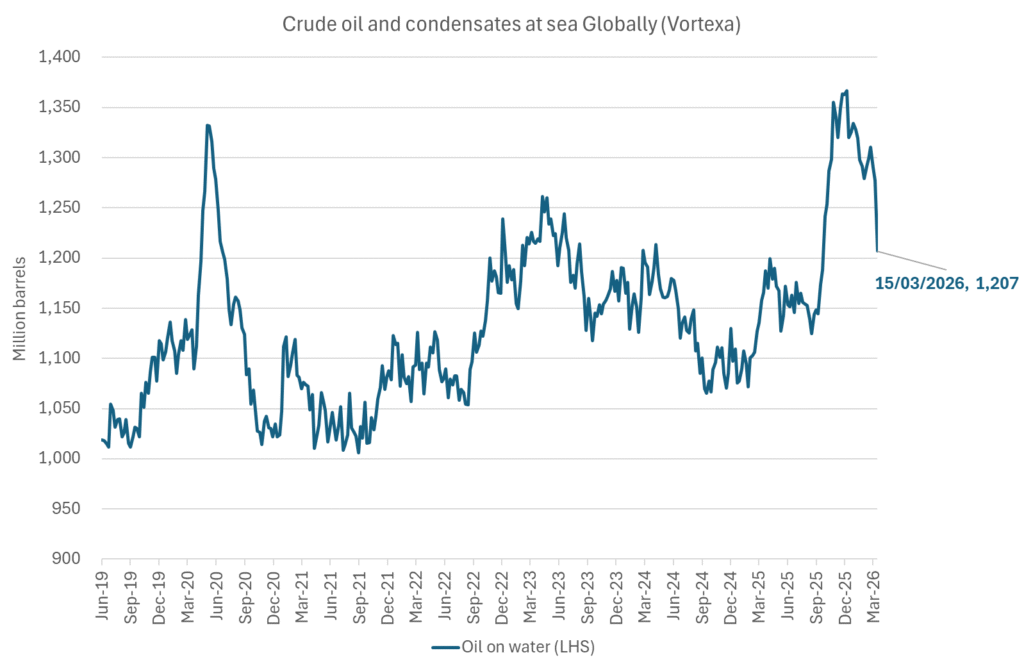
Oil and oil products are starting to become very pricy many places. Brent crude has still been shielded from spiking like the others.
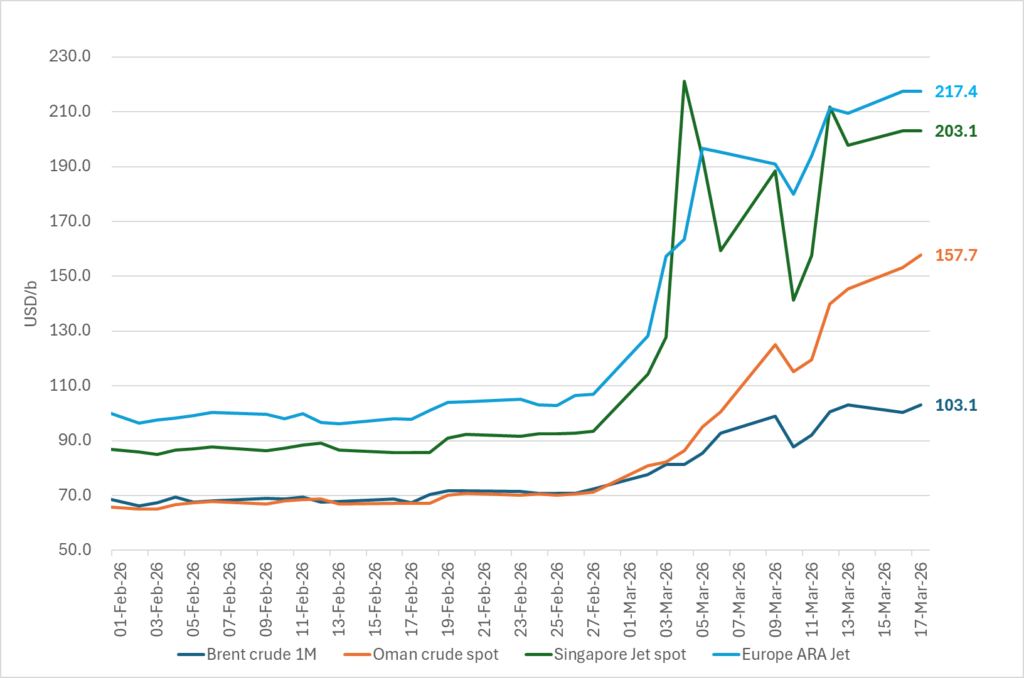



Market Still Betting on Timely Resolution, But Each Day Raises Shortage Risk

Christian Kopfer om läget för oljan

Marknaden måste börja betrakta de höga kopparpriserna som det nya normala

Det fysiska spotpriset på brentolja har slagit nytt rekord

40 minuter med Javier Blas om hur världen verkligen påverkas av energikrisen
40 minuter med Javier Blas om hur världen verkligen påverkas av energikrisen

Elpriserna fördubblas, stor osäkerhet inför sommaren

MP Materials, USA:s svar på Kinas dominans över sällsynta jordartsmetaller
Det fysiska spotpriset på brentolja har slagit nytt rekord

Studsvik har idag ansökt om att få bygga 1200-1600 MW kärnkraft i Valdemarsvik
-
 Nyheter3 veckor sedan
40 minuter med Javier Blas om hur världen verkligen påverkas av energikrisen
-
 Nyheter4 veckor sedan
Elpriserna fördubblas, stor osäkerhet inför sommaren
-
 Nyheter4 veckor sedan
MP Materials, USA:s svar på Kinas dominans över sällsynta jordartsmetaller
-
 Nyheter3 veckor sedan
Det fysiska spotpriset på brentolja har slagit nytt rekord
-
 Nyheter4 veckor sedan
Studsvik har idag ansökt om att få bygga 1200-1600 MW kärnkraft i Valdemarsvik
-
 Nyheter2 veckor sedan
Marknaden måste börja betrakta de höga kopparpriserna som det nya normala
-
Analys4 veckor sedan
TACO (or Whatever It Was) Sends Oil Lower — Iran Keeps Choking Hormuz
-

 Nyheter4 veckor sedan
Matproduktion är beroende av gödsel, Gulfkriget skapar brist