

Analys
SEB Råvarubrev 8 mars 2016

 Rekylen mattas av?
MARKNADEN I KORTHET
Sedan förra veckan har vi fortsatt att handla med i huvudsak en positiv underton. Arbetsmarknadsstatistiken från USA pekade på fortsatt tillväxt men med mycket svag lönetillväxt (=längre tid innan nästa FED-höjning). Över helgen har den kinesiska ledningen (Folkkongressen) signalerat att ytterligare monetära och fiskala åtgärder är att vänta vilket gav stöd åt börs och råvaror (järnmalmskontraktet i Shanghai steg t.ex. 19% på måndagen, den största enskilda uppgången någonsin). På torsdag förväntas ECB tillföra ytterligare monetära stimulanser.
Råvaror: Förra veckan avslutades mycket starkt med ordentliga uppgångar i olja och metaller. Även en del jordbruksprodukter drogs med i uppgången. I och med att ett antal olika råvaror nu nått eller är nära att nå sina primära korrektionsmål så bör vi vara lite försiktigare med att ta nya långa positioner. Snarare bör vi fundera på att ta hem en del vinst efter den senaste tjurrusningen för att sedan i vissa fall söka ett nytt och bättre läge att gå in igen (detta gäller speciellt guldet). Balansen för kaffet har försämrats vilket gör att möjligheten till uppgång förbättrats på sistone (och spekulanterna är väldigt korta = möjlig explosive rörelse om ett brott kommer på uppsidan). 20:e mars är en viktig dag i kalendern då OPEC och icke OPEC-medlemmar träffas i Ryssland för att diskutera frysningen av oljeproduktionen.
Valuta: Dollarn försvagades en del under veckan och speciellt så mot tillväxtmarknader som Brasilien, Sydafrika m.fl. Den japanska yenen är fortsatt efterfrågad så toppen är nog ännu inte satt.
Börser: Handlade fortsatt positivt men har nu i flera fall nog gått lite väl långt på kort tid. Räkna med rekyl på nedsidan om inte ECB levererar. Noterbart är också hur mycket bättre tillväxtmarknaderna gått sedan råvarorna började korrigera uppåt.
Räntor: Obligationsräntorna steg överlag med den tydligaste signalen i den tyska 10-åriga Bunden.
TRENDER I SAMMANDRAG
- Brentoljan har nu nått sitt primära korrektionsmål, $39/fat.
- Guldets innevarande uppgång är den sista i denna fas (ta vinst).
- Basmetallerna (exklusive aluminium) har nått eller är nära förstahandsmål.
- Majs och kaffe har möjliga dubbelbottnar.
- Vi väntar på dollarns nästa uppgångsfas.
VECKANS REKOMMENDATIONER

En placering i certifikat och warranter är förknippat med risker. Du kan förlora hela ditt investerade kapital. Läs mer om riskerna i SEB:s offentliggjorda Grundprospekt för certifikat- och warrantprogram på seb.se/cert eller seb.se/mini
OLJA BRENT
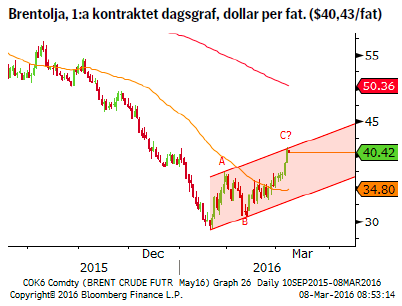 Signalvärdet av det ”falska” brottet över $36,25/fat visade sig vara noll och intet. Sedan förra veckan har priset fortsatt upp över vårt ideala korrektionsmål på $39/fat vilket gör att vi nu står beredda att dra nytta av en trolig kommande svaghet. Värt att notera är också årets korrektion än så länge väldigt tydligt följer mönstret av de senaste dvs. en klar trevågsrörelse (upp, ned och upp), ett klassiskt korrektionsmönster. Takten i uppbyggnaden av långa positioner (Nymex) har avtagit och vinsthemtagningar i långa ETF:er noterats. Det troligaste scenariot är nu att uppgången avstannar och priset faller tillbaka en bit inför mötet i Ryssland den 20:e mars.
TREND
- Antalet riggar har fortsatt att falla och ligger nu på 392 stycken vilket bara är 13 stycken över lägstanivån sedan statistiken infördes 1948.
- I västra Oklahoma (Andarko basin) steg dock riggarna till sin högsta nivå sedan augusti (lönsamt igen efter prisuppgången?).
- Utflöden ur olje-ETF:er inger tveksamhet om ytterligare uppgång.
- Långsammare uppbyggnad av långpositioner.
- Kurdisk olja (upp till 600k fpd) bör åter börja flyta till Turkiet igen inom någon dag (efter sabotaget i februari).
- Fru Clinton ett hot mot skifferspräckning? Ja alla fall om man lyssnade till en av de senaste debatterna.
- Kurvan har flackat betydligt då det i huvudsak är framändan som stigit i pris.
- Kina har förlängt tiden till när den strategiska reserven ska vara full till efter 2020 (lagerproblem?). Långsammare uppbyggnad innebär lägre inköpstakt, vilket dock inte ännu syns i statistiken som senast (februari) visade på ett nytt importrekord.
REKOMMENDATION
- BEAR OLJA X1 S (vi rekommenderar att öka hävstång om/när priset faller under $36,25/fat).
EL
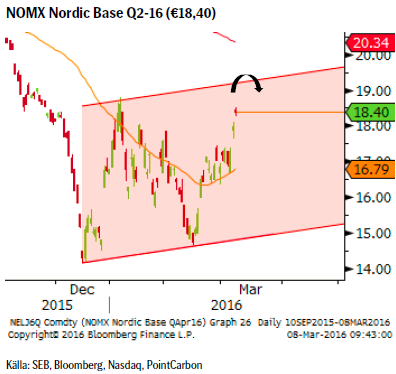 Efter en initial nedgång fortsatte priset dock att stiga under slutet av veckan (vilket vi ju också generellt såg inom i princip hela råvarukomplexet). Uppgången ser fortfarande korrektiv ut (även om månadsgrafen indikerar en möjlig bottenformation med sina långa nedsidesspikar). Ett förstahandsmål för en korrektion, €17,91, har uppnåtts (andrahandsmålet återfinns vid €19,30) varför vi innevarande vecka håller ögonen öppna för negativa tendenser. Prisuppgången på olja har fortsatt att ha haft positiv effekt även på elpriserna och spotpriset i mars handlas nu både stabilt på en högre nivå än i februari (~10% upp). Dock är ju priset fortfarande väldigt lågt för årstiden.
TREND
- Befinner sig fortsatt i en konsolidering (samma typ av trevågigt korrektionsmönster som i olja) inom en fallande trend.
- Prognosen för temperaturen de kommande 10 dagarna pekar på normal till något under medel i slutet av perioden.
- Nederbörden förväntas bli något under medel.
- Hydrobalansen, som för närvarande är -0.4 TWh förväntas under prognosperioden falla till -5 TWh.
REKOMMENDATION
- Ingen rekommendation för närvarande (en möjlig säljkandidat upp emot €19,30).
MAJS
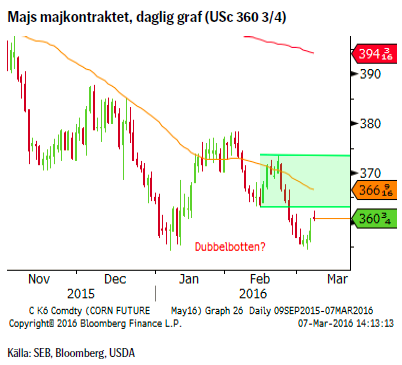 Frågan är nu om vi har skapat den möjliga dubbelbotten som vi flaggade för förra veckan. Med minsta möjliga marginal höll sig priset kvar både över vår stopp nivå (för den modige som köpte i intervallet 359 7/8 – 358 7/16), 354 ½, samt över bottennoteringen från i januari. Denna vecka höjer vi stoppen till 356 ¼ (faller priset under denna nivå bör vi också se en ny botten).
TREND
- Den rådande trenden är nedåtriktad men har tappat fart.
- Jordbruksekonomer vid Illinois universitetet har tittat på vad som händer med skörden efter en kraftig El Niňo (den som slutar nu är en av de kraftigaste uppmätta) och kommit fram till att det är 2/3 sannolikhet för en normal skörd och 1/3 risk för en dålig skörd.
- FAO sänkte förra veckan sin prognos för världsproduktionen, dock bara marginellt med några miljoner ton.
- Däremot så är utsikterna för södra Afrika riktigt dåliga. Torkan pga. El Niňo gör att t.ex. Sydafrika förra veckan hade sin största veckovisa import under 2015/16.
- Stora lager gör att någon större prisuppgång inte är att vänta (USDA prognosen är ett snitt på $3,65 för säsongen) men också att ett brott över 373 skulle överraska marknaden.
REKOMMENDATION
- BULL MAJS X4 S (dubbla vid ett brott över USc 373 och stäng positionen under 356 ¼).
NICKEL (LME 3M)
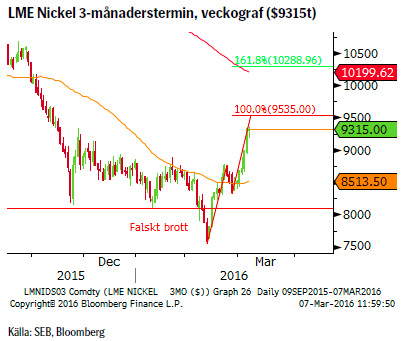 Köpsignalen som utlöstes av det falska månadsbrottet under $8100/t fortsatte att attrahera köpare förra veckan. Dessutom visade den senaste lagerstatistiken på en nedgång av LME-lagren. Skulle dessutom efterfrågan på rostfria produkter stiga mot sin historiska ökningstakt (5%) från dagens (1-2%) så ska priset kunna stiga ytterligare. Vårt förstahandsmål, $9335, varför det kan finnas en kortsiktig potential mot 9535. Givet närheten till nästa mål gör att vi redan nu tar vinst på förra veckans rekommendation.
TREND
- Trots innevarande rekyl är den långsiktiga trenden fortsatt negativ (föregående rekyltopp återfinns vid 10,785 och ett s.k. ”golden cross” inträffar strax under 10,200).
- Uppgången är samma korrektionsmönster som kan ses i t.ex. oljan.
- Helgens signaler från Kina om mer och fler penningpolitiska lättnader hjälper till att underbygga priset (så gör också signaler om en förbättrad fastighetsmarknad i Kina).
- Fortsatt relativt svaga ekonomiska data från Kina.
- Finansiella köp ser fortfarande ut att vara den huvudsakliga drivkraften bakom rallyt.
- En ny stor koppar/nickel gruva i Minnesota har nu klarat miljöprövningen vilket är ett stort steg emot en framtida produktion.
- Utbud och efterfrågan ska enligt prognos vara mer eller mindre i balans i år och framför allt under Kv2.
REKOMMENDATION
- BULL NICKEL X2 S – ta vinst.
GULD
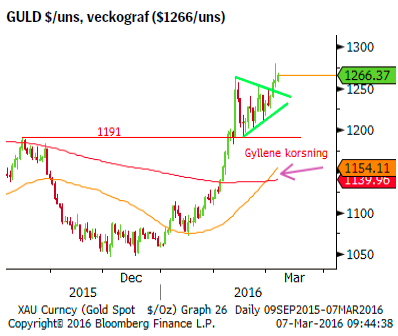 Guldpriset bröt i slutet av förra veckan upp från konsolideringen (i den positiva triangeln) och slutade på den högsta nivån sedan början av 2015. Även om vi ser en möjlig fortsättning på uppgången (till idealmålet $1300/1350 uns) så ser vi även ett antal indikationer på en ökad korrektionsrisk (bl.a. en nettolång positionering på nivåer där vi under förra året mötte aggressiva säljare).
TREND
- Den triangulära konsolideringen är ett fortsättningsmönster.
- Utbud och efterfrågan är relativt balanserat så små förändringar kan ge stora prisrörelser.
- Flödet in i både guld och guldgruve-ETF:er har fortsatt.
- CoT (Commitment of Traders report) – den långa spekulativa positioneringen har fortsatt att öka men i en långsammare takt än tidigare.
- CoT – långa spekulativa positioner är nu i princip på samma nivå som vid topparna (avseende både positionering och pris) under januari och oktober 2015.
- Bank of Canadas guldreserv hade per sista februari fallit till noll (västerländska centralbanker har dock varit usla på att tajma sina köp och försäljningar). Guldet går från väst till öst (där många centralbanker kraftigt ökat sina innehav).
- Tekniska indikatorer är överköpta varför rekylrisken är i stigande.
REKOMMENDATION
- Ta vinst på rekommendationen BULL GULD X2 S och sök ett nytt köp vid $1200 området (den som inte tror på rekyl bör stänga positionen mellan $1300 och 1350).
KAFFE
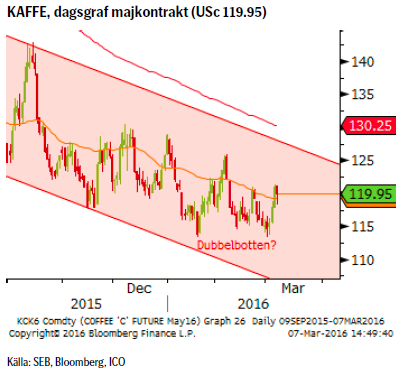 I och med att den senaste nedgången inte nådde ned till en ny botten så väcks frågan om det kan vara så att vi har en dubbelbotten på gång. De senaste rapporterna visar också på en nedskrivning av de tidigare så optimistiska brasilianska utsikterna (återigen en effekt av La Niňa). Antal säckar tillgängliga för leverans mot kaffekontraktet har på ett år fallit med över en miljon till 1,55m säckar. Vi håller denna vecka ögonen på världskaffekonferensen.
TREND
- ICO (Internationella kaffeorganisationen) har höjt sin prognos avseende den globala konsumtionen till 152m (60-kg) säckar vilket i sådana fall skulle vara ett nytt rekord.
- Den senaste prognosen (150m säckar) pekade då på ett underskott av 2,3m säckar vilket nu i sådana fall är betydligt större.
- Den brasilianska valutan, BRL, stärktes förra veckan med cirka sex procent.
- Den senaste CoT rapporten visade en kraftig ökning av korta spekulativa nettopositioner (av vilka en del redan bör ha stoppats ut).
- Exporten i januari var 0.9% lägre än januari 2015.
- Noterbart är också att under 2016 så når nedgångsfaserna inte längre ned till golvet i den årslånga fallande kanalen. Ett tecken på avtagande prispress?
REKOMMENDATION
- BULL KAFFE X4 S
AKTUELLA REKOMMENDATIONER
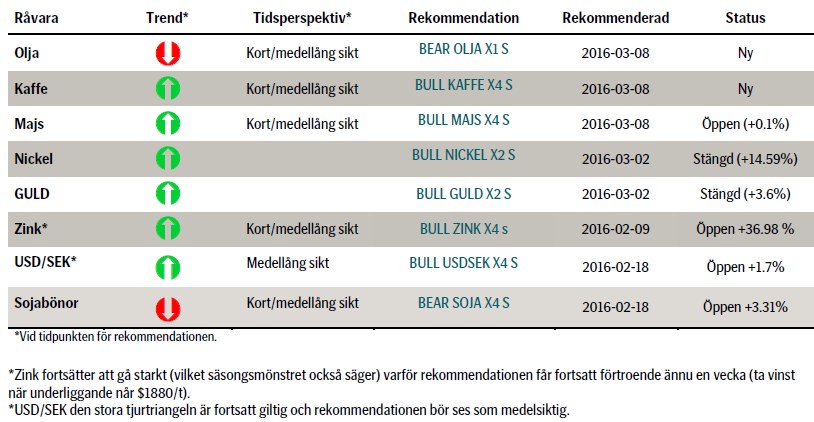
[box]SEB Veckobrev Veckans råvarukommentar är producerat av SEB:s Commodities Sales desk och publiceras i samarbete och med tillstånd på Råvarumarknaden.se[/box]
KÄLLOR
Bloomberg, Reuters, SEB
VILLKOR
För varje enskilt certifikat/mini future finns Slutliga Villkor som anger de fullständiga villkoren. Slutliga Villkor finns tillgängligt på kurssidan för respektive certifikat/mini future på www.seb.se, Börs & finans, fliken Strukturerade placeringar.
RISKER
En sammanfattning av de risker som är förknippade med Börshandlade certifikat generellt finns i Produktbroschyren för respektive certifikat eller mini future som är tillgängligt på seb.se/cert respektive seb.se/mini. För en fullständig bild av riskerna behöver du ta del av SEB:s offentliggjorda Grundprospekt för Certifikat- och Warrantprogram som är publicerat på www.seb.se/cert respektive seb.se/mini.
DISCLAIMER
Detta marknadsföringsmaterial, framtaget av SEB:s Commodities Sales desk, har upprättats enbart i informationssyfte.
Även om innehållet är baserat på källor som SEB bedömt som tillförlitliga ansvarar SEB inte för fel eller brister i informationen. Den utgör inte oberoende, objektiv investeringsanalys och skyddas därför inte av de bestämmelser som SEB har infört för att förebygga potentiella intressekonflikter. Yttranden från SEB:s Commodities Sales desk kan vara oförenliga med tidigare publicerat material från SEB, då den senare hänvisas uppmanas du att läsa den fullständiga rapporten innan någon åtgärd vidtas.
Dokumentationen utgör inte någon investeringsrådgivning och tillhandahålls till dig utan hänsyn till dina investeringsmål. Du uppmanas att självständigt bedöma och komplettera uppgifterna i denna dokumentation och att basera dina investeringsbeslut på material som bedöms erforderligt. Alla framåtblickande uttalanden, åsikter och förväntningar är föremål för risker, osäkerheter och andra faktorer och kan orsaka att det faktiska resultatet avviker väsentligt från det förväntade. Historisk avkastning är ingen garanti för framtida resultat. Detta dokument utgör inte ett erbjudande att teckna några värdepapper eller andra finansiella instrument. SEB svarar inte för förlust eller skada – direkt eller indirekt, eller av vad slag det vara må – som kan uppkomma till följd av användandet av detta material eller dess innehåll.
Observera att det kan förekomma att SEB, dess ledamöter, dess anställda eller dess moder- och/eller dotterbolag vid olika tillfällen innehar, har innehaft eller kommer att inneha aktier, positioner, rådgivningsuppdrag i samband med corporate finance-transaktioner, investment- eller merchantbanking-uppdrag och/eller lån i de bolag/finansiella instrument som nämns i materialet.
Materialet är avsett för mottagaren, all spridning, distribuering mångfaldigande eller annan användning av detta meddelande får inte ske utan SEB:s medgivande. Materialet riktar sig inte till personer vars medverkan kräver ytterligare prospekt, registrerings- eller andra åtgärder än vad som följer av svensk rätt. Det åligger var och en att iaktta sådana restriktioner. Materialet får inte distribueras i eller till land där distribution kräver ovan nämnda åtgärder eller strider mot reglering i sådant land. Materialet riktar sig således inte till fysiska eller juridiska personer hemmahörande i USA eller i något annat land där publicering eller tillhandahållande av materialet är förbjudet eller strider mot tillämpliga bestämmelser i landet.
Oaktat detta får SEB tillåta omfördelning av materialet till utvald tredje part i enlighet med gällande avtal. Materialet får inte spridas till fysiska eller juridiska personer som är medborgare eller har hemvist i ett land där sådan spridning är otillåten enligt tillämplig lag eller annan bestämmelse.
Skandinaviska Enskilda Banken AB (publ) är ett publikt aktiebolag och står under tillsyn av Finansinspektionen samt de lokala finansiella tillsynsmyndigheter i varje jurisdiktionen där SEB har filial eller dotterbolag.

Market is starting to take US/Iran headlines with a pinch of salt. Brent crude rose $2.8/b yesterday to an official close of $112.1/b. But after that it traded as low as $108.05/b before ending late night at around $109.7/b. Through the day it traded in a range of $106.87 – 112.72/b amid a flurry of news or rumors from Iran and the US. ”US temporary sanctions during negotiations” (falls alarm). ”We will bomb Iran” (not anyhow),… etc. While the market is still fluctuating to this kind of news flow, it is starting to take such headlines with a pinch of salt.

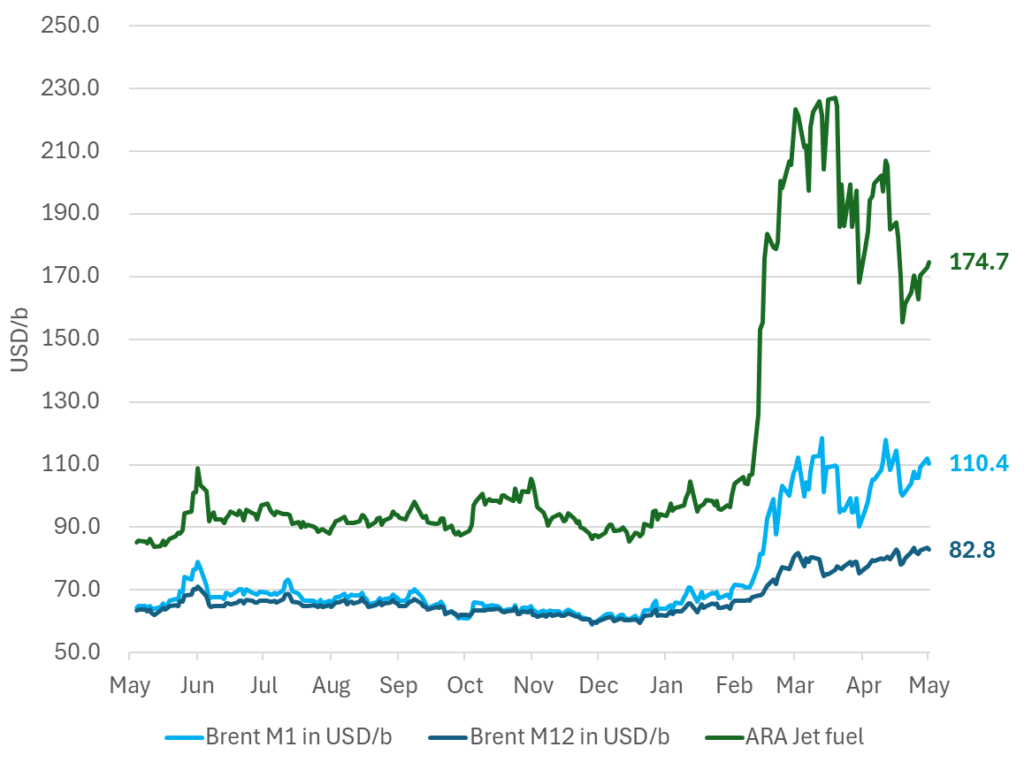
We’ll see. Maybe, maybe not. The Brent M1 contract is trading at $110.2/b this morning which very close to the average ticks through yesterday of $110.4/b.
Trump with bearish, verbal intervention whenever Brent trades above $110/b it seems. What seems to be a pattern is that Trump states something like ”very good negotiations going on with Iran”, ”New leaders in Iran are great,..”, ”Great progress in negotiations,…”, ”Deal in sight,..” etc whenever the Brent M1 contract trades above $110/b. An effort to cool the market. These hot air verbal interventions from Trump used to have a heavy bearish impact on prices, but they now seems to have less and less effect unless they are backed by reality.
As far as we can see there has been no real progress in the negotiations between the US and Iran with both sides still standing by their previous demands.
Iran is getting stronger while the cease fire lasts making a return to war for Trump yet harder. Iran is naturally in constant preparation for a return to war given Trump’s steady threats of bombing Iran again. Iran is naturally doing what ever is possible to prepare for a return to war. And every day the cease fire lasts it is better prepared. This naturally makes it more and more difficult and dangerous for the US to return to warring activity versus Iran as the consequences for energy infrastructure in the Persian Gulf will be more and more severe the longer the cease fire lasts. Israel seems to see it this way as well. That the war is not won and that current frozen state of a cease fire gives Iran opportunity to rebuild military and politically.
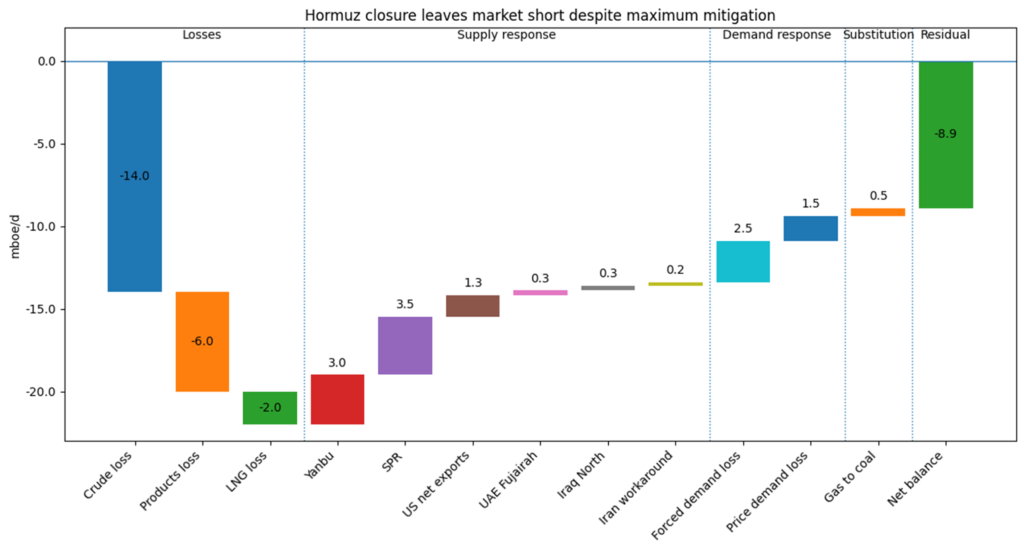
Global inventories are drawing down day by day. How much? In the meantime the Strait of Hormuz stays closed. There is varying measures and estimates of how much global inventories are drawing down. Our rough estimate, back of the envelope, is that global inventories are drawing down by at least some 10 mb/d or about 300 mb/d in a balance between loss of supply versus demand destruction. Other estimates we see are a monthly draw of 250-270 mb/d. The IEA only ’measured’ a draw in global observable stocks of 117 mb in April with oil on water rising 53 mb while on shore stocks fell 170 mb. But global stocks are hard to measure with large invisible, unmeasured stocks. As such a back of the envelope approach may be better.
Oil products is what the world is consuming. Oil product prices likely to rise while product stocks fall. Strategic Petroleum Reserves (SPR) are predominantly crude oil. Discharging oil from OECD SPR stocks, a sharp reduction in Chinese crude imports and a reduction in global refinery throughput of 6-7 mb/d has helped to keep crude oil markets satisfactorily supplied. But global inventories are drawing down none the less. And oil products is really what the world is consuming. So if global refinery throughput stays subdued, then demand will eventually have to match the supply of oil products. The likely path forward this summer is a steady draw down in jet fuel, diesel and gasoline. Higher prices for these. Then, if possible, higher refinery throughput and higher usage of crude in response to very profitable refinery margins. And lastly sharper draw in crude stocks and higher prices for these. But some 6 mb/d of oil products used to be exported through the Strait of Hormuz. And it may not be so easy to ramp up refinery activity across the world to compensate. Especially as Ukraine continues to damage Russian refineries as well as Russian crude production and export facilities.
Watch oil product stocks and prices as well as Brent calendar 2027. What to watch for this summer is thus oil product inventories falling and oil product premiums to crude rising. Another measure to watch is the Brent crude 2027 contract as it rises steadily day by day as the Strait of Hormuz stays closed and global oil inventories decline. The latter is close to the highest level since the start of the war and keeps rising.
The Brent M1 contract and the Brent 2027 prices and current price of jet fuel in Europe (ARA). All in USD/b
Our back of the envelope calculation of the global shortage created by the closure of the Strait of Hormuz. Note that 3.5 mb/d of discharge from SPR is also a draw. Note also that ’Forced demand loss’ of 2.5 mb/d is probably temporary and will fall back towards zero as logistics are sorted out leaving ’Price demand loss’ to do the job of balancing the market. Thus a shortfall of at least 9 mb/d created by the closure. More if SPR discharge is included and more if Forced demand loss recedes.
Brent is climbing higher. Front-month is at USD 106.3/bl this morning, close to a weekly high and a USD 9/bl jump from Mondays open. This is the move we flagged as a risk earlier in the week: the market shifting from ”a deal is around the corner” to ”this is going to take longer than we thought”.

Analyst Commodities, SEB
During April, rest-of-year Brent remained remarkably stable around USD 90/bl. A stability which rested on one single assumption: the SoH reopens around 1 May. That assumption is now slowly falling apart.
As we highlighted yesterday: every week of delay beyond 1 May adds (theoretically) ish USD 5/bl to the rest-of-year average, as global inventories draw 100 million barrels per week. i.e., a mid-May reopening implies rest-of-year Brent closer to USD 100/bl, and anything pushing into June or July takes us meaningfully higher.
What’s changed in the last 48 hours:
#1: The US military has formally warned that clearing suspected sea mines from SoH could take up to six months. That is a completely different timescale from what the financial market is pricing. Even a political deal tomorrow does not immediately reopen the strait.
#2: Trump has shifted his tone from urgency to ”strategic patience”. In yesterday’s press conference: ”Don’t rush me… I want a great deal.” The market is reading this as a president no longer feeling pressured by timelines, with the naval blockade running in the background.
#3: So far, the military activity is escalating, not de-escalating. Axios reports Iran is laying more mines in SoH. The US 3rd carrier strike group (USS George H.W. Bush) is arriving with two countermine vessels. Trump yesterday ordered the US Navy to destroy any Iranian boats caught laying mines. While CNN reports that the Pentagon is actively drawing up plans to strike Iranian SoH capabilities and individual Iranian military leaders if the ceasefire collapses. i.e., NOT a attitude consistent with an imminent deal!
Spot crude and product prices eased off the early-April highs on a combination of system rerouting and deal optimism. Both now weakening. Goldman estimates April Gulf output is reduced by 14.5 mbl/d, or 57% of pre-war supply, a number that keeps getting worse the longer this drags on.
Demand-side adaptation is ongoing: S. Korea has cut its Middle East crude dependence from 69% to 56% by pulling more from the Americas and Africa, and Japan is kicking off a second round of SPR releases from 1 May. But SPRs are finite.
Ref. to the negotiations, we should not bet on speed. The current Iranian leadership is dominated by genuine hardliners willing to absorb economic pain and run the clock to extract concessions. That is not a setup for a rapid resolution. US/Israeli media briefings keep framing the delay as ”internal Iranian divisions”, the reality is more complicated and points toward weeks and months, not days.
Our point is that the complexity is large, and higher prices have only just started (given a scenario where the negotiations drag out in time). The market spent April leaning on the USD 90/bl rest-of-year assumption; that case is diminishing by the hour. If ”early May reopening” is replaced by ”June, July or later” over the next week or two, both crude and products have meaningful room to reprice higher from here. There is a high risk being short energy and betting on any immediate political resolution(!).
Down on Friday. Up on Monday. The Brent June crude oil contract traded down 5.1% last week to a close of $90.38/b. It reached a high of $103.87/b last Monday and a low of $86.09/b on Friday as Iran announced that the Strait of Hormuz was fully open for transit. That quickly changed over the weekend as the US upheld its blockade of Iranian oil exports while Iran naturally responded by closing the SoH again. The US blew a hole in the engine room of the Iranian ship TOUSKA and took custody of the ship on Sunday. Brent crude is up 5.6% this morning to $95.4/b.
The cease-fire is expiring tomorrow. The US has said it will send a delegation for a second round of negotiations in Islamabad in Pakistan. But Iran has for now rejected a second round of talks as it views US demands as unrealistic and excessive while the US is also blocking the Strait of Hormuz.
While Brent is up 5% this morning, the financial market is still very optimistic that progress will be made. That talks will continue and that the SoH will fully open by the start of May which is consistent with a rest-of-year average Brent crude oil price of around $90/b with the market now trading that balance at around $88/b.
Financial optimism vs. physical deterioration. We have a divergence where the financial market is trading negotiations, improvements and resolution while at the same time the physical market is deteriorating day by day. Physical oil flows remain constrained by disrupted flows, longer voyage times and elevated freight and insurance costs.
Financial markets are betting that a US/Iranian resolution will save us in time from violent shortages down the road. But every day that the SoH remains closed is bringing us closer to a potentially very painful point of shortages and much higher prices.
The US blockade is also a weapon of leverage against its European and Asian allies. When Iran closed the SoH it held the world economy as a hostage against the US. The US blockade of the SoH is of course blocking Iranian oil exports. But it is also an action of disruption directed towards Europe and Asia. The US has called for the rest of the world to engaged in the war with Iran: ”If you want oil from the Persian Gulf, then go and get it”. A risk is that the US plays brinkmanship with the global oil market directed towards its European and Asian allies and maybe even towards China to force them to engage and take part. Maybe unthinkable. But unthinkable has become the norm with Trump in the White House.




Sommarväder skapar prisrally på elbörsen
Oil product price pain is set to rise as the Strait of Hormuz stays closed into summer

Solkraften pressar elpriserna dagtid

Michel Gubel ger sin syn på oljemarknaden