

Analys
SEB Jordbruksprodukter, 29 april 2013


 Sådden av majs i USA har inte kunnat ske på grund av den sena våren. Deadline, som anses vara den 10 maj närmar sig. Väderleksprognosen visar dock ett ”fönster” av gott väder, där sådden kan ske innan dess. De närmaste dagarnas väderutveckling kommer att ha ett avgörande inflytande över prisutvecklingen. Den kinesiska fågelinfluensan har sänkt konsumtionen av kyckling med upp till 80%. Det sänker efterfrågan på sojabönor i världen. Vi tror alltjämt på sjunkande priser på alla jordbruksprodukter. Grispriset i USA testar dock tekniska motståndsnivåer, möjligen just beroende på fågelinfluensan i Kina.
Odlingsväder
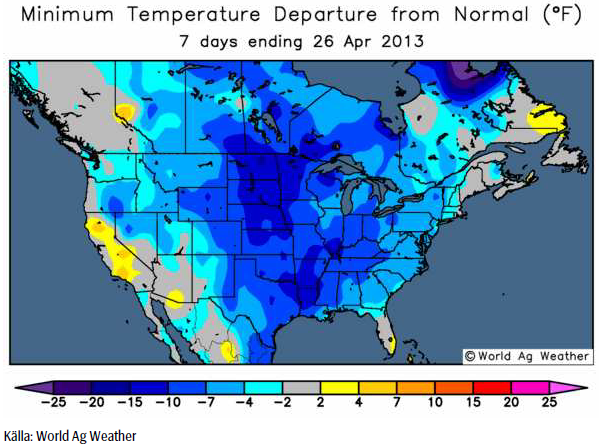
USA och Kanada var fortsatt kallare än normalt i veckan som gick. Prognosen för de kommande 7 dagarna är att detta ska bestå. Därefter för dag 7 till 14 väntas varmare väder, i synnerhet i Kanada.
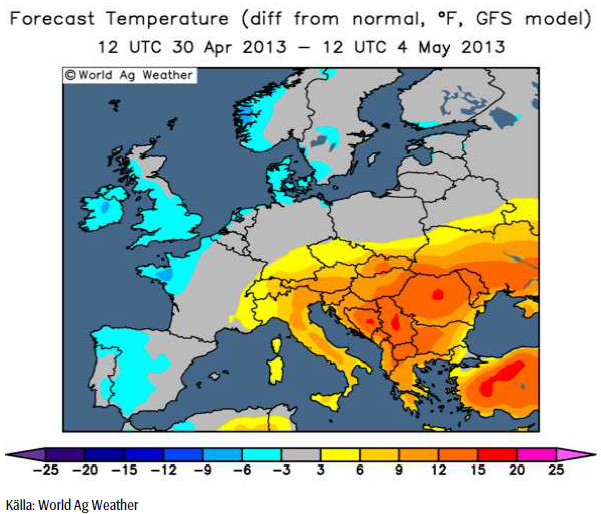
I ett område från Tyskland och österut har varit varmare än normalt den senaste veckan. Prognosen för de närmaste 7 dagarna är normal temperatur i centrala och norra Europa. Däremot väntas det bli varmare än normalt i Italien, på Balkan och i Stillahavsområdet.
I Australien är det fortsatt väldigt torrt inför sådden som börjar snart.
MARS
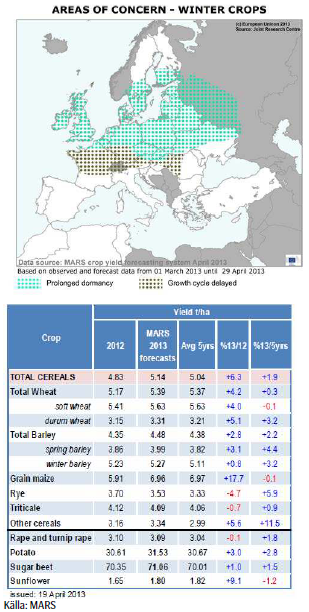
Enligt den senaste rapporten från EU-kommissionens MARS-enhet så har den kyliga starten på våren i Europa, som har fått Mars månad att noteras som en av de kallaste någonsin, orsakat en kraftig försening – mer än en månad – gällande höstgrödornas utveckling, och dessutom försenat vårsådden (med undantag av Medelhavsområdet och runt Svarta Havet). Förseningar är särskilt tydliga i Storbritannien, men även i Tyskland och Frankrike. Trots detta gör de inga justeringar i sitt estimat för avkastning med motiveringen att det är för tidigt att uttala sig om en avkastning under genomsnittet.
Vete
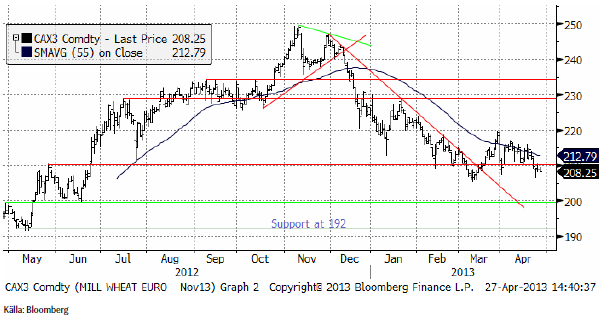
Priset på november (2013) har hållit sig över 210 euro, som nu återigen fungerar som ett tekniskt stöd. Frågan är om priset ska bryta uppåt och testa 230.
Decemberkontraktet på CBOT ser mindre ”bullish” ut än grafen för Matif-vetet. Så som Chicagovetet handlats förefaller ett test av 700 cent på nedsidan vara troligare.
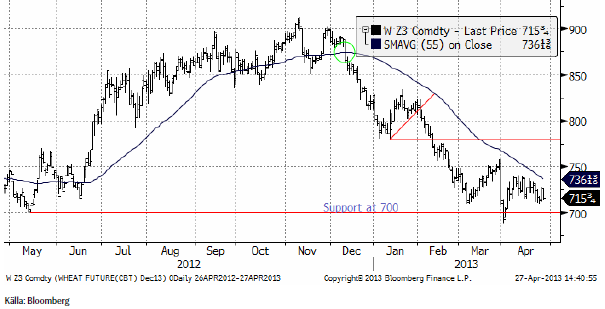
I onsdags drabbades Oklahoma av frost och det fick priset att gå upp temporärt.
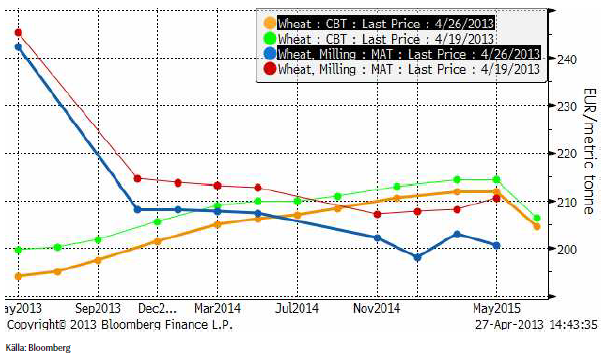
Ser vi på den senaste veckan förändring av terminskurvorna, ser vi att priserna gått ner både i Europa och i USA och ungefär lika mycket oavsett löptid, undantaget gammal skörd. Weetabix har slutat producera vissa frukostflingor i väntan på ny skörd. Det saknas helt enkelt brittiskt vete av gammal skörd.
Måndagens crop condition-rapport ser vi i sammanfattning nedan.
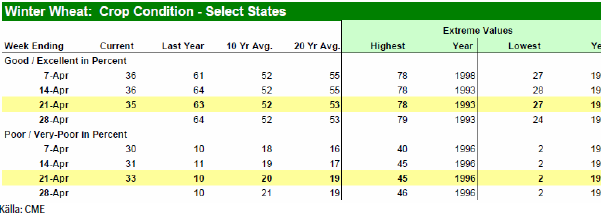
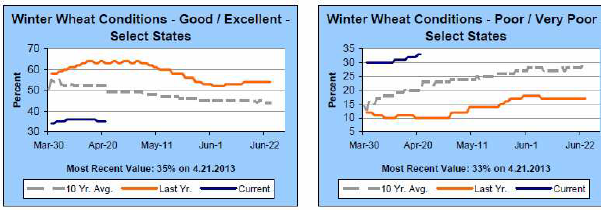
Måndagens Crop Progress rapport från USDA visar att tillståndet för det amerikanska höstvetet har försämrats något. Sammantaget för de 18 största höstvete producerande så var 35% klassat som ”good/excellent” per den 21 januari, en marginell nedjustering från förra veckans 36%. Höstvete klassat som ”poor/very poor” justeras upp till 33% från förra veckans 31% och är en kategori som har ökat i bl.a Kansas och Colorado, men som har minskat kraftigt i South Dakota, Nebraska och Texas – även om klassificeringen ”good/excellent” i dessa stater fortfarande är urusla.
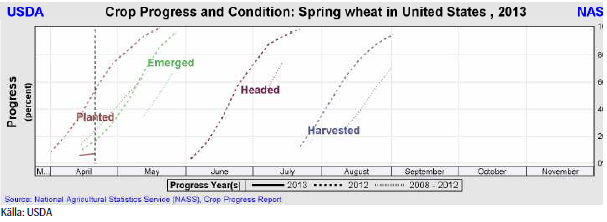
Sådden av vårvete gör minimala framsteg då endast 7% är avklarad i de 6 största staterna, vilket är en marginell ökning från förra veckans 6% och att jämföra med 52% för ett år sedan och det femåriga genomsnittet på 24%. Kallt väder och även snö har hindrat fältaktiviteter i vissa delar och hos topproducenten North Dakota har man ännu inte påbörjat sådden.
Ett tredje tecken på att skörden ligger efter i år är att bara 8% av höstvetet har gått i ax. Förra året den här tiden var det 42%.
StatsCanada skriver den 24 april att vårvetearealen ökar 14.4% till 19.4 miljoner acres. Det var mycket mer än marknaden väntat sig. Durum-arealen väntas också öka för tredje året i rad till 5.1 miljoner acres. I USDA:s prospective plantingsrapport för en månad sedan visades en minskning av arealen. Kanadensarna går alltså åt andra hållet.
Vi fortsätter att tro på sidledes eller lägre priser. Uppgångar bör ses som tillfällen att sälja.
Maltkorn
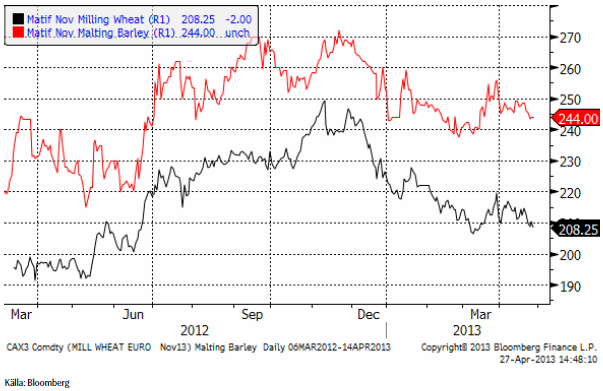
Priset på maltkorn med leverans i november har fortsatt att visa mer styrka än höstvetet / kvarnvetet på Matif.
StatsCanada rapporterar en korn-areal som är 2.2% mindre än förra året. Havrearealen ökar med 18.4%.
Lokala estimat pekar på väsentligt lägre sådd av maltkorn i Tyskland. På grund av den kalla och våta våren väntas arealen uppgå till 360,000 ha. Det är 40% mindre än förra året. Tyskland är EU:s största konsument av maltkorn och landet väntas behöva öka importen till 1 mt under 2013/14. Evergrain, den schweiziska mäklaren, estimerar Tysklands import i år (2012/13) till 265,000 ton.
Sådden av korn i USA ligger i linje med vad som är normalt. Tvärt emot vad som rapporterats på t ex Agrimoney. 23% är sått. Det var 43% förra året så här års, men 24% är det normala.
Det finns viss ”uppsidesrisk” för maltkornspriset med tanke på Kanadas och Tysklands mindre väntade skördar. Den senaste utvecklingen vi skriver om ovan, kan vi inte riktigt se fullt ut i starkare prisutveckling på maltkorn jämfört med vete.
Majs
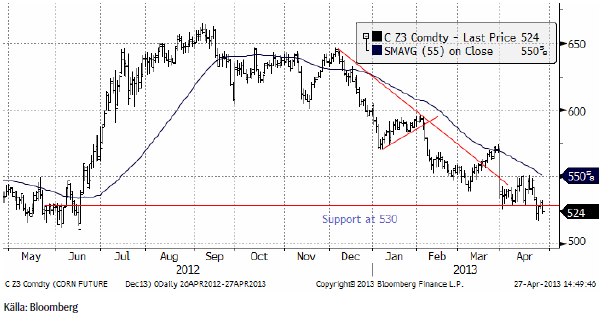
Majspriset (december 2013) bröt stödet på 530 cent, rekylerade upp och slutade veckan nedåt igen. Trenden är stadigt nedåtriktad.
Sådden ligger kraftigt efter i USA. Den 19 april var endast 4% sått. Förra året var det 28% och det tidiga året 2010 var det 50%. En åkerareal stor som Belgien och Holland tillsammans borde ha varit sådd, men har inte blivit det på grund av det kalla vädret. Sådden har ännu inte börjats i den största producerande staten, Iowa, och inte heller i Colorado, Michigan, Minnesota, Nebraska, North Dakota, South Dakota eller i Wisconsin. I Illinois, Indiana och Ohio är sådden endast avklarad till 1%.
Nedan ser vi såddens framåtskridande i USA. 6-årsintervallet sträcker sig från 2007 till 2012.
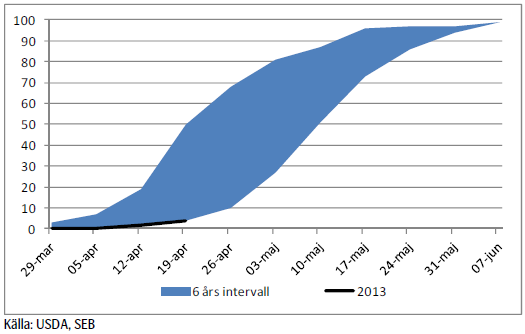
Utvecklingen sker exakt lika långsamt som år 2008, ett år där priserna trots allt föll kraftigt. På grund av att vädret i veckan inte varit perfekt, kan man inte vänta sig att sådden kommit upp till mer än 6-10% nu i rapporten som kommer på måndagskvällen. Därefter väntas, som vi såg ovan under ”odlingsväder” bättre väder komma, vilket ger ett tillfälle att så. Sås majsen för sent, den 10 maj betraktas som en slags deadline, får varje försening en negativ effekt på avkastningen. De närmaste dagarnas väder är alltså avgörande för priset.
Väderleksrapporten säger att det kommer att gå bra. Därför tror vi alltjämt på fallande priser.
Sojabönor
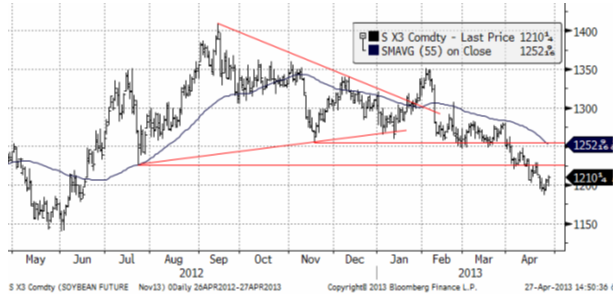
Sojabönorna (november 2013) ligger i en stadigt sjunkande pristrend. Amerikans sådd av soja har inte kommit igång alls. Förra året var 6% sått redan. Den kinesiska fågelinfluensan har ökat i nyhetsflödet och det fjäderfä i Kina är närmast osäljbart vad vi kan förstå från nyhetsrapporteringen.
Den argentinska skörden är 56% klar, men bönderna håller inne med sin vara. BAGE estimerar skörden till 48.5 mt (USDA har den senat på 51.5 mt). Den argentinska staten har just klubbat igenom lagar som reducerar möjligheten för företag och privatpersoner att värna sin egendom gentemot staten.
Statsinkomsterna kommer till stor del från exportskatter på soja. Den argentinska peson handlas på gatan till halva den officiella växlingskursen. Presidentens socialistiska och värdenihilistiska politik ser ut att föra landet mot en mörk framtid.
Väderutvecklingen i USA och dämpad efterfrågan från Kina gör att vi tror att priset kommer att fortsätta falla och rekommenderar en såld position i sojabönor. 1150 cent är nästa målkurs.
Raps
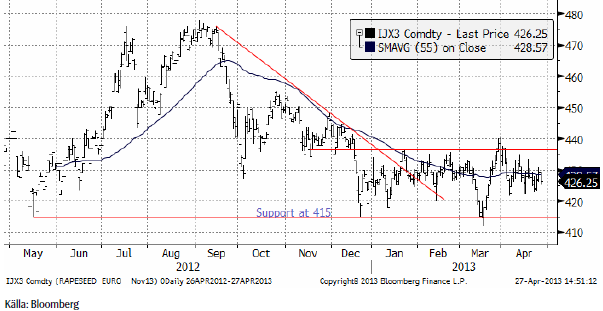
Rapspriset (november 2013) ligger kvar på någorlunda hög nivå. En anledning är att skörden i Europa väntas bli ca 1 månad senare än normalt.
Förra veckan skrev vi om ”spreaden” mellan augustikontraktet och novemberkontraktet. Den prisskillnaden ligger fortsatt på en onormal nivå, som indikerar att många väntar sig ett högre pris på augusti (som för gammal skörd) än ny-skörds-kontraktet november. Vi tror att vädret kommer att fortsätta förbättras, så att augusti är säljvärt.
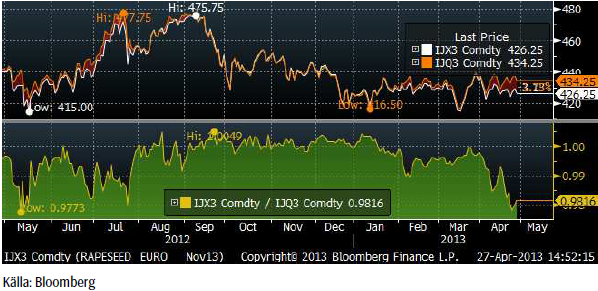
StatsCanada rapporterade i onsdags den 24 april att kanadensiska lantbrukare kommer att så 19.1 miljoner acres med canola. Det är 11% mindre än förra året och den första minskningen sedan 2006.
Det är ändå svårt att se att rapsmarknaden ska hålla sig så stark, medan priset på sojabönor faller. Vi fortsätter att rekommendera en såld position i raps. Den börjar dessutom bygga upp fallhöjd om och när ett brott av den tekniska stödnivån inträffar.
Gris
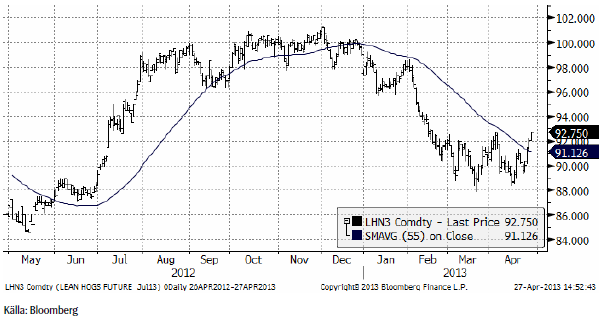
Grispriset (September 13) testar nu den nedåtgående trenden. Beroende på hur marknaden går i veckan, kan vi få en köpsignal från den tekniska analysen.
Mjölk
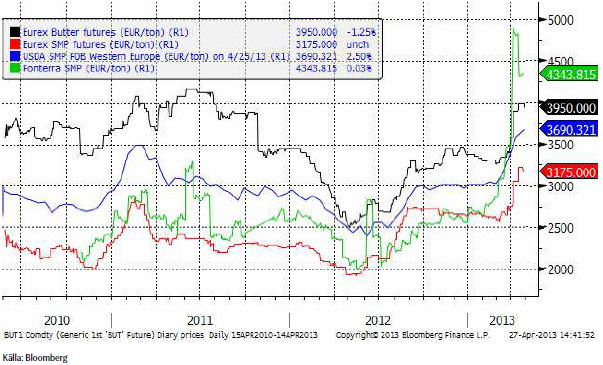
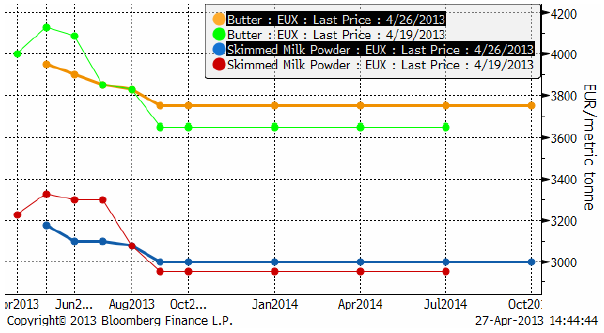
Eurexmarknaden gick ner i veckan som gick – på de korta kontrakten. De långa steg däremot både på SMP och smör.
I kursdiagrammet nedan ser vi priserna på Fonterras SMP, USDA:s prisnotering på SMP i Europa och Eurexbörsens pris, samt Eurex pris på smör. Alla priser är angivna i euro per ton.
Nedan ser vi terminskurvorna för smör och skummjölkspulver på Eurex i fredags vid börsens stängning och veckan innan.
SEB Commodities erbjuder ett litet ”prova-på” kontrakt som består av 0.5 ton Eurex-smör och 0.9 ton Eurex SMP. Ett paket som motsvarar 10 ton flytande mjölkråvara. Just nu är det underliggande värdet på ett sådant kontrakt drygt 33 000 kronor. Vi garanterar börspris eller bättre.
Den som vill följa priset på SMP på Eurex gör det via länken:
www.eurexchange.com/exchange-en/products/com/agr/14016/
Vi tycker att den här haussen på världsmarknaden skapar ett bra tillfälle att säkra via terminer.
[box]SEB Veckobrev Jordbruksprodukter är producerat av SEB Merchant Banking och publiceras i samarbete och med tillstånd på Råvarumarknaden.se[/box]
Disclaimer
The information in this document has been compiled by SEB Merchant Banking, a division within Skandinaviska Enskilda Banken AB (publ) (“SEB”).
Opinions contained in this report represent the bank’s present opinion only and are subject to change without notice. All information contained in this report has been compiled in good faith from sources believed to be reliable. However, no representation or warranty, expressed or implied, is made with respect to the completeness or accuracy of its contents and the information is not to be relied upon as authoritative. Anyone considering taking actions based upon the content of this document is urged to base his or her investment decisions upon such investigations as he or she deems necessary. This document is being provided as information only, and no specific actions are being solicited as a result of it; to the extent permitted by law, no liability whatsoever is accepted for any direct or consequential loss arising from use of this document or its contents.
About SEB
SEB is a public company incorporated in Stockholm, Sweden, with limited liability. It is a participant at major Nordic and other European Regulated Markets and Multilateral Trading Facilities (as well as some non-European equivalent markets) for trading in financial instruments, such as markets operated by NASDAQ OMX, NYSE Euronext, London Stock Exchange, Deutsche Börse, Swiss Exchanges, Turquoise and Chi-X. SEB is authorized and regulated by Finansinspektionen in Sweden; it is authorized and subject to limited regulation by the Financial Services Authority for the conduct of designated investment business in the UK, and is subject to the provisions of relevant regulators in all other jurisdictions where SEB conducts operations. SEB Merchant Banking. All rights reserved.

Brent is climbing higher. Front-month is at USD 106.3/bl this morning, close to a weekly high and a USD 9/bl jump from Mondays open. This is the move we flagged as a risk earlier in the week: the market shifting from ”a deal is around the corner” to ”this is going to take longer than we thought”.

Analyst Commodities, SEB
During April, rest-of-year Brent remained remarkably stable around USD 90/bl. A stability which rested on one single assumption: the SoH reopens around 1 May. That assumption is now slowly falling apart.
As we highlighted yesterday: every week of delay beyond 1 May adds (theoretically) ish USD 5/bl to the rest-of-year average, as global inventories draw 100 million barrels per week. i.e., a mid-May reopening implies rest-of-year Brent closer to USD 100/bl, and anything pushing into June or July takes us meaningfully higher.
What’s changed in the last 48 hours:
#1: The US military has formally warned that clearing suspected sea mines from SoH could take up to six months. That is a completely different timescale from what the financial market is pricing. Even a political deal tomorrow does not immediately reopen the strait.
#2: Trump has shifted his tone from urgency to ”strategic patience”. In yesterday’s press conference: ”Don’t rush me… I want a great deal.” The market is reading this as a president no longer feeling pressured by timelines, with the naval blockade running in the background.
#3: So far, the military activity is escalating, not de-escalating. Axios reports Iran is laying more mines in SoH. The US 3rd carrier strike group (USS George H.W. Bush) is arriving with two countermine vessels. Trump yesterday ordered the US Navy to destroy any Iranian boats caught laying mines. While CNN reports that the Pentagon is actively drawing up plans to strike Iranian SoH capabilities and individual Iranian military leaders if the ceasefire collapses. i.e., NOT a attitude consistent with an imminent deal!
Spot crude and product prices eased off the early-April highs on a combination of system rerouting and deal optimism. Both now weakening. Goldman estimates April Gulf output is reduced by 14.5 mbl/d, or 57% of pre-war supply, a number that keeps getting worse the longer this drags on.
Demand-side adaptation is ongoing: S. Korea has cut its Middle East crude dependence from 69% to 56% by pulling more from the Americas and Africa, and Japan is kicking off a second round of SPR releases from 1 May. But SPRs are finite.
Ref. to the negotiations, we should not bet on speed. The current Iranian leadership is dominated by genuine hardliners willing to absorb economic pain and run the clock to extract concessions. That is not a setup for a rapid resolution. US/Israeli media briefings keep framing the delay as ”internal Iranian divisions”, the reality is more complicated and points toward weeks and months, not days.
Our point is that the complexity is large, and higher prices have only just started (given a scenario where the negotiations drag out in time). The market spent April leaning on the USD 90/bl rest-of-year assumption; that case is diminishing by the hour. If ”early May reopening” is replaced by ”June, July or later” over the next week or two, both crude and products have meaningful room to reprice higher from here. There is a high risk being short energy and betting on any immediate political resolution(!).
Down on Friday. Up on Monday. The Brent June crude oil contract traded down 5.1% last week to a close of $90.38/b. It reached a high of $103.87/b last Monday and a low of $86.09/b on Friday as Iran announced that the Strait of Hormuz was fully open for transit. That quickly changed over the weekend as the US upheld its blockade of Iranian oil exports while Iran naturally responded by closing the SoH again. The US blew a hole in the engine room of the Iranian ship TOUSKA and took custody of the ship on Sunday. Brent crude is up 5.6% this morning to $95.4/b.

The cease-fire is expiring tomorrow. The US has said it will send a delegation for a second round of negotiations in Islamabad in Pakistan. But Iran has for now rejected a second round of talks as it views US demands as unrealistic and excessive while the US is also blocking the Strait of Hormuz.
While Brent is up 5% this morning, the financial market is still very optimistic that progress will be made. That talks will continue and that the SoH will fully open by the start of May which is consistent with a rest-of-year average Brent crude oil price of around $90/b with the market now trading that balance at around $88/b.
Financial optimism vs. physical deterioration. We have a divergence where the financial market is trading negotiations, improvements and resolution while at the same time the physical market is deteriorating day by day. Physical oil flows remain constrained by disrupted flows, longer voyage times and elevated freight and insurance costs.
Financial markets are betting that a US/Iranian resolution will save us in time from violent shortages down the road. But every day that the SoH remains closed is bringing us closer to a potentially very painful point of shortages and much higher prices.
The US blockade is also a weapon of leverage against its European and Asian allies. When Iran closed the SoH it held the world economy as a hostage against the US. The US blockade of the SoH is of course blocking Iranian oil exports. But it is also an action of disruption directed towards Europe and Asia. The US has called for the rest of the world to engaged in the war with Iran: ”If you want oil from the Persian Gulf, then go and get it”. A risk is that the US plays brinkmanship with the global oil market directed towards its European and Asian allies and maybe even towards China to force them to engage and take part. Maybe unthinkable. But unthinkable has become the norm with Trump in the White House.
Wild moves yesterday. Brent crude traded to a high of $114.43/b and a low of $96.0/b and closed at $99.94/b yesterday.
US – Iran negotiations ongoing or not? What a day. Donald Trump announced that good talks were ongoing between Iran and the US and that the 48 hour deadline before bombing Iranian power plants and energy infrastructure was postponed by five days subject to success of ongoing meetings. Iranian media meanwhile stated that no meetings were ongoing at all.
Today we are scratching our heads trying to figure out what yesterday was all about.
Friends and family playing the market? Was it just Trump and his friends and family who were playing with oil and equity markets with $580m and $1.46bn in bets being placed by someone in oil and equity markets just 15 minutes before Trump’s announcement?
Was Trump pulling a TACO as he reached his political and economic pain point: Brent at $112/b, US Gas at $4/gal, SPX below 200dma and US 10yr above 4.4%?
Different Iranian factions with Trump talking with one of them? Are there real negotiations going on but with the US talking to one faction in Iran while another, the hardliners, are not involved and are denying any such negotiations going on?
Extending the ultimatum to attack and invade Kharg island next weekend? Or, is the five day delay of the deadline a tactical decision to allow US amphibious assault ships and marines to arrive in the Gulf in the upcoming weekend while US and Israeli continues to degrade Iranian military targets till then. And then next weekend a move by the US/Israel to attack and conquer for example the Kharg island?
We do not really know which it is or maybe a combination of these.
We did get some kind of TACO ydy. But markets have been waiting for some kind of TACO to happen and yesterday we got some kind of TACO. And Brent crude is now trading at $101.5/b as a result rather than at $112-114/b as it did no the high yesterday.
But what really matters in our view is the political situation on the ground in Iran. Will hardliners continue to hold power or will a more pragmatic faction gain power?
If the hardliners remain in power then oil pain should extend all the way to US midterm elections. The hardliners were apparently still in charge as of last week. Iran immediately retaliated and damaged LNG infrastructure in Qatar after Israel hit Iranian South Pars. The SoH was still closed and all messages coming out of Iran indicated defiance. Hardliners continues in power has a huge consequence for oil prices going forward. The regime has played its ’oil-weapon’ (closing or chocking the Strait of Hormuz). It is using it to achieve political goals. Deterrence: it needs to be so politically and economically expensive to attack Iran that it won’t happen again in the future. Or at least that the US/Israel thinks 10-times over before they attack again. The highest Brent crude oil closing price since the start of the war is $112.19/b last Friday. In comparison the 20-year inflation adjusted Brent price is $103/b. So Brent crude last Friday at $112.19/b isn’t a shockingly high price. And it is still far below the nominal high of $148/b from 2008 which is $220/b if inflation adjusted. So once in a lifetime Iran activates its most powerful weapon. The oil weapon. It needs to show the power of this weapon and it needs to reap political gains. Getting Brent to $112/b and intraday high of $119.5/b (9 March) isn’t a display of the power of that weapon. And it is not a deterrence against future attacks.
So if the hardliners remain in power in Iran, then the SoH will likely remain chocked all the way to US midterm elections and Brent crude will at a minimum go above the historical nominal high of $148/b from 2008.
Thus the outlook for the oil price for the rest of the year doesn’t depend all that much of whether Trump pulls a TACO or not. Stops bombing or not. It depends more on who is in charge in Iran. If it is the hardliners, then deterrence against future attacks via chocking of the SoH and high oil prices is the likely line of action. It is impacting the world but the Iranian ’oil-weapon’ is directed towards the US president and the the US midterm elections.
If a pragmatic faction gets to power in Iran, then a very prosperous future is possible. However, if power is shifting towards a more pragmatic faction in Iran then a completely different direction could evolve. Such a faction could possibly be open for cooperation with the US and the GCC and possibly put its issues versus Israel aside. Then the prosperity we have seen evolving in Dubai could be a possible future also for Iran.
So far it looks like the hardliners are fully in charge. As far as we can see, the hardliners are still fully in control in Iran. That points towards continued chocking of the SoH and oil prices ticking higher as global inventories (the oil market buffers) are drawn lower. And not just for a few more weeks, but possibly all the way to the US midterm elections.



Brent crude up USD 9/bl on the week… ”deal around the corner” narrative fades
Market Still Betting on Timely Resolution, But Each Day Raises Shortage Risk

Christian Kopfer om läget för oljan

Marknaden måste börja betrakta de höga kopparpriserna som det nya normala

Det fysiska spotpriset på brentolja har slagit nytt rekord

40 minuter med Javier Blas om hur världen verkligen påverkas av energikrisen

Elpriserna fördubblas, stor osäkerhet inför sommaren
Det fysiska spotpriset på brentolja har slagit nytt rekord
Marknaden måste börja betrakta de höga kopparpriserna som det nya normala
Christian Kopfer om läget för oljan
-
 Nyheter3 veckor sedan
40 minuter med Javier Blas om hur världen verkligen påverkas av energikrisen
-
 Nyheter4 veckor sedan
Elpriserna fördubblas, stor osäkerhet inför sommaren
-
 Nyheter3 veckor sedan
Det fysiska spotpriset på brentolja har slagit nytt rekord
-
 Nyheter2 veckor sedan
Marknaden måste börja betrakta de höga kopparpriserna som det nya normala
-
 Nyheter2 veckor sedan
Christian Kopfer om läget för oljan
-

 Nyheter3 veckor sedan
Efter tillväxten: Guldbrev satsar på expansion i Europa
-
Analys4 dagar sedan
Market Still Betting on Timely Resolution, But Each Day Raises Shortage Risk
-
Analys11 timmar sedan
Brent crude up USD 9/bl on the week… ”deal around the corner” narrative fades