

Analys
SEB – Råvarukommentarer vecka 23 2012

Sammanfattning:
 Brett råvaruindex: + 0,35 %
UBS Bloomberg CMCI TR Index- Energi: – 1,02 %
UBS Bloomberg CMCI Energy TR Index - Ädelmetaller: – 2,85%
UBS Bloomberg CMCI Precious Metals TR Index - Industrimetaller: – 0,47 %
UBS Bloomberg CMCI Industrial Metals TR Index - Jordbruk: +3,13 %
UBS Bloomberg CMCI Agriculture TR Index
Kortsiktig marknadsvy:
- Guld: Neutral
- Olja: Neutral/sälj
- Koppar: Sälj
- Majs: Sälj
- Vete: Neutral
Guld
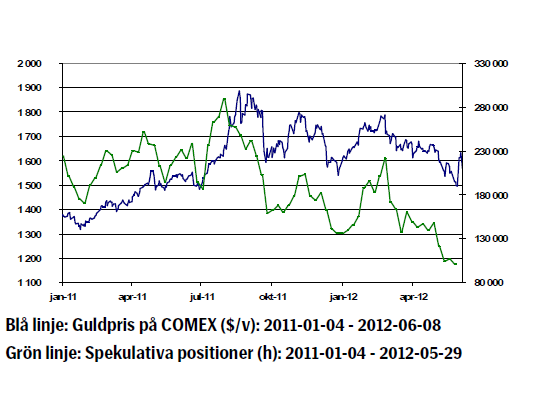
Guldpriset steg som en reaktion på ökade QE3-förväntningar p.g.a. svaghet i den amerikanska arbetsmarknaden. Dollarn försvagades också efter fredagens dåliga jobbsiffror.
Igår, torsdag, talade Bernanke inför den amerikanska kongressen och marknaden lyssnade lyhört efter tecken på kvantitativa lättnader dvs. mera pengar i omlopp. Inget konkret kom ur mötet mer än att Fed står redo att stimulera om så krävs vilket fick guldet att falla tre procent.
En ökad penningmängd driver på guldpriset men även andra ”risky assets” såsom råvaror generellt och aktier. Idag faller guldet p.g.a. bristen på antydningar om kvantitativa lättnader och vi fortsätter ha en försiktig hållning till guldet efter den snabba rekylen efter förra veckans rally.
Oron kring den spanska ekonomin ökar. Landets tioårsränta har legat fem procent över den tyska motsvarigheten i nio dagar nu. Igår sålde spanska staten obligationer för två miljarder euro. Den 10-åriga stadsobligationen gav en ränta på 6,044 procent. Oron för Europa och Spanien ger stöd åt guldpriset.
Europeiska centralbanken lämnade på onsdagen styrräntan oförändrad på en procent. Draghis kommentarer efter beskedet tydde på att europeiska centralbanken önskar politiska initiativ för att möta de problem som eurozonen står inför.
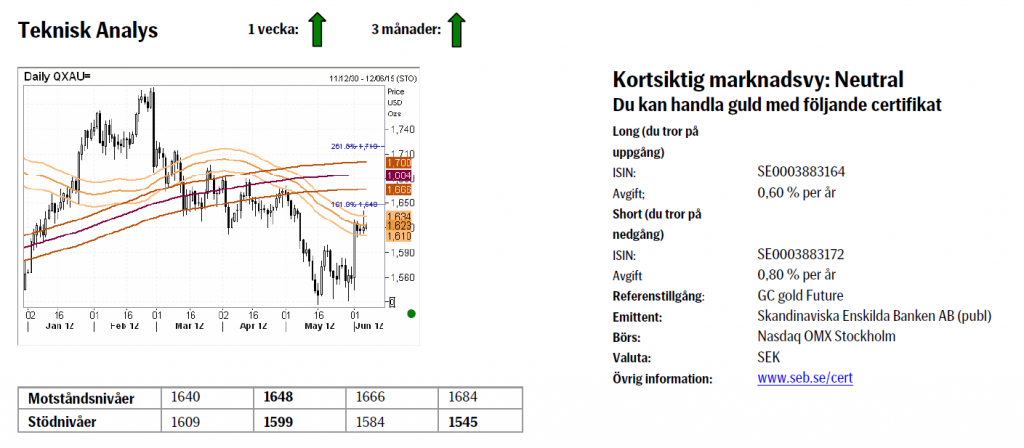
Teknisk analys: I en kraftig uppgångsfas. Den större bilden har blivit ytterligare stärkt av den kraftiga uppgång som noterades i förra veckan. Viss respekt visas den över delen av 55- dagars bandet, men en rörelse ner mot 1609/1599 ska ses som korrektiv och ska köpas. En dagsstängning över bandet, nu vid 1634 och brott över en projektionsnivå vid 1648 skulle höja ribban för ett test också in i 233-dagars bandet som just nu börjar vid 1666.
Olja
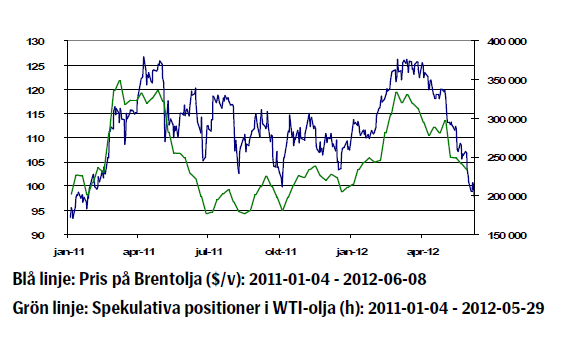
Fallande råvarupriser inledde veckan efter fredagens svaga jobbsiffror från USA. Oljepriset, vilket fallit cirka tio procent den senaste veckan, drogs även ned av skuldoro i Europa och tecken på konjunkturavmattning i Kina.
Opec-länderna håller möte den 14 juni och på agendan kan förväntas en diskussion kring produktionsnivåer. Opec:s kvoter tillåter idag en produktion på 30 miljoner fat per dag men Opec:s medlemmar producerar runt 31,5 miljoner fat per dag. Saudiarabien som länge önskat ett oljepris på100 dollar har producerat mer än man gjort på decennier, detta i avsikt att få bättre effekt av sanktionerna mot Iran.
FN:s säkerhetsråd + Tyskland möter Iran igen den 18-19 juni och förhoppningarna är stora att man ska finna en lösning på den rådande konflikt som bottnar i misstankar om att Iran tillverkar anrikat uran i kärnvapensyfte.
American Petroleum Institute (API) redovisade på tisdagen att råoljelager sjönk ~1,2 miljoner fat förra veckan, vilket är fem procent högre jämfört med föregående år. Siffror från DOE visade att råoljelager sjönk marginellt samtidigt som lager för oljeprodukter steg.
Driving season i USA startade officiellt i samband med Memorial Day förra veckan och man kan nu förväntas se en ökning i efterfrågan av oljerelaterade produkter. Vi har svårt att se ett mycket högre oljepris på kort sikt man har man en något längre tidshorisont kan nuvarande nivåer vara intressanta att gå in på.
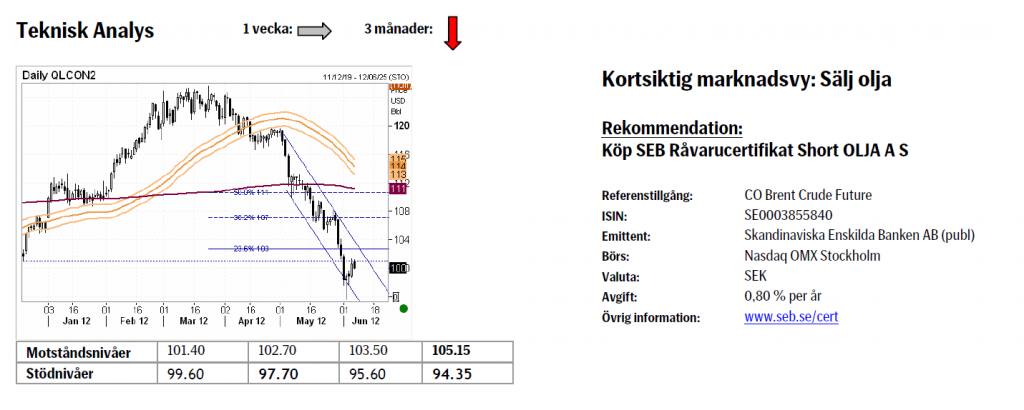
Teknisk analys: Korrektiv rörelse högre att vänta Även ett fritt fall tar någon gång slut. Den kortsiktigt överdrivna rörelsen ner mot $95.60 i måndags korrigeras nu och detta kan fortsätta upp mot första korrektionsmålet (23.6%) vid $102.70, möjligen också mot den fallande motståndslinjen, nu vid $103.50, eller t.o.m. mot gamla stödet vid $105.15. Tillbaka under $97.70 skulle omintetgöra möjligheterna till vidare uppgång i ett kortsiktigt perspektiv, utan i stället ställa om siktet mot höstens botten vid $94.35.
Koppar
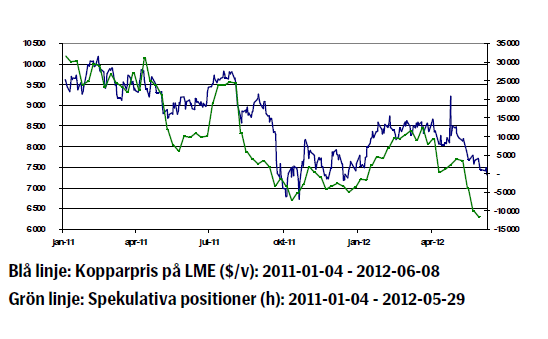
London Metal Exchange (LME) var stängd måndag och tisdag p.g.a. helgdagar. Skuldoro i Europa och flera tecken på en konjunkturavmattning i Kina har länge lagt sordin på kopparpriset.
Kinesisk statistik har varit svag på sistone. Ökningen i industriproduktionen för april landade på drygt nio procent på årlig basis vilket är den sämsta siffran på tre år. Nyutlåningen till banker föll med 33 procent i april jämfört med mars i år. Mycket talar för att siffran blir ännu sämre för maj. Nyutlåningar är i nära kopplad till investeringar i fasta tillgångar som föll till ett 10-årslägsta i april.
För att möta inbromsningen sänkte igår kinesiska centralbanken räntan på ettåriga lån med 25 punkter, en sänkning som träder ikraft idag. Den ettåriga räntan ligger nu på 6,31 procent. Kopparpriset reagerade positivt på denna nyhet och steg med 1,20 procent på beskedet. Uppgången var kortvarit och hela uppgången från igår är idag borta. På kort sikt tror vi dock att vi kan se lägre priser.
Söndagen en 17:e juni går Grekland till val vilket handlar om huruvida det grekiska folket ska gå med på åtstramningar i utbyte mot nya krislån eller istället kräva att överenskommelsen med EU/IMF/ECB rivs upp. Det senare skulle med största sannolikhet leda till att Grekland tvingas lämna euron. Grekisk lag förbjuder publicering av opinionsmätningar två veckor före valdagen vilket ökar ovissheten.
HSBC:s index för tjänstesektorn steg till 54,7 i maj jämfört med 54,1 föregående månad och kinesiska företag är fortsatt optimistiska om framtidsutsikterna. Indexet är konstruerat så att värden över 50 innebär ekonomisk expansion. Index för tjänstesektorn står i skarp kontrast till motsvarande undersökningar för industrisektorn som visade att Kinas industri slog av på takten i maj. Kinas tjänstesektor står nu för hela 43 procent av ekonomin.
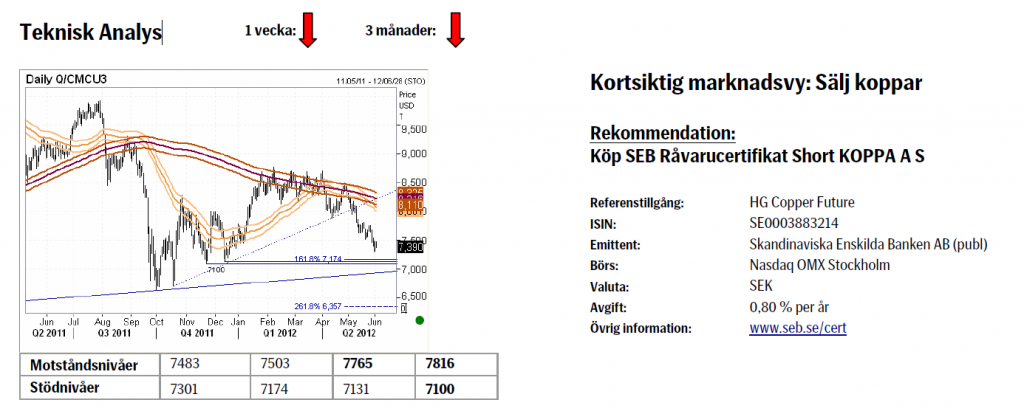
Teknisk analys: På väg mot $7174/7100. Den noterbara nedgången fortsätter med största sannolikhet ner mot nästa målområde som börjar med en projektionsnivå vid $7174, som sedan följs av botten som noterades i november förra året vid $7100 och därefter en mera långsiktig stigande stödlinje i $7000-området.
Majs
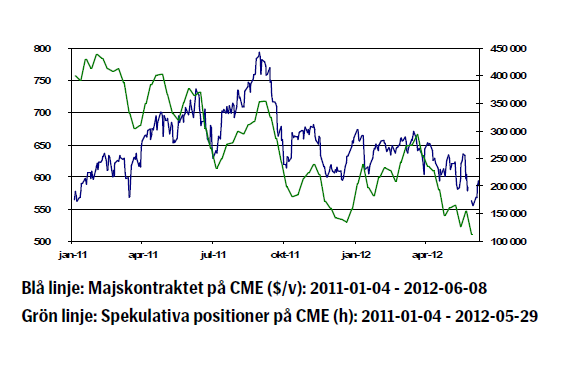
Majspriset Priset på decembermajs har varit stabilt pga. oro över det ovanligt torra vädret i USA samt obekräftade uppgifter om inköp av majs från Kina. En förväntad rekordproduktion i Brasilien och fortsatt goda skördar i USA fick dock priset att falla tillbaka i början av veckan.
Marknaden förväntade sig en försämring av kvalitén på majsskörden i USA men måndagens rapport från USDA uppvisade inga förändringar från föregående vecka utan good/excellent kvarstår på 72 procent vilket är väldigt högt.
USA:s majsskörd förväntas bli god och förväntas fylla på lager vars nivåer varit låga p.g.a. dåliga skördar föregående år.
Konsumtionen av majs till etanol har fallit p.g.a. att subventioner på inblandning i bensinen tagits bort från årsskiftet, vilket ytterligare tynger majspriset. På tisdag, den 12 juni, kommer USDA´s viktiga WASDE (World Agricultural Supply and Demand Estimates) rapport: Prognoserna för utbud och efterfrågan på majs förväntas höjas.
Trots torka så har prognosen för Brasiliens majsproduktion reviderats upp till rekordhöga 67,79 miljoner ton, jämfört med 65,9 miljoner ton för en månad sedan. Stämmer siffrorna så kommer det att vara första gången på över 10 år som Brasilien skördar mer majs än sojabönor. Goda skördar och gynnsamt väder gör att vi är fortsatt negativa till majspriset.
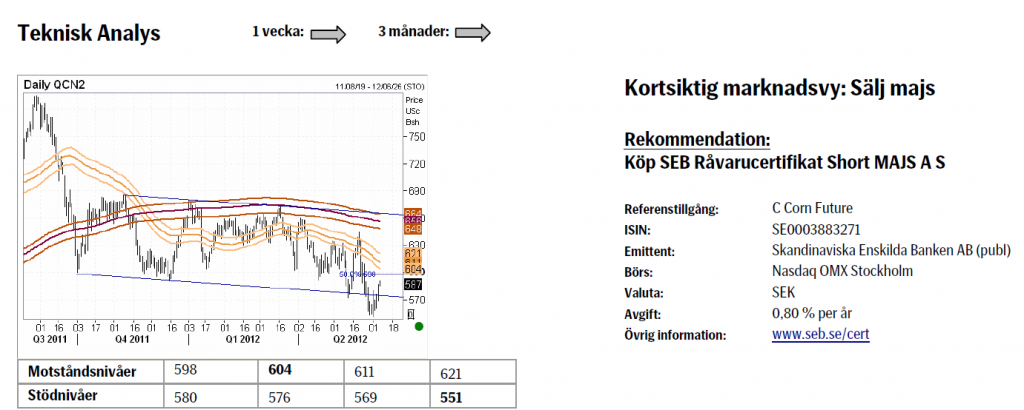
Teknisk analys: Återtest av tidigare stöd. Marknaden har klättrat tillbaka in i det tidigare stödområdet (som nyligen penetrerades). Vidare uppgång möter sannolikt motstånd närmare den lägre delen av det fallande 55-dagars bandet, nu vid 604.
Vete
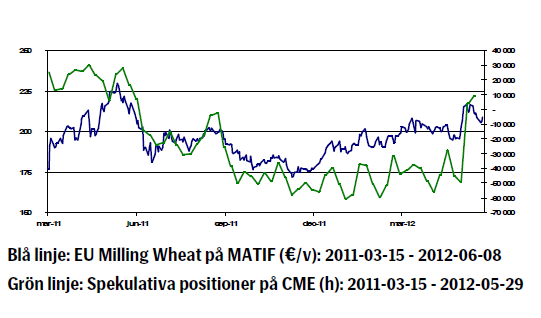
Det europeiska Matifvetet med novemberleverans föll tillbaka i fredags och bröt igenom stödnivån på 210 EUR. Förbättrade väderutsikter i Europa och Svartahavsområdet tillsammans med svag makrostatistik drog ned priset på kvarnvetet som sedan dess har pendlat mellan stödnivån 205 EUR och 208 EUR.
Kontrasterna i Europa har varit stora veckan som gått med varmt torrt väder i de västra delarna och kallt och regnigt i öster. I Frankrike och England har den senaste tidens regn främjat höstgrödornas utveckling, men också gett upphov till ökad risk för sjukdomar. Även Tyskland, Polen och norra Balkan har fått välbehövligt regn (10-35 mm) medan det torra och varma vädret i Italien och Spanien har gynnat skörden av vete.
Måttliga regnskurar har förbättrat utsikterna i de veteproducerande områdena i södra Ukraina och i de södra delarna av Rysslands södra distrikt.
Prognosen för veteproduktionen inom EU-27 har reviderats ned med 200 000 ton till 126,5 miljoner ton, främst på grund av lägre förväntad avkastning i Tyskland, Bulgarien och Rumänien. Tyska lantbrukarna har återigen fått uppleva en torr vår, efter förra årets vår med extremt låg nederbörd. Tysklands spannmålsskörd förväntas i detta skede att hamna under landets genomsnittliga årliga produktion men rikliga regn under de kommande dagarna och veckorna kan fortfarande bidra till en positiv utveckling.
Crop condition för vintervetet i USA, som rapporterades i måndagskväll ligger nu på 52 procent good/excellent och det är TVÅ procent lägre än förra veckan. Nivån är emellertid bra och jämfört med förra året är den t.o.m. mycket bra. Skörden av vintervete i USA går betydligt fortare fram än vanligt. Utsikterna för veteskörden ser fortsatt bra ut och vi behåller vår neurala syn.
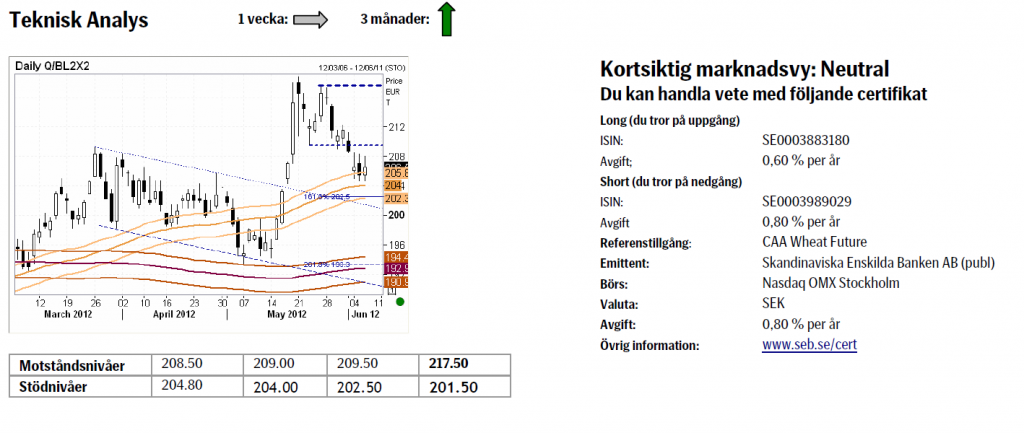
Teknisk analys: Utdragen korrektion Den pågående korrektionen lägre har tagit en djupare bana och kan möjligtvis bli mer komplicerad än vad som tidigare varit antaget. Stöd återfinns dock i 55-dagars bandet (€205.80/202.30), vid en projektionsnivå vid €202.50 och vid den tidigare brutna (fallande) motståndslinjen, nu vid €201.50. Under den senare skulle ifrågasätta om det bara är en korrektion eller om det är något större i görningen (då det skulle öppna också för ~€195). Tillbaka över €209.50 skulle minska trycket på nedsidan.
[box]SEB Veckobrev Veckans råvarukommentar är producerat av SEB Merchant Banking och publiceras i samarbete och med tillstånd på Råvarumarknaden.se[/box]
Disclaimer
The information in this document has been compiled by SEB Merchant Banking, a division within Skandinaviska Enskilda Banken AB (publ) (“SEB”).
Opinions contained in this report represent the bank’s present opinion only and are subject to change without notice. All information contained in this report has been compiled in good faith from sources believed to be reliable. However, no representation or warranty, expressed or implied, is made with respect to the completeness or accuracy of its contents and the information is not to be relied upon as authoritative. Anyone considering taking actions based upon the content of this document is urged to base his or her investment decisions upon such investigations as he or she deems necessary. This document is being provided as information only, and no specific actions are being solicited as a result of it; to the extent permitted by law, no liability whatsoever is accepted for any direct or consequential loss arising from use of this document or its contents.
About SEB
SEB is a public company incorporated in Stockholm, Sweden, with limited liability. It is a participant at major Nordic and other European Regulated Markets and Multilateral Trading Facilities (as well as some non-European equivalent markets) for trading in financial instruments, such as markets operated by NASDAQ OMX, NYSE Euronext, London Stock Exchange, Deutsche Börse, Swiss Exchanges, Turquoise and Chi-X. SEB is authorized and regulated by Finansinspektionen in Sweden; it is authorized and subject to limited regulation by the Financial Services Authority for the conduct of designated investment business in the UK, and is subject to the provisions of relevant regulators in all other jurisdictions where SEB conducts operations. SEB Merchant Banking. All rights reserved.

Market is starting to take US/Iran headlines with a pinch of salt. Brent crude rose $2.8/b yesterday to an official close of $112.1/b. But after that it traded as low as $108.05/b before ending late night at around $109.7/b. Through the day it traded in a range of $106.87 – 112.72/b amid a flurry of news or rumors from Iran and the US. ”US temporary sanctions during negotiations” (falls alarm). ”We will bomb Iran” (not anyhow),… etc. While the market is still fluctuating to this kind of news flow, it is starting to take such headlines with a pinch of salt.

We’ll see. Maybe, maybe not. The Brent M1 contract is trading at $110.2/b this morning which very close to the average ticks through yesterday of $110.4/b.
Trump with bearish, verbal intervention whenever Brent trades above $110/b it seems. What seems to be a pattern is that Trump states something like ”very good negotiations going on with Iran”, ”New leaders in Iran are great,..”, ”Great progress in negotiations,…”, ”Deal in sight,..” etc whenever the Brent M1 contract trades above $110/b. An effort to cool the market. These hot air verbal interventions from Trump used to have a heavy bearish impact on prices, but they now seems to have less and less effect unless they are backed by reality.
As far as we can see there has been no real progress in the negotiations between the US and Iran with both sides still standing by their previous demands.
Iran is getting stronger while the cease fire lasts making a return to war for Trump yet harder. Iran is naturally in constant preparation for a return to war given Trump’s steady threats of bombing Iran again. Iran is naturally doing what ever is possible to prepare for a return to war. And every day the cease fire lasts it is better prepared. This naturally makes it more and more difficult and dangerous for the US to return to warring activity versus Iran as the consequences for energy infrastructure in the Persian Gulf will be more and more severe the longer the cease fire lasts. Israel seems to see it this way as well. That the war is not won and that current frozen state of a cease fire gives Iran opportunity to rebuild military and politically.
Global inventories are drawing down day by day. How much? In the meantime the Strait of Hormuz stays closed. There is varying measures and estimates of how much global inventories are drawing down. Our rough estimate, back of the envelope, is that global inventories are drawing down by at least some 10 mb/d or about 300 mb/d in a balance between loss of supply versus demand destruction. Other estimates we see are a monthly draw of 250-270 mb/d. The IEA only ’measured’ a draw in global observable stocks of 117 mb in April with oil on water rising 53 mb while on shore stocks fell 170 mb. But global stocks are hard to measure with large invisible, unmeasured stocks. As such a back of the envelope approach may be better.
Oil products is what the world is consuming. Oil product prices likely to rise while product stocks fall. Strategic Petroleum Reserves (SPR) are predominantly crude oil. Discharging oil from OECD SPR stocks, a sharp reduction in Chinese crude imports and a reduction in global refinery throughput of 6-7 mb/d has helped to keep crude oil markets satisfactorily supplied. But global inventories are drawing down none the less. And oil products is really what the world is consuming. So if global refinery throughput stays subdued, then demand will eventually have to match the supply of oil products. The likely path forward this summer is a steady draw down in jet fuel, diesel and gasoline. Higher prices for these. Then, if possible, higher refinery throughput and higher usage of crude in response to very profitable refinery margins. And lastly sharper draw in crude stocks and higher prices for these. But some 6 mb/d of oil products used to be exported through the Strait of Hormuz. And it may not be so easy to ramp up refinery activity across the world to compensate. Especially as Ukraine continues to damage Russian refineries as well as Russian crude production and export facilities.
Watch oil product stocks and prices as well as Brent calendar 2027. What to watch for this summer is thus oil product inventories falling and oil product premiums to crude rising. Another measure to watch is the Brent crude 2027 contract as it rises steadily day by day as the Strait of Hormuz stays closed and global oil inventories decline. The latter is close to the highest level since the start of the war and keeps rising.
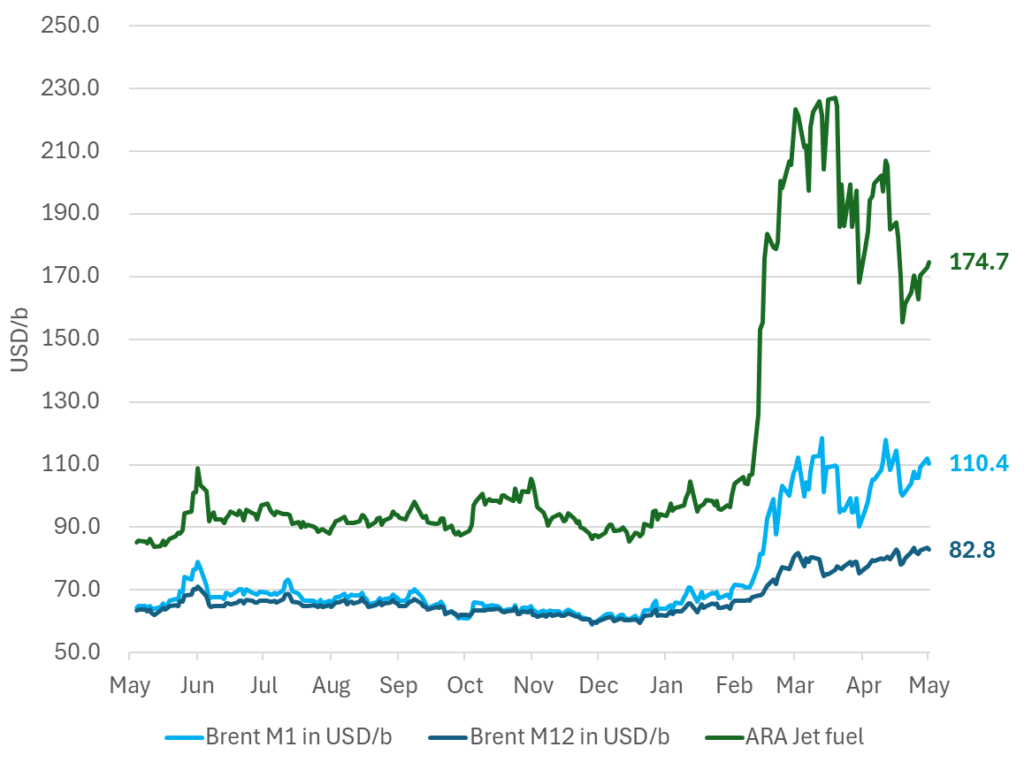
The Brent M1 contract and the Brent 2027 prices and current price of jet fuel in Europe (ARA). All in USD/b
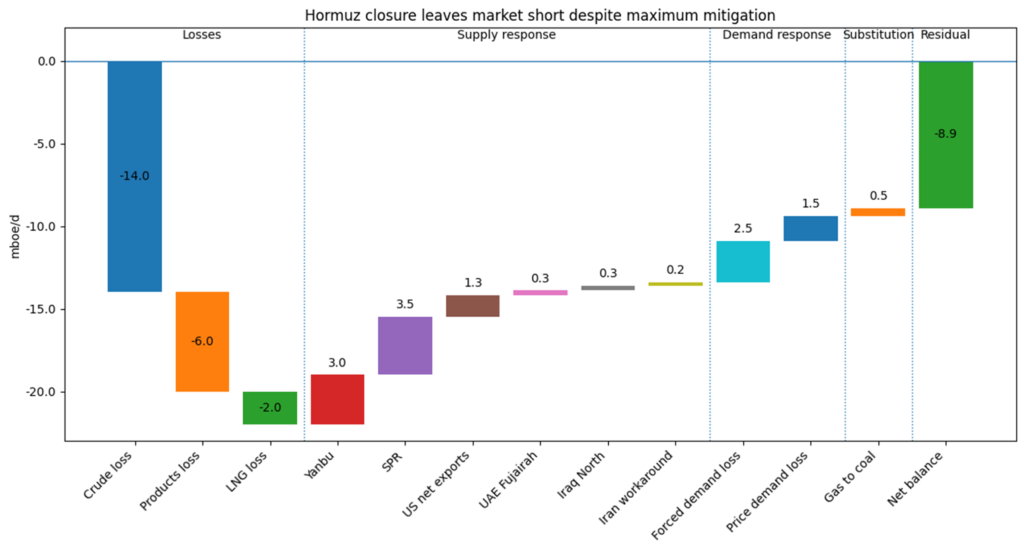
Our back of the envelope calculation of the global shortage created by the closure of the Strait of Hormuz. Note that 3.5 mb/d of discharge from SPR is also a draw. Note also that ’Forced demand loss’ of 2.5 mb/d is probably temporary and will fall back towards zero as logistics are sorted out leaving ’Price demand loss’ to do the job of balancing the market. Thus a shortfall of at least 9 mb/d created by the closure. More if SPR discharge is included and more if Forced demand loss recedes.
Brent is climbing higher. Front-month is at USD 106.3/bl this morning, close to a weekly high and a USD 9/bl jump from Mondays open. This is the move we flagged as a risk earlier in the week: the market shifting from ”a deal is around the corner” to ”this is going to take longer than we thought”.

Analyst Commodities, SEB
During April, rest-of-year Brent remained remarkably stable around USD 90/bl. A stability which rested on one single assumption: the SoH reopens around 1 May. That assumption is now slowly falling apart.
As we highlighted yesterday: every week of delay beyond 1 May adds (theoretically) ish USD 5/bl to the rest-of-year average, as global inventories draw 100 million barrels per week. i.e., a mid-May reopening implies rest-of-year Brent closer to USD 100/bl, and anything pushing into June or July takes us meaningfully higher.
What’s changed in the last 48 hours:
#1: The US military has formally warned that clearing suspected sea mines from SoH could take up to six months. That is a completely different timescale from what the financial market is pricing. Even a political deal tomorrow does not immediately reopen the strait.
#2: Trump has shifted his tone from urgency to ”strategic patience”. In yesterday’s press conference: ”Don’t rush me… I want a great deal.” The market is reading this as a president no longer feeling pressured by timelines, with the naval blockade running in the background.
#3: So far, the military activity is escalating, not de-escalating. Axios reports Iran is laying more mines in SoH. The US 3rd carrier strike group (USS George H.W. Bush) is arriving with two countermine vessels. Trump yesterday ordered the US Navy to destroy any Iranian boats caught laying mines. While CNN reports that the Pentagon is actively drawing up plans to strike Iranian SoH capabilities and individual Iranian military leaders if the ceasefire collapses. i.e., NOT a attitude consistent with an imminent deal!
Spot crude and product prices eased off the early-April highs on a combination of system rerouting and deal optimism. Both now weakening. Goldman estimates April Gulf output is reduced by 14.5 mbl/d, or 57% of pre-war supply, a number that keeps getting worse the longer this drags on.
Demand-side adaptation is ongoing: S. Korea has cut its Middle East crude dependence from 69% to 56% by pulling more from the Americas and Africa, and Japan is kicking off a second round of SPR releases from 1 May. But SPRs are finite.
Ref. to the negotiations, we should not bet on speed. The current Iranian leadership is dominated by genuine hardliners willing to absorb economic pain and run the clock to extract concessions. That is not a setup for a rapid resolution. US/Israeli media briefings keep framing the delay as ”internal Iranian divisions”, the reality is more complicated and points toward weeks and months, not days.
Our point is that the complexity is large, and higher prices have only just started (given a scenario where the negotiations drag out in time). The market spent April leaning on the USD 90/bl rest-of-year assumption; that case is diminishing by the hour. If ”early May reopening” is replaced by ”June, July or later” over the next week or two, both crude and products have meaningful room to reprice higher from here. There is a high risk being short energy and betting on any immediate political resolution(!).
Down on Friday. Up on Monday. The Brent June crude oil contract traded down 5.1% last week to a close of $90.38/b. It reached a high of $103.87/b last Monday and a low of $86.09/b on Friday as Iran announced that the Strait of Hormuz was fully open for transit. That quickly changed over the weekend as the US upheld its blockade of Iranian oil exports while Iran naturally responded by closing the SoH again. The US blew a hole in the engine room of the Iranian ship TOUSKA and took custody of the ship on Sunday. Brent crude is up 5.6% this morning to $95.4/b.
The cease-fire is expiring tomorrow. The US has said it will send a delegation for a second round of negotiations in Islamabad in Pakistan. But Iran has for now rejected a second round of talks as it views US demands as unrealistic and excessive while the US is also blocking the Strait of Hormuz.
While Brent is up 5% this morning, the financial market is still very optimistic that progress will be made. That talks will continue and that the SoH will fully open by the start of May which is consistent with a rest-of-year average Brent crude oil price of around $90/b with the market now trading that balance at around $88/b.
Financial optimism vs. physical deterioration. We have a divergence where the financial market is trading negotiations, improvements and resolution while at the same time the physical market is deteriorating day by day. Physical oil flows remain constrained by disrupted flows, longer voyage times and elevated freight and insurance costs.
Financial markets are betting that a US/Iranian resolution will save us in time from violent shortages down the road. But every day that the SoH remains closed is bringing us closer to a potentially very painful point of shortages and much higher prices.
The US blockade is also a weapon of leverage against its European and Asian allies. When Iran closed the SoH it held the world economy as a hostage against the US. The US blockade of the SoH is of course blocking Iranian oil exports. But it is also an action of disruption directed towards Europe and Asia. The US has called for the rest of the world to engaged in the war with Iran: ”If you want oil from the Persian Gulf, then go and get it”. A risk is that the US plays brinkmanship with the global oil market directed towards its European and Asian allies and maybe even towards China to force them to engage and take part. Maybe unthinkable. But unthinkable has become the norm with Trump in the White House.




Sommarväder skapar prisrally på elbörsen
Oil product price pain is set to rise as the Strait of Hormuz stays closed into summer

Solkraften pressar elpriserna dagtid

Michel Gubel ger sin syn på oljemarknaden