

Analys
SEB – Jordbruksprodukter, vecka 49

 Idag träffas EU-ledarna och besked väntas imorgon. Troligtvis blir det mer av pompa och mindre av en lösning, även om de alltså kommer att påstå det. Den politiska debatten är inriktad på sparande i statsbudgetarna i problemländerna. Problemet är dock ett klassiskt fall av för dålig konkurrenskraft för Spanien, Italien, Grekland, Portugal, delvis Frankrike, pga att lönerna och kostnaderna är för höga i förhållande eurons växelkurs för dessa länder i förhållande till andra länder.
Dessa länder borde antingen göra en ”intern devalvering”, som Estland gjorde, eller en devalvering som Sverige tvingades till 1992. Att fortsätta att ha kvar en fast växelkurs (euron) dödar ekonomin i dessa länder, som gör det än mer akut att devalvera (dvs lämna euron eller sänka lönerna). Hade Bengt Dennis fått hållas med 500% ränta i Sverige hade det inte funnits ett enda företag kvar 1992- 1993. Och konkursade företag återuppstår inte. Alltså, eftersom politikerna inte insett vad som är problemet och försöker ”spara” sig ur detta – alltså slå ut ekonomin ännu fortare, skyndar man bara på den totala kollapsen.
Till slut kommer inget alternativ återstå förutom att trycka pengar och inflatera bort skulderna, men än så länge kommer det bara att blir värre. Missförstå mig inte, inflation är ingen bra lösning, något av en katastrof för ekonomisk hälsa, men skulder måste betalas och det enklaste sättet är att trycka upp pengarna för det.
USDA:s WASDE-rapport imorgon är inte komplett och brukar inte ge någon effekt alls på marknaden.
Globalt väder
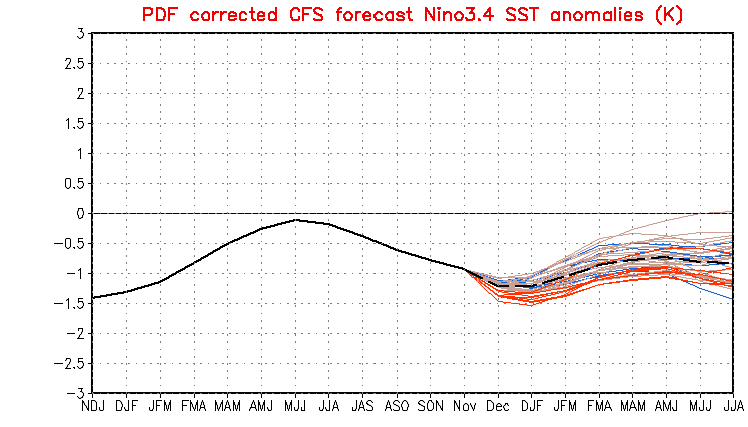
Nedan ser vi ensembleprognosen för La Niña från den 5 december och framåt. Ensembleprognosen är den streckade svarta linjen och den antyder att La Niña ska fortsätta att stärkas under våren 2012 och att den hänger kvar under sommaren.
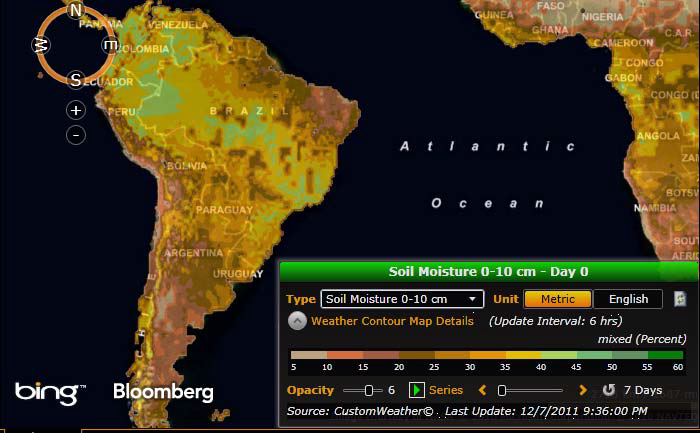
Nedan ser vi markfuktigheten på 0 – 10 cm djup. Vi ser att det är torrt i Argentina och i södra Brasilien.
Vete
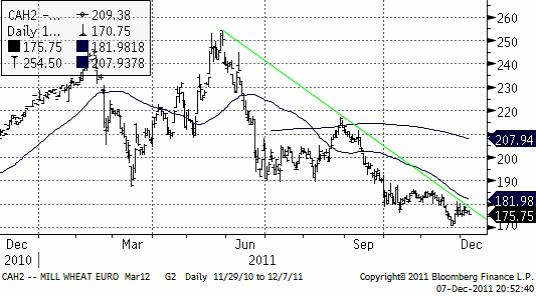
Terminspriset på Matif-vete (mars) har handlats i spannet 174.75 eur – 179.00 eur sedan förra veckan. Viss fundamenta har angett riktning för priset men marknaden påverkas också i nuläget av den oro som råder över den ekonomiska krisen i Europa. Aktiviteten har dock varit låg i avvaktan på fredagens WASDE rapport och utgången av EU-toppmötet.
 Det ukrainska jordbruksministeriet gick i fredags ut och meddelande att för nästa års veteskörd, 2012/13, så kommer produktionen endast att uppgå till 8.5 MT till skillnad mot 22.2 MT för 2011/12.
Man ska dock ta dessa uppgifter med en nypa salt då det fortfarande är tidigt att sia om nästa års skörd men OM de skulle stämma så skulle det vara vara ett stort bortfall för landet och det fick också terminspriserna att stiga ordentligt.
Sedan tog den ekonomiska oron över igen och terminspriserna föll tillbaka under måndag kväll efter att ratinginstitutet Standard & Poors beslutat att sätta 15 av de 17 euroländerna under bevakning med negativa utsikter.
Svartahavs-ländernas dominans på exportmarknaden av vete till Egypten bröts i tisdags då Argentina klev in på scenen och tog hem försäljningen av 180 000 ton (den första för den här säsongen).
Ryssland gick dock inte helt lottlösa i denna budgivning men bidrar med en ”mindre” del denna gång, 60 000 ton. Priserna på det europeiska vetet är fortfarande inte konkurrenskraftiga nog mot länderna ovan och Frankrike räknar med ett bortfall i sin export till Egypten på ca 90 % för 2011/12.
USA var inte med denna gång heller.
Vintertid brukar betyda logistikproblem för FSU-länderna. Kazakhstan hyrde in 5000 godsvagnar från Ryssland i ett försök att underlätta logistiken av sin rekordskörd, men har istället fått problem med åtkomsten till exporthamnar eftersom dessa ligger hos Ryssland och Ukraina som själva har fullt upp med att få ut sitt spannmål på marknaden. I väntan på att grannarna ska bli klara med sin export används godsvagnarna istället till lagring av spannmål.
Australien håller som bäst på att skörda det som som enligt ABARES förväntas bli en rekordsköd.
Även om regnet har ställt till det en del vad gäller kvalitén så finns det gott om köpare i Asien som ser fram emot att ersätta dyr majs med billigare vete från ”down under” till lägre kostnader och i försök att stävja de stigande matpriserna.
Även kanadensiska StatCan rapporterar om ökad veteproduktion för året med en uppgång på 9% eller 2.1 MT från 2010 och där framförallt durumvetet står för en stor del av ökningen.
Alexander Solovyev, vice jordbruksminister i Ryssland sade igår att den ryska exporten under marknadsföringsåret kan nå minst 25 mt. USDA väntar sig 19 mt enligt den senaste WASDErapporten.
Detta var alltså negativa nyheter för priset.
Solovyev menade också att exporten kan fördubblas de kommande 15 – 20 åren pga högre skörd per hektar och ökad areal. Allt tyder på att vetepriset ska ner.
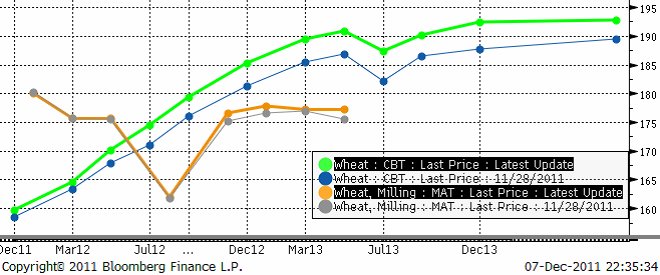
Nedan ser vi terminskurvan för Chicagovete och Matif nu och för en vecka sedan. De ”feta” kurvorna är de aktuella. De ”smala” är förra veckans. Matif är nästan inte förändrat alls, medan priserna gått upp i Chicago – för längre löptider. Bakom ligger oro för kommande skörd pga La Niña kanske och förmodligen också för att räntorna (som man kan låna till) är högre.
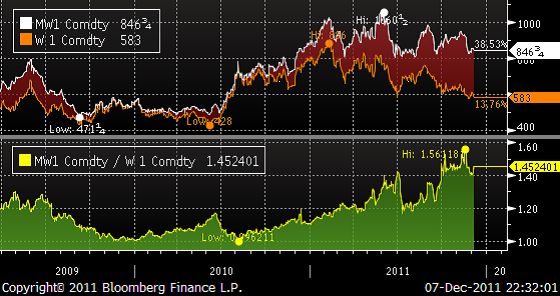
Högproteinvete har blivit allt mer av en bristvara. Det vete som handlas på terminsbörser är det amerikanska vårvetet ”Red Spring” på Minneapolis Grain Exchange. Priset på det har dragit iväg i förhållande till ”kak-vetet” som handlas på Chicago Board of Trade. Nedan ser vi att spotkontraktet på MGX handlas 45% högre än CBOT:s.
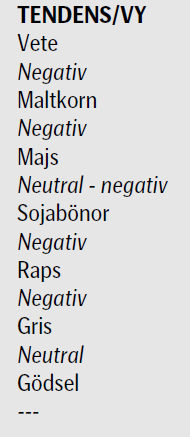
Allt talar för att Matif-vete faller ner i första hand till 150 – 160 – euro-nivån.
Maltkorn
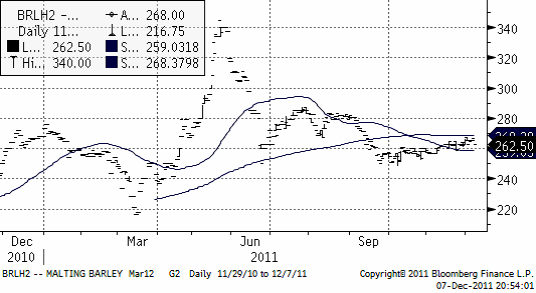
Maltkornsmarknaden följer vetet och det finns inga speciella nyheter att rapportera. Tekniskt ligger priset under glidande medelvärden. Den tekniska trenden är alltså nedåtriktad.
Potatis
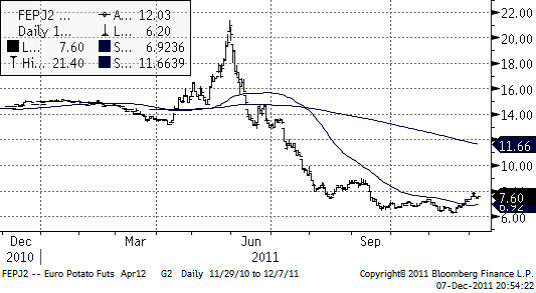
Priset på potatis av årets skörd fortsatte stiga i veckan, ännu en vecka. Rapporten kom från Jordbruksverket tidigare i veckan om en betydligt högre skörd av matpotatis i Sverige, men informationen nådde alltså marknaden redan på försommaren, när priserna började falla.
Nedan ser vi kursdiagrammet på europeisk potatis, som handlas på Eurex; terminen avser leverans april nästa år.
Majs
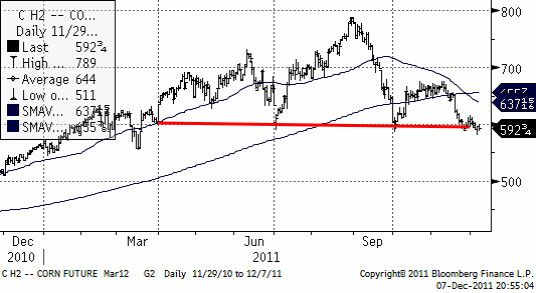
Majspriset har hållit sig kvar vid stödet på 600 cent för mars-kontraktet. Väderleksrapporten för Argentina och södra Brasilien för de närmaste två veckorna innehåller väldigt lite regn och det gör, tillsammans med en oro för La Niña som verkar stärkas, att majsmarknaden fått stöd.
Kopplingen till etanol och oron kring Irans kärnvapenprogram och dess potentiellt explosiva effekt på oljepriset gör majshandlare oroliga att sälja, fast mycket annat tyder på att priset borde vara lägre.
Nedan ser vi marskontraktet på CBOT, där priset ligger på den nivå vid 600 cent där marknaden funnit stöd flera gånger. Den svagare dollarn gav ytterligare stöd för majspriset idag. Priset föll dock av ändå och stängde lågt.
Etanolmarginalen för amerikanska brännerier har säckat ihop och det beror på att etanolpriset handlas betydligt lägre för leverans nästa år jämfört med i år. Skatterabatten för att blanda etanol i bränsle försvinner, som bekant. Nedan ser vi terminspriserna framåt i tiden, där den nedre, lite kraftigare linjen är terminskurvan från onsdagskvällen (igår), medan den smalare är terminskurvan för 7 dagar sedan (den första av de terminerna har hunnit förfalla till idag).
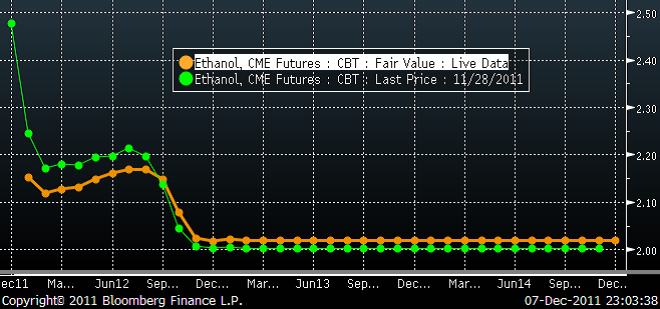
Etanolefterfrågan har hållit majspriset uppe och nu ”borde” majspriset kunna falla under 600 cent / bu. WASDE imorgon fredag innehåller ingen statistik på produktion och marknadspåverkan blir därför väldigt liten. Decemberrapporterna brukar inte påverka marknaden.
Sojabönor
Priset på sojabönor befinner sig i en sjunkande trend. Priset har rekylerat upp lite den senaste veckan och det torde vara ett bra säljtillfälle.
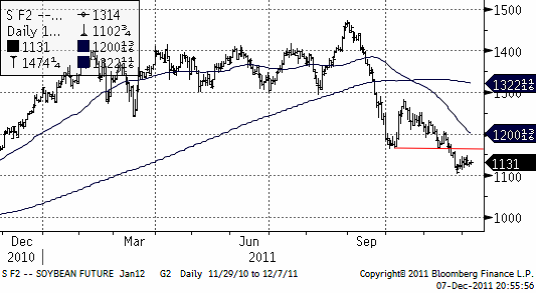
Vi är negativa ur tekniskt perspektiv de närmaste tre månaderna.
Raps
Priset på raps har gått upp något sedan förra veckan och funnit stöd både från energimarknaden (råolja WTI som påverkas av det spända läget I Mellanöstern) och den vegetabiliska oljemarknaden (palmolja).
StatCan rapporterar att produktionen av raps (canola) slog nytt rekord under 2011 enligt deras sista prognos för året. Prognosen är 14.2 mt, en höjning sedan senast från 12.9 mt. Förra årets skörd var 12.8 mt.
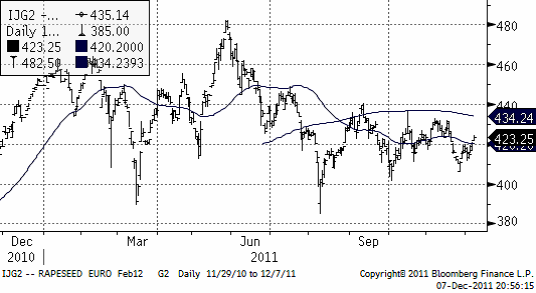
ABARES i Australien höjde prognosen för rapsskörden med 200 kt. Nedan ser vi priset på februariterminen på Matif.
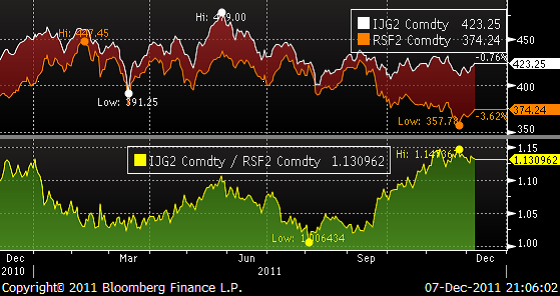
Matifraps är ovanligt dyrt i förhållande till canola i Kanada, som vi ser i nedanstående diagram. Ett premium på 13% är ovanligt högt.
Vi har en negativ vy på Matif raps.
Mjölk
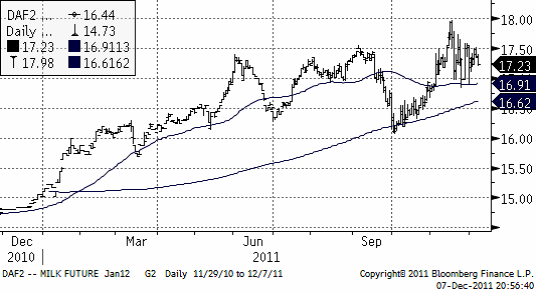
Nedan ser vi priset på januarikontraktet på flytande mjölk (kontakt avräknat mot USDA:s prisindex). Priset har varit väldigt rörligt den senaste tiden. Trenden är uppåtriktad, men hög prisosäkerhet som vi ser nu, uppstår ibland i slutet av trender.
Gris
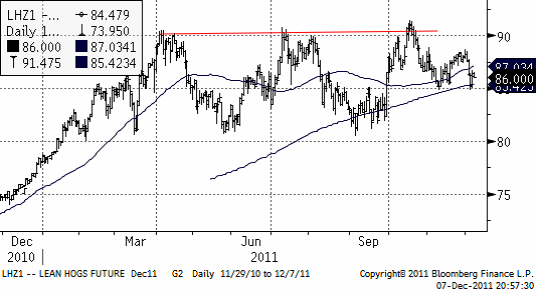
Tekniskt vilar priset på lean hogs på de glidande medelvärdena. Att priset ligger över gör att trenden är uppåtriktad. Det har inte kommit några nämnvärda nyheter sedan förra veckan. Tekniskt är bilden väldigt otydlig.
Valutor
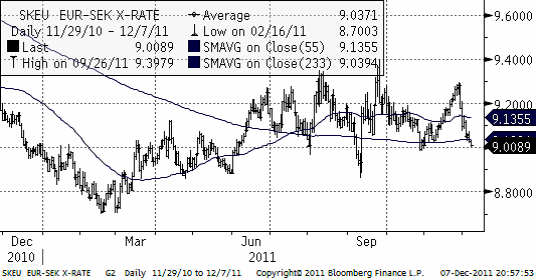
EURSEK har handlats ner till den psykologiskt viktiga nivån 9 kr. Spänningen är stor inför fredagens EU-toppmöte.
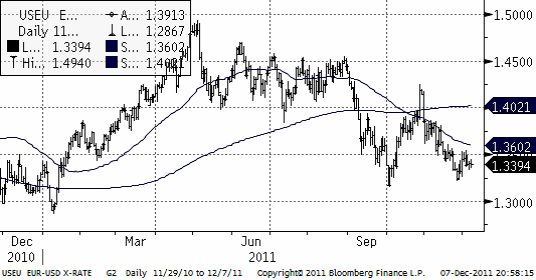
EURUSD är i en tydlig negativ trend.
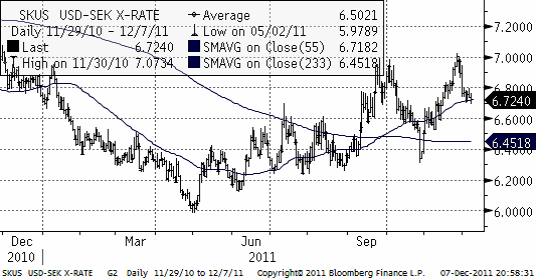
USDSEK har en stigande trend. Just nu vilar priset på 55-dagars glidande medelvärde, och det ger stöd (många tittar på den tekniska indikatorn).
Gödsel
Kväve
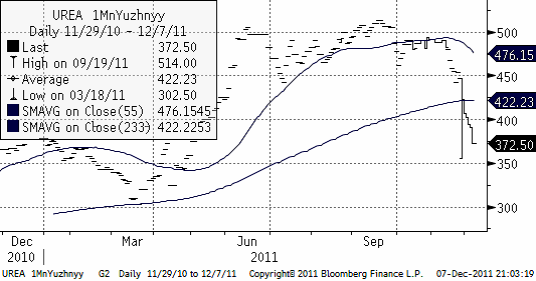
Nedan ser vi 1 månads terminspris på Urea fob Uyzhnyy. Priset har fallit kraftigt under hösten.
[box]SEB Veckobrev Jordbruksprodukter är producerat av SEB Merchant Banking och publiceras i samarbete och med tillstånd på Råvarumarknaden.se[/box]
Disclaimer
The information in this document has been compiled by SEB Merchant Banking, a division within Skandinaviska Enskilda Banken AB (publ) (“SEB”).
Opinions contained in this report represent the bank’s present opinion only and are subject to change without notice. All information contained in this report has been compiled in good faith from sources believed to be reliable. However, no representation or warranty, expressed or implied, is made with respect to the completeness or accuracy of its contents and the information is not to be relied upon as authoritative. Anyone considering taking actions based upon the content of this document is urged to base his or her investment decisions upon such investigations as he or she deems necessary. This document is being provided as information only, and no specific actions are being solicited as a result of it; to the extent permitted by law, no liability whatsoever is accepted for any direct or consequential loss arising from use of this document or its contents.
About SEB
SEB is a public company incorporated in Stockholm, Sweden, with limited liability. It is a participant at major Nordic and other European Regulated Markets and Multilateral Trading Facilities (as well as some non-European equivalent markets) for trading in financial instruments, such as markets operated by NASDAQ OMX, NYSE Euronext, London Stock Exchange, Deutsche Börse, Swiss Exchanges, Turquoise and Chi-X. SEB is authorized and regulated by Finansinspektionen in Sweden; it is authorized and subject to limited regulation by the Financial Services Authority for the conduct of designated investment business in the UK, and is subject to the provisions of relevant regulators in all other jurisdictions where SEB conducts operations. SEB Merchant Banking. All rights reserved.

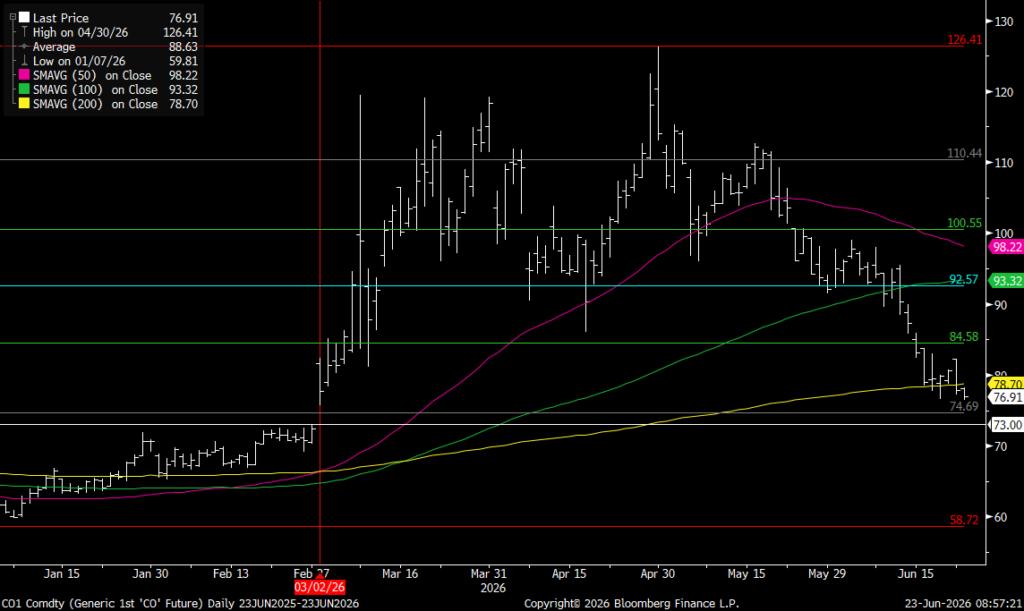
Brent M1 moving below the 200 dma of $78.7/b. Brent crude continued its move lower yesterday with a decline of 3.3% to $77.9/b. This morning it is adding another drop of 1.4% to $76.8/b. Israel bombing Lebanon during the weekend was a violence of the MoU and Iran was quick to declare the SoH closed again. But the willingness to move forward by both the US and Iran obviously trumped the bombing in Lebanon making the event more of a hiccup on the road of further negotiations.

The US has now waived sanctions against Iranian oil exports for two months allowing Iran to sell its oil all over the world, though sanctions instated in Europe will take more time to unwind. Oil from Iran, Russia as well as Venezuela can for the time being be sold across the world without any sharp discount due to sanctions. Chinese Tea-pot refineries will suffer as they previously could buy rebated crude while selling products at market prices.
Crude oil is no flowing out of the SoH with latest number close to 7 mb/d on a three day moving average. That is still well below the 14 mb/d of crude and 6 mb/d of products normally flowing out of the SoH. Latest estimate is that there is around 80 mb of crude on water inside the Persian Gulf and maybe another 80 mb of oil products on water as well. If crude is exiting the SoH at a rate of around 7 mb/d, then the 80 mb of crude would be depleted within 10-15 days and there after the flow would rely on new crude tankers entering, loading and then exiting the SoH to continue further flows. Given the uncertainties surrounding the status of the SoH with Iran stating that it was closed again as recent as this weekend, there is likely an asymmetry here where ships and oil stranded in the SoH for months are much more eager to exit than new ships are eager to enter.
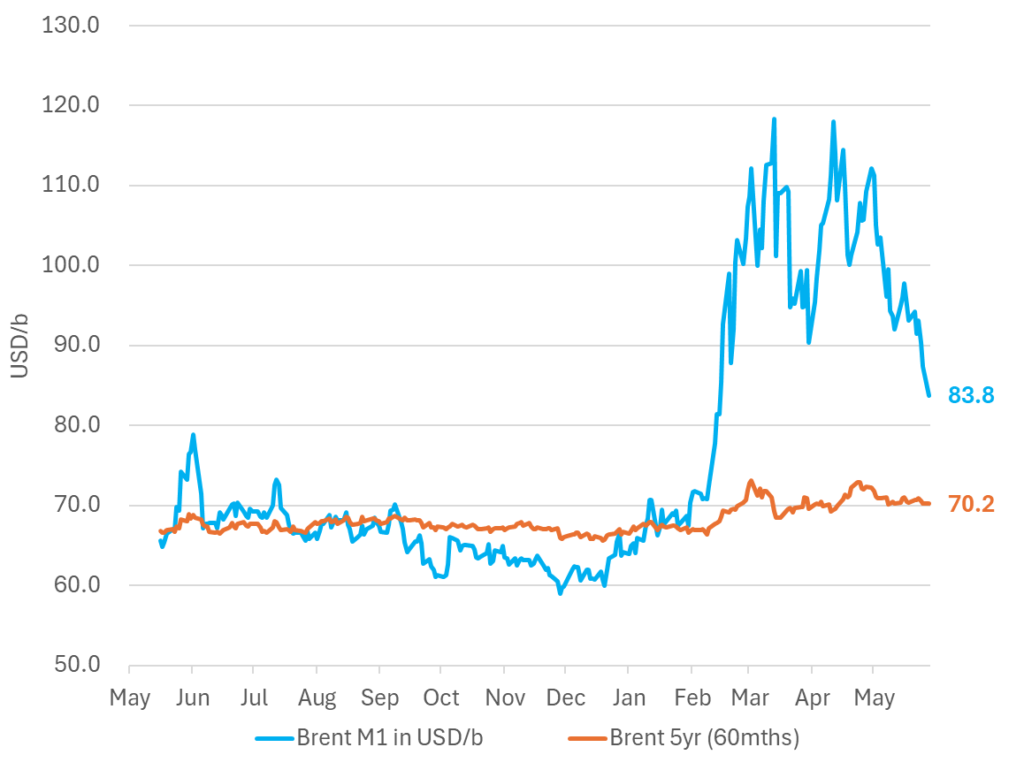
For now Brent crude keeps falling like a rock with the front-end Brent contract now only trading at a premium of $7.6/b above the five year contract. Quickly heading towards parity. The Brent M1 contract has now broken below its 200 dma of $78.7/b and is closing in on the Fibo-level at $74.7/b. Below that there is not much more supporting levels to be found before $73/b which would close the gap from February 3.
Brent crude M1 technical levels
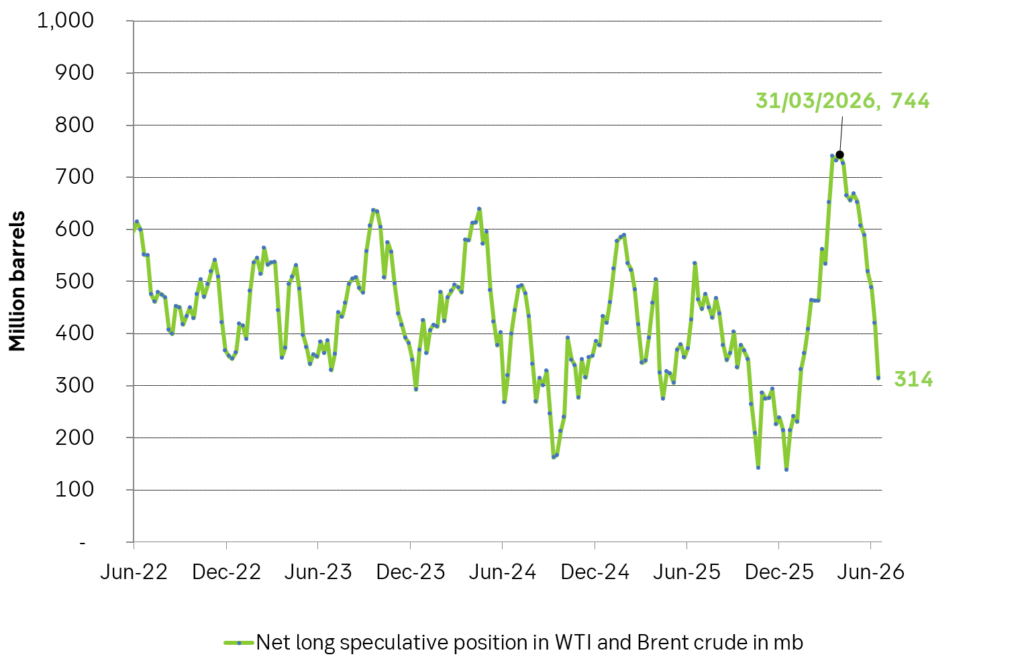
Net long speculative positions are also falling like a rock and as of Tuesday last week the net long positioning in Brent and WTI together summed to 314 million barrels and falling fast.
Will there be a rebound? A possible combination could be an exhaustion of the oil blob caught within the SoH within 1-2 weeks if exits continue at current rate while new ships entering are much more cautious, more Israeli bombardments in Lebanon as Netanyahu fights for re-election, a temporary closure of the SoH again while speculative short positions take cover buying back and covering their positions.
US and Israeli stands versus Iran could harden beyond elections so 2027 surplus is far from given. But Iran and the US are all in all moving towards a set of solutions with both clearly eager to reopen the SoH and keep it open. And that is what the market is pricing along with sharply falling prices. The ongoing discussions will likely take months and last beyond both the upcoming Israeli election (before 27 oct) and the US midterm elections on 3 Nov. Beyond those dates the stance by both Israel and the US may harden again versus Iran. But Iran knows that and is most likely preparing for such a hardening turn. Thus a surplus of oil and global oil stock rebuilding in 2027 (as now is mostly projected) is far from given.
Selling down on a ”deal”. Brent crude fell 6.2% last week with accelerated weakness towards the end of the week. Close of the week at $87.33/b and low of the week (and on Friday) of $85.8/b. Brent is falling another 4% this morning to $83.7/b on confirmation by Iran that a MoU text has been reached and that it will be signed on Friday this week.
So what is this ”deal” worth? Talk on the desk here this morning is that it is much like ”putting lipstick on a pig” where Trump has to sell this at home as a victory where ”the SoH has reopened”, the nuclear issue will be ironed out over the coming 60 days (or maybe 600 days?) and US consumers are getting a lower gasoline price and maybe US republicans survives the midterm elections.
The importance for Iran is that it emerges as the defacto winner of this war in the eyes of the non-US public world. That Iran now onwards is the ”ruler of the SoH” (combo of geography and new weapons systems like drones) or more softer: ”the guarantor of safe passage through the SoH”.
Iran doesn’t need nuclear weapons any more. Nuclear deterrence doesn’t work any more. Ukraine has made many attacks deep into Russia without being nuked in return. Plenty of Iranian ballistic rockets blasts over Israel but Iran wasn’t nuked in return.
There is no trust between the US and Iran. We don’t know all the details yet of the MoU. But what we do know is that there is no trust between the US and Iran what so ever. This is probably more like a descriptive text on how they can cooperate in a way where both sides keeps tactical leverage. Neither side makes irreversible concessions. Violations can be punished quickly. Cooperation produces immediate benefits.
This is a fragile structure. It can easily break down. There may be details which cannot be overcome. To be seen on Friday. The US has to show that it is willing put enough force behind managing and restraining Israel versus Hezbollah in Lebanon. We have seen that Netanyahu hasn’t listened all that much to Trump’s directives and wishes. This could be a major obstacle.
A gradual reopening is tactically preferable for Iran. A tactical leverage for Iran right now is that global oil stocks have been drawn down towards painful and increasingly dangerous levels with increasing risks for oil price spikes in mid-July to August. This together with US midterm elections on 3 November gives tactical leverage to Iran. Iran probably doesn’t want to fully give up on that leverage. A rapid, full reopening where global stocks are able to refill over the coming 60 days will significantly erode that leverage. If Iran reinstates a closure of the SoH after 60 days (if talks break down again), then the effect won’t be that impactful in terms of prices and the US midterm elections.
So a gradual and partial reopening where global markets gets the oil they need while they are unable to rebuild stocks could be a practical middle way for both parties. Trump can sell it as ”the SoH has reopened” and get affordable gasoline for US consumers. Iran can sell it as ”the SoH has fully reopened, but there is some friction” so flow is only 60-80% of normal.
Not much real demand destruction below $100/b. What we do know is that there is not much real price pain demand destruction for oil globally at an oil price below $100/b. A lot of demand-shock destruction. Fear. But demand should now come roaring back towards normal with fear for exceptionally high prices now is rapidly receding.
Sudden China demand destruction due to EVs? Bullocks. EV share of total Chinese carpool now around 13%. Share of new sales of EVs has reached 50%. This is a very gradual process. It doesn’t make oil demand fall like a rock over night. When EV new sales share reaches 100%, then the gasoline car pool will contract by some 5-10% per year. But that is only gasoline. Sudden reduction in Chinese oil demand is more about shock and risk.
Chinese crude oil imports will come roaring back. At what price? Today’s ”neutral” oil price is $70/b. That is the five year price which has steadily traded around the $70/b mark over the past 3-4 years. With still a risky picture one would think that China and the rest of the world will be big buyers of oil in the range of $70-85/b.
Global demand will likely snap back towards normal, forecasted demand and growth at such prices.
Physical reopening is a gradual process. The physical and practical reopening of the SoH will likely be gradual rather than sudden. And that probably suites Iran tactically as well.
Brent M1 price versus the Brent 5-yr (today’s ”normal” price)
Market is starting to take US/Iran headlines with a pinch of salt. Brent crude rose $2.8/b yesterday to an official close of $112.1/b. But after that it traded as low as $108.05/b before ending late night at around $109.7/b. Through the day it traded in a range of $106.87 – 112.72/b amid a flurry of news or rumors from Iran and the US. ”US temporary sanctions during negotiations” (falls alarm). ”We will bomb Iran” (not anyhow),… etc. While the market is still fluctuating to this kind of news flow, it is starting to take such headlines with a pinch of salt.
We’ll see. Maybe, maybe not. The Brent M1 contract is trading at $110.2/b this morning which very close to the average ticks through yesterday of $110.4/b.
Trump with bearish, verbal intervention whenever Brent trades above $110/b it seems. What seems to be a pattern is that Trump states something like ”very good negotiations going on with Iran”, ”New leaders in Iran are great,..”, ”Great progress in negotiations,…”, ”Deal in sight,..” etc whenever the Brent M1 contract trades above $110/b. An effort to cool the market. These hot air verbal interventions from Trump used to have a heavy bearish impact on prices, but they now seems to have less and less effect unless they are backed by reality.
As far as we can see there has been no real progress in the negotiations between the US and Iran with both sides still standing by their previous demands.
Iran is getting stronger while the cease fire lasts making a return to war for Trump yet harder. Iran is naturally in constant preparation for a return to war given Trump’s steady threats of bombing Iran again. Iran is naturally doing what ever is possible to prepare for a return to war. And every day the cease fire lasts it is better prepared. This naturally makes it more and more difficult and dangerous for the US to return to warring activity versus Iran as the consequences for energy infrastructure in the Persian Gulf will be more and more severe the longer the cease fire lasts. Israel seems to see it this way as well. That the war is not won and that current frozen state of a cease fire gives Iran opportunity to rebuild military and politically.
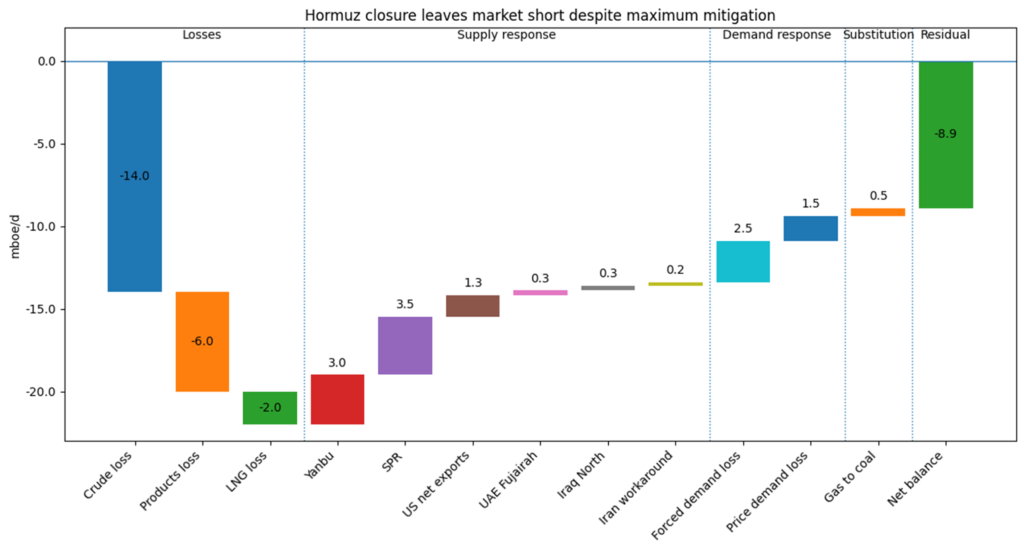
Global inventories are drawing down day by day. How much? In the meantime the Strait of Hormuz stays closed. There is varying measures and estimates of how much global inventories are drawing down. Our rough estimate, back of the envelope, is that global inventories are drawing down by at least some 10 mb/d or about 300 mb/d in a balance between loss of supply versus demand destruction. Other estimates we see are a monthly draw of 250-270 mb/d. The IEA only ’measured’ a draw in global observable stocks of 117 mb in April with oil on water rising 53 mb while on shore stocks fell 170 mb. But global stocks are hard to measure with large invisible, unmeasured stocks. As such a back of the envelope approach may be better.
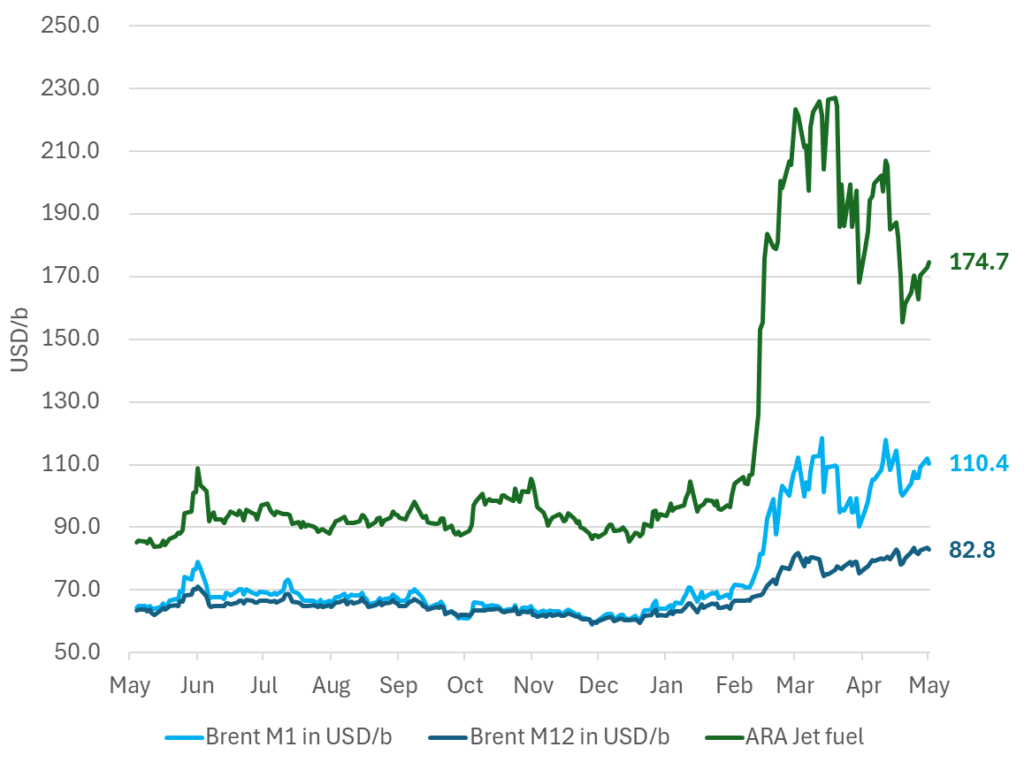
Oil products is what the world is consuming. Oil product prices likely to rise while product stocks fall. Strategic Petroleum Reserves (SPR) are predominantly crude oil. Discharging oil from OECD SPR stocks, a sharp reduction in Chinese crude imports and a reduction in global refinery throughput of 6-7 mb/d has helped to keep crude oil markets satisfactorily supplied. But global inventories are drawing down none the less. And oil products is really what the world is consuming. So if global refinery throughput stays subdued, then demand will eventually have to match the supply of oil products. The likely path forward this summer is a steady draw down in jet fuel, diesel and gasoline. Higher prices for these. Then, if possible, higher refinery throughput and higher usage of crude in response to very profitable refinery margins. And lastly sharper draw in crude stocks and higher prices for these. But some 6 mb/d of oil products used to be exported through the Strait of Hormuz. And it may not be so easy to ramp up refinery activity across the world to compensate. Especially as Ukraine continues to damage Russian refineries as well as Russian crude production and export facilities.
Watch oil product stocks and prices as well as Brent calendar 2027. What to watch for this summer is thus oil product inventories falling and oil product premiums to crude rising. Another measure to watch is the Brent crude 2027 contract as it rises steadily day by day as the Strait of Hormuz stays closed and global oil inventories decline. The latter is close to the highest level since the start of the war and keeps rising.
The Brent M1 contract and the Brent 2027 prices and current price of jet fuel in Europe (ARA). All in USD/b
Our back of the envelope calculation of the global shortage created by the closure of the Strait of Hormuz. Note that 3.5 mb/d of discharge from SPR is also a draw. Note also that ’Forced demand loss’ of 2.5 mb/d is probably temporary and will fall back towards zero as logistics are sorted out leaving ’Price demand loss’ to do the job of balancing the market. Thus a shortfall of at least 9 mb/d created by the closure. More if SPR discharge is included and more if Forced demand loss recedes.




Brent falling like a rock with oil likely to flow from SoH until at least 3 November

Vattenfalls och Industrikrafts kärnkraftsbolag Videberg Kraft har valt Rolls-Royce SMR
Selling down on a ”deal”

Sommarväder skapar prisrally på elbörsen
Oil product price pain is set to rise as the Strait of Hormuz stays closed into summer
Sommarväder skapar prisrally på elbörsen
Vattenfalls och Industrikrafts kärnkraftsbolag Videberg Kraft har valt Rolls-Royce SMR
Selling down on a ”deal”
Brent falling like a rock with oil likely to flow from SoH until at least 3 November
-
Nyheter3 veckor sedan
Sommarväder skapar prisrally på elbörsen
-
 Nyheter1 vecka sedan
Vattenfalls och Industrikrafts kärnkraftsbolag Videberg Kraft har valt Rolls-Royce SMR
-
Analys1 vecka sedan
Selling down on a ”deal”
-
Analys14 timmar sedan
Brent falling like a rock with oil likely to flow from SoH until at least 3 November