

Analys
SEB – Råvarukommentarer vecka 34 2012

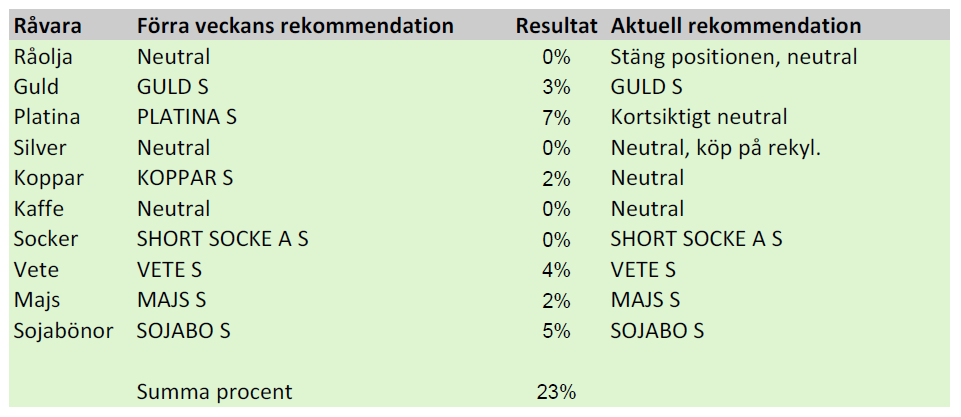
Sammanfattning av rekommendationer
Råolja – Brent
Oljan närmar sig slutet av den här uppgångsfasen. Det är en ”tight” balans mellan tillgång och efterfrågan på råolja i Atlanten. Detta återspeglas i ”backwardation” i terminskurvan. Nedan ser vi kursdiagrammet på spotkontraktet på Brent på ICE.
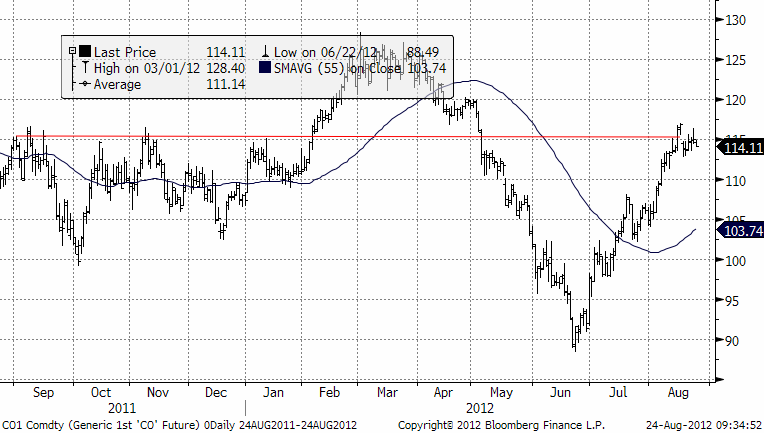
SEB:s teknisk analys tyder på en sidledes utveckling, så vi fortsätter att vara neutrala på kort sikt.
Guld
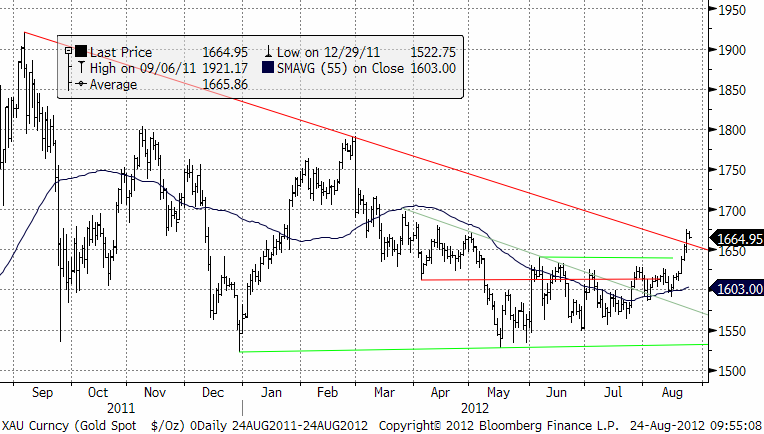
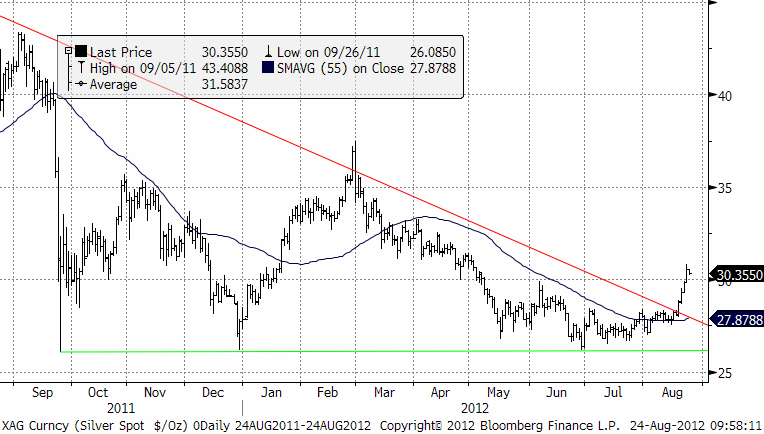
Vår favorit bland ädelmetallerna, platina har utvecklat sig väl. De som följt vårt råd borde vara glada därför att PLATINA S har gått upp med drygt 7% sedan förra veckobrevet. Det börjar pratas om ett nytt QE3. I FOMC-protokollet sägs detta rätt så tydligt. Så här skrev man: MORE STIMULUS SHOULD BE LAUNCHED IF A ”SUBSTANTIAL AND SUSTAINABLE” IMPROVEMENT IN THE RECOVERY IS NOT SEEN ”FAIRLY SOON”. Det talar för ädelmetaller. Vi tycker att man ska äga PLATINA S, GULD S och SILVER S. Möjligen kan man ta hem vinster på PLATINA S nu och byta till GULD S. Vi ser i diagrammet nedan, att guldpriset i dollar har brutit motståndslinjen, vilket är en teknisk köpsignal.
Platina
Sedan oroligheterna vid Lonmin’s Marikana-gruva i Sydafrika eskalerade i förra veckan har priset stiga ca 10 %., från ca $1400/oz till dagens notering på $1547. Lonmin har finansiella problem vilket förvärrar situationen. Företaget producerar 750 000 oz, ca 16 % av Sydafrikas totala utbud som i sin tur utgör hela 75 % av det globala utbudet (ca 6,4 Milj oz). Risken finns att konflikten sprider sig till andra gruvor i landet. Den senaste strejken vid Impalas gruvor i januari varade i 6 veckor och orsakades av samma orsaker, vilket inkluderar en maktkamp mellan olika fackföreningar. För att ytterligare störa situationen gav Sydafrikas president, Jacob Zuma, gruvarbetarna sitt stöd. Han hotade med att ta Lonmins gruvlicens om bolaget inte gav gruvarbetarna 40% mer i lön, som är vad de kräver. Lonmin tjänar inga pengar, utan redovisade en förlust det första halvåret i år. Det är alltså en ohållbar situation och det torde innebära att priset på platina, allt annat lika, kommer att gå upp. Förutom utbudsrisken får Platina stöd i sig egenskap av ädelmetall, och hänger på guldprisets uppåt (där förhoppningar om ett amerikanskt stimulanspaket är huvudförklaringen). Platina klassas som ädelmetall, men sett till konsumtionen är den en industrimetall. Bilindustrin är den största konsumenten där metallen är en viktig beståndsdel i katalysatorer, vars tillverkning står för ca 35 % av den totala efterfrågan. Med vår syn på basmetaller och guld kombinerat talar det mesta för en fortsatt stark prisbild på sikt. Kortsiktigt finns dock risk för rekyl då uppgången gått lite väl fort i samband med oroligheterna i Sydafrika.
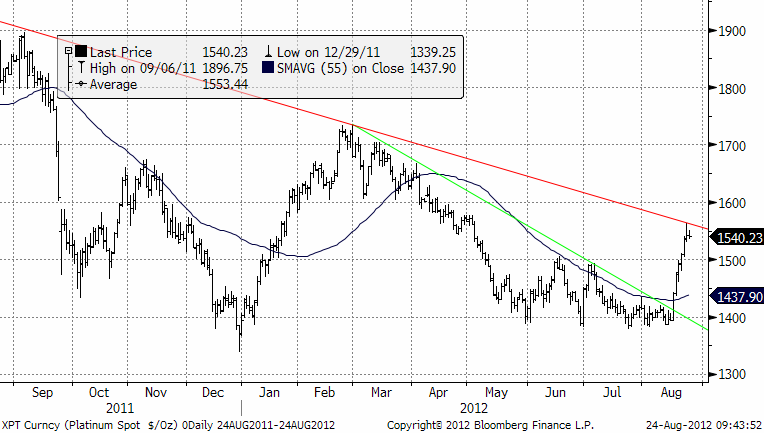
Mot bakgrund av den senaste veckans kraftiga prisuppgång på platina och att vi har en uppgång på 7% i PLATINA S, gör att vi väljer att kliva av här. Notera också att priset i diagrammet ovan gått upp precis till motståndslinjen. Skulle den brytas gå vi omedelbart in igen!
Silver
Silver har levererat på den tekniska bilden, på ett nästan skolboksmässigt sätt. Priset har gått upp hastigt och det vore inte förvånande om det kom en kortsiktig rekyl, som då är ett köptillfälle, ett tillfälle att köpa SILVER S.
Koppar
Efter en i övrigt ganska nyhetsfattig vecka blev den stora höjdpunkten onsdagskvällens FEDs protokoll. Marknaden gillade att ett tillräckligt stort antal ledamöter var positiva till ett nytt stimulanspaket. Riskhattarna åkte på. Basmetaller hade redan börjat vända upp i början av veckan. Prisuppgången i veckan ligger mellan 2 och 4 % för de största metallerna. Nickel utmärker sig (som varit den svagaste den senaste tiden) med en uppgång på 4,5 % sen öppningen i måndags. En viktig nyhet under veckan var att BHP meddelade att de lägger tre sedan tidigare planerade projekt på is med ett värde av 68 Mdr dollar.
Man anger låga råvarupriser som huvudsakligt skäl. En förklaring till den svaga tendensen under sommaren har just varit oron för ett ökat utbud. Vi utryckte vår bedömning förra veckan att priserna ligger i startgroparna inför det säsongsmässigt starkare fjärde kvartalet. Frågan är om det vi nu ser är en tjuvstart? Det mesta talar för en början till vändning, men risken är stor att priserna (vid någon besvikelse över någon makrodata) faller tillbaka igen. Tekniskt sett har trenderna definitivt vänt från neråtgående till mer sidledes. Det behövs mer tid för kraftansamling. Koppar visade vid sidan av nickel störst styrka under veckan. Det är för tidigt att tala om en vändning uppåt. Tekniska analytiker bevakar 100dagarssnittet som kommer in på $7724. Dagens högsta nivå är 7720 ! Marknaden står och väger och frågan är om den har kraft nog att bryta uppåt i nuläget. Oron kvarstår för Kina. Helgens nyhet att fastighetspriserna steg i 49 av 70 större städer som regeringen följer i juli jämfört med juni, minskar sannolikheten för ett snart stimulanspaket i Kina. Det finns således anledning att vila lite på hanen. För den tradingbenägne kan det dock erbjudas intressanta möjligheter i intervallet: 7300-7400 på nedsidan och 7600-7700 på uppsidan.
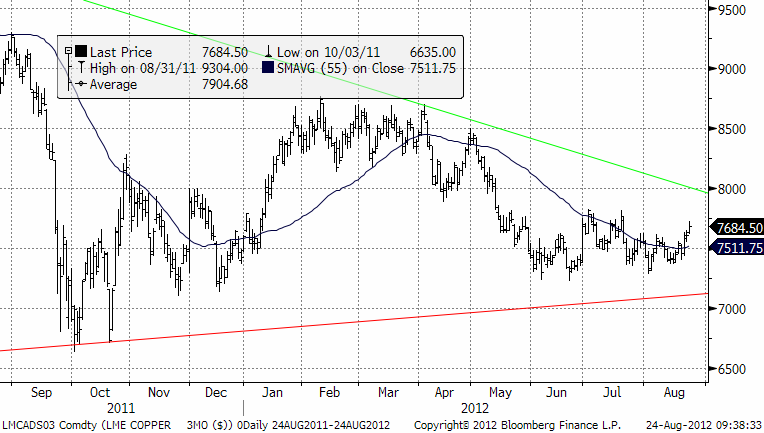
Vi rekommenderade förra veckan ett köp av KOPPAR S, som sedan dess stigit med 2%. Vi tror att det är lite för tidigt att gå in för lite längre sikt, så vi kliver ur den positionen och har en neutral vy.
Kaffe
Priset på Arabica, har funnit ett stöd på den jämna siffran 160 cent. Möjligen kan detta stöd bli en bas för en ny uppgång såsom skedde i juni – juli.
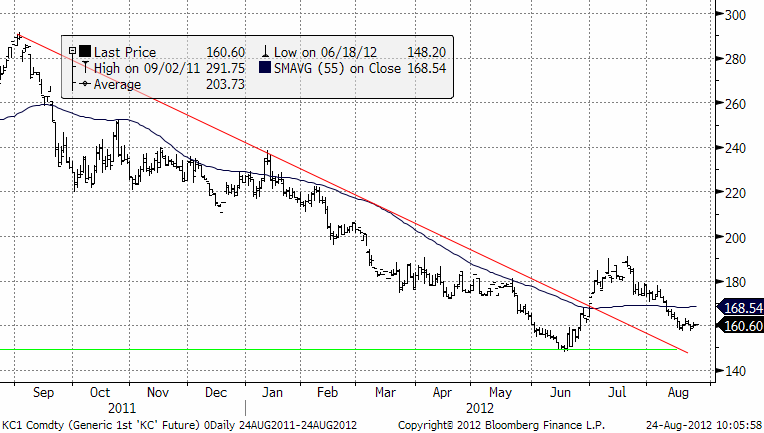
Det är låga priser på kaffe och det är, kanske på grund av El Niño – torrt i Vietnam, världens största producent av Robusta. Det gör att bönorna blir mindre, med mindre skörd som följd. Det finns alltså fundamenta som inte bara pekar på lägre priser.
Socker
Priset på socker har, såsom vi har förutspått, fortsatt att sjunka. Vi skrev för en vecka sedan att 20 cent är en psykologiskt viktig nivå. Marknaden tvekade lite där, men bröt sedan stödet. Det gör att vi tror att priset kommer att fortsätta ner mot 19 cent i första hand.
Brasiliens sockerrörsområden har haft uppehåll i regnen, vilket gör att skörden kan gå framåt snabbare.
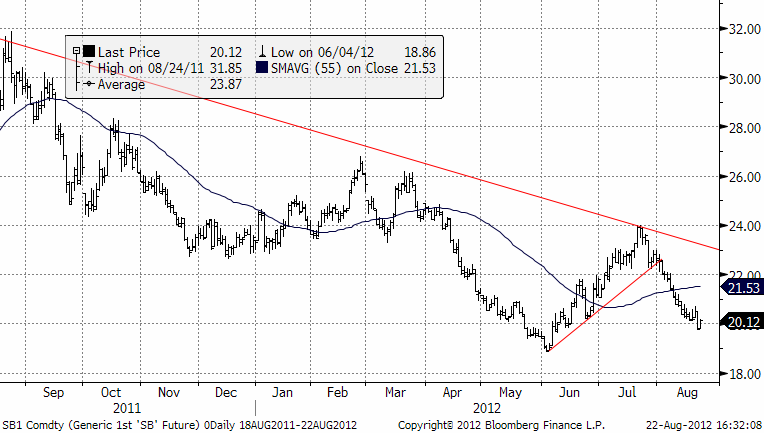
Vi rekommenderade köp av certifikatet SHORT SOCKE A S med en hävstång på – 1.2 för två veckor sedan. Första veckan gav den +5% och den senaste veckan +3%.
Vi rekommenderar att man fortsatt är kort socker, men den som vill ta hem vinster nu vid 20 cent kan kanske göra det för att sedan försöka sälja igen om priset rekylerar upp lite.
Kakao
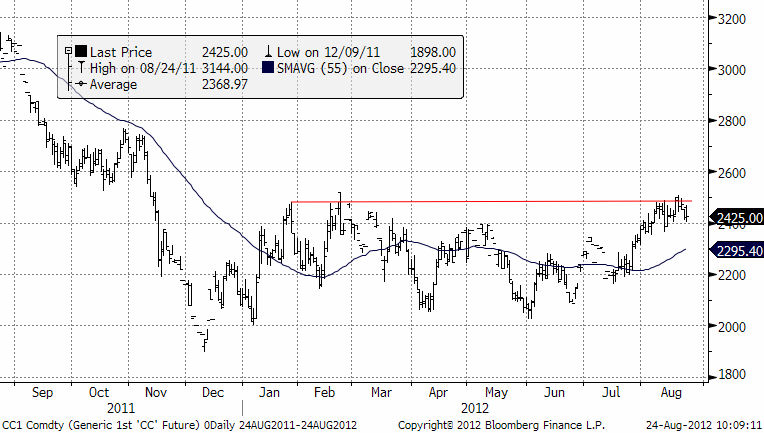
Kakaopriset har fortsatt att backa efter att ha stött på tekniskt motstånd vid 2500. Vi fortsätter att förhålla oss neutrala vad gäller vår uppfattning om priset.
Om jordbruksprodukterna
Priserna på jordbruksprodukter har fortsatt upp. Tekniskt ser det ut som om priserna på spannmål och oljeväxter kommer att fortsätta stiga, men gårdagskvällens rapport från StatsCanada, som visar en av de största skördarna av spannmål någonsin och den största skörden av raps någonsin, fick marknaderna att tveka.
Pro Farmer crop tour visar en skörd i bättre skick än USDA har förutspått.
Eurozonen ser ut att gå mot en vecka där man får se sanningen i vitögat och det lär knappast öka konsumtionsviljan.
Vi tror att detta kan vara ett köptillfälle och vi fortsätter att tro på högre priser. Än har ransoneringen av konsumtionen av majs – den mest kritiska marknaden – och drivande för vetemarknaden – inte visat något tecken på att komma igång. Tvärtom, faktiskt. Såväl utfordring av djur i USA, som etanolproduktion i USA ökar enligt de senaste rapporterna.
För spannmål och övriga jordbruksprodukter hänvisas till gårdagens nyhetsbrev.
[box]SEB Veckobrev Veckans råvarukommentar är producerat av SEB Merchant Banking och publiceras i samarbete och med tillstånd på Råvarumarknaden.se[/box]
Disclaimer
The information in this document has been compiled by SEB Merchant Banking, a division within Skandinaviska Enskilda Banken AB (publ) (“SEB”).
Opinions contained in this report represent the bank’s present opinion only and are subject to change without notice. All information contained in this report has been compiled in good faith from sources believed to be reliable. However, no representation or warranty, expressed or implied, is made with respect to the completeness or accuracy of its contents and the information is not to be relied upon as authoritative. Anyone considering taking actions based upon the content of this document is urged to base his or her investment decisions upon such investigations as he or she deems necessary. This document is being provided as information only, and no specific actions are being solicited as a result of it; to the extent permitted by law, no liability whatsoever is accepted for any direct or consequential loss arising from use of this document or its contents.
About SEB
SEB is a public company incorporated in Stockholm, Sweden, with limited liability. It is a participant at major Nordic and other European Regulated Markets and Multilateral Trading Facilities (as well as some non-European equivalent markets) for trading in financial instruments, such as markets operated by NASDAQ OMX, NYSE Euronext, London Stock Exchange, Deutsche Börse, Swiss Exchanges, Turquoise and Chi-X. SEB is authorized and regulated by Finansinspektionen in Sweden; it is authorized and subject to limited regulation by the Financial Services Authority for the conduct of designated investment business in the UK, and is subject to the provisions of relevant regulators in all other jurisdictions where SEB conducts operations. SEB Merchant Banking. All rights reserved.

Market is starting to take US/Iran headlines with a pinch of salt. Brent crude rose $2.8/b yesterday to an official close of $112.1/b. But after that it traded as low as $108.05/b before ending late night at around $109.7/b. Through the day it traded in a range of $106.87 – 112.72/b amid a flurry of news or rumors from Iran and the US. ”US temporary sanctions during negotiations” (falls alarm). ”We will bomb Iran” (not anyhow),… etc. While the market is still fluctuating to this kind of news flow, it is starting to take such headlines with a pinch of salt.

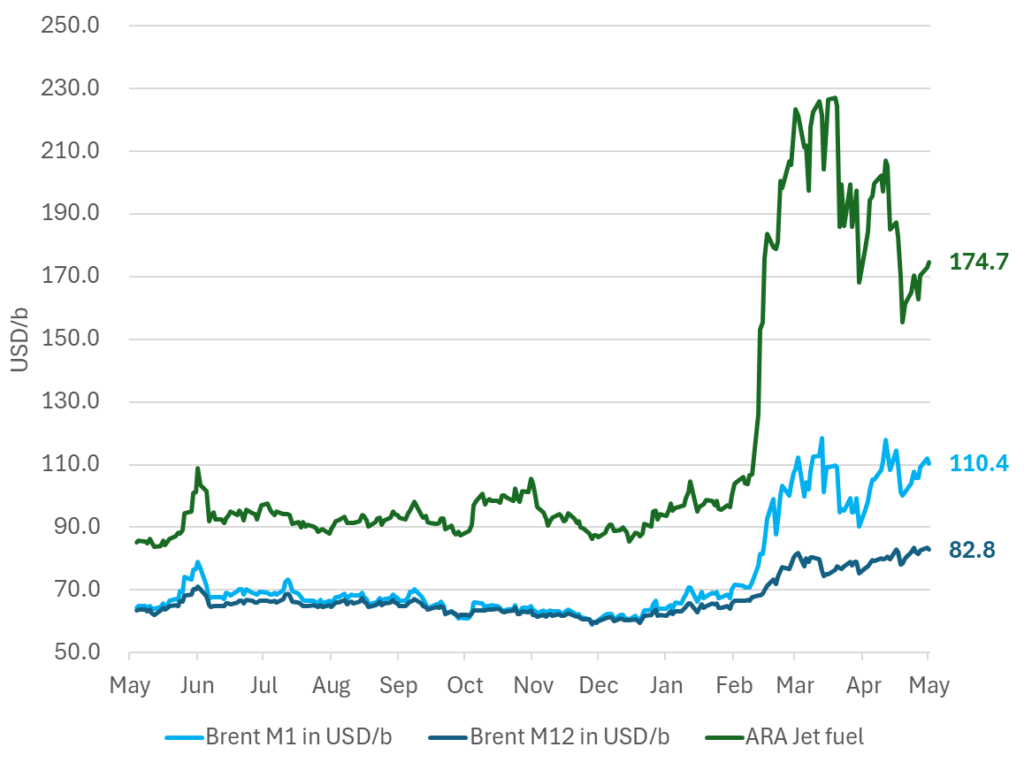
We’ll see. Maybe, maybe not. The Brent M1 contract is trading at $110.2/b this morning which very close to the average ticks through yesterday of $110.4/b.
Trump with bearish, verbal intervention whenever Brent trades above $110/b it seems. What seems to be a pattern is that Trump states something like ”very good negotiations going on with Iran”, ”New leaders in Iran are great,..”, ”Great progress in negotiations,…”, ”Deal in sight,..” etc whenever the Brent M1 contract trades above $110/b. An effort to cool the market. These hot air verbal interventions from Trump used to have a heavy bearish impact on prices, but they now seems to have less and less effect unless they are backed by reality.
As far as we can see there has been no real progress in the negotiations between the US and Iran with both sides still standing by their previous demands.
Iran is getting stronger while the cease fire lasts making a return to war for Trump yet harder. Iran is naturally in constant preparation for a return to war given Trump’s steady threats of bombing Iran again. Iran is naturally doing what ever is possible to prepare for a return to war. And every day the cease fire lasts it is better prepared. This naturally makes it more and more difficult and dangerous for the US to return to warring activity versus Iran as the consequences for energy infrastructure in the Persian Gulf will be more and more severe the longer the cease fire lasts. Israel seems to see it this way as well. That the war is not won and that current frozen state of a cease fire gives Iran opportunity to rebuild military and politically.
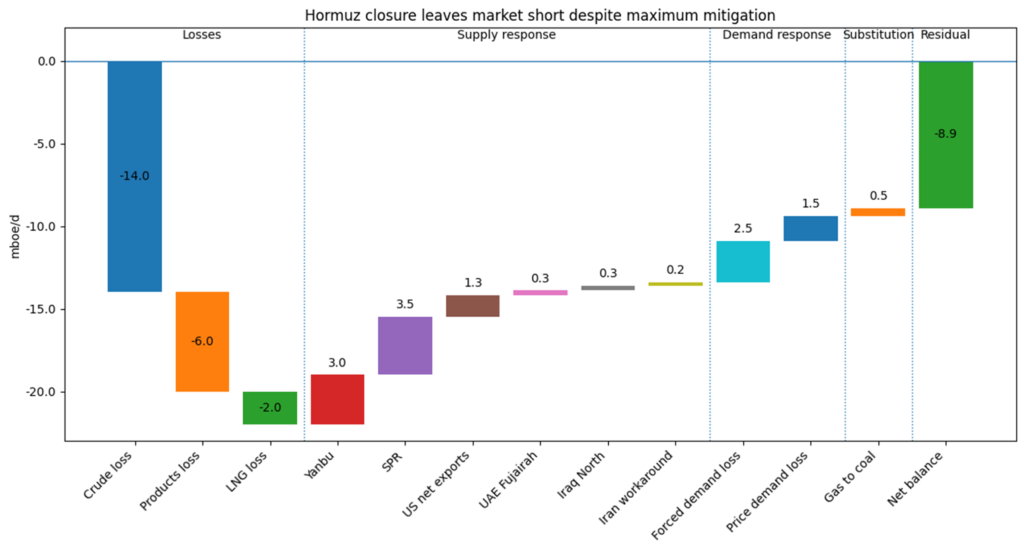
Global inventories are drawing down day by day. How much? In the meantime the Strait of Hormuz stays closed. There is varying measures and estimates of how much global inventories are drawing down. Our rough estimate, back of the envelope, is that global inventories are drawing down by at least some 10 mb/d or about 300 mb/d in a balance between loss of supply versus demand destruction. Other estimates we see are a monthly draw of 250-270 mb/d. The IEA only ’measured’ a draw in global observable stocks of 117 mb in April with oil on water rising 53 mb while on shore stocks fell 170 mb. But global stocks are hard to measure with large invisible, unmeasured stocks. As such a back of the envelope approach may be better.
Oil products is what the world is consuming. Oil product prices likely to rise while product stocks fall. Strategic Petroleum Reserves (SPR) are predominantly crude oil. Discharging oil from OECD SPR stocks, a sharp reduction in Chinese crude imports and a reduction in global refinery throughput of 6-7 mb/d has helped to keep crude oil markets satisfactorily supplied. But global inventories are drawing down none the less. And oil products is really what the world is consuming. So if global refinery throughput stays subdued, then demand will eventually have to match the supply of oil products. The likely path forward this summer is a steady draw down in jet fuel, diesel and gasoline. Higher prices for these. Then, if possible, higher refinery throughput and higher usage of crude in response to very profitable refinery margins. And lastly sharper draw in crude stocks and higher prices for these. But some 6 mb/d of oil products used to be exported through the Strait of Hormuz. And it may not be so easy to ramp up refinery activity across the world to compensate. Especially as Ukraine continues to damage Russian refineries as well as Russian crude production and export facilities.
Watch oil product stocks and prices as well as Brent calendar 2027. What to watch for this summer is thus oil product inventories falling and oil product premiums to crude rising. Another measure to watch is the Brent crude 2027 contract as it rises steadily day by day as the Strait of Hormuz stays closed and global oil inventories decline. The latter is close to the highest level since the start of the war and keeps rising.
The Brent M1 contract and the Brent 2027 prices and current price of jet fuel in Europe (ARA). All in USD/b
Our back of the envelope calculation of the global shortage created by the closure of the Strait of Hormuz. Note that 3.5 mb/d of discharge from SPR is also a draw. Note also that ’Forced demand loss’ of 2.5 mb/d is probably temporary and will fall back towards zero as logistics are sorted out leaving ’Price demand loss’ to do the job of balancing the market. Thus a shortfall of at least 9 mb/d created by the closure. More if SPR discharge is included and more if Forced demand loss recedes.
Brent is climbing higher. Front-month is at USD 106.3/bl this morning, close to a weekly high and a USD 9/bl jump from Mondays open. This is the move we flagged as a risk earlier in the week: the market shifting from ”a deal is around the corner” to ”this is going to take longer than we thought”.

Analyst Commodities, SEB
During April, rest-of-year Brent remained remarkably stable around USD 90/bl. A stability which rested on one single assumption: the SoH reopens around 1 May. That assumption is now slowly falling apart.
As we highlighted yesterday: every week of delay beyond 1 May adds (theoretically) ish USD 5/bl to the rest-of-year average, as global inventories draw 100 million barrels per week. i.e., a mid-May reopening implies rest-of-year Brent closer to USD 100/bl, and anything pushing into June or July takes us meaningfully higher.
What’s changed in the last 48 hours:
#1: The US military has formally warned that clearing suspected sea mines from SoH could take up to six months. That is a completely different timescale from what the financial market is pricing. Even a political deal tomorrow does not immediately reopen the strait.
#2: Trump has shifted his tone from urgency to ”strategic patience”. In yesterday’s press conference: ”Don’t rush me… I want a great deal.” The market is reading this as a president no longer feeling pressured by timelines, with the naval blockade running in the background.
#3: So far, the military activity is escalating, not de-escalating. Axios reports Iran is laying more mines in SoH. The US 3rd carrier strike group (USS George H.W. Bush) is arriving with two countermine vessels. Trump yesterday ordered the US Navy to destroy any Iranian boats caught laying mines. While CNN reports that the Pentagon is actively drawing up plans to strike Iranian SoH capabilities and individual Iranian military leaders if the ceasefire collapses. i.e., NOT a attitude consistent with an imminent deal!
Spot crude and product prices eased off the early-April highs on a combination of system rerouting and deal optimism. Both now weakening. Goldman estimates April Gulf output is reduced by 14.5 mbl/d, or 57% of pre-war supply, a number that keeps getting worse the longer this drags on.
Demand-side adaptation is ongoing: S. Korea has cut its Middle East crude dependence from 69% to 56% by pulling more from the Americas and Africa, and Japan is kicking off a second round of SPR releases from 1 May. But SPRs are finite.
Ref. to the negotiations, we should not bet on speed. The current Iranian leadership is dominated by genuine hardliners willing to absorb economic pain and run the clock to extract concessions. That is not a setup for a rapid resolution. US/Israeli media briefings keep framing the delay as ”internal Iranian divisions”, the reality is more complicated and points toward weeks and months, not days.
Our point is that the complexity is large, and higher prices have only just started (given a scenario where the negotiations drag out in time). The market spent April leaning on the USD 90/bl rest-of-year assumption; that case is diminishing by the hour. If ”early May reopening” is replaced by ”June, July or later” over the next week or two, both crude and products have meaningful room to reprice higher from here. There is a high risk being short energy and betting on any immediate political resolution(!).
Down on Friday. Up on Monday. The Brent June crude oil contract traded down 5.1% last week to a close of $90.38/b. It reached a high of $103.87/b last Monday and a low of $86.09/b on Friday as Iran announced that the Strait of Hormuz was fully open for transit. That quickly changed over the weekend as the US upheld its blockade of Iranian oil exports while Iran naturally responded by closing the SoH again. The US blew a hole in the engine room of the Iranian ship TOUSKA and took custody of the ship on Sunday. Brent crude is up 5.6% this morning to $95.4/b.
The cease-fire is expiring tomorrow. The US has said it will send a delegation for a second round of negotiations in Islamabad in Pakistan. But Iran has for now rejected a second round of talks as it views US demands as unrealistic and excessive while the US is also blocking the Strait of Hormuz.
While Brent is up 5% this morning, the financial market is still very optimistic that progress will be made. That talks will continue and that the SoH will fully open by the start of May which is consistent with a rest-of-year average Brent crude oil price of around $90/b with the market now trading that balance at around $88/b.
Financial optimism vs. physical deterioration. We have a divergence where the financial market is trading negotiations, improvements and resolution while at the same time the physical market is deteriorating day by day. Physical oil flows remain constrained by disrupted flows, longer voyage times and elevated freight and insurance costs.
Financial markets are betting that a US/Iranian resolution will save us in time from violent shortages down the road. But every day that the SoH remains closed is bringing us closer to a potentially very painful point of shortages and much higher prices.
The US blockade is also a weapon of leverage against its European and Asian allies. When Iran closed the SoH it held the world economy as a hostage against the US. The US blockade of the SoH is of course blocking Iranian oil exports. But it is also an action of disruption directed towards Europe and Asia. The US has called for the rest of the world to engaged in the war with Iran: ”If you want oil from the Persian Gulf, then go and get it”. A risk is that the US plays brinkmanship with the global oil market directed towards its European and Asian allies and maybe even towards China to force them to engage and take part. Maybe unthinkable. But unthinkable has become the norm with Trump in the White House.




Sommarväder skapar prisrally på elbörsen
Oil product price pain is set to rise as the Strait of Hormuz stays closed into summer

Solkraften pressar elpriserna dagtid

Michel Gubel ger sin syn på oljemarknaden