

Analys
SEB – Råvarukommentarer vecka 31 2012

Sammanfattning av rekommendationer
Råvara – Rekommendation
Råolja – Köp OLJA S
Guld – Köp BULL GULD X4 S (hög risk) eller GULD S (låg risk)
Silver – Ingen rekommendation
Koppar – Köp KOPPAR S
Zink – Ingen rekommendation
Kaffe – Köp KAFFE S
Socker – Köp SHORT SOCKE A S
Vete – Köp VETE S
Majs – Köp MAJS S
Sojabönor – Köp SOJABO S
Inledning
Efter den positiva avslutningen förra veckan, efter Drahgis ”löften” om ett kraftfullt penningpolitiskt agerande, började handeln avvaktande i måndags. Centralbanksmöten både i USA, England och ECB:s under veckan och det var upplagt för prisrörelser. Det var det vi fick se idag torsdag, men på nedsidan.
Drahgis uttalande diskonterade in alltför positiva utsikter. FED vilar på hanen ännu en månad och ECB redovisade inget nytt. Eurodollarn föll kraftigt och så gjorde metallerna. De större basmetallerna koppar, aluminium, zink och nickel är ned 2-3 %.
Marknaderna för jordbruksprodukter har varit avvaktande efter de stora prisuppgångarna. Kortsiktig brist måste ransoneras, men när är det dags för priset att vända ner igen?
Guld och socker har fått nya tekniska signaler. Köpsignal för guld och säljsignal för socker.
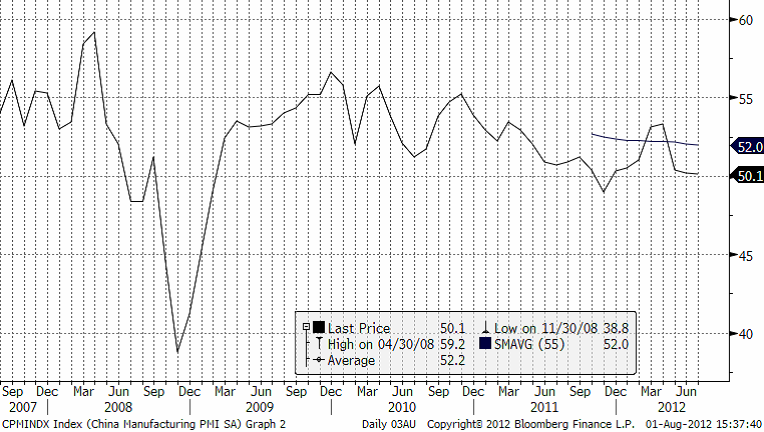
Brent tycker vi att man bör köpa på ”dippar” under 100 dollar. Iran försöker peddla sin olja till dem som vågar trotsa EU.s och USA:s köpförbud. OPEC producerar på sin lägsta nivå sedan 2008 pga detta. Kina bromsar in, men försöker stimulera ekonomin på olika sätt. Frågar än när dessa stimulanser biter. Kinesiskt PMI (inköpschefsindex) kom in på 50.1. Det är lite lägre än förra månadens 50.2. Ett värde över 50 indikerar att ekonomin växer och ett värde under 50 indikerar att ekonomin krymper.
Eurokrisen
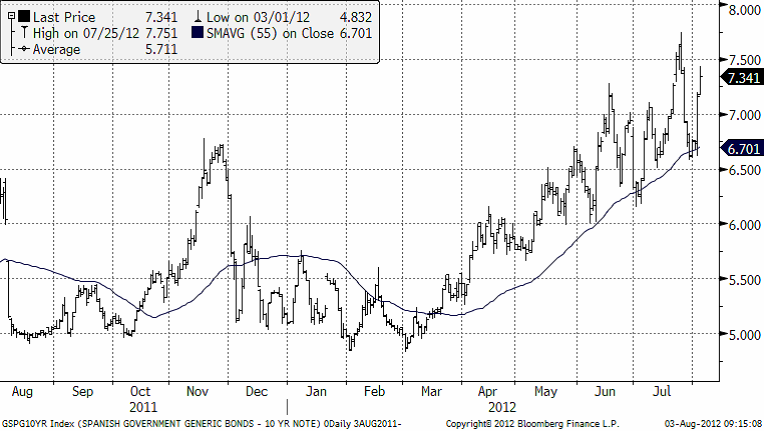
Vad som sker i EU är att det finns en social acceptans att banker tas över av staten därför att man inte vill uppleva obehaget av att bankerna går under var och en för sig, Detta gör att det är rimligt att anta att staternas i fråga egentliga skulder är deras egen statsskuld + bankernas skulder. När man studerar den typen av skuldberg i förhållande till de här ländernas skatteintäkter, får man en skrämmande bild. Än så länge försöker man skjuta upp det oundvikliga. ECB:s satsning på att få ner räntorna i Spanien är det senaste och främsta exemplet på detta. Vi ser nedan hur räntorna har på deras tioårs statsobligation föll från 7.75 till 6.68. Efter Draghis tal igår steg räntorna återigen upp till 7.34% i skrivande stund.
Inköpschefsindex, PMI, för de stora ekonomierna har sjunkit stadigt det senaste året. Tysklands PMI för tillverkningsindustrin ligger nu under Frankrikes, på 43 mot 43.4. Eurozonen ligger på 44. Storbritannien har bromsat in fort de senaste tre månaderna och har sjunkit från 50.2 i april till 45.4 i juli. USA har halkat under 50. Endast Kina ligger över 50. Gårdagens kinesiska PMI kom in på 50.1, vilket är en tiondel lägre än i juni (50.2). PMI anses vara en ”ledande indikator” för ekonomins utveckling.
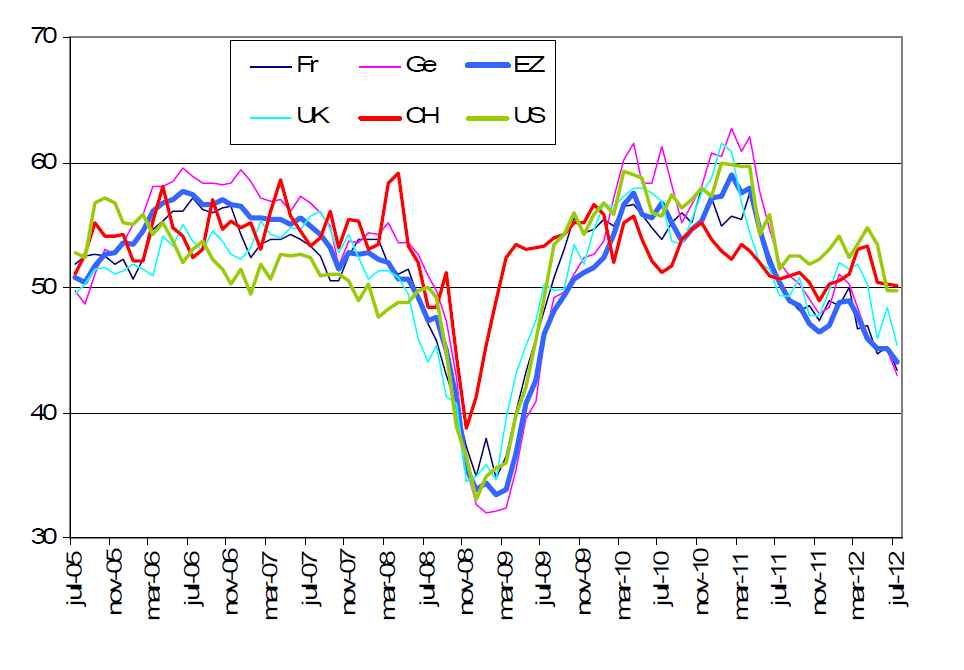
PMI, som är en ledande indikator, är för Eurozonen på samma nivå som månaden före Lehmankraschen 2008. Folk verkar inte göra någonting och det märks när t ex Dagens Industri varnar för ”döda aktier”, aktier med bristfällig likviditet. Vad gick bra under hösten 2008? Det var nästan guld och guldet steg ordentligt det året. Om det vill sig illa är råvaror och då främst guld den tillgång man vill ha i sin portfölj när det skakar på värde-pappers-marknaderna.
Råolja – Brent
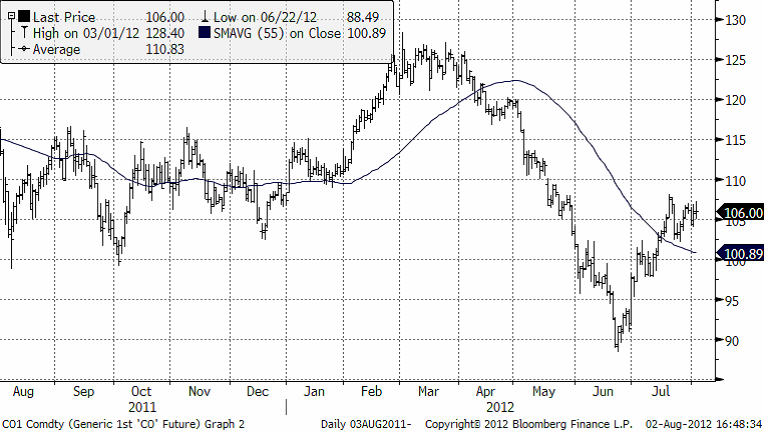
Nedan ser vi kursdiagrammet på spotkontraktet på Brent. 90 – 100 dollar tycks Brent vara köpvärt. Samtidigt finns ett kortsiktigt tekniskt motstånd på ca 110 dollar. SEB:s prognos är 115 dollar per fat under det fjärde kvartalet i år.
Råvarucertifikat får sin avkastning inte endast från stigande priser, utan också på att över tiden tillgodogöra sig rabatter på terminer i förhållande till spot. Vi ser i diagrammet nedan att terminer är billigare än spot på Brent. Genom att över tiden köpa billigt och sälja till spot (dyrt), samlar man på sig vinster. Råvarucertifikat gör just detta genom sin konstruktion. De hämtar sin avkastning från terminskontrakt, som ”rullas” in i längre kontrakt när tiden gjort att det gamla kontraktet är nära förfall.
Att köpa t ex OLJA S, och sitta på det, kan därför ge ganska hög avkastning, även om priset på råolja väntar med att stiga.
Nedan ser vi antalet borr-riggar i världen de senaste 30 åren enligt Baker Hughes Inc. Blå linje är priset på Brent.
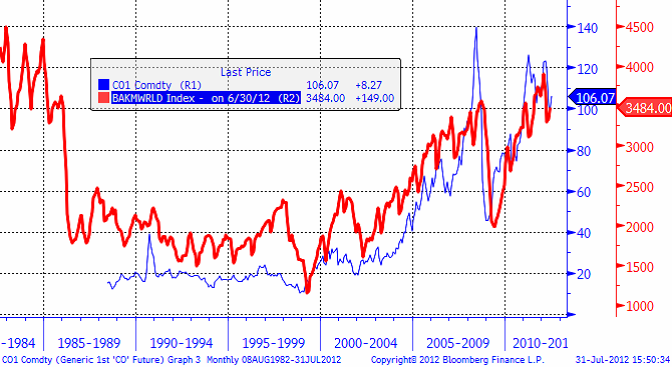
Nedan ser vi hur antalet oljeriggar i USA har utvecklat sig. Sedan 2009 är det en ökning på 1200 riggar. Det betyder att en stor del av prospekteringen och produktionsökningen sker i det fria landet USA.
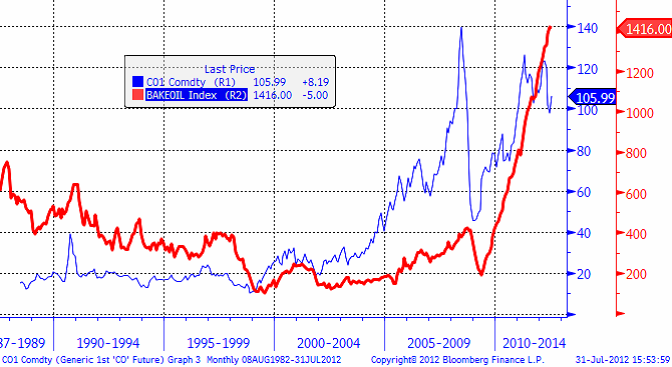
För gasriggar ser det helt annorlunda ut. Från en toppnotering på 1600 borr-riggar i drift 2008 är det nu bara 505 riggar i drift. Frackingtekniken har ökat utbudet och pressat ner priset, så det är inte lönsamt att borra efter gas på samma sätt som förut. Omställningen till konsumtion av den billiga gasen har inte gått lika fort som teknikutvecklingen.
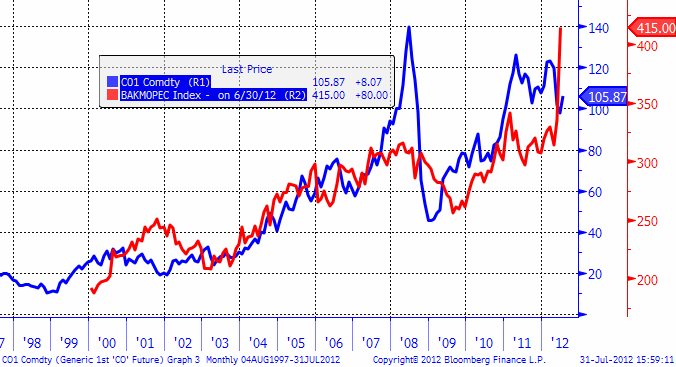
Antalet oljeriggar i alla OPEC-länder uppgår till relativt blygsamma 415 stycken. Men det är ändå en ökning på 100 riggar sedan början av året, som vi ser i diagrammet nedan.
Guld
Guldpriset i dollar har brutit den kortsiktiga nedåtgående trendlinjen och rekylerat tillbaka till denna. Det brukar vara ett bra köptillfälle när detta sker.
Den fundamentala kraften som verkar positivt på guldpriset är naturligtvis finanskrisen i Europa och skuldbergen runtom i världens stater. Men som vi ser nedan under jordbruksprodukter är momsunen (nederbörden) i Indien 21% sämre den här säsongen och torka råder. Det gör att guldefterfrågan från Indien, det största enskilda konsumentlandet, sannolikt kommer att minska. GFMS släppte en rapport om detta den 16 juli. GFMS har också sänkt efterfrågeestimatet för Kina till 870 ton på helåret. Tidigare trodde man att efterfrågan skulle nå upp till 1000 ton. Samtidigt fortsätter såväl Kina som Indien att stimulera, liksom ECB som för en tid sedan sänkte korträntan till 0.75%. Räntesänkningar brukar innebära högre guldpris.
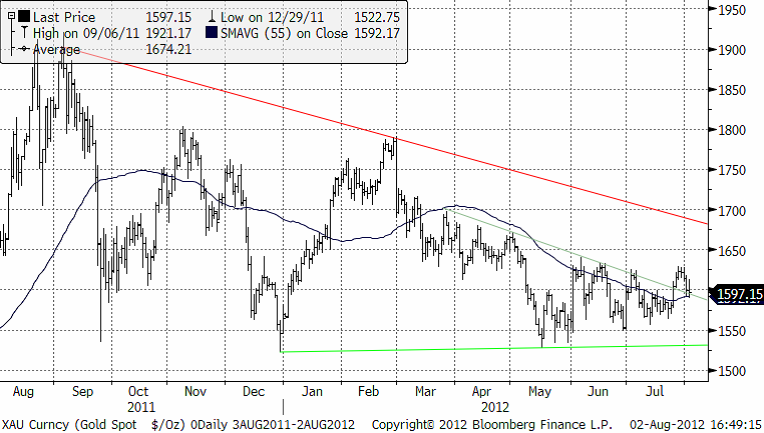
Den som är lite modig kan försöka sig på att köpa ett certifikat med hög hävstång och hög förlustrisk om priset vänder ner. Ett sådant är BULL GULD X4 S. Det ger 4 gångers utväxling på prisuppgångar (och till nackdel om priset istället faller). Den som är mindre modig och mer saktmodig kanske, kanske föredrar GULD S, vars värdeförändringar i kronor är desamma som värdeförändringen på en guldtacka i svenska kronor.
Silver
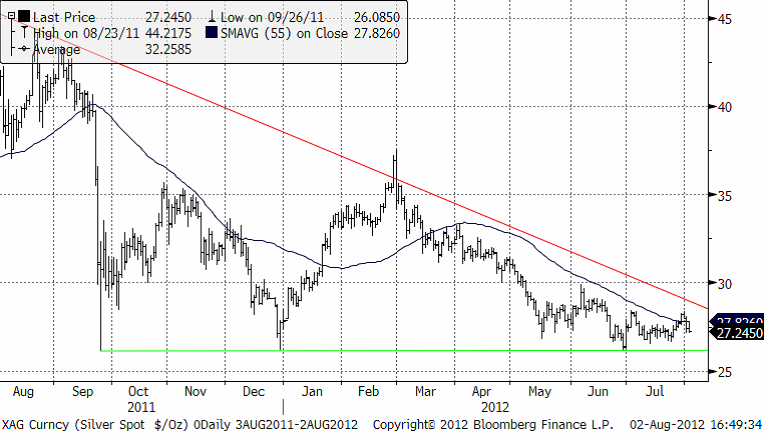
Silver har ännu inte brutit några tekniska köpsignaler. Med sjunkande industriproduktion i världen, sjunker efterfrågan på silver. Scenariot just nu med sjunkande PMI för tillverkningsindustrin innebär alltså att silver inte alls har en lika positiv uppbackning som guld.
Koppar
Den fundamentala situationen är stark. Utbudet har under flera år överraskat på nedsidan, och ser ut att göra så även i år. Kopparhalterna är så pass låga i Chile att de inte mäktar med att öka enligt tidigare prognoser. Det mesta tyder på en produktionsökning globalt på endast 2-3 % mot prognostiserat 6-7 %.
Lagren utanför Kina har kontinuerligt minskat det senaste året – till stor del med destination Kina, som står för 40 % av den globala konsumtionen. Enligt International Copper Study Group noterades ett underskott om 384 tton för årets fyra första månader (ca 5 % av årsproduktionen).
Svagare konsumtion i Europa och USA de senaste månaderna indikerar en marknad närmare balans på årsbasis. Allt hänger på Kina. Hu Jintao aviserade i veckan kommande finans- och penningpolitiska stimulanser under hösten. Det kinesiska analyshuset Antaike prognostiserar en konsumtionsökning med 5 % i Kina 2012, till stor del baserat på fortsatt utbyggnad av elnätet.
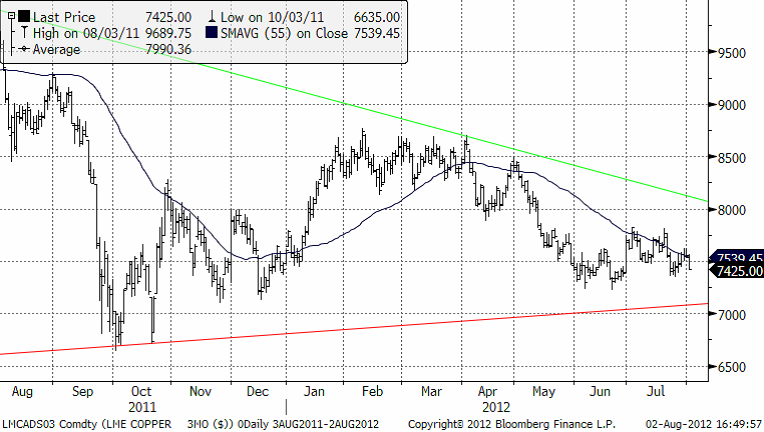
Som en anekdot producerade Kina 1,8 millioner mil kraftkabel första halvåret (430 varv runt jorden), innebärande en ökning med 13,7 % jämfört med samma period förra året. Kina kommer att konsumera mycket koppar även i framtiden, så mycket är klart, samtidigt som risken är stor att utbudet inte räcker till. Kina har utnyttjat varje större korrigering i marknaden till köp och ökad import. Mycket tyder på att det kommer att upprepas. Fråga är bara hur långt ner man ”släpper” marknaden. Den tekniska bilden kan ge oss viss vägledning. Den långsiktigt uppåtgående trenden kommer in ungefär vid $7000/ton (motsvaras av $3,18/lbs för Comex-kontraktet), ca 4,5 % under dagens nivå på $7330.
Bara att äga råvarucertifikat på koppar gör att man tjänar pengar, även om priset på koppar står still.
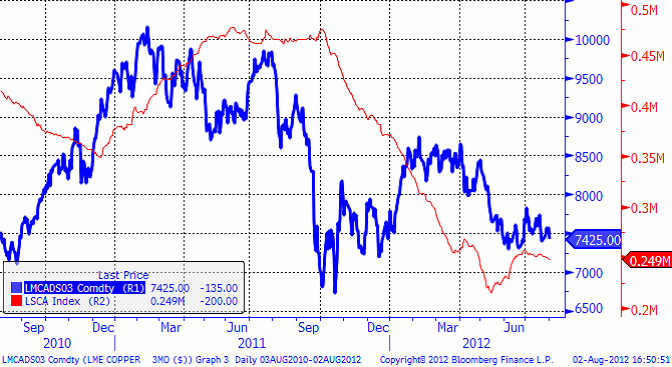
Anledningen till detta är att kopparmarknaden är i backwardation, som vi ser i nedanstående diagram. När det är backwardation köper man terminer billigare än spot. Den rabatten blir en vinst över tiden.
Koppar är en råvara som konsekvent över tiden ofta för att inte säga, nästan alltid, handlats med rabatt på terminerna. Trots att prisuppgången på t ex guld har varit så stor, har ändå en råvarucertifikatinvestering i koppar gett imponerande avkastning.
I nedanstående diagram ser vi kopparpriset och lagren i antal ton i LME:s lagerhus. Vi ser att lagernivåerna har fallit sedan mitten av 2011. Konsumtionen är alltså större än produktionen. Det är ingen mekanisk sanning, men allt annat lika ”borde” sjunkande lager i vart fall ge stöd åt priset.
Vi rekommenderar köp av koppar, via ett råvarucertifikat utan hävstång och då är KOPPAR S ett sådant som skulle kunna placeras i. Koppar har en hög korrelation med konjunkturen och kallas ibland för ”Dr Copper” för dess roll som ekonomiskt ledande indikator (inte bara elektriskt alltså). Nedan ser vi 3-månaders kopparterminspris och MSCI World aktieindex.
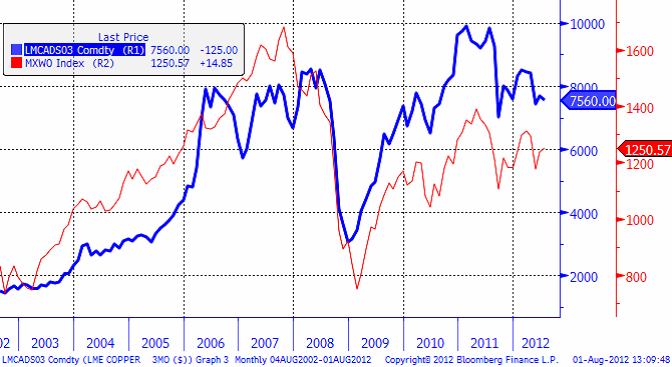
Vilket har varit den bästa placeringen för att spekulera i konjunkturcykeln under den här tiden? Ja, i diagrammet nedan ser vi hur 100 dollar investerat i koppar (blå linje) och 100 dollar investerat i MSCI World (inkl utdelningar, röd linje) har utvecklat sig.
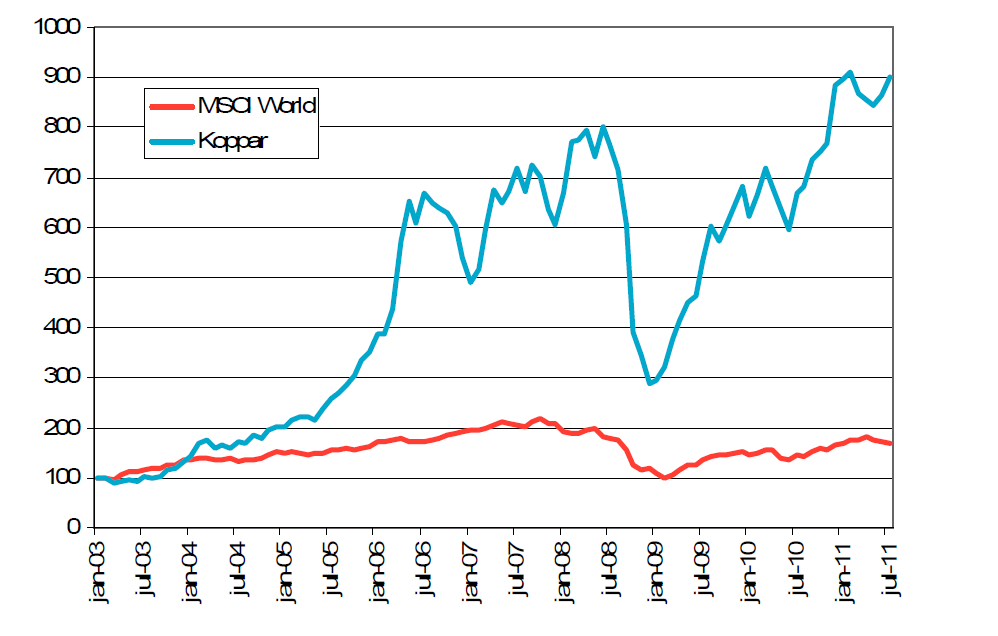
Den intelligente läsaren invänder kanske att koppar ser ut att ha högre risk. Det stämmer. Volatiliteten har legat på 30% i koppar och bara 16% i MSCI World. Så… med samma risknivå, hade 100 dollar i koppar bara blivit 450 dollar idag. Mot 170 dollar i MSCI World aktieindex. Så varför ska man spekulera i konjunkturcykler i aktier, när det finns ”Dr Koppar” som är mycket mer rätt på vad gäller konjunkturen och dessutom via ständig rabatt på terminerna erbjuder en förutsägbar riskpremie till investeraren?
Det säger inget om framtiden, men en placering på det här sättet, som man får via KOPPAR S, har under lång tid varit bättre än en placering i aktier.
Zink
Zinkpriset ligger på bottennivåer i det prisintervall som etablerats sedan 2009. Produktionskostnaden för zink ligger på dessa nivåer. I råvarumarknaden brukar man kalla detta för råvarans ”fundamentala golv”. Vi ser därför inte några stora kursfallsrisker i zink.
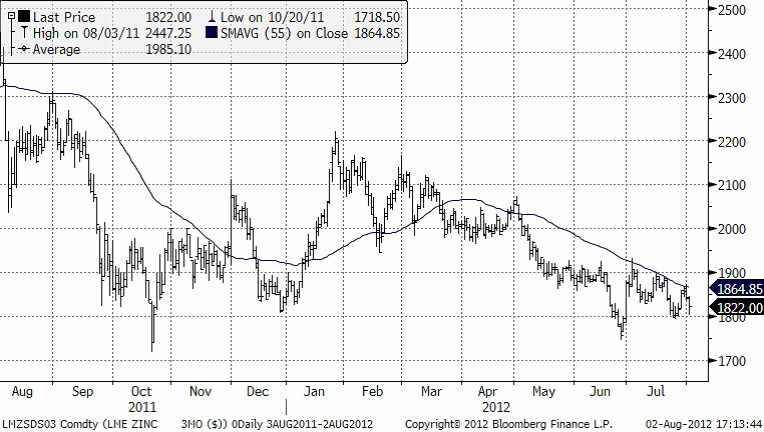
Vi är positiva till zink, men inte lika mycket så som för koppar.
Kaffe
Priset på Arabica, som handlas i New York, har brutit sin nedåtgående trend, efter att ha varit nere på 150 cent per pund. 150 cent var toppnoteringen från slutet av 2009 och var därför för många en naturlig nivå att lägga in köpordrar på.
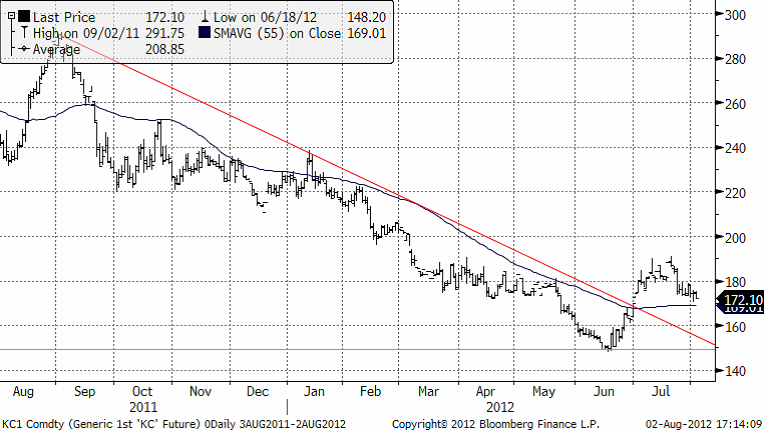
Vi tycker att man kan börja köpa på sig certifikat på kaffe, på rekyler. Den rekyl vi har haft de senaste dagarna kan t ex vara ett sådant tillfälle. Om man inte önskar ta så hög risk kan råvarucertifikatet KAFFE S vara ett bra val.
Socker
Priset på socker har precis brutit den kortsiktiga stigande trenden och vi är därför negativa till kaffeprisutvecklingen såväl på lång som kort sikt.
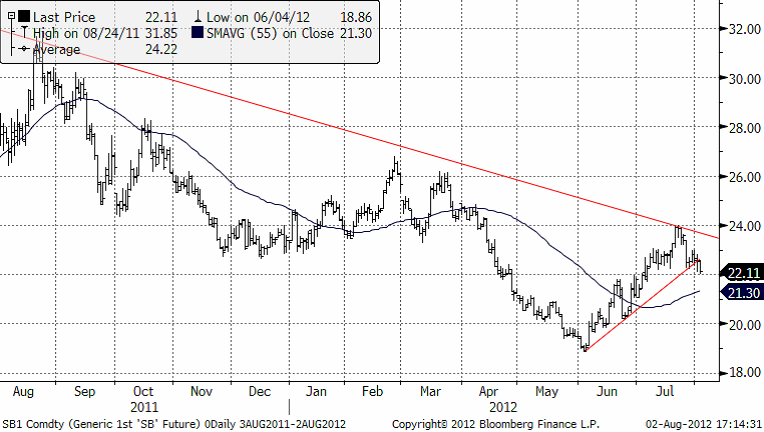
Vi rekommenderar köp av certifikatet SHORT SOCKE A S med en hävstång på – 1.2 för den som vill ta position i enlighet med vår vy. Stöd finns på 20 cent och det finns alltså en vinstpotential på ca 12% för en placering i certifikatet. Vi antar att man kliver ur positionen vid ett sockerpris på 20 cent.
För att läsa mer om SEBs syn på spannmål så rekommenderar vi en genomläsning av gårdagens utskick, Jordbruksprodukter från SEB.
[box]SEB Veckobrev Veckans råvarukommentar är producerat av SEB Merchant Banking och publiceras i samarbete och med tillstånd på Råvarumarknaden.se[/box]
Disclaimer
The information in this document has been compiled by SEB Merchant Banking, a division within Skandinaviska Enskilda Banken AB (publ) (“SEB”).
Opinions contained in this report represent the bank’s present opinion only and are subject to change without notice. All information contained in this report has been compiled in good faith from sources believed to be reliable. However, no representation or warranty, expressed or implied, is made with respect to the completeness or accuracy of its contents and the information is not to be relied upon as authoritative. Anyone considering taking actions based upon the content of this document is urged to base his or her investment decisions upon such investigations as he or she deems necessary. This document is being provided as information only, and no specific actions are being solicited as a result of it; to the extent permitted by law, no liability whatsoever is accepted for any direct or consequential loss arising from use of this document or its contents.
About SEB
SEB is a public company incorporated in Stockholm, Sweden, with limited liability. It is a participant at major Nordic and other European Regulated Markets and Multilateral Trading Facilities (as well as some non-European equivalent markets) for trading in financial instruments, such as markets operated by NASDAQ OMX, NYSE Euronext, London Stock Exchange, Deutsche Börse, Swiss Exchanges, Turquoise and Chi-X. SEB is authorized and regulated by Finansinspektionen in Sweden; it is authorized and subject to limited regulation by the Financial Services Authority for the conduct of designated investment business in the UK, and is subject to the provisions of relevant regulators in all other jurisdictions where SEB conducts operations. SEB Merchant Banking. All rights reserved.

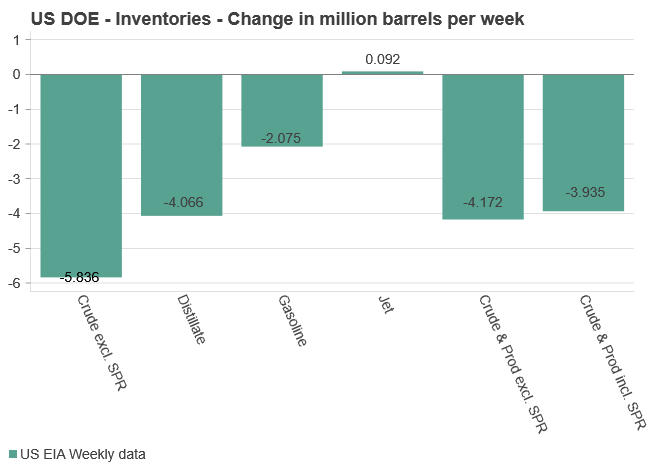
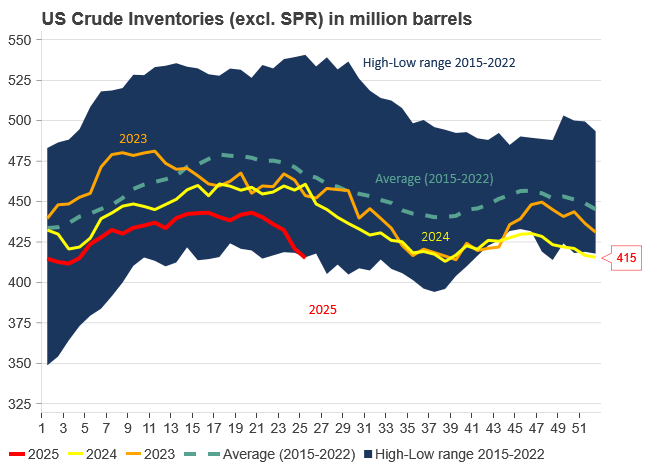
The latest weekly report from the US DOE showed a substantial drawdown across key petroleum categories, adding more upside potential to the fundamental picture.

Commercial crude inventories (excl. SPR) fell by 5.8 million barrels, bringing total inventories down to 415.1 million barrels. Now sitting 11% below the five-year seasonal norm and placed in the lowest 2015-2022 range (see picture below).
Product inventories also tightened further last week. Gasoline inventories declined by 2.1 million barrels, with reductions seen in both finished gasoline and blending components. Current gasoline levels are about 3% below the five-year average for this time of year.
Among products, the most notable move came in diesel, where inventories dropped by almost 4.1 million barrels, deepening the deficit to around 20% below seasonal norms – continuing to underscore the persistent supply tightness in diesel markets.
The only area of inventory growth was in propane/propylene, which posted a significant 5.1-million-barrel build and now stands 9% above the five-year average.
Total commercial petroleum inventories (crude plus refined products) declined by 4.2 million barrels on the week, reinforcing the overall tightening of US crude and products.
A classic case of “buy the rumor, sell the news” played out in oil markets, as Brent crude has dropped sharply – down nearly USD 10 per barrel since yesterday evening – following Iran’s retaliatory strike on a U.S. air base in Qatar. The immediate reaction was: “That was it?” The strike followed a carefully calibrated, non-escalatory playbook, avoiding direct threats to energy infrastructure or disruption of shipping through the Strait of Hormuz – thus calming worst-case fears.
After Monday morning’s sharp spike to USD 81.4 per barrel, triggered by the U.S. bombing of Iranian nuclear facilities, oil prices drifted sideways in anticipation of a potential Iranian response. That response came with advance warning and caused limited physical damage. Early this morning, both the U.S. President and Iranian state media announced a ceasefire, effectively placing a lid on the immediate conflict risk – at least for now.
As a result, Brent crude has now fallen by a total of USD 12 from Monday’s peak, currently trading around USD 69 per barrel.
Looking beyond geopolitics, the market will now shift its focus to the upcoming OPEC+ meeting in early July. Saudi Arabia’s decision to increase output earlier this year – despite falling prices – has drawn renewed attention considering recent developments. Some suggest this was a response to U.S. pressure to offset potential Iranian supply losses.
However, consensus is that the move was driven more by internal OPEC+ dynamics. After years of curbing production to support prices, Riyadh had grown frustrated with quota-busting by several members (notably Kazakhstan). With Saudi Arabia cutting up to 2 million barrels per day – roughly 2% of global supply – returns were diminishing, and the risk of losing market share was rising. The production increase is widely seen as an effort to reassert leadership and restore discipline within the group.
That said, the FT recently stated that, the Saudis remain wary of past missteps. In 2018, Riyadh ramped up output at Trump’s request ahead of Iran sanctions, only to see prices collapse when the U.S. granted broad waivers – triggering oversupply. Officials have reportedly made it clear they don’t intend to repeat that mistake.
The recent visit by President Trump to Saudi Arabia, which included agreements on AI, defense, and nuclear cooperation, suggests a broader strategic alignment. This has fueled speculation about a quiet “pump-for-politics” deal behind recent production moves.
Looking ahead, oil prices have now retraced the entire rally sparked by the June 13 Israel–Iran escalation. This retreat provides more political and policy space for both the U.S. and Saudi Arabia. Specifically, it makes it easier for Riyadh to scale back its three recent production hikes of 411,000 barrels each, potentially returning to more moderate increases of 137,000 barrels for August and September.
In short: with no major loss of Iranian supply to the market, OPEC+ – led by Saudi Arabia – no longer needs to compensate for a disruption that hasn’t materialized, especially not to please the U.S. at the cost of its own market strategy. As the Saudis themselves have signaled, they are unlikely to repeat previous mistakes.
Conclusion: With Brent now in the high USD 60s, buying oil looks fundamentally justified. The geopolitical premium has deflated, but tensions between Israel and Iran remain unresolved – and the risk of missteps and renewed escalation still lingers. In fact, even this morning, reports have emerged of renewed missile fire despite the declared “truce.” The path forward may be calmer – but it is far from stable.
Analys
A muted price reaction. Market looks relaxed, but it is still on edge waiting for what Iran will do
Brent crossed the 80-line this morning but quickly fell back assigning limited probability for Iran choosing to close the Strait of Hormuz. Brent traded in a range of USD 70.56 – 79.04/b last week as the market fluctuated between ”Iran wants a deal” and ”US is about to attack Iran”. At the end of the week though, Donald Trump managed to convince markets (and probably also Iran) that he would make a decision within two weeks. I.e. no imminent attack. Previously when when he has talked about ”making a decision within two weeks” he has often ended up doing nothing in the end. The oil market relaxed as a result and the week ended at USD 77.01/b which is just USD 6/b above the year to date average of USD 71/b.

Brent jumped to USD 81.4/b this morning, the highest since mid-January, but then quickly fell back to a current price of USD 78.2/b which is only up 1.5% versus the close on Friday. As such the market is pricing a fairly low probability that Iran will actually close the Strait of Hormuz. Probably because it will hurt Iranian oil exports as well as the global oil market.
It was however all smoke and mirrors. Deception. The US attacked Iran on Saturday. The attack involved 125 warplanes, submarines and surface warships and 14 bunker buster bombs were dropped on Iranian nuclear sites including Fordow, Natanz and Isfahan. In response the Iranian Parliament voted in support of closing the Strait of Hormuz where some 17 mb of crude and products is transported to the global market every day plus significant volumes of LNG. This is however merely an advise to the Supreme leader Ayatollah Ali Khamenei and the Supreme National Security Council which sits with the final and actual decision.
No supply of oil is lost yet. It is about the risk of Iran closing the Strait of Hormuz or not. So far not a single drop of oil supply has been lost to the global market. The price at the moment is all about the assessed risk of loss of supply. Will Iran choose to choke of the Strait of Hormuz or not? That is the big question. It would be painful for US consumers, for Donald Trump’s voter base, for the global economy but also for Iran and its population which relies on oil exports and income from selling oil out of that Strait as well. As such it is not a no-brainer choice for Iran to close the Strait for oil exports. And looking at the il price this morning it is clear that the oil market doesn’t assign a very high probability of it happening. It is however probably well within the capability of Iran to close the Strait off with rockets, mines, air-drones and possibly sea-drones. Just look at how Ukraine has been able to control and damage the Russian Black Sea fleet.
What to do about the highly enriched uranium which has gone missing? While the US and Israel can celebrate their destruction of Iranian nuclear facilities they are also scratching their heads over what to do with the lost Iranian nuclear material. Iran had 408 kg of highly enriched uranium (IAEA). Almost weapons grade. Enough for some 10 nuclear warheads. It seems to have been transported out of Fordow before the attack this weekend.
The market is still on edge. USD 80-something/b seems sensible while we wait. The oil market reaction to this weekend’s events is very muted so far. The market is still on edge awaiting what Iran will do. Because Iran will do something. But what and when? An oil price of 80-something seems like a sensible level until something do happen.


Samtal om flera delar av råvarumarknaden
Tightening fundamentals – bullish inventories from DOE

Jonas Lindvall är tillbaka med ett nytt oljebolag, Perthro, som ska börsnoteras

Oljan, guldet och marknadens oroande tystnad

Domstolen ger klartecken till Lappland Guldprospektering

Stor uppsida i Lappland Guldprospekterings aktie enligt analys

Brookfield ska bygga ett AI-datacenter på hela 750 MW i Strängnäs

Sommaren inleds med sol och varierande elpriser
Silverpriset släpar efter guldets utveckling, har mer uppsida
Brent needs to fall to USD 58/b to make cheating unprofitable for Kazakhstan
-
 Nyheter3 veckor sedan
Stor uppsida i Lappland Guldprospekterings aktie enligt analys
-
 Nyheter4 veckor sedan
Brookfield ska bygga ett AI-datacenter på hela 750 MW i Strängnäs
-
 Nyheter4 veckor sedan
Sommaren inleds med sol och varierande elpriser
-
 Nyheter3 veckor sedan
Silverpriset släpar efter guldets utveckling, har mer uppsida
-
Analys4 veckor sedan
Brent needs to fall to USD 58/b to make cheating unprofitable for Kazakhstan
-
 Nyheter4 veckor sedan
Tradingfirman XTX Markets bygger datacenter i finska Kajana för 1 miljard euro
-
 Nyheter2 veckor sedan
Uppgången i oljepriset planade ut under helgen
-

 Nyheter2 veckor sedan
Låga elpriser i sommar – men mellersta Sverige får en ökning