

Analys
SEB – Råvarukommentarer, 10 november 2014

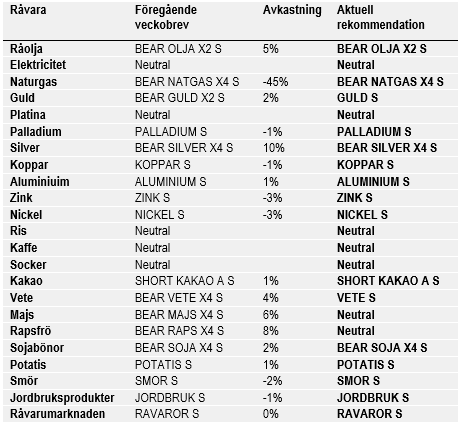
Veckans rekommendationer
Råolja – Brent
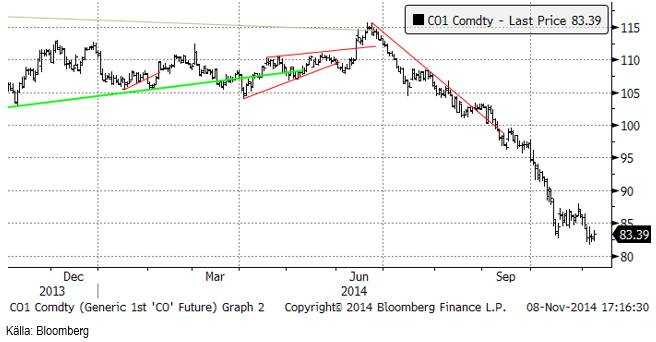
Råoljepriset sjönk med 3% förra veckan och stängde på 83.39 dollar per fat.
Bortfallet av 290,000 bpd i oljeproduktion i Libyen är positivt för oljepriset, men har antagligen bara varit tillräckligt för att stoppa prisfallet och inte nog för att motivera en rekyl uppåt. El Sharara-fältet stängdes efter att lokala stammar angripit det. Det önskar mer av oljeintäkterna. Myndigheter, om de existerar, säger att produktionen snart ska återtas.
Saudiarabien har sagt till marknaden (och till Venezuela) att de inte kommer att vara någon buffertproducent. Uttalandet löd ”We will not be the swinger and we will say it again at the OPEC meeting on Nov 27”.
OPEC:s långsiktiga prognos innehåller ett lägre estimat på hur mycket OPEC-olja världen kommer att efterfråga i framtiden. OPEC estimerar att behovet för 2017 uppgår till 28.2 mbpd. OPEC:s produktion under oktober i år var 31 mbpd.
Vi tror att oljan kommer att handlas svagt fram till OPEC-mötet i Wien den 27 november. Det finns en liten chans (30% uppskattningsvis) att Iran finner en lösning den 24 november, men förhandlingarna kommer att fortsätta och sannolikheten för en lösning de kommande 1 – 2 åren är nog ganska goda. Det är låg sannolikhet att OPEC-medlemmarna enas om en minskning av sin produktion den 27 november. Det blir antagligen mycket stök och en säkert en del uttalanden som kan skrämma marknaden, men logiken säger att det inte kommer att bli någon överenskommelse. Om det blir riktigt låga priser under det första halvåret nästa år kan det möjligen bli en överenskommelse vid OPEC-mötet i maj.
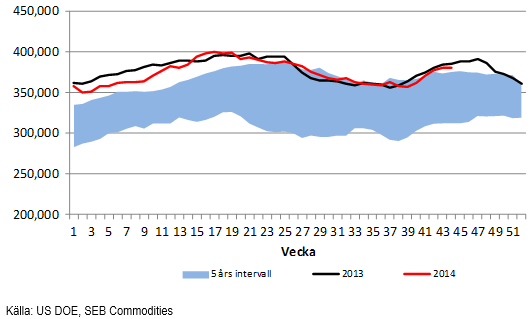
Lagren i USA är lite svagare än de var så här års förra året, enligt den senaste statistiken från US DOE.
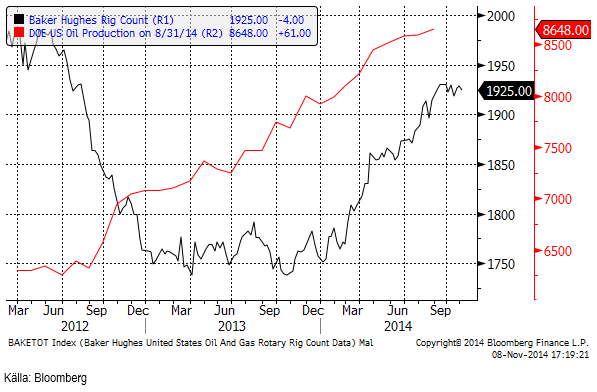
Nedan ser vi ett diagram på antalet oljeriggar i USA, enligt Baker Hughes statistik (svart). Antalet minskade med fyra till 1925 riggar i drift. Prisfallet på olja börjar att bita på lusten att borra. Antalet riggar som specifikt är ute efter olja föll med 14 i veckan. Sedan toppen i oktober har antalet riggar inriktade helt på olja minskat med 49 sedan oktober till 1609 stycken. Oljemarknaden lär ta intryck av den här informationen.
Vi rekommenderar en kort position, t ex med BEAR OLJA X2 S.
Elektricitet
Den här veckan har starkare nordiska signaler stått mot väldigt svaga signaler från bränslen (kol, natgas, olja). Det har krupit upp lite i fronten på högre och stabilare spot och torrare väder, och mot det har svaga bränslen gjort att långa kurvan varit ganska sidledes!
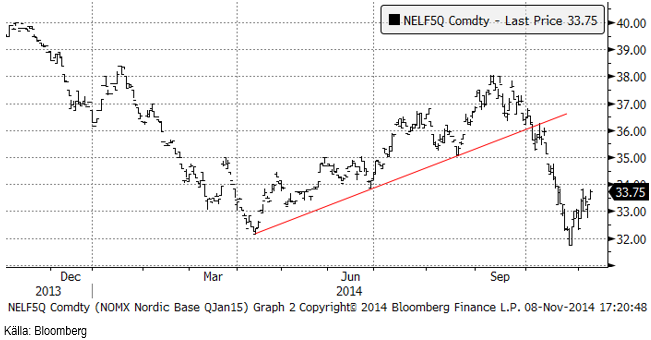
Terminen för det första kvartalet har gått upp från 32.35 till 33.75 euro per MWh. 34 euro är ett visst motstånd och nästa, lite starkare motstånd finns redan vid 35 euro per MWh.
Temperaturprognosen enligt GFS-modellen som publicerades under söndagen visar en temperatur i Svealand och Götaland som är 3 -6 grader över det normala den närmaste veckan. Därefter är prognosen normal.
Vi har ingen stark tro på varken upp eller nedsida. Vi tror inte det finns mycket utrymme åt nåt håll, varför vi fortsätter med neutral position.
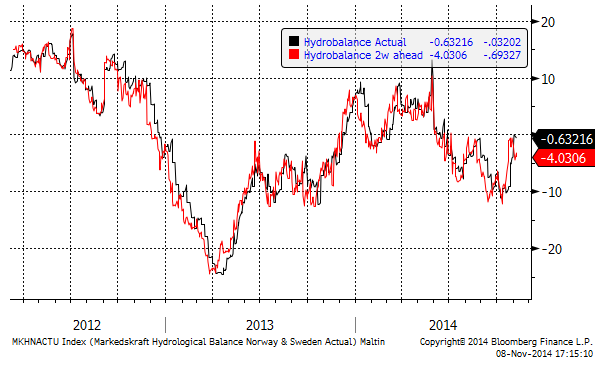
Hydrologisk balans har enligt 2-veckors prognosen fallit tillbaka något, till ett underskott på 4 TWh.
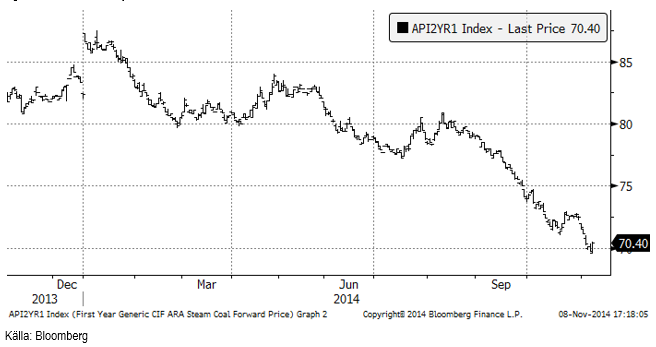
Nedan ser vi terminspriset för kalenderåret 2015 avseende energikol. Förra veckan skrev vi att ett nytt test av 71-dollarsnivån var inom räckhåll. Priset föll i veckan ytterligare från 71.65 till 70.40 dollar. Fredagens prisrörelse var dock väldigt stark – och kan signalera förestående styrka i marknaden.
Naturgas
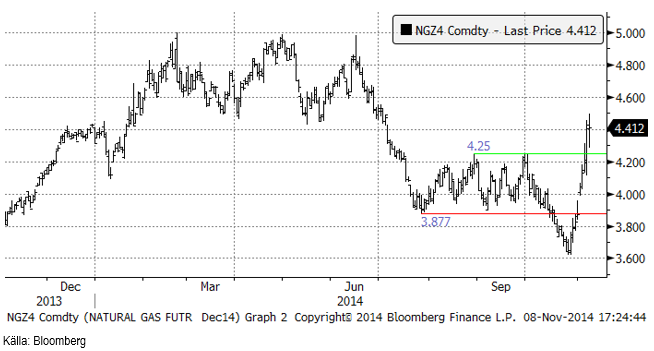
Naturgaspriset (decemberkontraktet) fortsatte tyvärr upp från 3.87 till 4.42, dvs med hela 14%! Prisrörelsen gick rakt genom de tekniska nivåerna 3.877 och 4.25 och hejdades inte förrän vid 4.50. Nu är 4.25 ett tekniskt stöd. Vi tror inte att priset går genom 4.50 och det logiska blir därför att behålla BEAR NATGAS X4 S.
Koppar
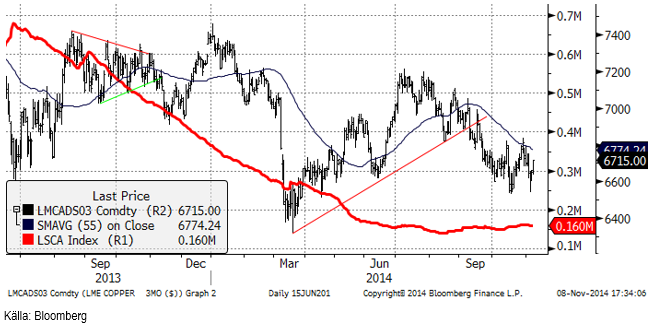
Risken för en eskalerande arbetskonflikt vid Grasberggruvan tycks minska efter måndagens nyhet att den planerade 30-dagarsstrejken avblåstes. Det är svårt att säga i vilken utsträckning som strejken har påverkat kopparpriset, men att det inte blev någon strejk bidrog säkert till den svaga marknadsutvecklingen i mitten av veckan, som huvudsakligen förklarades av nedgraderingen av tillväxten i Europa. Bortsett från detta finns inte så mycket att rapportera från kopparmarknaden. Backwardation i terminerna verkar vara väletablerat. Lagerförändringar och förändringar i fysiska premier är små. Vi tror att metallen kommer att handlas starkt åtminstone året ut och följa den allmänna trenden för basmetallerna, snarare än att leda prisutvecklingen.
Vi kan dock notera att ett fallande oljepris allmänt sätt är bra för efterfrågan på metaller. Vi anser, och anser oss ha goda grunder för det, att oljeprisfallet inte är relaterat till efterfrågan, utan specifikt till utbudet av olja. Metaller påverkas inte av den nya tekniken att utvinna olja. Tillväxten gynnas allmänt av ett lägre oljepris, t ex efterfrågan på metall till bilar.
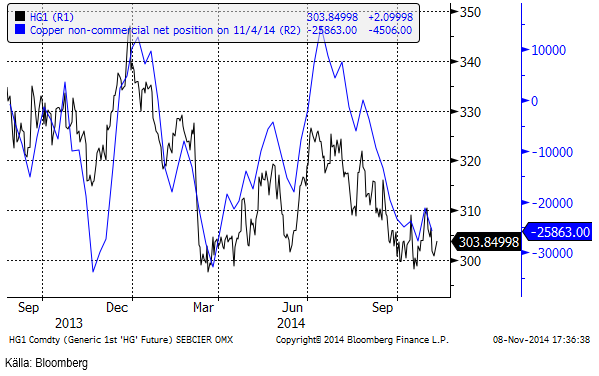
Koppar är den enda basmetallen som handlas i USA och därför har vi tillgång till statistik på vad spekulantkollektivet gör där. Vi ser att de har sålt sig ganska korta sedan början av juli. Nettopositionen är 21,000 kontrakt. I den rapport som kom i fredags kväll och visade förändringen tisdag – tisdag, hade de köpt tillbaka 6000 kontrakt. En stor såld position kan när den täcks ge lite extra stöd för priset.
Vi håller fast vid vår rekommendation av KOPPAR S.
Aluminium
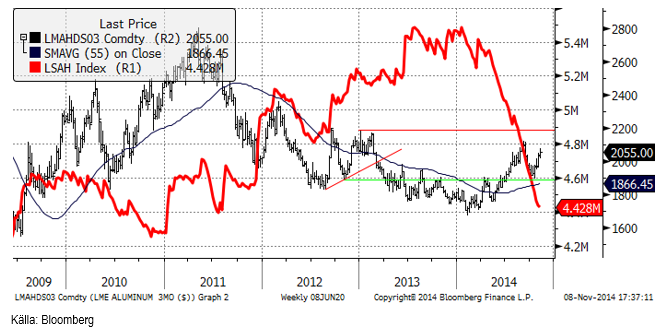
Det mesta ser positivt för aluminium, åtminstone fram till årsskiftet. Efterfrågan på metall rapporteras vara stark, till stor del driven av bilindustrin, som visar starka försäljningssiffror, inte minst i USA. Vi erfar från en vanligtvis tillförlitlig källa i aluminiumindustrin att den fysiska marknaden präglas av brist på fysisk metall. Premierna för fysisk metall fortsätter att vara höga. Även om vi tror att trycket kommer att lätta nästa år, kommer bristsituationen förmodligen att bestå in bit in på det nya året.
Som vi skrev förra veckan gick marknaden från backwardation till contango som hastigast i början av veckan. Fenomenet kom tillbaka mot slutet av veckan och det råder backwardation från novembers (tredje onsdag).
Tekniskt ser marknaden positiv ut, så vad skulle kunna hindra en hausse? Det finns alltid en risk att marknaden diskonterar lite för mycket av fundamenta, vilket kan ge en rekyl. Det talas om producenter som inväntar lämpligt läge att prissäkra sig och det kan ge motstånd i marknaden, men kanske inte förändra trenden.
Vi fortsätter att rekommendera köp av ALUMINIUM S.
Zink
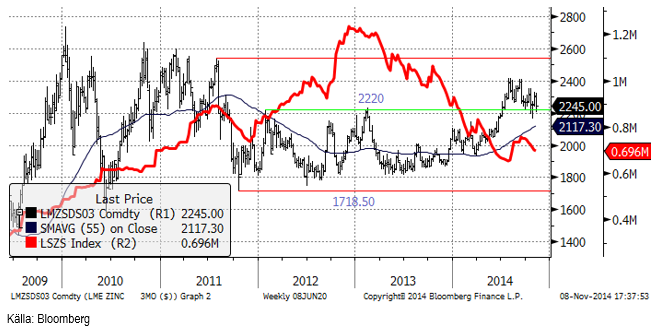
Säljtrycket i mitten av veckan (i samband med nedgraderingen av tillväxten i Europa) verkade tynga zinkpriset mer än de andra basmetallerna. Zinken återhämtade sig inte mot slutet av veckan, som vi såg de andra metallerna göra. Som vi nämnde förra veckan, är CTA-kollektivet väldigt aktiva i zinkmarknaden. Det ryktades att det såldes en hel del från det hållet. Priset håller sig i mitten av det gamla tradingintervallet, vilekt gör att sentimentet är ganska neutralt.
Det fundamentala förbättringen i balansen flyttade fram ett hack i tid, då utbudet verkar vara högre än väntat. Vi väntar oss att priset fortsätter i konsolidering. Tekniskt behövs ett brott av 2350 dollar för att locka till sig fler köpare.
Vi rekommenderar köp av ZINK S.
Nickel
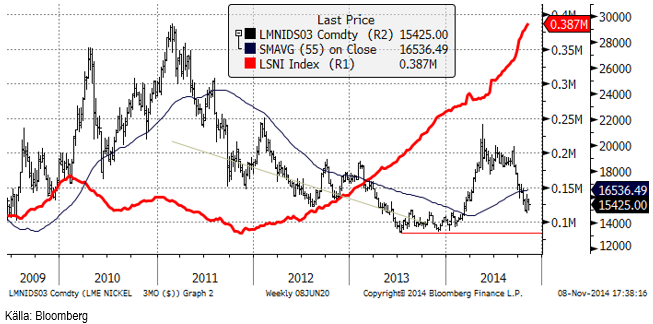
Den trendförändring vi såg förra veckan var allt för tidig. Nickelpriset föll tillbaka i sällskap med de andra basmetallerna i tisdags, inte hela vägen, men nära på. Köparna återvände ganska fort och priset stabiliserade sig. LME-lagret är i fokus på marknaden. I veckan noterades ett ökande antal annullerade lagerbevis (warrants), vilket är ett positivt tecken. Det betyder att metall hämtas ut från LME:s lager. I fredags ökade dock lagren med 1100 ton, vilket är en påminnelse om att det tar tid att vända den fundamentala trenden.
Ur teknisk synvinkel kan vi konstatera att den branta fallande trenden är bruten. Det mest troliga scenariot är att marknaden konsoliderar sig i prisintervallet 15 – 16,000 dollar. Så länge LME-lagren inte visar någon tendens att byta trend, kan vi dock inte utesluta ytterligare ett test på nedsidan. Vårt huvudscenario är dock att vi får se en gradvis förbättring under resten av året.
Vi tycker att de kommande veckorna kan ge möjlighet att komma in på den långa sidan och rekommenderar köp av NICKEL S.
Guld
Guldpriset inledde veckan i fortsatt fallande trend, men i fredags rusade priset efter att statistik publicerats som visade att amerikanska företag anställde färre än väntat under oktober, vilket medförde förväntningar om fortsatt låg ränta. Fredagens uppgång var den största sedan juni. Sammantaget slutade veckan med oförändrat pris. Omsättningen var mer än dubbel så hög som vanligt.
Payrolls steg med 214,000 personer enligt det amerikanska arbetsmarknadsdepartementet, mot väntade 235,000.
Det är folkomröstning i Schweiz den 30 november om landet ska köpa tillbaka de 1500 ton guld, som såldes i början av 2000-talet. Schweiz lämnade då en regel där de hade en partiell guldmyntfot, som det sista landet i världen. Utfallet av omröstningen blir troligen ett ”nej”, men det är ju rätt ”bullish” om det blir ett ”ja”.
I veckan tillkännagav London Bullion Market Association att den globala börskoncernen ICE tar över guldfixingen. ICE Benchmark Administration (IBA) kommer att sköta fixingen från någon gång under det första kvartalet nästan år.
Rapporter från Indien och Kina tyder på att efterfrågan på guld håller på att öka. Guld är billigare än på fyra år och det ökar efterfrågan. Såväl smycken som tackor är i båda länderna populära som penningplacering och som gåva. Importen av guld till Kina från Hong Kong var i september den högsta på sedan april, på 61.7 ton. World Gold Council räknar med efterfrågan på guld i Kina ökar med 20% på tre år. Indiska juvelerare väntar sig en uppgång i försäljningen under det fjärde kvartalet i år. The All India Gems & Jewellery Trade Federation har sagt att efterfrågan kommer att öka med 75% under det fjärde kvartalet.
Det verkar också som om myntsamlare drar nytta av det låga guldpriset. The US Mint sålde 67,500 uns i oktober, vilket är mer än någon månad sedan januari. Hittills i november har det sålts 30,500 uns. Av silvermyntet American Eagle sålde US Mint slut på mynten efter att ha sålt 1.26 miljoner mynt (1 uns per mynt), enligt ett mail den 5 november.
Allt fler gruvbolag går med förlust vartefter guldpriset har fallit sedan i somras, vilket gör att de blir försiktigare med expansion.
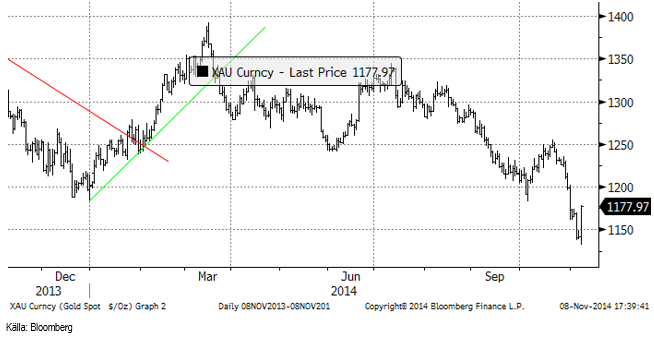
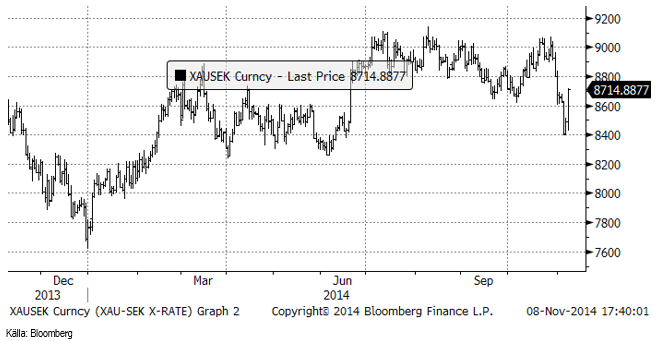
Chartet för guld i kronor föll ner till 8400 kronor, men vände som ovan nämnt, kraftigt upp i fredags och stängde på 8715 kronor.
Institutionella investerare fortsätter att sälja av guldfonder – faktiskt i en allt snabbare takt nu i november. Dessa verkar inte vara ”value investors”, utan snarare trendföljare, vilket jag har påpekat tidigare. De är orsakar inte prisrörelser genom sitt agerande, utan deras agerande orsakas av prisrörelsen. Det är väldigt typiskt för den här kategorin av placerare. Detta har visats av en rad studier, bland annat av IMF (2006) och OECD (2010).
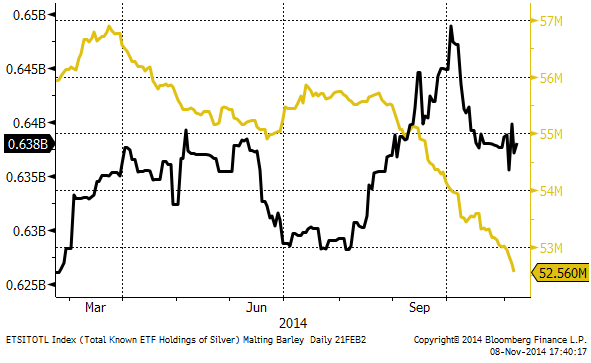
Vi lämnar den korta positionen i guld och köper GULD S.
Silver
Silverpriset hängde på guldet upp i fredags, men det finns ännu inte någon trendförändring. Trenden är fortfarande nedåtriktad.
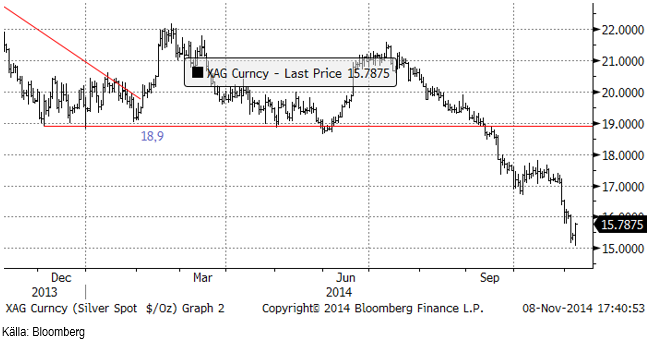
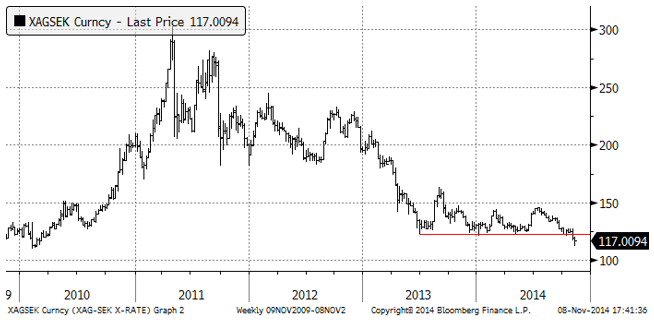
Silverpriset i kronor, nedan visat i ett veckochart, ser fortfarande väldigt negativt ut. Visst kan en rekyl upp mot 125 kronor per uns (31 gram) komma, men en sådan skulle enligt handboken i teknisk analys bara vara ett säljtillfälle.
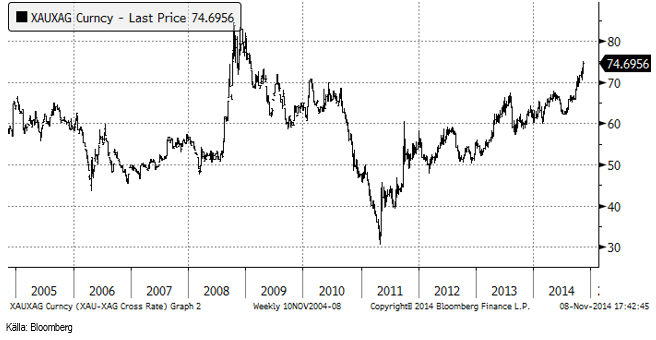
Silver är fortsatt billigt i förhållande till guld och det kan vara en anledning att byta en investering i guld mot silver. Sedan förra veckan har kvoten gått från 72.6 till 74.7! Rekordet är 84.5 och noterades i oktober 2008 – när guldpriset steg pga finanskrisen.
Vi fortsätter att på kort sikt rekommendera en kort position i silver med köp av BEAR SILVER X4 S.
Platina & Palladium
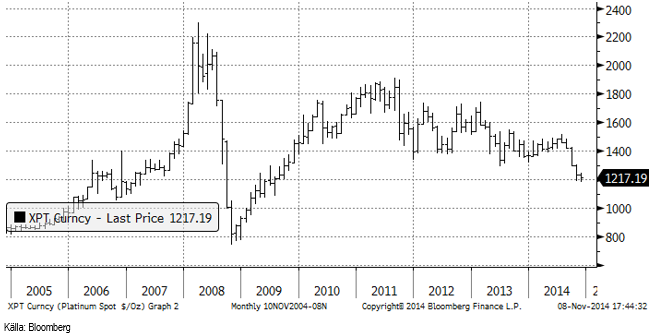
Platina har funnit stöd vi 1200 dollar. Frågan är om det kommer att hålla, eller om priset kommer att fortsätta ner till 1100 och kanske 1000 dollar. Vi behåller tills vidare neutral rekommendation.
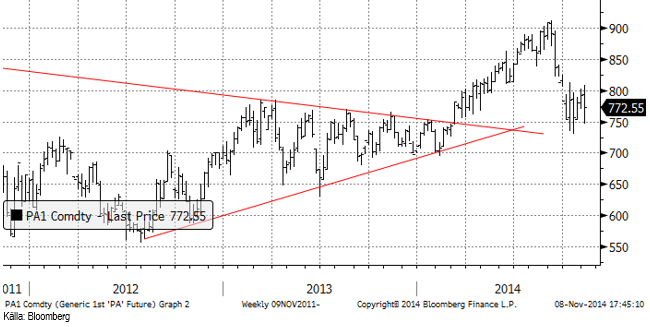
Palladium fortsatte att handla i konsolideringsintervallet mellan 750 och 800 dollar och stängde veckan på 772, dvs ganska mitt i intervallet. Vi tror dock att en uppgång kommer att följa efter den här konsolideringsfasen, och behåller därför köprekommendationen.
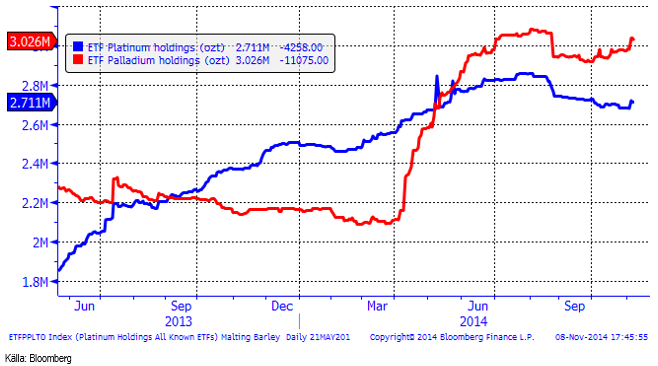
Nedanför ser vi hur mycket metall som finns i börshandlade fonder för platina respektive palladium. Investerare har ökat på innehaven i båda metallerna, framförallt i palladium.
Vi fortsätter med neutral rekommendation på platina, men rekommenderar köp av palladium via t ex PALLADIUM S.
Ris
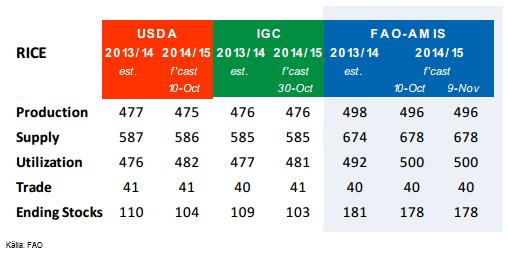
Efter förra veckans stora prisrörelse i ris, var det lite lugnare i veckan som gick. Marknaden handlade dock huvudsakligen ner priset, som till slut noterade en nedgång med 1% när veckan stängde.
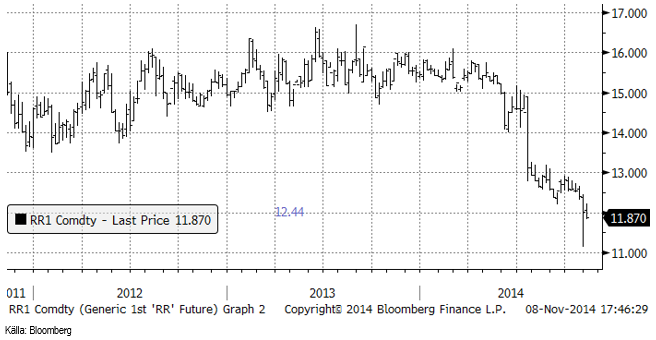
FAO/AMIS gjorde ingen förändring alls, vare sig vad gäller produktion eller konsumtion i rapporten från den 6 november. Det står ”9 november” i tabellen nedan, som är klippt från rapporten, men rapporten kom den 6 november.
Kaffe
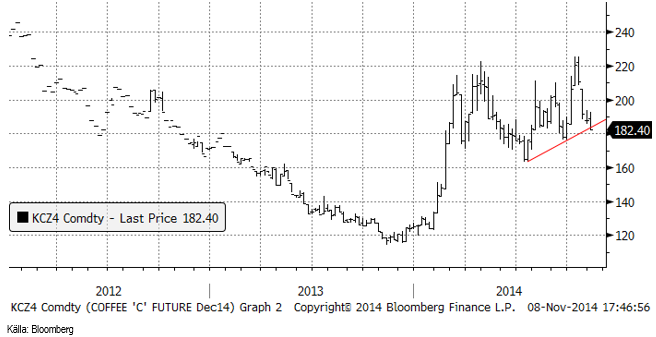
Kaffepriset backade med 3% i veckan som gick. Tekniskt bröt marknaden också det stöd som fanns vid ca 184 cent, vilket signalerar fortsatt svaghet i marknaden. Ur teknisk synvinkel är en prisnedgång till 175 eller kanske strax över 160 cent nu möjlig.
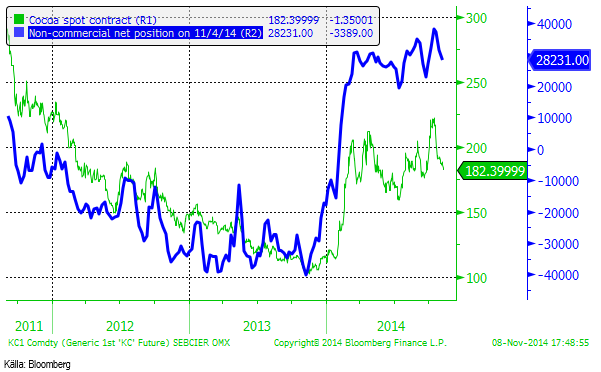
Som vi ser i nedanstående diagram är non-commercials enligt CFTC:s definition ovanligt köpta kaffemarknaden. Det finns därför ett ovanligt stort latent säljintresse hos dessa aktörer, som normalt sett säljer när marknaden har börjat på ner.
Kakao
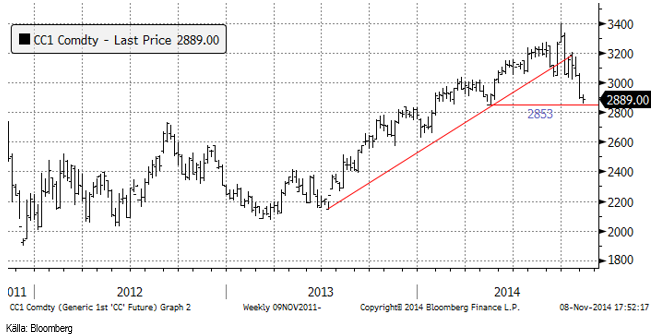
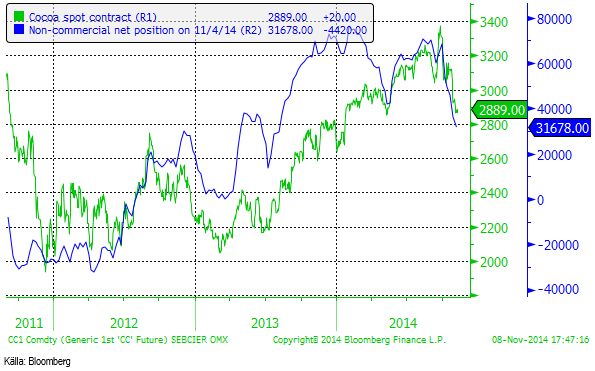
Kakaopriset gick ner med 10 dollar till 2889 dollar under veckan som gick. Det finns, som vi ser i veckochartet nedan, ett tekniskt stöd vid 2853 dollar, som vi nämnde förra veckan. Det fanns uppenbarligen köpintressen på den här nivån och det begränsade nedgången i veckan. Priset står nu och väger. Det kan bli en rekyl upp, men stödet kan också brytas och därmed följas av ytterligare nedgång till 2600 dollar.
Non-commercials fortsätter att sälja av sin långa position i terminer. I veckan såldes drygt 4000 kontrakt av non-commercials, som tar hem vinster efter att ha byggt upp en köpt position sedan 2012 när priset var 800 dollar lägre än det är nu.
Vi behåller positionen i SHORT KAKAO A S.
För fler analyser från SEB på jordbruksråvaror se jorbruksanalysbrevet.
[box]SEB Veckobrev Veckans råvarukommentar är producerat av SEB Merchant Banking och publiceras i samarbete och med tillstånd på Råvarumarknaden.se[/box]
Disclaimer
The information in this document has been compiled by SEB Merchant Banking, a division within Skandinaviska Enskilda Banken AB (publ) (“SEB”).
Opinions contained in this report represent the bank’s present opinion only and are subject to change without notice. All information contained in this report has been compiled in good faith from sources believed to be reliable. However, no representation or warranty, expressed or implied, is made with respect to the completeness or accuracy of its contents and the information is not to be relied upon as authoritative. Anyone considering taking actions based upon the content of this document is urged to base his or her investment decisions upon such investigations as he or she deems necessary. This document is being provided as information only, and no specific actions are being solicited as a result of it; to the extent permitted by law, no liability whatsoever is accepted for any direct or consequential loss arising from use of this document or its contents.
About SEB
SEB is a public company incorporated in Stockholm, Sweden, with limited liability. It is a participant at major Nordic and other European Regulated Markets and Multilateral Trading Facilities (as well as some non-European equivalent markets) for trading in financial instruments, such as markets operated by NASDAQ OMX, NYSE Euronext, London Stock Exchange, Deutsche Börse, Swiss Exchanges, Turquoise and Chi-X. SEB is authorized and regulated by Finansinspektionen in Sweden; it is authorized and subject to limited regulation by the Financial Services Authority for the conduct of designated investment business in the UK, and is subject to the provisions of relevant regulators in all other jurisdictions where SEB conducts operations. SEB Merchant Banking. All rights reserved.

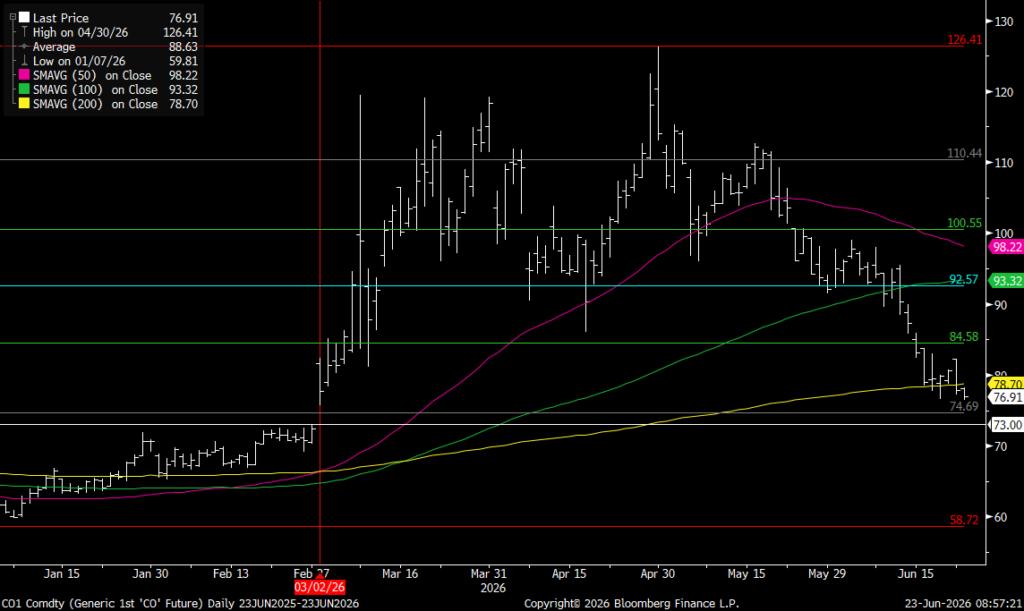
Brent M1 moving below the 200 dma of $78.7/b. Brent crude continued its move lower yesterday with a decline of 3.3% to $77.9/b. This morning it is adding another drop of 1.4% to $76.8/b. Israel bombing Lebanon during the weekend was a violence of the MoU and Iran was quick to declare the SoH closed again. But the willingness to move forward by both the US and Iran obviously trumped the bombing in Lebanon making the event more of a hiccup on the road of further negotiations.

The US has now waived sanctions against Iranian oil exports for two months allowing Iran to sell its oil all over the world, though sanctions instated in Europe will take more time to unwind. Oil from Iran, Russia as well as Venezuela can for the time being be sold across the world without any sharp discount due to sanctions. Chinese Tea-pot refineries will suffer as they previously could buy rebated crude while selling products at market prices.
Crude oil is no flowing out of the SoH with latest number close to 7 mb/d on a three day moving average. That is still well below the 14 mb/d of crude and 6 mb/d of products normally flowing out of the SoH. Latest estimate is that there is around 80 mb of crude on water inside the Persian Gulf and maybe another 80 mb of oil products on water as well. If crude is exiting the SoH at a rate of around 7 mb/d, then the 80 mb of crude would be depleted within 10-15 days and there after the flow would rely on new crude tankers entering, loading and then exiting the SoH to continue further flows. Given the uncertainties surrounding the status of the SoH with Iran stating that it was closed again as recent as this weekend, there is likely an asymmetry here where ships and oil stranded in the SoH for months are much more eager to exit than new ships are eager to enter.
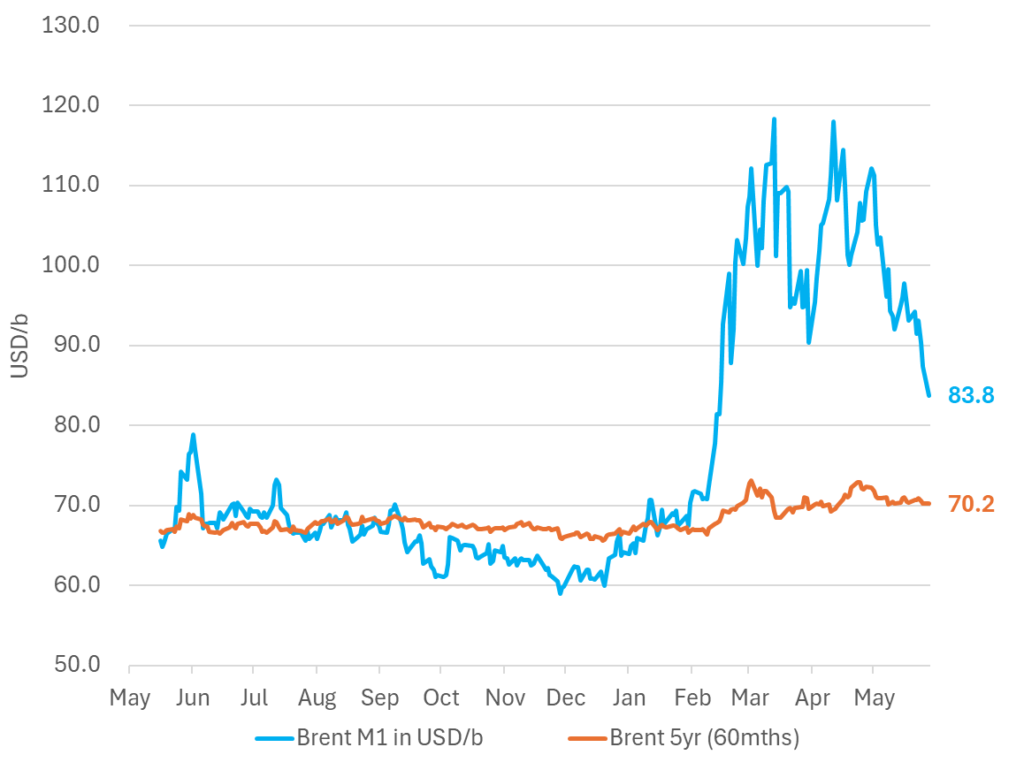
For now Brent crude keeps falling like a rock with the front-end Brent contract now only trading at a premium of $7.6/b above the five year contract. Quickly heading towards parity. The Brent M1 contract has now broken below its 200 dma of $78.7/b and is closing in on the Fibo-level at $74.7/b. Below that there is not much more supporting levels to be found before $73/b which would close the gap from February 3.
Brent crude M1 technical levels
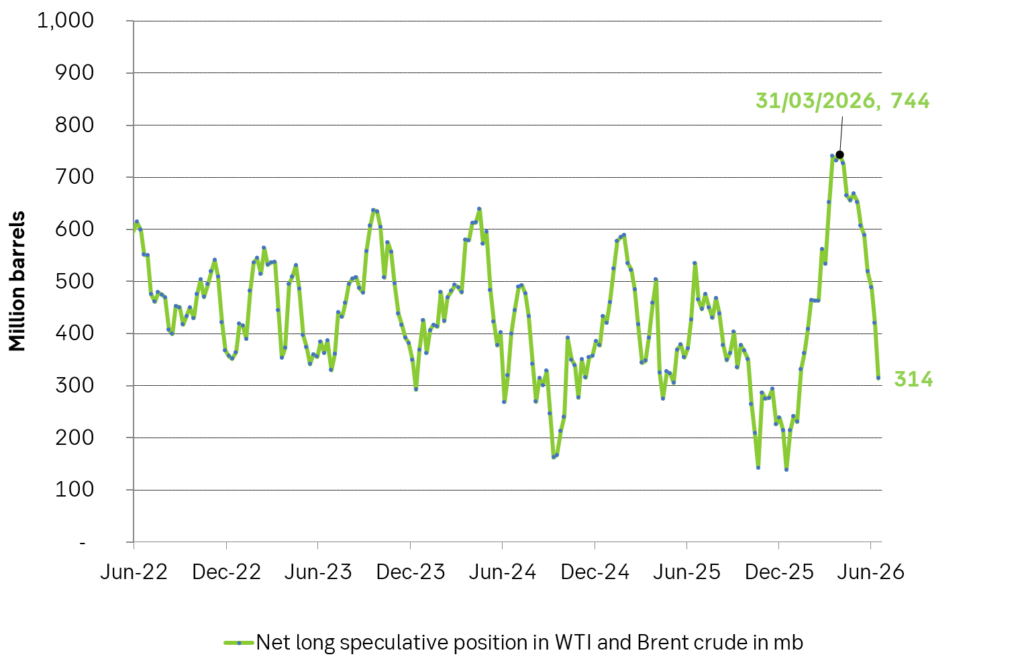
Net long speculative positions are also falling like a rock and as of Tuesday last week the net long positioning in Brent and WTI together summed to 314 million barrels and falling fast.
Will there be a rebound? A possible combination could be an exhaustion of the oil blob caught within the SoH within 1-2 weeks if exits continue at current rate while new ships entering are much more cautious, more Israeli bombardments in Lebanon as Netanyahu fights for re-election, a temporary closure of the SoH again while speculative short positions take cover buying back and covering their positions.
US and Israeli stands versus Iran could harden beyond elections so 2027 surplus is far from given. But Iran and the US are all in all moving towards a set of solutions with both clearly eager to reopen the SoH and keep it open. And that is what the market is pricing along with sharply falling prices. The ongoing discussions will likely take months and last beyond both the upcoming Israeli election (before 27 oct) and the US midterm elections on 3 Nov. Beyond those dates the stance by both Israel and the US may harden again versus Iran. But Iran knows that and is most likely preparing for such a hardening turn. Thus a surplus of oil and global oil stock rebuilding in 2027 (as now is mostly projected) is far from given.
Selling down on a ”deal”. Brent crude fell 6.2% last week with accelerated weakness towards the end of the week. Close of the week at $87.33/b and low of the week (and on Friday) of $85.8/b. Brent is falling another 4% this morning to $83.7/b on confirmation by Iran that a MoU text has been reached and that it will be signed on Friday this week.
So what is this ”deal” worth? Talk on the desk here this morning is that it is much like ”putting lipstick on a pig” where Trump has to sell this at home as a victory where ”the SoH has reopened”, the nuclear issue will be ironed out over the coming 60 days (or maybe 600 days?) and US consumers are getting a lower gasoline price and maybe US republicans survives the midterm elections.
The importance for Iran is that it emerges as the defacto winner of this war in the eyes of the non-US public world. That Iran now onwards is the ”ruler of the SoH” (combo of geography and new weapons systems like drones) or more softer: ”the guarantor of safe passage through the SoH”.
Iran doesn’t need nuclear weapons any more. Nuclear deterrence doesn’t work any more. Ukraine has made many attacks deep into Russia without being nuked in return. Plenty of Iranian ballistic rockets blasts over Israel but Iran wasn’t nuked in return.
There is no trust between the US and Iran. We don’t know all the details yet of the MoU. But what we do know is that there is no trust between the US and Iran what so ever. This is probably more like a descriptive text on how they can cooperate in a way where both sides keeps tactical leverage. Neither side makes irreversible concessions. Violations can be punished quickly. Cooperation produces immediate benefits.
This is a fragile structure. It can easily break down. There may be details which cannot be overcome. To be seen on Friday. The US has to show that it is willing put enough force behind managing and restraining Israel versus Hezbollah in Lebanon. We have seen that Netanyahu hasn’t listened all that much to Trump’s directives and wishes. This could be a major obstacle.
A gradual reopening is tactically preferable for Iran. A tactical leverage for Iran right now is that global oil stocks have been drawn down towards painful and increasingly dangerous levels with increasing risks for oil price spikes in mid-July to August. This together with US midterm elections on 3 November gives tactical leverage to Iran. Iran probably doesn’t want to fully give up on that leverage. A rapid, full reopening where global stocks are able to refill over the coming 60 days will significantly erode that leverage. If Iran reinstates a closure of the SoH after 60 days (if talks break down again), then the effect won’t be that impactful in terms of prices and the US midterm elections.
So a gradual and partial reopening where global markets gets the oil they need while they are unable to rebuild stocks could be a practical middle way for both parties. Trump can sell it as ”the SoH has reopened” and get affordable gasoline for US consumers. Iran can sell it as ”the SoH has fully reopened, but there is some friction” so flow is only 60-80% of normal.
Not much real demand destruction below $100/b. What we do know is that there is not much real price pain demand destruction for oil globally at an oil price below $100/b. A lot of demand-shock destruction. Fear. But demand should now come roaring back towards normal with fear for exceptionally high prices now is rapidly receding.
Sudden China demand destruction due to EVs? Bullocks. EV share of total Chinese carpool now around 13%. Share of new sales of EVs has reached 50%. This is a very gradual process. It doesn’t make oil demand fall like a rock over night. When EV new sales share reaches 100%, then the gasoline car pool will contract by some 5-10% per year. But that is only gasoline. Sudden reduction in Chinese oil demand is more about shock and risk.
Chinese crude oil imports will come roaring back. At what price? Today’s ”neutral” oil price is $70/b. That is the five year price which has steadily traded around the $70/b mark over the past 3-4 years. With still a risky picture one would think that China and the rest of the world will be big buyers of oil in the range of $70-85/b.
Global demand will likely snap back towards normal, forecasted demand and growth at such prices.
Physical reopening is a gradual process. The physical and practical reopening of the SoH will likely be gradual rather than sudden. And that probably suites Iran tactically as well.
Brent M1 price versus the Brent 5-yr (today’s ”normal” price)
Market is starting to take US/Iran headlines with a pinch of salt. Brent crude rose $2.8/b yesterday to an official close of $112.1/b. But after that it traded as low as $108.05/b before ending late night at around $109.7/b. Through the day it traded in a range of $106.87 – 112.72/b amid a flurry of news or rumors from Iran and the US. ”US temporary sanctions during negotiations” (falls alarm). ”We will bomb Iran” (not anyhow),… etc. While the market is still fluctuating to this kind of news flow, it is starting to take such headlines with a pinch of salt.
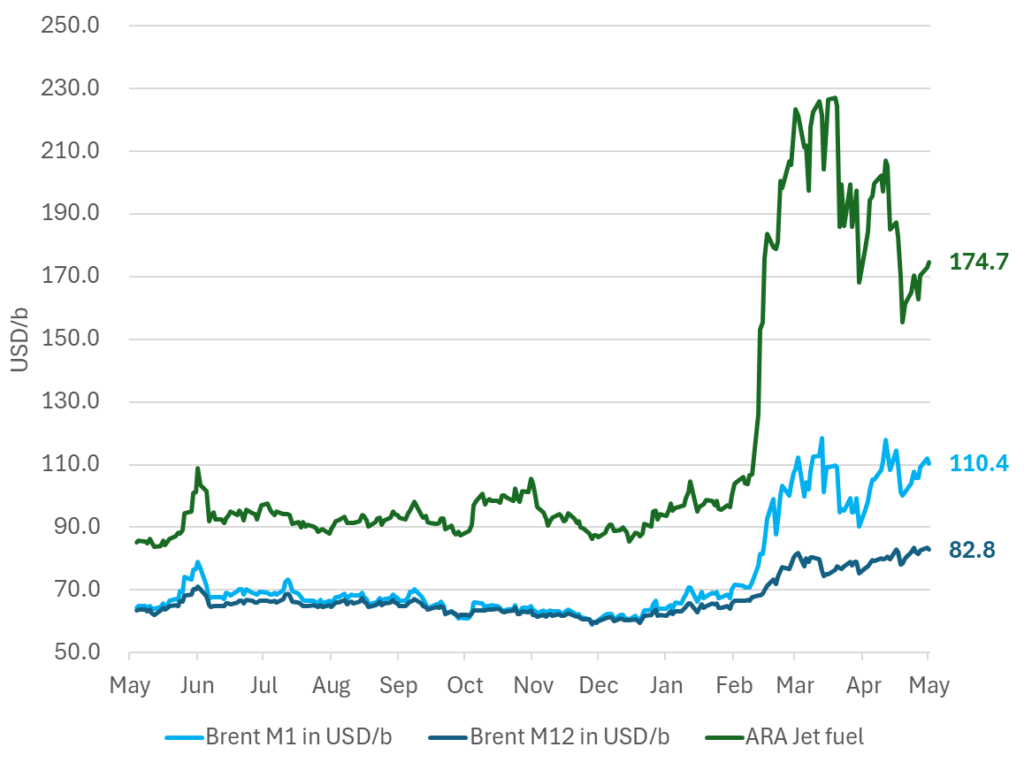
We’ll see. Maybe, maybe not. The Brent M1 contract is trading at $110.2/b this morning which very close to the average ticks through yesterday of $110.4/b.
Trump with bearish, verbal intervention whenever Brent trades above $110/b it seems. What seems to be a pattern is that Trump states something like ”very good negotiations going on with Iran”, ”New leaders in Iran are great,..”, ”Great progress in negotiations,…”, ”Deal in sight,..” etc whenever the Brent M1 contract trades above $110/b. An effort to cool the market. These hot air verbal interventions from Trump used to have a heavy bearish impact on prices, but they now seems to have less and less effect unless they are backed by reality.
As far as we can see there has been no real progress in the negotiations between the US and Iran with both sides still standing by their previous demands.
Iran is getting stronger while the cease fire lasts making a return to war for Trump yet harder. Iran is naturally in constant preparation for a return to war given Trump’s steady threats of bombing Iran again. Iran is naturally doing what ever is possible to prepare for a return to war. And every day the cease fire lasts it is better prepared. This naturally makes it more and more difficult and dangerous for the US to return to warring activity versus Iran as the consequences for energy infrastructure in the Persian Gulf will be more and more severe the longer the cease fire lasts. Israel seems to see it this way as well. That the war is not won and that current frozen state of a cease fire gives Iran opportunity to rebuild military and politically.
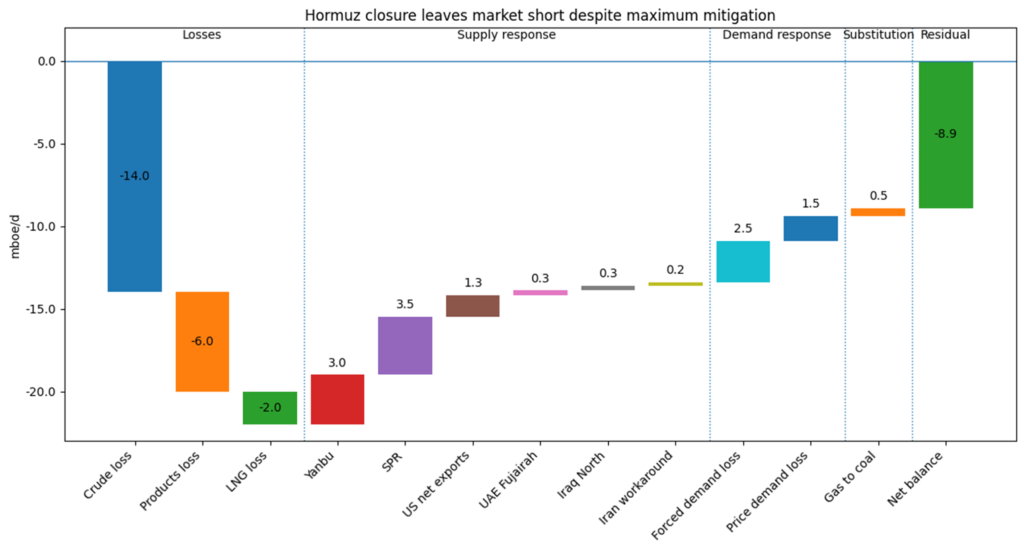
Global inventories are drawing down day by day. How much? In the meantime the Strait of Hormuz stays closed. There is varying measures and estimates of how much global inventories are drawing down. Our rough estimate, back of the envelope, is that global inventories are drawing down by at least some 10 mb/d or about 300 mb/d in a balance between loss of supply versus demand destruction. Other estimates we see are a monthly draw of 250-270 mb/d. The IEA only ’measured’ a draw in global observable stocks of 117 mb in April with oil on water rising 53 mb while on shore stocks fell 170 mb. But global stocks are hard to measure with large invisible, unmeasured stocks. As such a back of the envelope approach may be better.
Oil products is what the world is consuming. Oil product prices likely to rise while product stocks fall. Strategic Petroleum Reserves (SPR) are predominantly crude oil. Discharging oil from OECD SPR stocks, a sharp reduction in Chinese crude imports and a reduction in global refinery throughput of 6-7 mb/d has helped to keep crude oil markets satisfactorily supplied. But global inventories are drawing down none the less. And oil products is really what the world is consuming. So if global refinery throughput stays subdued, then demand will eventually have to match the supply of oil products. The likely path forward this summer is a steady draw down in jet fuel, diesel and gasoline. Higher prices for these. Then, if possible, higher refinery throughput and higher usage of crude in response to very profitable refinery margins. And lastly sharper draw in crude stocks and higher prices for these. But some 6 mb/d of oil products used to be exported through the Strait of Hormuz. And it may not be so easy to ramp up refinery activity across the world to compensate. Especially as Ukraine continues to damage Russian refineries as well as Russian crude production and export facilities.
Watch oil product stocks and prices as well as Brent calendar 2027. What to watch for this summer is thus oil product inventories falling and oil product premiums to crude rising. Another measure to watch is the Brent crude 2027 contract as it rises steadily day by day as the Strait of Hormuz stays closed and global oil inventories decline. The latter is close to the highest level since the start of the war and keeps rising.
The Brent M1 contract and the Brent 2027 prices and current price of jet fuel in Europe (ARA). All in USD/b
Our back of the envelope calculation of the global shortage created by the closure of the Strait of Hormuz. Note that 3.5 mb/d of discharge from SPR is also a draw. Note also that ’Forced demand loss’ of 2.5 mb/d is probably temporary and will fall back towards zero as logistics are sorted out leaving ’Price demand loss’ to do the job of balancing the market. Thus a shortfall of at least 9 mb/d created by the closure. More if SPR discharge is included and more if Forced demand loss recedes.



Brent falling like a rock with oil likely to flow from SoH until at least 3 November

Vattenfalls och Industrikrafts kärnkraftsbolag Videberg Kraft har valt Rolls-Royce SMR
Selling down on a ”deal”

Sommarväder skapar prisrally på elbörsen
Oil product price pain is set to rise as the Strait of Hormuz stays closed into summer
Sommarväder skapar prisrally på elbörsen
Vattenfalls och Industrikrafts kärnkraftsbolag Videberg Kraft har valt Rolls-Royce SMR
Selling down on a ”deal”
Brent falling like a rock with oil likely to flow from SoH until at least 3 November
-
Nyheter3 veckor sedan
Sommarväder skapar prisrally på elbörsen
-
 Nyheter1 vecka sedan
Vattenfalls och Industrikrafts kärnkraftsbolag Videberg Kraft har valt Rolls-Royce SMR
-
Analys1 vecka sedan
Selling down on a ”deal”
-
Analys3 timmar sedan
Brent falling like a rock with oil likely to flow from SoH until at least 3 November