

Analys
SEB – Jordbruksprodukter, vecka 7 2012

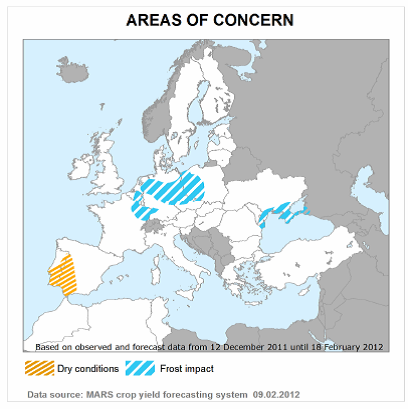
 Förra veckans WASDE rapport fick samtliga jordbruksprodukter att falla i pris men fortfarande kvarstår viss oro över det torra, varma vädret i delar av Sydamerika och det kalla vädret i Europa. MARS skriver i sin februari-rapport att den hittills milda vintern delvis har gjort grödorna mindre vinterhärdiga samtidigt som de har varit utsatta för köld och frost i västra Europa men även i västra Polen, Tjeckien och runt Svarta havet och att sannolikheten är stor att det kommer att leda till köld och uttorkningsskador.
Frågetecknen kvarstår kring Grekland men trots våldsamma protester och upplopp i Aten röstade det grekiska parlamentet, med röstsiffrorna 199 mot 74, igenom det nya besparingspaketet sent i söndags. Förslaget, som nu är lag, omfattar budgetåtstramningar på 3.3 mdr eur och innehåller bland annat sänkta pensioner och minimilöner och att man tar bort 150 000 statliga jobb fram till 2015. Förutom ett parlamentariskt godkännande kräver trojkan också att ledarna för de två största politiska partierna skriftligt ska lova att de kommer att följa förslaget efter det nyval som väntas hållas inom två månader.
Kreditvärderingsföretagen har haft fullt upp. S&P sänkte under fredagen kreditbetygen för 34 italienska banker (som en följd av att Italiens kreditbetyg sänktes i januari) för att sedan på måndagen också sänka kreditbetyget för 15 spanska banker, bla storbanken Santander. Moody´s sänkte under natten till tisdagen kreditbyten för sex europeiska länder (Spanien, Italien, Portugal, Malta, Slovakien och Slovenien) medan utsikterna för Storbritannien, Frankrike och Österrike sänktes från stabila till negativa.
Vete
Vetepriset föll tillbaka kraftigt efter förra veckans WASDE rapport och har sedan dess rört sig mest sidledes.
Dagen innan USDA kom med sin WASDE rapport i förra veckan kom också FAO med sin rapport där den globala produktionen av spannmål under 2011 förväntas vara mer än tillräcklig för att tillgodose den förväntade konsumtionen under 2011/12. Ett större utbud resulterade i sjunkande priser under andra halvan av 2011 men priserna återhämtade sig i januari, vilket huvudsakligen återspeglar en oro över vädrets påverkan av 2012 års kommande skördar i flera stora spannmålsproducerande regioner.
 FAO höjer sin prognos för 2011 års globala spannmålsproduktion med 4,6 mt till 2 327 mt jämfört med sin december rapport, vilket skulle vara en ökning med 3.6 procent från 2010 och ett nytt rekord. Mycket av ökningen tillskrivs ”coarse grains” (där bl.a majs och korn ingår), där produktionen sannolikt kommer att öka med 2,3 procent till nästan 1 152 mt, vilket är 4 miljoner mer än vad som rapporterades i december. Efter årets slut så har prognosen för den globala veteproduktionen för 2011 fastställts till 694,5 mt, ett nytt rekord och en ökning med 6.3 procent jämfört med 2010.
Prognosen för den globala konsumtionen av spannmål under 2011/12 justerats ned något sedan föregående rapport till 2 309 mt, vilket fortfarande är 1,8 procent högre än 2010/11. Konsumtionen av vete förväntas dock öka, och den viktigaste faktorn bakom denna tillväxt är den förväntade expansionen av vete som foder till följd av det kraftiga globala utbudet och konkurrenskraftiga priser på vetet i förhållande till majs. Konsumtionen av majs väntas däremot bara öka marginellt då efterfrågan som foderingrediens förväntas avta (och ersättas med vete) samtidigt som den industriella användningen också ökar i långsammare takt än tidigare, främst pga en stagnerande majsbaserad etanolproduktion.
Baserat på de senaste prognoserna för spannmålsproduktion under 2011 och spannmålskonsumtion under 2011/12 har FAO:s prognos för globala utgående lager i slutet av säsongen höjts med 5 mt till 516 mt. Globala utgående lager för vete förväntas öka med 29 procent, långt över det 10-åriga genomsnittet. Däremot förväntas utgående lager för t.ex majs att minska kraftigt, framför allt i USA.
Egyptens GASC köpte 55 000 ton vete från USA i helgen vilket är första gången som Egypten köper vete från USA denna säsong. Det visar dock på att det amerikanska vetet nu är konkurrenskraftigt i prissättningen i jämförelse med Ryssland och Frankrike som gick lottlösa denna gång.
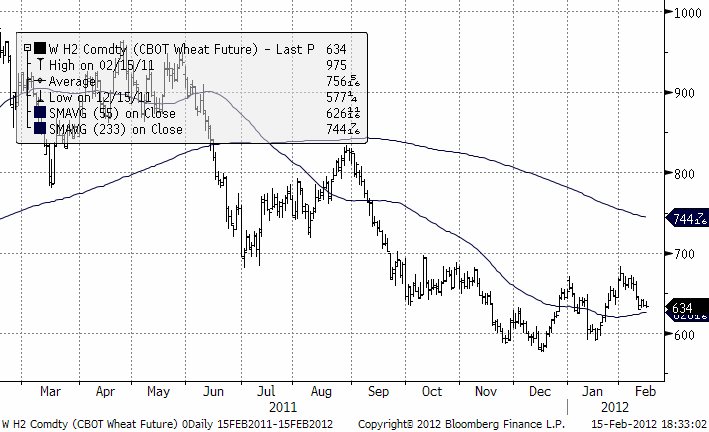
Nedan ser vi terminspriset på Chicago-vete (mars) som föll tillbaka efter WASDE-rapporten men som därefter har handlats i intervallet 630 – 640 USc.
Det verkar som att Ukrainas jordbruksminister har bett spannmålshandlare som verkar på den inhemska marknaden att vara restriktiva i sin export av vete då torkan som drabbade landet i höstas samt det nuvarande kalla vädret i kombination med brist på snötäcke i vissa delar kommer att påverka årets veteskörd. Handelshusen uppmanas att noggrant följa den inhemska vetemarknadens utbud och efterfrågan och att inte prioriterade vete i spannmål för export. Korn och majs berörs dock inte av detta. Regeringen vill också undvika ett eventuellt införande av exportrestriktioner och förhoppningen är att en återhållsammare export tillgodoser detta.
Ukrainas spannmålsexport har varit fri från restriktioner i ungefär en och en halv månad nu.
Beskattningen på export av korn gällde från förra sommaren fram till den 31 dec 2011, medan exportskatten på vete och majs gällde från sommaren och fram till oktober 2011. Dessförinnan var landets spannmålsexport begränsad av kvoter under 7 månader efter torkan sommaren 2010.
Australiensiska ABARES adderar ytterligare 700 000 ton i sin prognos för landets export av vete 2011/12, som nu uppgår till 22,3 mt, efter att ha justerat upp Australiens veteskörd med 1.23 mt till en rekordnivå på 29.5 mt. ABARES prognos över exportsiffrorna ligger över USDA estimat på 21 mt i förra veckans WASDE rapport och om siffrorna stämmer kommer Australien att hamna på andra plats i världsrankingen, före både Europa och Ryssland.
Veteproduktionen i Indien för 2011/12 förväntas uppgå till 88,31 mt, vilket är ett nytt rekord, samtidigt som de statliga lagren uppgick till 25,7 mt per den 1 januari vilket är 3 gånger mer än det officiella målet för nuvarande kvartal. Indiens egen konsumtion av vete uppgår till ca 76 mt vilket skulle ge möjlighet att exportera överskottet.
Iran har vänt sig till Indien för köp av vete då andra säljare är avvaktande pga sanktionsrelaterade problem med betalningar för bl.a europeiskt spannmål och som nu också har stoppats landets import av palmolja. Iran har en växande lista över livsmedel som importeras och som nu påverkas av USA’s och EU’s sanktioner som syftar till att tvinga Teheran att skrota ett misstänkt kärnvapenprogram. Iran importerar ca 4,5 mt spannmål per år, varav ca 3,5 mt majs som framförallt används till djurfoder. Enligt USDA förlitar sig landet på import för att möta mer än 60 procents av sitt behov av majs men endast 3 procent av sitt behov av vete. Vete kan dock användas för att ersätta majs som djurfoder, vilket skulle kunna vara förklaringen att Iran vänt sig till Indien med en förfrågan, särskilt efter att nyheten att importen av majs från Ukraina har halverats.
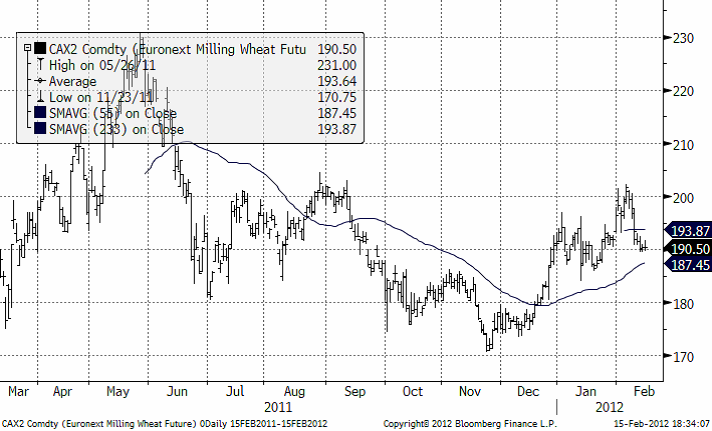
Nedan ser vi terminspriset på Matif-vete (november) .
Maltkorn
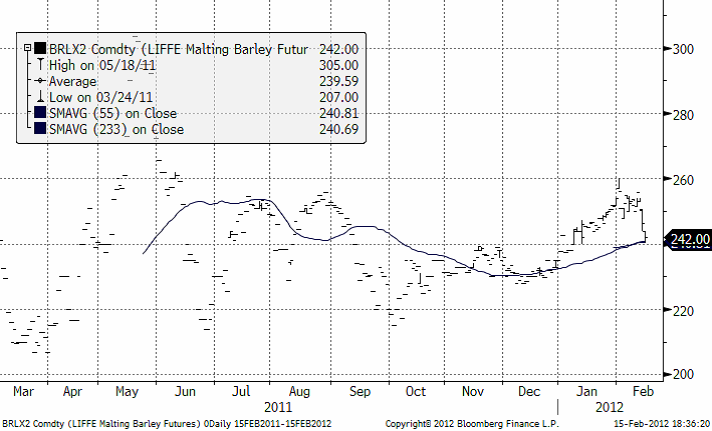
Nedan ser vi terminskontraktet för maltkorn med novemberleverans på Matif.
Potatis
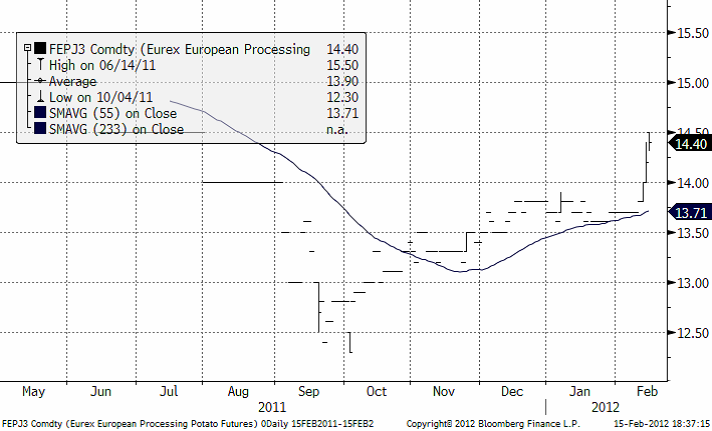
Nedan ser vi kursdiagrammet på europeisk potatis, som handlas på Eurex; terminen avser leverans april 2013.
Majs
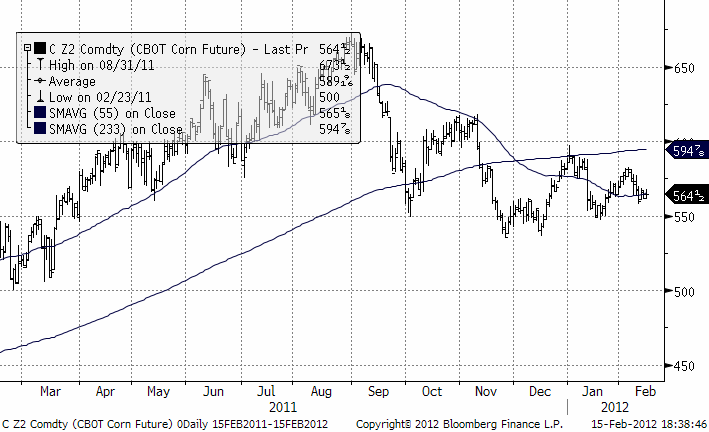
Argentinas majsproduktion drabbades hårt av torkan under december och januari och Buenos Aires Cereals Exchange sänkte sin prognos för produktionen av majs 2011/12 till 21,3 mt, en minskning från 22 mt veckan innan. I början av säsongen förväntades majs produktionen att uppgå till 30 mt men varmt och torrt väder har drabbat grödorna hårt. Majs som såddes i början av säsongen drabbades värst av torkan under dess viktigaste tillväxtfas, men en del av det bortfallet kommer att kompenseras av högre avkastning i de norra delarna där sådden skedde senare och grödorna fick tillräckligt med regn. Argentina är världens näst största exportör av majs efter USA och oron över torkan som drabbat landet har drivit upp priserna.
Nedan är estimat för Argentinas majs produktion 2011/12
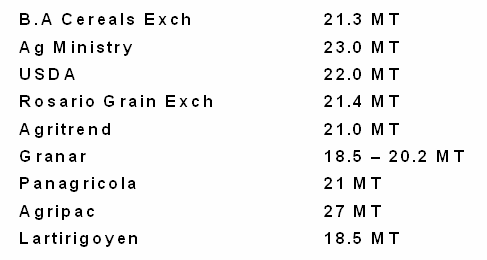
Som vi skrev i förra veckans brev så ser man ovan att så USDA´s 22 mt ligger högt i intervallet av prognoser medan inhemska Argentinska prognosmakare mer ligger i intervallet 18 – 22 mt. Produktionen skulle alltså ha kunnat minska med 8 mt istället för de 4 mt som USDA förutspår nu i sin februari rapport.
Det torra vädret har också påverkat grödorna i Sydafrika och Mexiko. USDA justerar ned majsskörden i Sydafrika med mer än 400 000 ton till följd av torra väderförhållanden och Mexikos majsskörd förväntas hamna på ett 11-års lägsta om 18,4 mt då landet har genomlidit den värsta torkan på flera årtionden.
Nedan ser vi terminskontraktet på Chicago för majs (december).
Ukrainas majs export till Iran sjönk med 40 procent förra månaden till följd av sanktioner från EU som orsakar försenade eller uteblivna betalningar från iranska köpare. Förhandlingar förs dock mellan de två länderna för att undvika konflikter eftersom Iran utgör en viktig marknad för Ukraina och Ukraina i sin tur utgör Irans viktigaste leverantör av majs tillsammans med Brasilien och Argentina.
Sojabönor
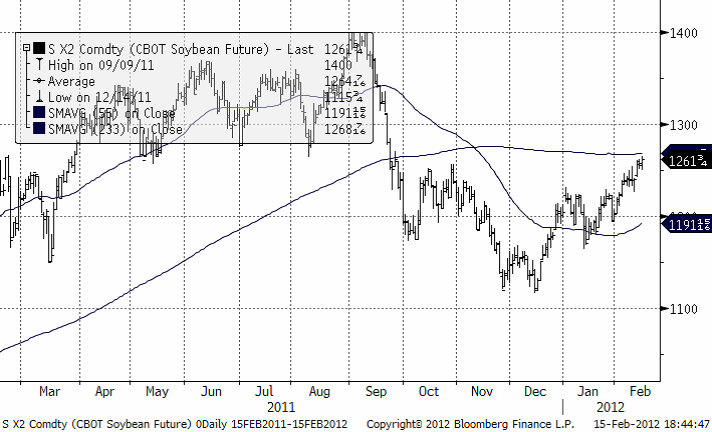
Priset på sojabönor fick sig också en törn efter WASD rapporten men har sedan dess fortsatt uppåt igen då oron över det torra vädret i södra Brasilien kvarstår.
Baserat på lägre Sydamerikanska skördar justerar USDA ner den globala sojabönsproduktionen för 2011/12 med 5,5 mt till 251,5 mt (jämfört med 264.2 mt 2010/11). Man hade tidigare räknat med att produktionen i Sydamerika delvis skulle kompensera minskningen i den amerikanska produktionen, men detta verkar nu osannolikt. Som en följd av lägre produktion väntas de globala utgående lagren minska med 13 procent i år till 60.3 mt.
Brasiliens produktion justeras ned med 2 mt till 72 mt. En stor del av minskningen beror på bortfall i den södra delstaten Parana. Regionen har i stort sett endast fått hälften av den normala säsongsmässiga nederbörden. Längre söderut, i Rio Grande Do Sul, har sådden skett senare men grödorna är nu i stort behov av regn. Trots problemen med produktionen i de södra regionerna, har Brasilien fortfarande möjlighet att få sin näst största skörd någonsin i år till följd av ökad areal och gynnsamma växtförhållanden i andra delar av landet. Skörden i Mato Grosso har avstannat något pga ihållande regnväder och således är endast 6 procent av landets sojabönsskörd avklarad.
På andra sidan gränsen, i Paraguay, har vädret varit lika torrt som i Parana med väldigt lite regn sedan början på december. Minskad areal och kraftigt minskad avkastning gör att estimatet för Paraguays sojabönsskörd krymper till 6,4 mt i år, jämfört med förra månadens prognos på 7,6 mt och förra årets rekordskörd på 8,3 mt.
Nedan ser vi terminspriset på Chicago för sojabönor (november).
Nederbörden i december i centrala Argentina visar på historiskt låg mängd för månaden och torkan förvärrades också av intensiv värme. Sedan mitten av januari har dock nederbördsmängden förbättrats något, vilket har stabiliserat växtförhållandena och uppmuntrat till fortsatt sådd. Den argentinska regeringen rapporterade att sådden av sojabönor per den 2 februari uppgick till 18,5 miljoner hektar och det kommer troligtvis inte att ske någon större förändring gällande den siffran då man är i slutet av den tidsperiod då sådd är möjlig. Det är nu väsentligt att landet får tillräckligt med nederbörd. Om regnet fortsätter (liksom förra året då regnet kom efter en tidig torrperiod) kan avkastningen fortfarande ligga nära genomsnittet, å andra sidan skulle det också kunna vara möjligt att avkastningen minskar dramatiskt om torkan fortsätter att hålla i sig. Prognosen för Argentinas produktion har justerats ned 2,5 mt till 48 mt.
Även om Uruguays produktion av sojabönor hamnar i skuggan jämfört med sina större grannar har den expanderat snabbt under det senaste det senaste decenniet och arealen för i år uppskattas till rekordhöga 1 miljon hektar. Men det torra och varma vädret har också drabbat Uruguay och estimatet för årets produktion justeras ned 100 000 ton till 1,7 miljoner ton. Nästan allt går till export.
Lägre utbud och stigande priser på sojabönor kommer sannolikt att bromsa den globala importen av sojabönor. Kina som står för ca 60 procent av den globala handeln med sojabönor har under perioden oktober 2011 till januari 2012 importerat ca 19,5 mt, en liten nedjustering från 19,8 mt året innan.
Raps
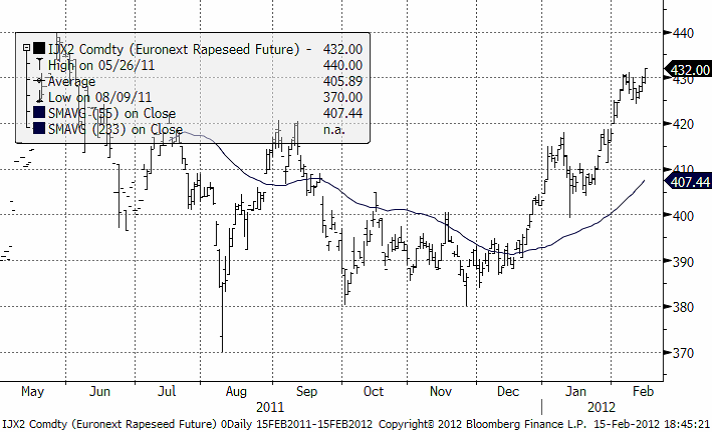
Priset på raps har fortsatt uppåt sedan förra veckan och får support av ett begränsat utbud samt prisuppgången på sojabönor på CBOT och en fortsatt uppgång I priset på råolja.
Oil World har justerat ned sina estimat för raps produktionen i Ukraina till 1.05 mt för 2012 jämfört med 1.38 mt förra året.
Även om Indien kommer att få en rekordskörd av vete i år så ser det värre ut för rapsproduktionen som sannolikt kommer att minska med en fjärdedel, vilket innebär att landets import av vegetabiliska oljor kan komma att öka kraftigt. Den förväntade minskningen av raps speglar sannolikt en krympande produktion i Rajasthan, den indiska delstaten i norr som står för ungefär hälften av landets raps produktion till följd av minskad areal, torrt väder under sådden i oktober och att lantbrukare föredrar att så kikärtor istället.
Förra årets rekordskörd av kanadensisk canola (raps) håller på att försvinna snabbt och beror i första hand på en stark exportefterfrågan. Exporten för 2011/12 beräknas uppgå till rekordhöga 8 mt, en ökning med 800 000 ton från förra månadens prognos, och där Kina står för en majoritet av ökningen med en estimerad import på 1,4 mt. Även Kinas import av rapsmjöl från Canada kan komma att öka då Kina nyligen har förbjudit import av rapsmjöl från Indien till följd av att man upptäckt laster med rapsmjöl som innehållit färgämnen (malakitgrönt) som används för att märka spannmålssäckar.
Enligt ABARES förväntas Australiens canola produktion uppgå till 2,78 mt, en ökning med 280 000 ton mot tidigare estimat, och tillräckligt för en export av ca 2 mt (mot tidigare 1.88 mt).
Nedan ser vi terminskontraktet på Matif för raps (november) som fortfarande håller ett högt pris ur ett historiskt perspektiv och är säljvärt, tror vi.
Mjölk
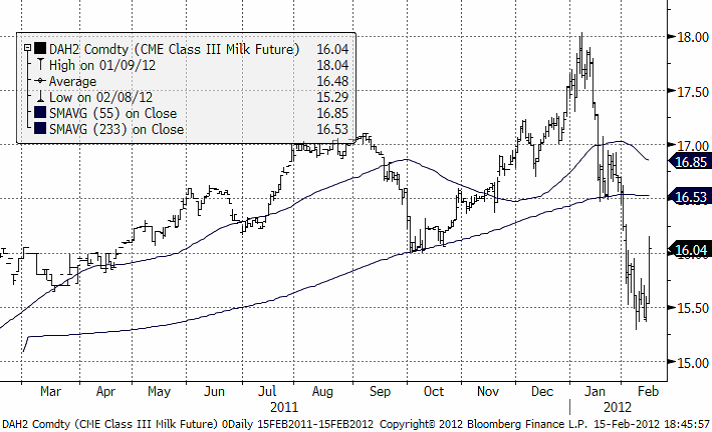
Nedan ser vi priset på marskontraktet på flytande mjölk (kontakt avräknat mot USDA:s prisindex). Priset har som vi ser fallit kraftigt i februari.
Gris
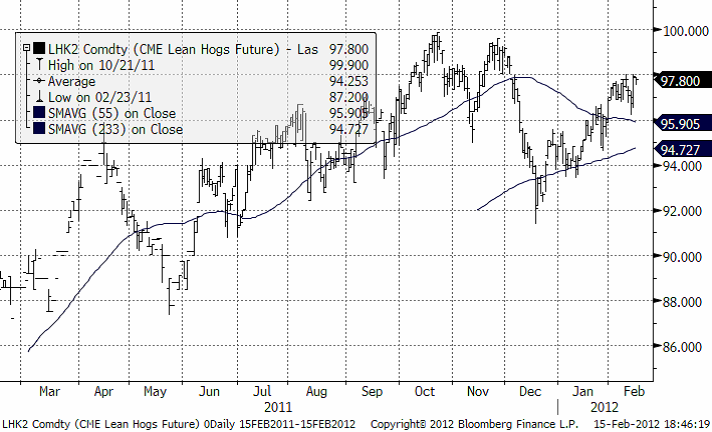
Priset på lean hogs har segat sig uppåt och befinner sig nu återigen i sälj-området. Nedan ser vi terminspriset för leverans i maj.
Valutor
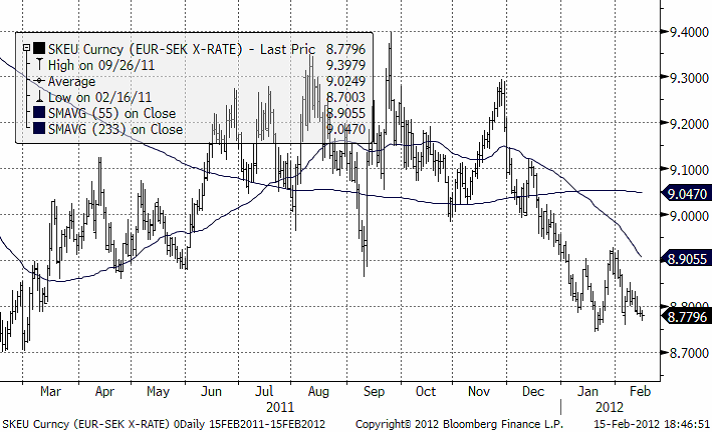
EURSEK
Vi har en neutral rekommendation på både en veckas sikt och tre månaders.
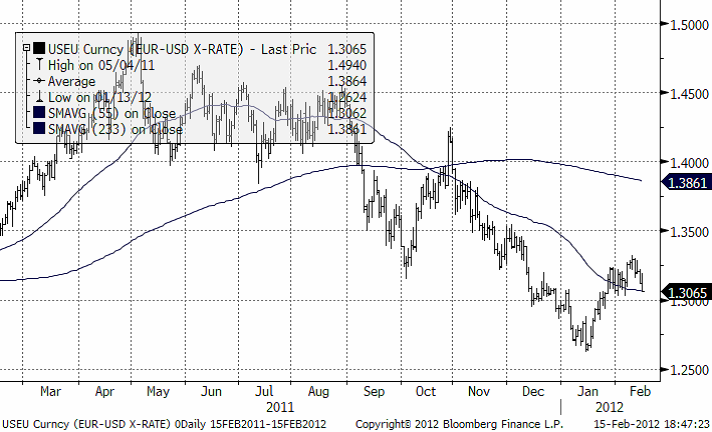
EURUSD
Rekommendation: Neutral på en veckas sikt. Negativ på tre månader.
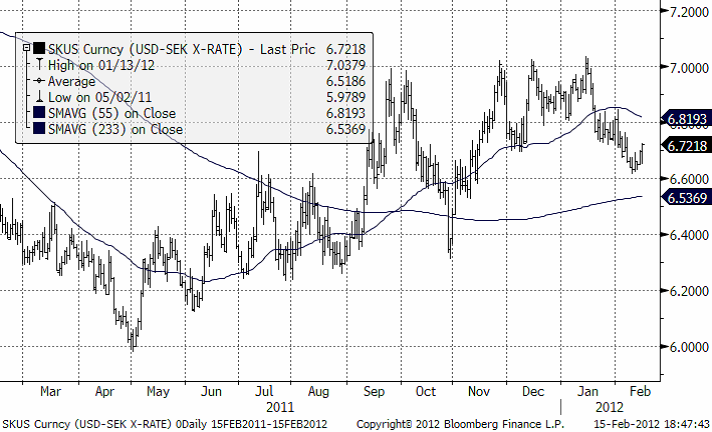
USDSEK
Vi har en neutral rekommendation på en veckas sikt, men är positiva på tre månader.
[box]SEB Veckobrev Jordbruksprodukter är producerat av SEB Merchant Banking och publiceras i samarbete och med tillstånd på Råvarumarknaden.se[/box]
Disclaimer
The information in this document has been compiled by SEB Merchant Banking, a division within Skandinaviska Enskilda Banken AB (publ) (“SEB”).
Opinions contained in this report represent the bank’s present opinion only and are subject to change without notice. All information contained in this report has been compiled in good faith from sources believed to be reliable. However, no representation or warranty, expressed or implied, is made with respect to the completeness or accuracy of its contents and the information is not to be relied upon as authoritative. Anyone considering taking actions based upon the content of this document is urged to base his or her investment decisions upon such investigations as he or she deems necessary. This document is being provided as information only, and no specific actions are being solicited as a result of it; to the extent permitted by law, no liability whatsoever is accepted for any direct or consequential loss arising from use of this document or its contents.
About SEB
SEB is a public company incorporated in Stockholm, Sweden, with limited liability. It is a participant at major Nordic and other European Regulated Markets and Multilateral Trading Facilities (as well as some non-European equivalent markets) for trading in financial instruments, such as markets operated by NASDAQ OMX, NYSE Euronext, London Stock Exchange, Deutsche Börse, Swiss Exchanges, Turquoise and Chi-X. SEB is authorized and regulated by Finansinspektionen in Sweden; it is authorized and subject to limited regulation by the Financial Services Authority for the conduct of designated investment business in the UK, and is subject to the provisions of relevant regulators in all other jurisdictions where SEB conducts operations. SEB Merchant Banking. All rights reserved.

Wild moves yesterday. Brent crude traded to a high of $114.43/b and a low of $96.0/b and closed at $99.94/b yesterday.

US – Iran negotiations ongoing or not? What a day. Donald Trump announced that good talks were ongoing between Iran and the US and that the 48 hour deadline before bombing Iranian power plants and energy infrastructure was postponed by five days subject to success of ongoing meetings. Iranian media meanwhile stated that no meetings were ongoing at all.
Today we are scratching our heads trying to figure out what yesterday was all about.
Friends and family playing the market? Was it just Trump and his friends and family who were playing with oil and equity markets with $580m and $1.46bn in bets being placed by someone in oil and equity markets just 15 minutes before Trump’s announcement?
Was Trump pulling a TACO as he reached his political and economic pain point: Brent at $112/b, US Gas at $4/gal, SPX below 200dma and US 10yr above 4.4%?
Different Iranian factions with Trump talking with one of them? Are there real negotiations going on but with the US talking to one faction in Iran while another, the hardliners, are not involved and are denying any such negotiations going on?
Extending the ultimatum to attack and invade Kharg island next weekend? Or, is the five day delay of the deadline a tactical decision to allow US amphibious assault ships and marines to arrive in the Gulf in the upcoming weekend while US and Israeli continues to degrade Iranian military targets till then. And then next weekend a move by the US/Israel to attack and conquer for example the Kharg island?
We do not really know which it is or maybe a combination of these.
We did get some kind of TACO ydy. But markets have been waiting for some kind of TACO to happen and yesterday we got some kind of TACO. And Brent crude is now trading at $101.5/b as a result rather than at $112-114/b as it did no the high yesterday.
But what really matters in our view is the political situation on the ground in Iran. Will hardliners continue to hold power or will a more pragmatic faction gain power?
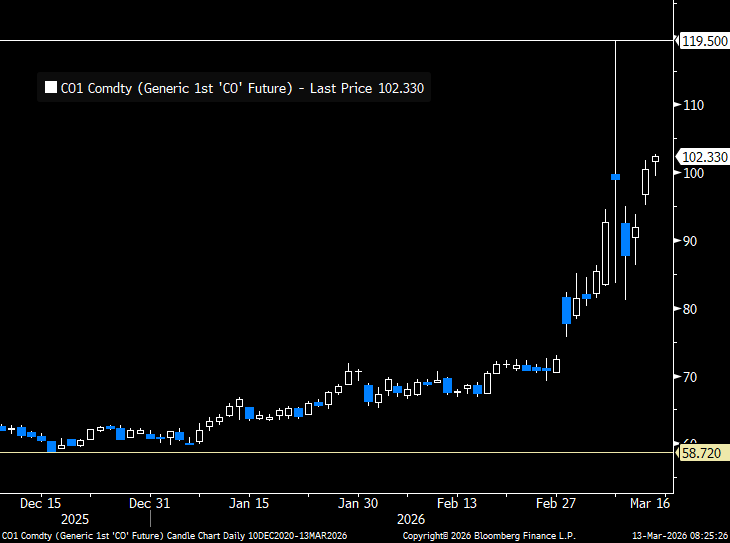
If the hardliners remain in power then oil pain should extend all the way to US midterm elections. The hardliners were apparently still in charge as of last week. Iran immediately retaliated and damaged LNG infrastructure in Qatar after Israel hit Iranian South Pars. The SoH was still closed and all messages coming out of Iran indicated defiance. Hardliners continues in power has a huge consequence for oil prices going forward. The regime has played its ’oil-weapon’ (closing or chocking the Strait of Hormuz). It is using it to achieve political goals. Deterrence: it needs to be so politically and economically expensive to attack Iran that it won’t happen again in the future. Or at least that the US/Israel thinks 10-times over before they attack again. The highest Brent crude oil closing price since the start of the war is $112.19/b last Friday. In comparison the 20-year inflation adjusted Brent price is $103/b. So Brent crude last Friday at $112.19/b isn’t a shockingly high price. And it is still far below the nominal high of $148/b from 2008 which is $220/b if inflation adjusted. So once in a lifetime Iran activates its most powerful weapon. The oil weapon. It needs to show the power of this weapon and it needs to reap political gains. Getting Brent to $112/b and intraday high of $119.5/b (9 March) isn’t a display of the power of that weapon. And it is not a deterrence against future attacks.
So if the hardliners remain in power in Iran, then the SoH will likely remain chocked all the way to US midterm elections and Brent crude will at a minimum go above the historical nominal high of $148/b from 2008.
Thus the outlook for the oil price for the rest of the year doesn’t depend all that much of whether Trump pulls a TACO or not. Stops bombing or not. It depends more on who is in charge in Iran. If it is the hardliners, then deterrence against future attacks via chocking of the SoH and high oil prices is the likely line of action. It is impacting the world but the Iranian ’oil-weapon’ is directed towards the US president and the the US midterm elections.
If a pragmatic faction gets to power in Iran, then a very prosperous future is possible. However, if power is shifting towards a more pragmatic faction in Iran then a completely different direction could evolve. Such a faction could possibly be open for cooperation with the US and the GCC and possibly put its issues versus Israel aside. Then the prosperity we have seen evolving in Dubai could be a possible future also for Iran.
So far it looks like the hardliners are fully in charge. As far as we can see, the hardliners are still fully in control in Iran. That points towards continued chocking of the SoH and oil prices ticking higher as global inventories (the oil market buffers) are drawn lower. And not just for a few more weeks, but possibly all the way to the US midterm elections.
A brief sigh of relief yesterday as oil infra at Kharg wasn’t damaged. But higher today. Brent crude dabbled around a bit yesterday in relief that oil infrastructure at Iran’s Kharg island wasn’t damaged. It traded briefly below the 100-line and in a range of $99.54 – 106.5/b. Its close was near the low at $100.21/b.
No easy victorious way out for Trump. So no end in sight yet. Brent is up 3.2% today to $103.4/b with no signs that the war will end anytime soon. Trump has no easy way to declare victory and mission accomplished as long as Iran is in full control of the Strait of Hormuz while also holding some 440 kg of uranium enriched to 60% and not far from weapons grade at 90%. As long as these two factors are unresolved it is difficult for Trump to pull out of the Middle East. Naturally he gets increasingly frustrated over the situation as the oil price and US retail gas prices keeps ticking higher while the US is tied into the mess in the Middle East. Trying to drag NATO members into his mess but not much luck there.
When commodity prices spike they spike 2x, 3x, 4x or 5x. Supply and demand for commodities are notoriously inflexible. When either of them shifts sharply, the the price can easily go to zero (April 2022) or multiply 2x, 3x, or even 5x of normal. Examples in case cobalt in 2025 where Kongo restricted supply and the price doubled. Global LNG in 2022 where the price went 5x normal for the full year average. Demand for tungsten in ammunition is up strongly along with full war in the middle east. And its price? Up 537%.
Why hasn’t the Brent crude oil price gone 2x, 3x, 4x or 5x versus its normal of $68/b given close to full stop in the flow of oil of the Strait of Hormuz? We are after all talking about close to 20% of global supply being disrupted. The reason is the buffers. It is fairly easy to store oil. Commercial operators only hold stocks for logistical variations. It is a lot of oil in commercial stocks, but that is predominantly because the whole oil system is so huge. In addition we have Strategic Petroleum Reserves (SPRs) of close to 2500 mb of crude and 1000 mb of oil products. The IEA last week decided to release 400 mb from global SPR. Equal to 20 days of full closure of the Strait of Hormuz. Thus oil in commercial stocks on land, commercial oil in transit at sea and release of oil from SPRs is currently buffering the situation.
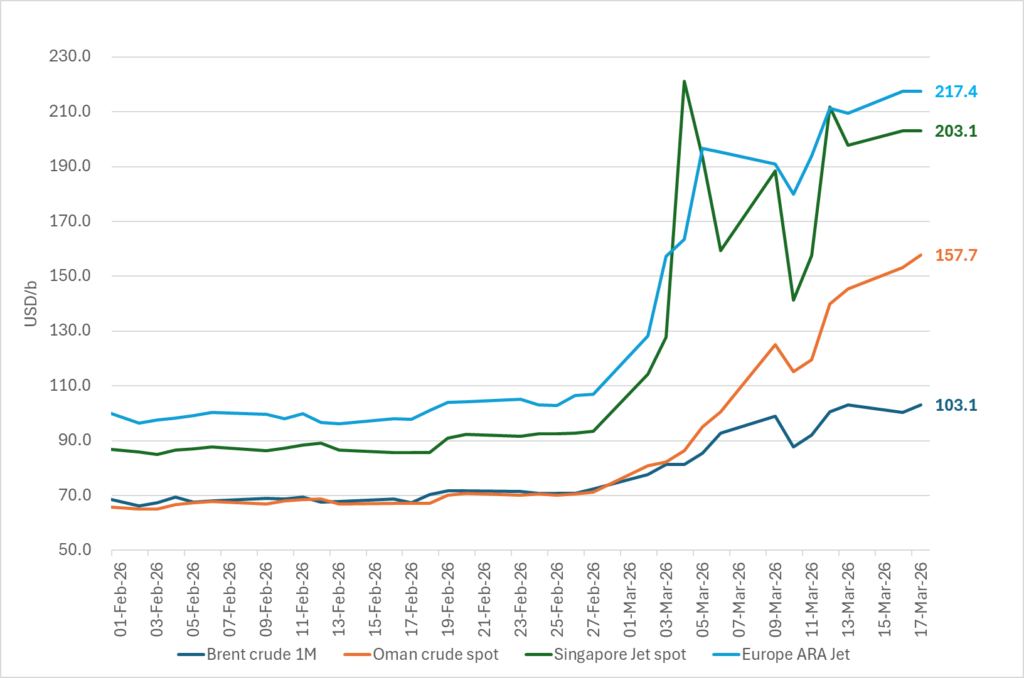
But we are running the buffers down day by day. As a result we see gradually increasing stress here and there in the global oil market. Asia is feeling the pinch the most. It has very low self sufficiency of oil and most of the exports from the Gulf normally head to Asia. Availability of propane and butane many places in India (LPG) has dried up very quickly. Local prices have tripled as a result. Local availability of crude, bunker oil, fuel oil, jet fuel, naphtha and other oil products is quickly running down to critical levels many places in Asia with prices shooting up. Oman crude oil is marked at $153/b. Jet fuel in Singapore is marked at $191/b.
Oil at sea originating from Strait of Hormuz from before 28 Feb is rapidly emptied. Oil at sea is a large pool of commercial oil. An inventory of oil in constant move. If we assume that the average journey from the Persian Gulf to its destinations has a volume weighted average of 13.5 days then the amount of oil at sea originating from the Persian Gulf when the the US/Israel attacked on 28 Feb was 13.5 days * 20 mb/d = 269 mb. Since the strait closed, this oil has increasingly been delivered at its destinations. Those closest to the Strait, like Pakistan, felt the emptying of this supply chain the fastest. Propane prices shooting to 3x normal there already last week and restaurants serving cold food this week is a result of that. Some 50-60% of Asia’s imports of Naphtha normally originates from the Persian Gulf. So naphtha is a natural pain point for Asia. The Gulf also a large and important exporter of Jet fuel. That shut in has lifted jet prices above $200/b.
To simplify our calculations we assume that no oil has left the Strait since that date and that there is no increase in Saudi exports from Yanbu. Then the draining of this inventory at sea originated from the Persian Gulf will essentially look like this:
The supply chain of oil at sea originating from the Strait of Hormuz is soon empty. Except for oil allowed through the Strait of Hormuz by Iran and increased exports from Yanbu in the Red Sea. Not included here.
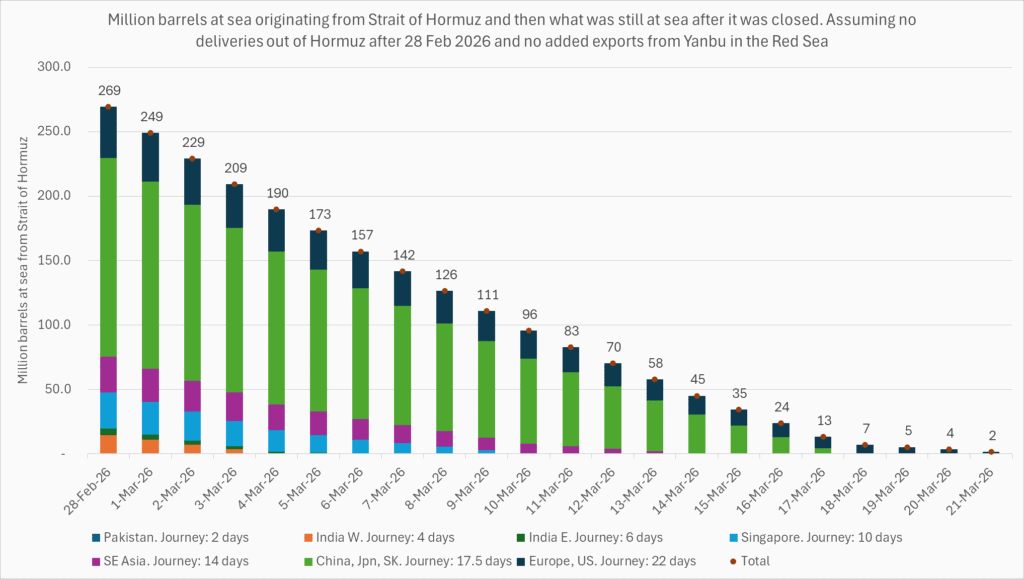
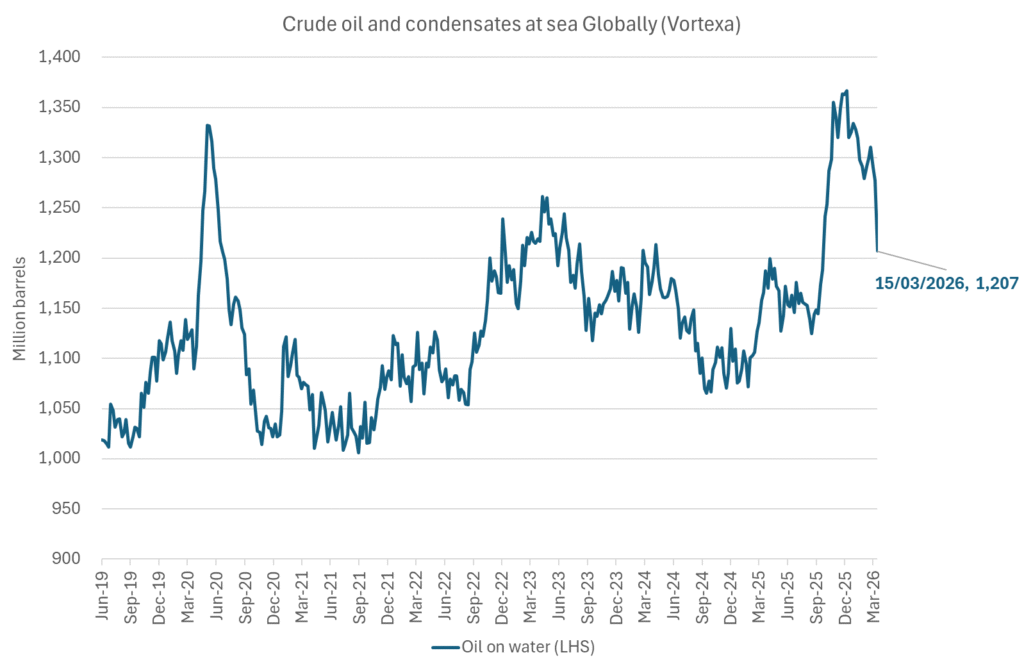
Oil at sea is falling fast as oil is delivered without any new refill in the Persian Gulf. Waivers for Russian crude is also shifting Russian crude to consumers. Brent crude will likely start to feel the pinch much more forcefully when oil at sea is drawn down another 200 mb to around 1000 mb. That is not much more than 10 days from here.
Oil and oil products are starting to become very pricy many places. Brent crude has still been shielded from spiking like the others.
Closing at highest since Aug 2022. Brent crude gained 9.2% yesterday. The trading range was limited to $95.2 – 101.85/b with a close at $100.46/b and higher than the Monday close of $98.96/b. Ydy close was the highest close since August 2022. This morning Brent is up 2% to $102.4/b and is trading at the highest intraday level since Monday when it high an intraday high of $119.5/b.
A military hit at Iran’s Kharg island would be a big, big bang for the oil price. The big, big risk for the weekend is that oil infrastructure could be damaged. For example Iran’s Kharg island which is Iran’s major oil export hub. If damaged we would have a longer lasting loss of supply stretching way beyond Trump’s announced ”two more weeks”. It will make the spot price spike higher and it will lift the curve. Brent crude 2027 swap would jump above $80/b immediately. An attack on Kharg island would naturally lead Iran to strike back at other oil infrastructures in the Gulf. Especially those belonging to countries who harbor US military bases. I.e. countries who essentially are supporting the attack by US and Israel towards Iran. Though if not in spirit, then in practical operational terms. An attack on Kharg island would not just lead to a lasting outage of supply from Iran until it would be repaired. It would immediately endanger other oil infrastructure in the region as well and additional lasting loss of supply.
No one in their right mind would dare to sit short oil over the coming weekend. Oil is thus set to close the week at a very strong note today.
Prepare for another 400 mb SPR release next week. This week’s announcement of a 400 mb release from Strategic Oil Reserves totally underwhelmed the market with the oil price going higher rather than lower following the announcement. For one it means that the market expects the war and the closure of the Strait of Hormuz to last longer than Trump’s recent announced ”two more weeks”. 400 mb only amounts to 20 days of lost supply to the world through Hormuz and we are already at day 14. So next week when we are getting close to the 20 day mark, we are likely to see another announcement of another 400 mb release of SPR stocks to the market. Preparing for the next 20 days of war.
Global oil logistics in total disarray. We have previously addressed the issue of the huge logistical web of the global oil market which is now in total disarray. The logistical disruption started to fry the oil market at the end of last week. Helped to spike the oil market on Monday. What we hear from our shipping clients is that the problems with supply of fuels locally in Korea, Singapore, India and Africa are getting worse with physical availability of fuels there drying up. It is getting increasingly difficult to find physical supply of bunker oil with local, physical prices shooting way higher than financial benchmarks. To the point that biofuels have become the cheap option many places. Availability of fuels in the US is still good. Not so surprising as the US is self-sufficient with crude and refineries.
The disruption in global oil logistics doesn’t seem to improve. Rather the opposite. If you cannot get fuel to run your ships, then how can you distribute fuels to where it is needed.
Buy Brent Dec-2026 calls with strike $150/b!! As the days goes by the oil price is ticking higher while Trump is getting one day closer to US midterm elections. Trump was betting that he could put this war to bead well before November. But that will probably not be up to him to decide. It will be up to Iran to decide when to reopen the Strait of Hormuz. It is very hard to imagine that Iran will let Trump easily off the hock after he has killed its Supreme Leader. This will likely go all the way to November. Buy Brent Dec-2026 calls with strike $150/b!!
Brent closed at highest since 2022 ydy. Will end this Friday at a very strong note! Consumers still dreaming of $60/b oil



Christian Kopfer om läget för oljan

Marknaden måste börja betrakta de höga kopparpriserna som det nya normala

Det fysiska spotpriset på brentolja har slagit nytt rekord

40 minuter med Javier Blas om hur världen verkligen påverkas av energikrisen

Efter tillväxten: Guldbrev satsar på expansion i Europa
40 minuter med Javier Blas om hur världen verkligen påverkas av energikrisen

Elpriserna fördubblas, stor osäkerhet inför sommaren

MP Materials, USA:s svar på Kinas dominans över sällsynta jordartsmetaller
Det fysiska spotpriset på brentolja har slagit nytt rekord

Studsvik har idag ansökt om att få bygga 1200-1600 MW kärnkraft i Valdemarsvik
-
 Nyheter2 veckor sedan
40 minuter med Javier Blas om hur världen verkligen påverkas av energikrisen
-
 Nyheter3 veckor sedan
Elpriserna fördubblas, stor osäkerhet inför sommaren
-
 Nyheter4 veckor sedan
MP Materials, USA:s svar på Kinas dominans över sällsynta jordartsmetaller
-
 Nyheter2 veckor sedan
Det fysiska spotpriset på brentolja har slagit nytt rekord
-
 Nyheter4 veckor sedan
Studsvik har idag ansökt om att få bygga 1200-1600 MW kärnkraft i Valdemarsvik
-
 Nyheter2 veckor sedan
Marknaden måste börja betrakta de höga kopparpriserna som det nya normala
-

 Nyheter4 veckor sedan
Matproduktion är beroende av gödsel, Gulfkriget skapar brist
-
Analys4 veckor sedan
TACO (or Whatever It Was) Sends Oil Lower — Iran Keeps Choking Hormuz