

Analys
Iran – Hard to swallow a double insult

 Brent crude fell back 0.3% to $75.08/bl ydy after a strong rebound on Mon but is again up 0.8% this morning to $75.7/bl. It is taking little notice of the escalating trade war between the US and China which is threatening global growth and oil demand growth down the road. It is not even daunted by the repeated proposition by Russia to lift the production cap by 1.5 m bl/d.

Bjarne Schieldrop, Chief analyst commodities
Iran is naturally offended and disgusted by first having US sanctions reactivated forcing down its production and exports and then at the same time seeing Donald calling for more oil from from OPEC+ in order to push oil prices lower and appease US consumers so the Republicans can make a good mid-term election in Nov. Iran is thus naturally opposing any suggestion of an increase in production. Iran argues that if the oil price now goes high and the US consumers suffers at the pump then Donald is directly to be blamed for this due to the Iran sanctions.
Apparently it looks like Saudi Arabia wants more oil from OPEC+ because Donald Trump is asking for it as a return favour for reviving sanctions towards Iran and standing by Saudi Arabia as a long term ally. Thus even if the most sensible and responsible thing to do is to increase production in the face of collapsing production in Venezuela and now also Libya it will be extremely difficult for Iran to swallow a decision to increase production. It would be a double insult to see the “US bully” first having its way with Iran and then having its way with OPEC+.
It is important to remember that OPEC+ has been extremely lucky with its production cuts. Yes, they have been good and delivered on their cuts but they have also definitely been lucky. If it had not been for a continuous improvement in the global economy since late 2016 and thus strong oil demand growth and a collapsing production in Venezuela then things might have looked quite differently today. Then the group might have had to cut deeper and then yet deeper again in 2019. Now instead the five active cutters (Saudi Arabia, Kuwait, UAE, Iraq and Russia), can and should responsibly exit their cuts in order to avoid a further rallying in the oil price towards $100/bl in 2H18. An oil price of $75/bl is already taxing global consumers (ex-US) as when the oil price was $110/bl back in 2011 to 2014 due to the today much stronger USD. Thus having the oil price rallying to $100/bl in 2H18 at today’s dollar strength would not be good for the global economy at all.
By exiting cuts and reviving production the group is achieving two things. Firs it avoids creating unnecessary risk of hurting global growth and thus oil demand growth. Worst case if OPEC+ does not revive production would be a real spike in the oil price tipping the global economy into recession. In that case there would be no exit from current cuts as an option and instead the cutters would potentially have to cut yet deeper in the face of booming US shale oil production and a tanking global economy. Secondly, by exiting cuts now that it is possible and necessary to do so it will strengthen the position of the group to cut the next time it is a need for cuts by the group.
Thus the only sensible thing to do seems to be to revive production and exit cuts. However, as long as it seems like OPEC+ is abiding by Donald Trump’s call for more oil from OPEC+ it must be very difficult for Iran to swallow such a double insult. To us however it seem more like the real call for more oil and exit of cuts is coming from Russia. Its private oil companies are clearly eager to get back in business and away from their “voluntary” caps directed by Putin/Novak in cooperation with OPEC+. After all the goal of the cuts of getting OECD inventories back down to the rolling five year average has been reached.
It would be great if OPEC+ could unite behind exit of cuts and revival of production. The challenge would be to formulate a statement that removes any suggestion that the increase in production comes as a response to Donald’s call for more oil from OPEC+. It would however be difficult to avoid that Donald would take it as a victory to see a revival of production by the cutters in the group following he’s recent tweets on the subject. Iran’s oil minister Zanganeh has said that he’ll leave Vienna on Friday following the normal OPEC meeting and not attending the Saturday meeting including the ten cooperating countries.
We think that OPEC+ will either unanimously decide to lift production or the cutters will increase production anyhow. Cutters lifting production by 1 m bl/d in 2H18 and another 0.5 m bl/d in 2019 will however not lift total production by OPEC+ in our estimates due to declines within the group. It would probably look more like Iran is in control of the situation if it unites together with OPEC+ on lifting production.
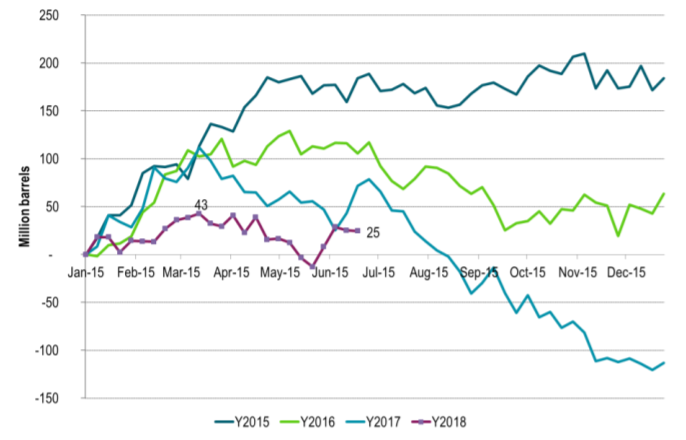
Ch1: Weekly crude and product inventories US, EU, Sing, Floating given as change vs. start of year in million barrels.
Iran has a point that it does not seem like there is a need for more oil in the market as inventories are actually up ytd by 25 m bl. This does however not take into account likely further rapid decline in Venezuela’s production in 2H18 together with seasonally higher demand in the second half of the year. Latest disruption in Libya’s production adds to the tightening outlook for 2H18. The jump in weekly stocks does however look a little random and may just be a temporary issue due to refinery maintenance.

Market is starting to take US/Iran headlines with a pinch of salt. Brent crude rose $2.8/b yesterday to an official close of $112.1/b. But after that it traded as low as $108.05/b before ending late night at around $109.7/b. Through the day it traded in a range of $106.87 – 112.72/b amid a flurry of news or rumors from Iran and the US. ”US temporary sanctions during negotiations” (falls alarm). ”We will bomb Iran” (not anyhow),… etc. While the market is still fluctuating to this kind of news flow, it is starting to take such headlines with a pinch of salt.

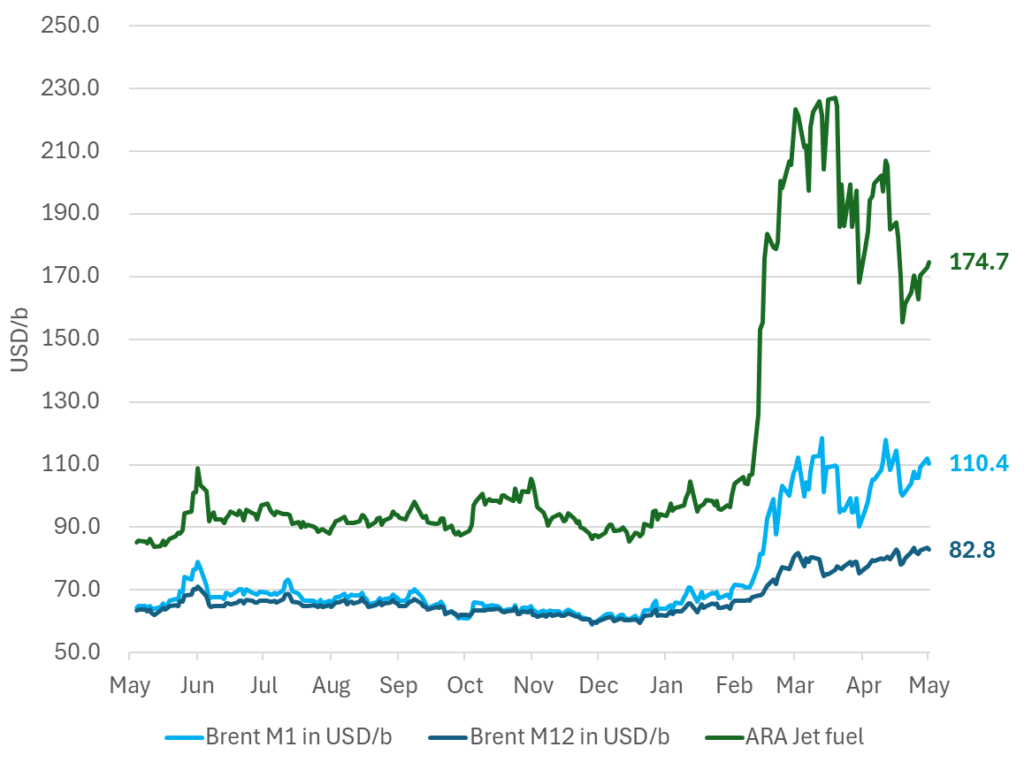
We’ll see. Maybe, maybe not. The Brent M1 contract is trading at $110.2/b this morning which very close to the average ticks through yesterday of $110.4/b.
Trump with bearish, verbal intervention whenever Brent trades above $110/b it seems. What seems to be a pattern is that Trump states something like ”very good negotiations going on with Iran”, ”New leaders in Iran are great,..”, ”Great progress in negotiations,…”, ”Deal in sight,..” etc whenever the Brent M1 contract trades above $110/b. An effort to cool the market. These hot air verbal interventions from Trump used to have a heavy bearish impact on prices, but they now seems to have less and less effect unless they are backed by reality.
As far as we can see there has been no real progress in the negotiations between the US and Iran with both sides still standing by their previous demands.
Iran is getting stronger while the cease fire lasts making a return to war for Trump yet harder. Iran is naturally in constant preparation for a return to war given Trump’s steady threats of bombing Iran again. Iran is naturally doing what ever is possible to prepare for a return to war. And every day the cease fire lasts it is better prepared. This naturally makes it more and more difficult and dangerous for the US to return to warring activity versus Iran as the consequences for energy infrastructure in the Persian Gulf will be more and more severe the longer the cease fire lasts. Israel seems to see it this way as well. That the war is not won and that current frozen state of a cease fire gives Iran opportunity to rebuild military and politically.
Global inventories are drawing down day by day. How much? In the meantime the Strait of Hormuz stays closed. There is varying measures and estimates of how much global inventories are drawing down. Our rough estimate, back of the envelope, is that global inventories are drawing down by at least some 10 mb/d or about 300 mb/d in a balance between loss of supply versus demand destruction. Other estimates we see are a monthly draw of 250-270 mb/d. The IEA only ’measured’ a draw in global observable stocks of 117 mb in April with oil on water rising 53 mb while on shore stocks fell 170 mb. But global stocks are hard to measure with large invisible, unmeasured stocks. As such a back of the envelope approach may be better.
Oil products is what the world is consuming. Oil product prices likely to rise while product stocks fall. Strategic Petroleum Reserves (SPR) are predominantly crude oil. Discharging oil from OECD SPR stocks, a sharp reduction in Chinese crude imports and a reduction in global refinery throughput of 6-7 mb/d has helped to keep crude oil markets satisfactorily supplied. But global inventories are drawing down none the less. And oil products is really what the world is consuming. So if global refinery throughput stays subdued, then demand will eventually have to match the supply of oil products. The likely path forward this summer is a steady draw down in jet fuel, diesel and gasoline. Higher prices for these. Then, if possible, higher refinery throughput and higher usage of crude in response to very profitable refinery margins. And lastly sharper draw in crude stocks and higher prices for these. But some 6 mb/d of oil products used to be exported through the Strait of Hormuz. And it may not be so easy to ramp up refinery activity across the world to compensate. Especially as Ukraine continues to damage Russian refineries as well as Russian crude production and export facilities.
Watch oil product stocks and prices as well as Brent calendar 2027. What to watch for this summer is thus oil product inventories falling and oil product premiums to crude rising. Another measure to watch is the Brent crude 2027 contract as it rises steadily day by day as the Strait of Hormuz stays closed and global oil inventories decline. The latter is close to the highest level since the start of the war and keeps rising.
The Brent M1 contract and the Brent 2027 prices and current price of jet fuel in Europe (ARA). All in USD/b
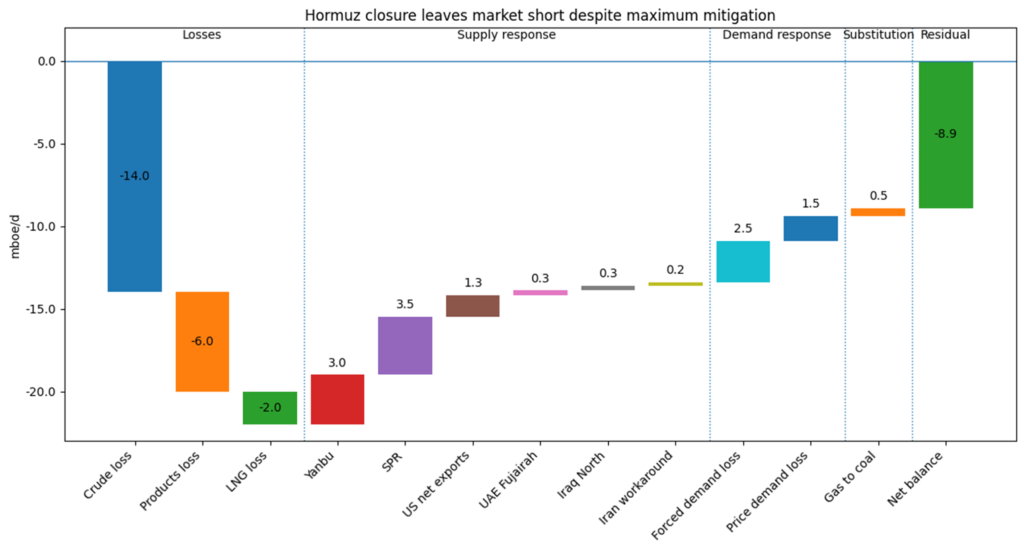
Our back of the envelope calculation of the global shortage created by the closure of the Strait of Hormuz. Note that 3.5 mb/d of discharge from SPR is also a draw. Note also that ’Forced demand loss’ of 2.5 mb/d is probably temporary and will fall back towards zero as logistics are sorted out leaving ’Price demand loss’ to do the job of balancing the market. Thus a shortfall of at least 9 mb/d created by the closure. More if SPR discharge is included and more if Forced demand loss recedes.
Brent is climbing higher. Front-month is at USD 106.3/bl this morning, close to a weekly high and a USD 9/bl jump from Mondays open. This is the move we flagged as a risk earlier in the week: the market shifting from ”a deal is around the corner” to ”this is going to take longer than we thought”.

Analyst Commodities, SEB
During April, rest-of-year Brent remained remarkably stable around USD 90/bl. A stability which rested on one single assumption: the SoH reopens around 1 May. That assumption is now slowly falling apart.
As we highlighted yesterday: every week of delay beyond 1 May adds (theoretically) ish USD 5/bl to the rest-of-year average, as global inventories draw 100 million barrels per week. i.e., a mid-May reopening implies rest-of-year Brent closer to USD 100/bl, and anything pushing into June or July takes us meaningfully higher.
What’s changed in the last 48 hours:
#1: The US military has formally warned that clearing suspected sea mines from SoH could take up to six months. That is a completely different timescale from what the financial market is pricing. Even a political deal tomorrow does not immediately reopen the strait.
#2: Trump has shifted his tone from urgency to ”strategic patience”. In yesterday’s press conference: ”Don’t rush me… I want a great deal.” The market is reading this as a president no longer feeling pressured by timelines, with the naval blockade running in the background.
#3: So far, the military activity is escalating, not de-escalating. Axios reports Iran is laying more mines in SoH. The US 3rd carrier strike group (USS George H.W. Bush) is arriving with two countermine vessels. Trump yesterday ordered the US Navy to destroy any Iranian boats caught laying mines. While CNN reports that the Pentagon is actively drawing up plans to strike Iranian SoH capabilities and individual Iranian military leaders if the ceasefire collapses. i.e., NOT a attitude consistent with an imminent deal!
Spot crude and product prices eased off the early-April highs on a combination of system rerouting and deal optimism. Both now weakening. Goldman estimates April Gulf output is reduced by 14.5 mbl/d, or 57% of pre-war supply, a number that keeps getting worse the longer this drags on.
Demand-side adaptation is ongoing: S. Korea has cut its Middle East crude dependence from 69% to 56% by pulling more from the Americas and Africa, and Japan is kicking off a second round of SPR releases from 1 May. But SPRs are finite.
Ref. to the negotiations, we should not bet on speed. The current Iranian leadership is dominated by genuine hardliners willing to absorb economic pain and run the clock to extract concessions. That is not a setup for a rapid resolution. US/Israeli media briefings keep framing the delay as ”internal Iranian divisions”, the reality is more complicated and points toward weeks and months, not days.
Our point is that the complexity is large, and higher prices have only just started (given a scenario where the negotiations drag out in time). The market spent April leaning on the USD 90/bl rest-of-year assumption; that case is diminishing by the hour. If ”early May reopening” is replaced by ”June, July or later” over the next week or two, both crude and products have meaningful room to reprice higher from here. There is a high risk being short energy and betting on any immediate political resolution(!).
Down on Friday. Up on Monday. The Brent June crude oil contract traded down 5.1% last week to a close of $90.38/b. It reached a high of $103.87/b last Monday and a low of $86.09/b on Friday as Iran announced that the Strait of Hormuz was fully open for transit. That quickly changed over the weekend as the US upheld its blockade of Iranian oil exports while Iran naturally responded by closing the SoH again. The US blew a hole in the engine room of the Iranian ship TOUSKA and took custody of the ship on Sunday. Brent crude is up 5.6% this morning to $95.4/b.
The cease-fire is expiring tomorrow. The US has said it will send a delegation for a second round of negotiations in Islamabad in Pakistan. But Iran has for now rejected a second round of talks as it views US demands as unrealistic and excessive while the US is also blocking the Strait of Hormuz.
While Brent is up 5% this morning, the financial market is still very optimistic that progress will be made. That talks will continue and that the SoH will fully open by the start of May which is consistent with a rest-of-year average Brent crude oil price of around $90/b with the market now trading that balance at around $88/b.
Financial optimism vs. physical deterioration. We have a divergence where the financial market is trading negotiations, improvements and resolution while at the same time the physical market is deteriorating day by day. Physical oil flows remain constrained by disrupted flows, longer voyage times and elevated freight and insurance costs.
Financial markets are betting that a US/Iranian resolution will save us in time from violent shortages down the road. But every day that the SoH remains closed is bringing us closer to a potentially very painful point of shortages and much higher prices.
The US blockade is also a weapon of leverage against its European and Asian allies. When Iran closed the SoH it held the world economy as a hostage against the US. The US blockade of the SoH is of course blocking Iranian oil exports. But it is also an action of disruption directed towards Europe and Asia. The US has called for the rest of the world to engaged in the war with Iran: ”If you want oil from the Persian Gulf, then go and get it”. A risk is that the US plays brinkmanship with the global oil market directed towards its European and Asian allies and maybe even towards China to force them to engage and take part. Maybe unthinkable. But unthinkable has become the norm with Trump in the White House.




Sommarväder skapar prisrally på elbörsen
Oil product price pain is set to rise as the Strait of Hormuz stays closed into summer

Solkraften pressar elpriserna dagtid

Michel Gubel ger sin syn på oljemarknaden