

Analys
SEB – Råvarukommentarer vecka 34 2012

Sammanfattning av rekommendationer
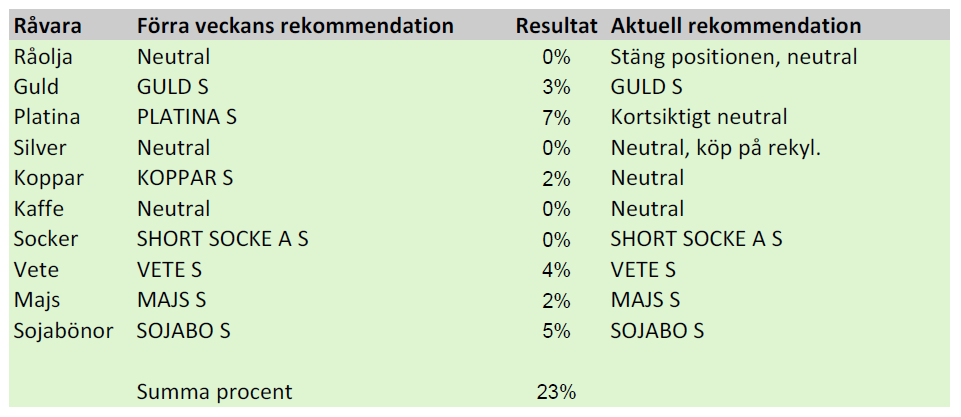
Råolja – Brent
Oljan närmar sig slutet av den här uppgångsfasen. Det är en ”tight” balans mellan tillgång och efterfrågan på råolja i Atlanten. Detta återspeglas i ”backwardation” i terminskurvan. Nedan ser vi kursdiagrammet på spotkontraktet på Brent på ICE.
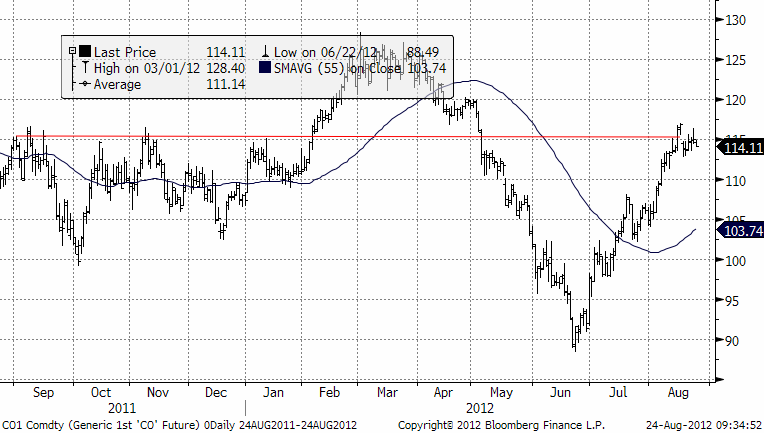
SEB:s teknisk analys tyder på en sidledes utveckling, så vi fortsätter att vara neutrala på kort sikt.
Guld
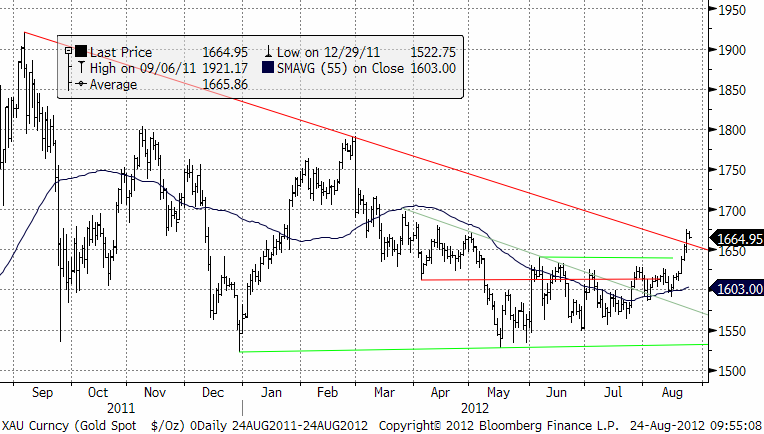
Vår favorit bland ädelmetallerna, platina har utvecklat sig väl. De som följt vårt råd borde vara glada därför att PLATINA S har gått upp med drygt 7% sedan förra veckobrevet. Det börjar pratas om ett nytt QE3. I FOMC-protokollet sägs detta rätt så tydligt. Så här skrev man: MORE STIMULUS SHOULD BE LAUNCHED IF A ”SUBSTANTIAL AND SUSTAINABLE” IMPROVEMENT IN THE RECOVERY IS NOT SEEN ”FAIRLY SOON”. Det talar för ädelmetaller. Vi tycker att man ska äga PLATINA S, GULD S och SILVER S. Möjligen kan man ta hem vinster på PLATINA S nu och byta till GULD S. Vi ser i diagrammet nedan, att guldpriset i dollar har brutit motståndslinjen, vilket är en teknisk köpsignal.
Platina
Sedan oroligheterna vid Lonmin’s Marikana-gruva i Sydafrika eskalerade i förra veckan har priset stiga ca 10 %., från ca $1400/oz till dagens notering på $1547. Lonmin har finansiella problem vilket förvärrar situationen. Företaget producerar 750 000 oz, ca 16 % av Sydafrikas totala utbud som i sin tur utgör hela 75 % av det globala utbudet (ca 6,4 Milj oz). Risken finns att konflikten sprider sig till andra gruvor i landet. Den senaste strejken vid Impalas gruvor i januari varade i 6 veckor och orsakades av samma orsaker, vilket inkluderar en maktkamp mellan olika fackföreningar. För att ytterligare störa situationen gav Sydafrikas president, Jacob Zuma, gruvarbetarna sitt stöd. Han hotade med att ta Lonmins gruvlicens om bolaget inte gav gruvarbetarna 40% mer i lön, som är vad de kräver. Lonmin tjänar inga pengar, utan redovisade en förlust det första halvåret i år. Det är alltså en ohållbar situation och det torde innebära att priset på platina, allt annat lika, kommer att gå upp. Förutom utbudsrisken får Platina stöd i sig egenskap av ädelmetall, och hänger på guldprisets uppåt (där förhoppningar om ett amerikanskt stimulanspaket är huvudförklaringen). Platina klassas som ädelmetall, men sett till konsumtionen är den en industrimetall. Bilindustrin är den största konsumenten där metallen är en viktig beståndsdel i katalysatorer, vars tillverkning står för ca 35 % av den totala efterfrågan. Med vår syn på basmetaller och guld kombinerat talar det mesta för en fortsatt stark prisbild på sikt. Kortsiktigt finns dock risk för rekyl då uppgången gått lite väl fort i samband med oroligheterna i Sydafrika.
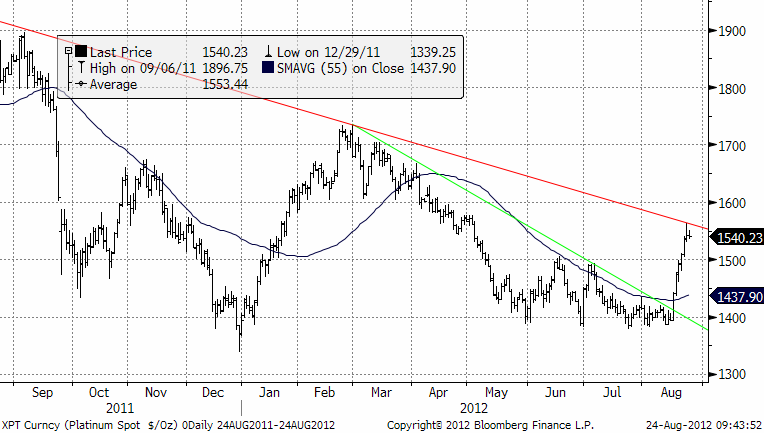
Mot bakgrund av den senaste veckans kraftiga prisuppgång på platina och att vi har en uppgång på 7% i PLATINA S, gör att vi väljer att kliva av här. Notera också att priset i diagrammet ovan gått upp precis till motståndslinjen. Skulle den brytas gå vi omedelbart in igen!
Silver
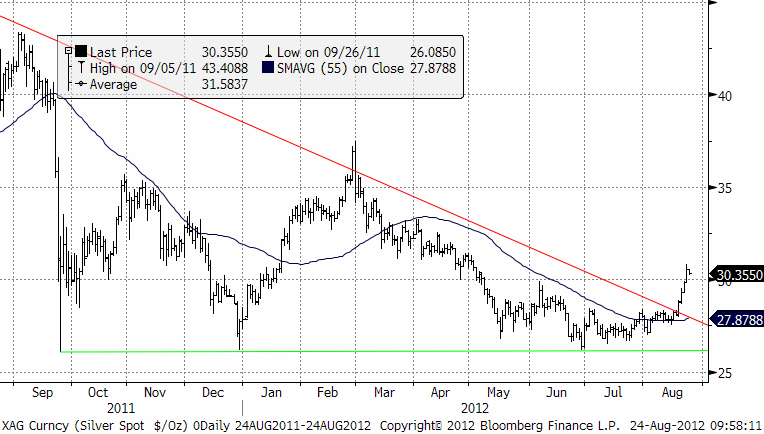
Silver har levererat på den tekniska bilden, på ett nästan skolboksmässigt sätt. Priset har gått upp hastigt och det vore inte förvånande om det kom en kortsiktig rekyl, som då är ett köptillfälle, ett tillfälle att köpa SILVER S.
Koppar
Efter en i övrigt ganska nyhetsfattig vecka blev den stora höjdpunkten onsdagskvällens FEDs protokoll. Marknaden gillade att ett tillräckligt stort antal ledamöter var positiva till ett nytt stimulanspaket. Riskhattarna åkte på. Basmetaller hade redan börjat vända upp i början av veckan. Prisuppgången i veckan ligger mellan 2 och 4 % för de största metallerna. Nickel utmärker sig (som varit den svagaste den senaste tiden) med en uppgång på 4,5 % sen öppningen i måndags. En viktig nyhet under veckan var att BHP meddelade att de lägger tre sedan tidigare planerade projekt på is med ett värde av 68 Mdr dollar.
Man anger låga råvarupriser som huvudsakligt skäl. En förklaring till den svaga tendensen under sommaren har just varit oron för ett ökat utbud. Vi utryckte vår bedömning förra veckan att priserna ligger i startgroparna inför det säsongsmässigt starkare fjärde kvartalet. Frågan är om det vi nu ser är en tjuvstart? Det mesta talar för en början till vändning, men risken är stor att priserna (vid någon besvikelse över någon makrodata) faller tillbaka igen. Tekniskt sett har trenderna definitivt vänt från neråtgående till mer sidledes. Det behövs mer tid för kraftansamling. Koppar visade vid sidan av nickel störst styrka under veckan. Det är för tidigt att tala om en vändning uppåt. Tekniska analytiker bevakar 100dagarssnittet som kommer in på $7724. Dagens högsta nivå är 7720 ! Marknaden står och väger och frågan är om den har kraft nog att bryta uppåt i nuläget. Oron kvarstår för Kina. Helgens nyhet att fastighetspriserna steg i 49 av 70 större städer som regeringen följer i juli jämfört med juni, minskar sannolikheten för ett snart stimulanspaket i Kina. Det finns således anledning att vila lite på hanen. För den tradingbenägne kan det dock erbjudas intressanta möjligheter i intervallet: 7300-7400 på nedsidan och 7600-7700 på uppsidan.
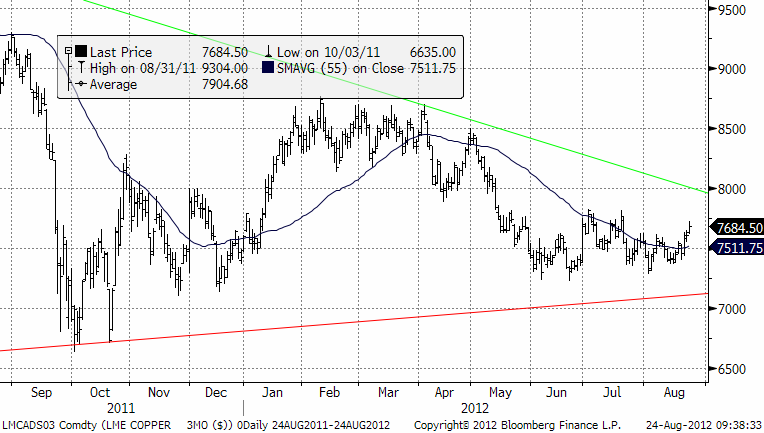
Vi rekommenderade förra veckan ett köp av KOPPAR S, som sedan dess stigit med 2%. Vi tror att det är lite för tidigt att gå in för lite längre sikt, så vi kliver ur den positionen och har en neutral vy.
Kaffe
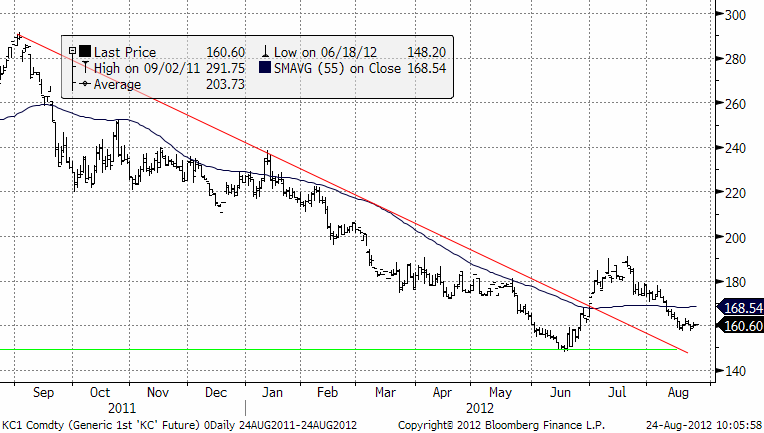
Priset på Arabica, har funnit ett stöd på den jämna siffran 160 cent. Möjligen kan detta stöd bli en bas för en ny uppgång såsom skedde i juni – juli.
Det är låga priser på kaffe och det är, kanske på grund av El Niño – torrt i Vietnam, världens största producent av Robusta. Det gör att bönorna blir mindre, med mindre skörd som följd. Det finns alltså fundamenta som inte bara pekar på lägre priser.
Socker
Priset på socker har, såsom vi har förutspått, fortsatt att sjunka. Vi skrev för en vecka sedan att 20 cent är en psykologiskt viktig nivå. Marknaden tvekade lite där, men bröt sedan stödet. Det gör att vi tror att priset kommer att fortsätta ner mot 19 cent i första hand.
Brasiliens sockerrörsområden har haft uppehåll i regnen, vilket gör att skörden kan gå framåt snabbare.
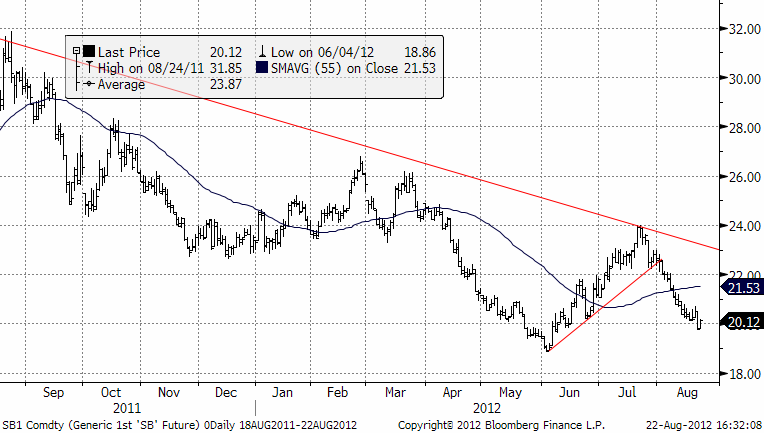
Vi rekommenderade köp av certifikatet SHORT SOCKE A S med en hävstång på – 1.2 för två veckor sedan. Första veckan gav den +5% och den senaste veckan +3%.
Vi rekommenderar att man fortsatt är kort socker, men den som vill ta hem vinster nu vid 20 cent kan kanske göra det för att sedan försöka sälja igen om priset rekylerar upp lite.
Kakao
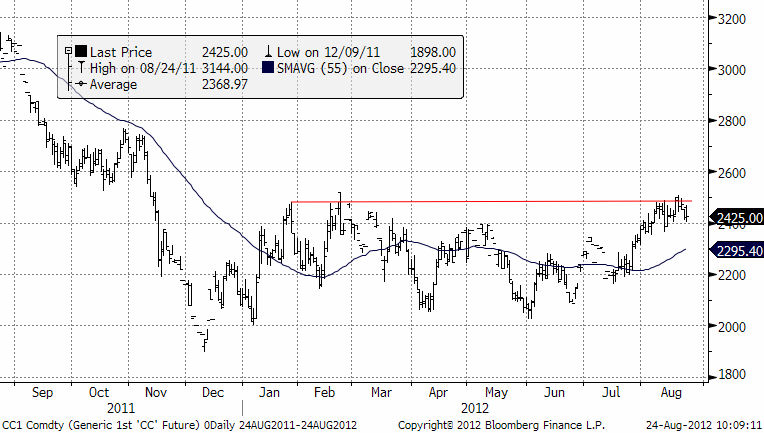
Kakaopriset har fortsatt att backa efter att ha stött på tekniskt motstånd vid 2500. Vi fortsätter att förhålla oss neutrala vad gäller vår uppfattning om priset.
Om jordbruksprodukterna
Priserna på jordbruksprodukter har fortsatt upp. Tekniskt ser det ut som om priserna på spannmål och oljeväxter kommer att fortsätta stiga, men gårdagskvällens rapport från StatsCanada, som visar en av de största skördarna av spannmål någonsin och den största skörden av raps någonsin, fick marknaderna att tveka.
Pro Farmer crop tour visar en skörd i bättre skick än USDA har förutspått.
Eurozonen ser ut att gå mot en vecka där man får se sanningen i vitögat och det lär knappast öka konsumtionsviljan.
Vi tror att detta kan vara ett köptillfälle och vi fortsätter att tro på högre priser. Än har ransoneringen av konsumtionen av majs – den mest kritiska marknaden – och drivande för vetemarknaden – inte visat något tecken på att komma igång. Tvärtom, faktiskt. Såväl utfordring av djur i USA, som etanolproduktion i USA ökar enligt de senaste rapporterna.
För spannmål och övriga jordbruksprodukter hänvisas till gårdagens nyhetsbrev.
[box]SEB Veckobrev Veckans råvarukommentar är producerat av SEB Merchant Banking och publiceras i samarbete och med tillstånd på Råvarumarknaden.se[/box]
Disclaimer
The information in this document has been compiled by SEB Merchant Banking, a division within Skandinaviska Enskilda Banken AB (publ) (“SEB”).
Opinions contained in this report represent the bank’s present opinion only and are subject to change without notice. All information contained in this report has been compiled in good faith from sources believed to be reliable. However, no representation or warranty, expressed or implied, is made with respect to the completeness or accuracy of its contents and the information is not to be relied upon as authoritative. Anyone considering taking actions based upon the content of this document is urged to base his or her investment decisions upon such investigations as he or she deems necessary. This document is being provided as information only, and no specific actions are being solicited as a result of it; to the extent permitted by law, no liability whatsoever is accepted for any direct or consequential loss arising from use of this document or its contents.
About SEB
SEB is a public company incorporated in Stockholm, Sweden, with limited liability. It is a participant at major Nordic and other European Regulated Markets and Multilateral Trading Facilities (as well as some non-European equivalent markets) for trading in financial instruments, such as markets operated by NASDAQ OMX, NYSE Euronext, London Stock Exchange, Deutsche Börse, Swiss Exchanges, Turquoise and Chi-X. SEB is authorized and regulated by Finansinspektionen in Sweden; it is authorized and subject to limited regulation by the Financial Services Authority for the conduct of designated investment business in the UK, and is subject to the provisions of relevant regulators in all other jurisdictions where SEB conducts operations. SEB Merchant Banking. All rights reserved.

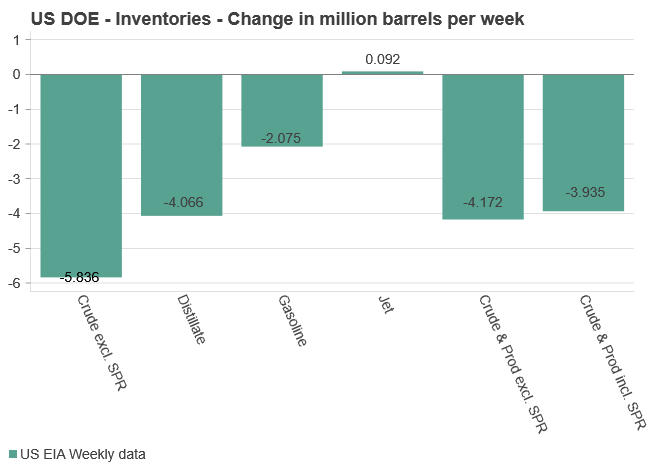
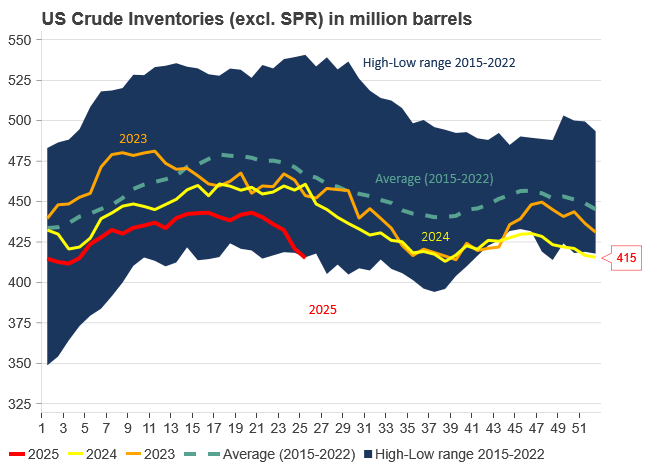
The latest weekly report from the US DOE showed a substantial drawdown across key petroleum categories, adding more upside potential to the fundamental picture.

Commercial crude inventories (excl. SPR) fell by 5.8 million barrels, bringing total inventories down to 415.1 million barrels. Now sitting 11% below the five-year seasonal norm and placed in the lowest 2015-2022 range (see picture below).
Product inventories also tightened further last week. Gasoline inventories declined by 2.1 million barrels, with reductions seen in both finished gasoline and blending components. Current gasoline levels are about 3% below the five-year average for this time of year.
Among products, the most notable move came in diesel, where inventories dropped by almost 4.1 million barrels, deepening the deficit to around 20% below seasonal norms – continuing to underscore the persistent supply tightness in diesel markets.
The only area of inventory growth was in propane/propylene, which posted a significant 5.1-million-barrel build and now stands 9% above the five-year average.
Total commercial petroleum inventories (crude plus refined products) declined by 4.2 million barrels on the week, reinforcing the overall tightening of US crude and products.
A classic case of “buy the rumor, sell the news” played out in oil markets, as Brent crude has dropped sharply – down nearly USD 10 per barrel since yesterday evening – following Iran’s retaliatory strike on a U.S. air base in Qatar. The immediate reaction was: “That was it?” The strike followed a carefully calibrated, non-escalatory playbook, avoiding direct threats to energy infrastructure or disruption of shipping through the Strait of Hormuz – thus calming worst-case fears.
After Monday morning’s sharp spike to USD 81.4 per barrel, triggered by the U.S. bombing of Iranian nuclear facilities, oil prices drifted sideways in anticipation of a potential Iranian response. That response came with advance warning and caused limited physical damage. Early this morning, both the U.S. President and Iranian state media announced a ceasefire, effectively placing a lid on the immediate conflict risk – at least for now.
As a result, Brent crude has now fallen by a total of USD 12 from Monday’s peak, currently trading around USD 69 per barrel.
Looking beyond geopolitics, the market will now shift its focus to the upcoming OPEC+ meeting in early July. Saudi Arabia’s decision to increase output earlier this year – despite falling prices – has drawn renewed attention considering recent developments. Some suggest this was a response to U.S. pressure to offset potential Iranian supply losses.
However, consensus is that the move was driven more by internal OPEC+ dynamics. After years of curbing production to support prices, Riyadh had grown frustrated with quota-busting by several members (notably Kazakhstan). With Saudi Arabia cutting up to 2 million barrels per day – roughly 2% of global supply – returns were diminishing, and the risk of losing market share was rising. The production increase is widely seen as an effort to reassert leadership and restore discipline within the group.
That said, the FT recently stated that, the Saudis remain wary of past missteps. In 2018, Riyadh ramped up output at Trump’s request ahead of Iran sanctions, only to see prices collapse when the U.S. granted broad waivers – triggering oversupply. Officials have reportedly made it clear they don’t intend to repeat that mistake.
The recent visit by President Trump to Saudi Arabia, which included agreements on AI, defense, and nuclear cooperation, suggests a broader strategic alignment. This has fueled speculation about a quiet “pump-for-politics” deal behind recent production moves.
Looking ahead, oil prices have now retraced the entire rally sparked by the June 13 Israel–Iran escalation. This retreat provides more political and policy space for both the U.S. and Saudi Arabia. Specifically, it makes it easier for Riyadh to scale back its three recent production hikes of 411,000 barrels each, potentially returning to more moderate increases of 137,000 barrels for August and September.
In short: with no major loss of Iranian supply to the market, OPEC+ – led by Saudi Arabia – no longer needs to compensate for a disruption that hasn’t materialized, especially not to please the U.S. at the cost of its own market strategy. As the Saudis themselves have signaled, they are unlikely to repeat previous mistakes.
Conclusion: With Brent now in the high USD 60s, buying oil looks fundamentally justified. The geopolitical premium has deflated, but tensions between Israel and Iran remain unresolved – and the risk of missteps and renewed escalation still lingers. In fact, even this morning, reports have emerged of renewed missile fire despite the declared “truce.” The path forward may be calmer – but it is far from stable.
Analys
A muted price reaction. Market looks relaxed, but it is still on edge waiting for what Iran will do
Brent crossed the 80-line this morning but quickly fell back assigning limited probability for Iran choosing to close the Strait of Hormuz. Brent traded in a range of USD 70.56 – 79.04/b last week as the market fluctuated between ”Iran wants a deal” and ”US is about to attack Iran”. At the end of the week though, Donald Trump managed to convince markets (and probably also Iran) that he would make a decision within two weeks. I.e. no imminent attack. Previously when when he has talked about ”making a decision within two weeks” he has often ended up doing nothing in the end. The oil market relaxed as a result and the week ended at USD 77.01/b which is just USD 6/b above the year to date average of USD 71/b.

Brent jumped to USD 81.4/b this morning, the highest since mid-January, but then quickly fell back to a current price of USD 78.2/b which is only up 1.5% versus the close on Friday. As such the market is pricing a fairly low probability that Iran will actually close the Strait of Hormuz. Probably because it will hurt Iranian oil exports as well as the global oil market.
It was however all smoke and mirrors. Deception. The US attacked Iran on Saturday. The attack involved 125 warplanes, submarines and surface warships and 14 bunker buster bombs were dropped on Iranian nuclear sites including Fordow, Natanz and Isfahan. In response the Iranian Parliament voted in support of closing the Strait of Hormuz where some 17 mb of crude and products is transported to the global market every day plus significant volumes of LNG. This is however merely an advise to the Supreme leader Ayatollah Ali Khamenei and the Supreme National Security Council which sits with the final and actual decision.
No supply of oil is lost yet. It is about the risk of Iran closing the Strait of Hormuz or not. So far not a single drop of oil supply has been lost to the global market. The price at the moment is all about the assessed risk of loss of supply. Will Iran choose to choke of the Strait of Hormuz or not? That is the big question. It would be painful for US consumers, for Donald Trump’s voter base, for the global economy but also for Iran and its population which relies on oil exports and income from selling oil out of that Strait as well. As such it is not a no-brainer choice for Iran to close the Strait for oil exports. And looking at the il price this morning it is clear that the oil market doesn’t assign a very high probability of it happening. It is however probably well within the capability of Iran to close the Strait off with rockets, mines, air-drones and possibly sea-drones. Just look at how Ukraine has been able to control and damage the Russian Black Sea fleet.
What to do about the highly enriched uranium which has gone missing? While the US and Israel can celebrate their destruction of Iranian nuclear facilities they are also scratching their heads over what to do with the lost Iranian nuclear material. Iran had 408 kg of highly enriched uranium (IAEA). Almost weapons grade. Enough for some 10 nuclear warheads. It seems to have been transported out of Fordow before the attack this weekend.
The market is still on edge. USD 80-something/b seems sensible while we wait. The oil market reaction to this weekend’s events is very muted so far. The market is still on edge awaiting what Iran will do. Because Iran will do something. But what and when? An oil price of 80-something seems like a sensible level until something do happen.



Sommarvädret styr elpriset i Sverige

Samtal om flera delar av råvarumarknaden
Tightening fundamentals – bullish inventories from DOE

Jonas Lindvall är tillbaka med ett nytt oljebolag, Perthro, som ska börsnoteras

Oljan, guldet och marknadens oroande tystnad

Stor uppsida i Lappland Guldprospekterings aktie enligt analys

Brookfield ska bygga ett AI-datacenter på hela 750 MW i Strängnäs
Silverpriset släpar efter guldets utveckling, har mer uppsida

Tradingfirman XTX Markets bygger datacenter i finska Kajana för 1 miljard euro

Uppgången i oljepriset planade ut under helgen
-
 Nyheter3 veckor sedan
Stor uppsida i Lappland Guldprospekterings aktie enligt analys
-
 Nyheter4 veckor sedan
Brookfield ska bygga ett AI-datacenter på hela 750 MW i Strängnäs
-
 Nyheter3 veckor sedan
Silverpriset släpar efter guldets utveckling, har mer uppsida
-
 Nyheter4 veckor sedan
Tradingfirman XTX Markets bygger datacenter i finska Kajana för 1 miljard euro
-
 Nyheter2 veckor sedan
Uppgången i oljepriset planade ut under helgen
-

 Nyheter2 veckor sedan
Låga elpriser i sommar – men mellersta Sverige får en ökning
-
Analys2 veckor sedan
Very relaxed at USD 75/b. Risk barometer will likely fluctuate to higher levels with Brent into the 80ies or higher coming 2-3 weeks
-

 Nyheter1 vecka sedan
Mahvie Minerals växlar spår – satsar fullt ut på guld