

Analys
SEB – Råvarukommentarer vecka 13 2012

Sammanfattning: Föregående vecka
- Brett råvaruindex: -1,33 %
UBS Bloomberg CMCI TR Index - Energi: -0,91 %
UBS Bloomberg CMCI Energy TR Index - Ädelmetaller: +0,11 %
UBS Bloomberg CMCI Precious Metals TR Index - Industrimetaller: -2,67 %
UBS Bloomberg CMCI Industrial Metals TR Index - Jordbruk: -0,92 %
UBS Bloomberg CMCI Agriculture TR Index
Kortsiktig marknadsvy:
- Guld: Neutral/köp
- Olja: Neutral
- Koppar: Sälj
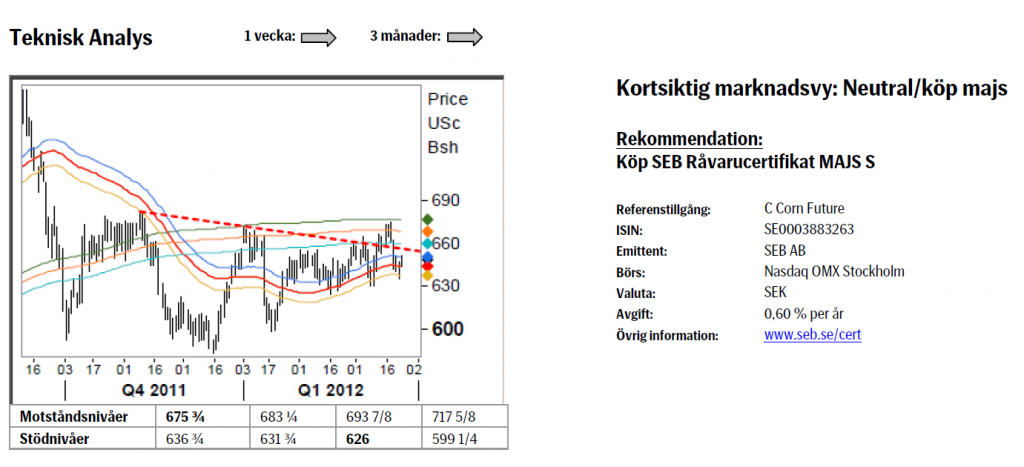
- Majs: Neutral/köp
- Vete: Neutral/köp
Guld
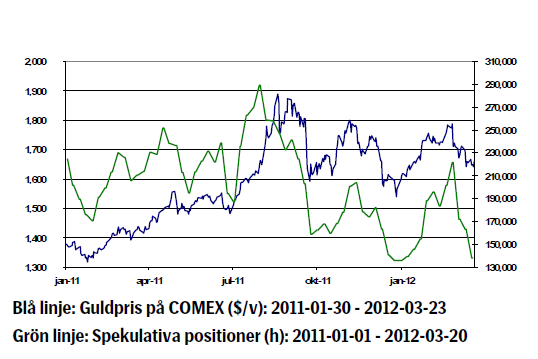
- Det grekiska parlamentet godkände på onsdagen formellt det sparpaket som var förutsättningen för ett andra räddningspaket från EU och IMF. Detta var mest en formalitet men beskedet gav stöd åt euron. Denna föll emellertid igen på torsdagen då inköpsprisindex från Tyskland var sämre än förväntat. Dollarn steg och råvaror sjönk brett. Italiens premiärminister Monti varnade i helgen för att Spanien skulle kunna utlösa en ny allvarlig kris i EMU och uppmanade landet att ta kontroll över sin statsbudget. Oron för en recession i Europa ökar.
- Guldet föll totalt 6,5 procent förra veckan. Innehavare av fysiska ETF:er minskade sina innehav och världens största guld-ETF, SPDR Gold Trust, tappade 8 ton guld.
- Från den första april i år inför Indien en fyraprocentig importskatt på guld, en åtgärd som har lett till att landets 300 000 juvelerare nu strejkar. Indien är det land i världen som importerar störst mängd guld.
- Vi bedömer att guldpriset på kort sikt sannolikt inte kommer att kunna gå undernuvarande nivåer. Vid eventuella bakslag i den globala återhämtningen kan dock priset komma upp något igen. Med detta som bakgrund förhåller vi oss svagt positiva till guldpriset denna vecka.
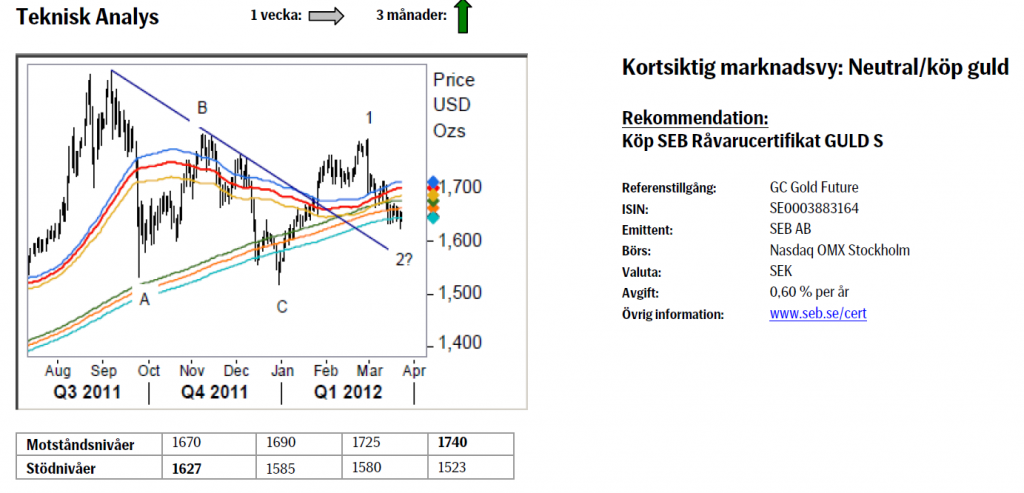
- Teknisk Analys: Under den senaste veckan har marknaden i princip varje dag handlat ned under 233-dagarsbandet bara för att när dagen är slut ha återvänt in i det. Beteendet visar på kontinuerligt köpande i området och framför allt torsdagens kursrörelse indikerar att säljarna nu tappat kraft. Följaktligen fortsätter vi rekommendera försiktiga köp i området (över 1725/40 mer aggressivt då vi då kan bekräfta vändningen uppåt).
Olja
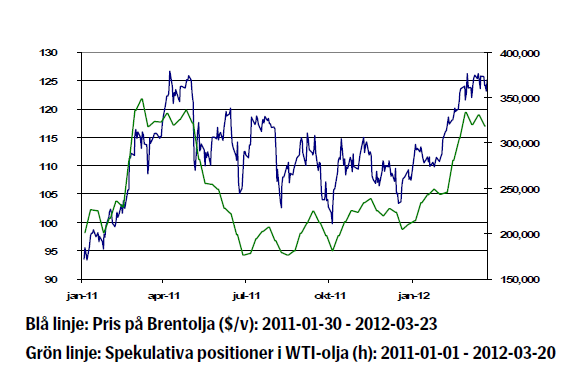
- Oljepriset föll totalt med 0,5 procent förra veckan, men i fredags steg Brentpriset plötsligt tre dollar efter en rapport från Petrologistics att oljeexporten från Iran väntas sjunka betydligt i mars. Råoljeexporten från Iran verkar falla med 300 000 fat olja per dag vilket motsvarar cirka tio procent av landets totala export.
- Bränslekostnader i Kina, vilka styrs direkt av kinesiska myndigheter, har höjts. Detta för att rädda landets raffinaderier vilka köper olja på rörligt pris men slutprodukter till fast pris. Detta medför i dagsläget ekonomiska problem för dem och bidrog till att oljepriset föll då man räknar med att efterfrågan minskar. Kina är världens näst största oljekonsument.
- Trots att det för tillfället inte råder någon brist på olja i marknaden så fortsätter oron kring Iran att ge stöd åt priset och rykten och nyheter gör att priset snabbt kan stiga. En hög riskpremie finns med andra ord kvar i marknaden. Både Bernanke och Obama har uttryckt oro för att oljepriset kommer att ligga kvar på nuvarande höga nivåer. Även i Europa uttrycks oro från politikers håll och Frankrike har annonserat att man överväger att släppa lös strategiska oljereserver. USA utövar påtryckningar på Kina och Indien att de ska minska oljeimporten från Iran, för att på så sätt undgå sanktioner från USA. De minskningar som länderna gjort hittills är inte tillräckliga.
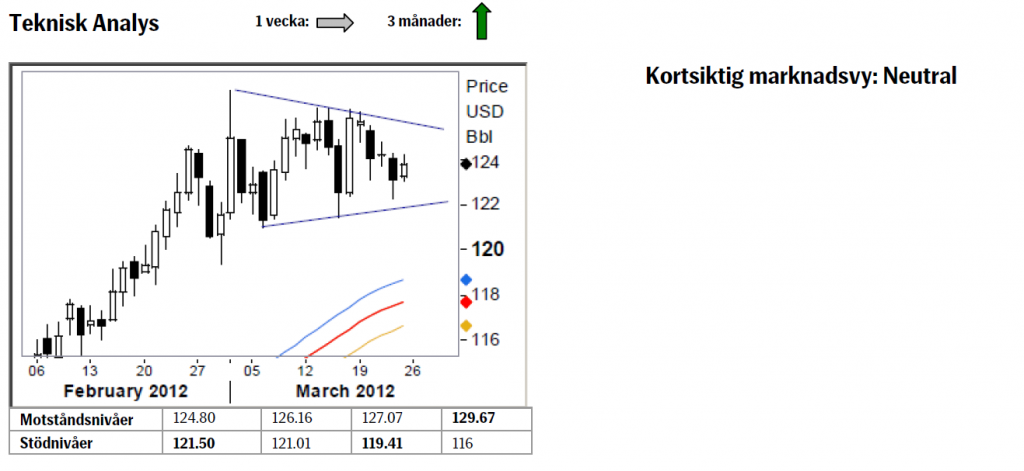
- Teknisk Analys: Vår vy är sedan förra veckan helt oförändrad och kommer att så förbli tills antingen vi bryter upp ur triangeln bekräftandes vår vy om en ny topp i 129-131-området alternativt bryter ned under 121,50, vilket skulle göra triangeln obsolet och då snarare peka på en toppformation (såsom det ju eventuellt ser ut att bli i fallet koppar).Teknisk Analys: I och med brottet över aprilkontraktets tidigare topp förstärks uppåt potentialen. Nästa givna mål ska sökas vid 129.75/131.39 området, nästa Fibonacci projektionsområde. Där ovanför återfinns också toppen från 2007, 147.50. Det är dock noterbart att i €uro termer så handlas Brentoljan nu på nya rekordnivåer.
Koppar
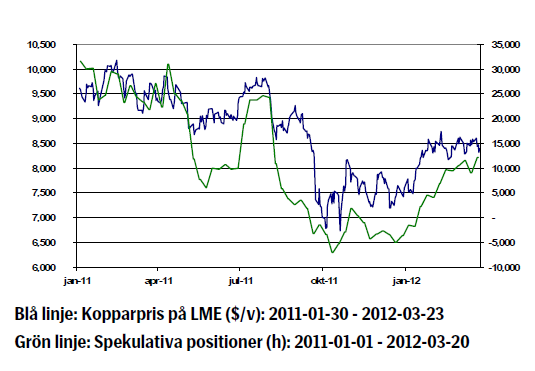
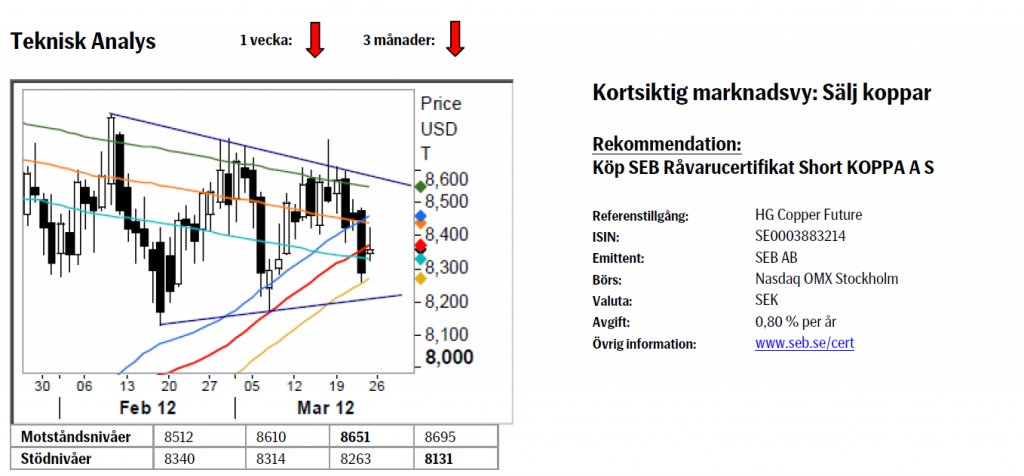
- Kopparpriset föll 2,18 procent förra veckan. Det största raset skedde på torsdagen då priset föll till 8262 dollar per ton, det lägsta priset på två år. Inköpsprisindex från Europa och Kina kom in på lägre nivåer än förväntat vilket ökad farhågan i marknaden att efterfrågan på koppar, främst från Kina, kommer att minska.
- Kinesiskt HSBC:s flash-PMI för mars kom in svagare än föregående månad och föll från 49.6 till 48.1, vilket innebär att index nu legat under 50-nivån fem månader i rad. Index för nya ordrar föll och sysselsättningen noterade den lägsta nivån sedan mars 2009. Ett värde under 50 innebär en kontraktion.
- Kinesisk fastighetsmarknad har kylts av något, vilket också varit avsikten med myndigheternas restriktivare penningpolitik. Ytterligare ekonomiska stimulanser är inte troliga för tillfället från kinesiska myndigheters håll, vilket verkar dämpande på kopparpriset.
- Teknisk Analys: Det eventuellt positiva triangelscenario vi skrev om förra veckan har sedan dess tappat mark givet den kraftiga (dock fortsatt inom triangeln) nedgång som skett. Sannolikheten för ett negativt utfall måste därför anses ha ökat och ett test av stödområdet dvs. feb/mar-bottnarna bör ske under nästkommande vecka.
Majs
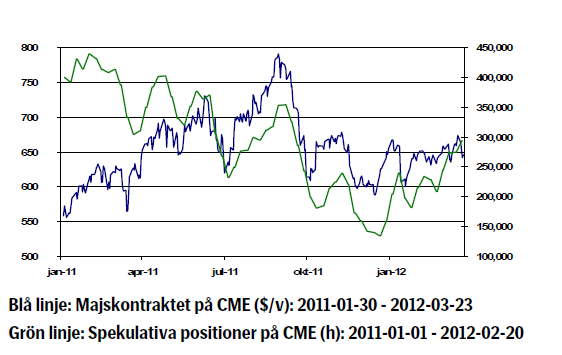
- Förra veckan började med ett par procents nedgång, detta efter svaga exportsiffror från USA och generella uttag från investerarkollektivet. Enligt CME fanns även viss oro för att det kinesiska majspriset skulle falla tillbaka något från förra veckans rekordnivåer.
- Torsdagens svaga inköpchefsindexsiffror från Europa och Kina satte nedåttryck på råvarupriserna, detta med undantag för jordbrukssektorn. Signaler om en god global efterfrågan och frågetecken kring den kommande majsskörden i Nord- och Sydamerika tryckte exempelvis majspriset uppåt. Med andra ord var tendenserna de omvända jämfört med den första halvan av veckan.
- Vidare gick en statlig kinesisk nyhetskanal i torsdags ut med indikationer om ett växande underskott av majs de kommande åren. Även om denna typ av utspel inte påverkar priset direkt ökar den generella efterfrågan och kan på så sätt ge kortsiktigt stöd åt priset.
- Denna vecka håller vi ögonen på Argentina, där både majs och sojabönor har fått visst stöd uppåt av landets försämrade produktionsutsikter. Vi bibehåller med detta vår kortsiktigt svagt positiva syn.
- Teknisk Analys: Uppenbarligen ropade vi hej lite för tidigt förra veckan. Brottet över trendlinjen fick aldrig sin givna fortsättning, ett brott av 233-dagarsbandet och följaktligen tröttnande snart köparna och stängde en lång position. Så vi är nu tillbaka på ruta ett i det neutrala området mellan medelvärdesbanden.
Vete
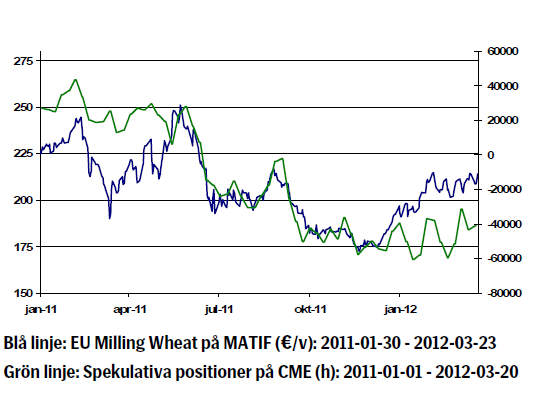
- Precis som majs och sojabönor gick vetet svagt under första halvan av veckan, där framförallt investerare valde att minska andelen jordbruksråvaror i portföljerna. De gynnsamma regn som föll i de vintervetesproducerande delarna av USA förstärkte denna rörelse ytterligare.
- Även om vetepriset i Chicago återhämtade sig något under torsdagen och fredagen var det ingenting mot den rörelse vi kunde se i Paris, där priset under denna period steg med drygt 2,5 procent och innebar en knapp uppgång jämfört med veckan innan.
- Enligt analysfirman DTN väntas den kommande veckan bli ovanligt torr i stora delar av Europa, vilket kan påverka den nuvarande skörden av vintervete. Denna oro får anses vara central för den starka avslutningen förra veckan.
- Under februari månad spekulerades det en hel del kring huruvida den ryska skörden av vintervete skulle bli väsentligen sämre än vad marknaden tidigare hade förväntat sig. Det extremt kalla vädret gjorde att risken för omfattande produktionsbortfall (som en konsekvens av frostskador) ansågs vara stor. Enligt Bloomberg har nu ryska spannmålsorgan kunnat bekräfta att bortfallet inte är så stort som man befarat.
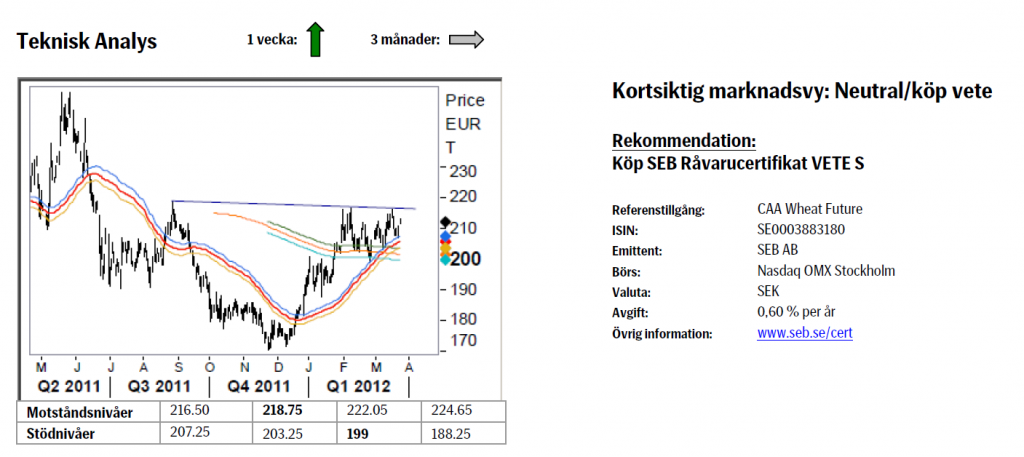
- Med den förväntade torkan i Europa som starkaste argument förhåller vi oss fortsatt svagt positiva till vetepriset på MATIF.
- Teknisk Analys: Konsolideringen ovanför medelvärdesbanden har fortsatt även den senaste veckan. Vår förväntan är att vi kommer att bryta upp över topplinjen vilken vecka som helst och att ett sådant brott i sinom tur bör kunna utlösa en rörelse upp emot majtoppen från förra året. Bara ett överraskande brott under 199 förändrar ovanstående vy.
[box]SEB Veckobrev Veckans råvarukommentar är producerat av SEB Merchant Banking och publiceras i samarbete och med tillstånd på Råvarumarknaden.se[/box]
Disclaimer
The information in this document has been compiled by SEB Merchant Banking, a division within Skandinaviska Enskilda Banken AB (publ) (“SEB”).
Opinions contained in this report represent the bank’s present opinion only and are subject to change without notice. All information contained in this report has been compiled in good faith from sources believed to be reliable. However, no representation or warranty, expressed or implied, is made with respect to the completeness or accuracy of its contents and the information is not to be relied upon as authoritative. Anyone considering taking actions based upon the content of this document is urged to base his or her investment decisions upon such investigations as he or she deems necessary. This document is being provided as information only, and no specific actions are being solicited as a result of it; to the extent permitted by law, no liability whatsoever is accepted for any direct or consequential loss arising from use of this document or its contents.
About SEB
SEB is a public company incorporated in Stockholm, Sweden, with limited liability. It is a participant at major Nordic and other European Regulated Markets and Multilateral Trading Facilities (as well as some non-European equivalent markets) for trading in financial instruments, such as markets operated by NASDAQ OMX, NYSE Euronext, London Stock Exchange, Deutsche Börse, Swiss Exchanges, Turquoise and Chi-X. SEB is authorized and regulated by Finansinspektionen in Sweden; it is authorized and subject to limited regulation by the Financial Services Authority for the conduct of designated investment business in the UK, and is subject to the provisions of relevant regulators in all other jurisdictions where SEB conducts operations. SEB Merchant Banking. All rights reserved.

Market is starting to take US/Iran headlines with a pinch of salt. Brent crude rose $2.8/b yesterday to an official close of $112.1/b. But after that it traded as low as $108.05/b before ending late night at around $109.7/b. Through the day it traded in a range of $106.87 – 112.72/b amid a flurry of news or rumors from Iran and the US. ”US temporary sanctions during negotiations” (falls alarm). ”We will bomb Iran” (not anyhow),… etc. While the market is still fluctuating to this kind of news flow, it is starting to take such headlines with a pinch of salt.

We’ll see. Maybe, maybe not. The Brent M1 contract is trading at $110.2/b this morning which very close to the average ticks through yesterday of $110.4/b.
Trump with bearish, verbal intervention whenever Brent trades above $110/b it seems. What seems to be a pattern is that Trump states something like ”very good negotiations going on with Iran”, ”New leaders in Iran are great,..”, ”Great progress in negotiations,…”, ”Deal in sight,..” etc whenever the Brent M1 contract trades above $110/b. An effort to cool the market. These hot air verbal interventions from Trump used to have a heavy bearish impact on prices, but they now seems to have less and less effect unless they are backed by reality.
As far as we can see there has been no real progress in the negotiations between the US and Iran with both sides still standing by their previous demands.
Iran is getting stronger while the cease fire lasts making a return to war for Trump yet harder. Iran is naturally in constant preparation for a return to war given Trump’s steady threats of bombing Iran again. Iran is naturally doing what ever is possible to prepare for a return to war. And every day the cease fire lasts it is better prepared. This naturally makes it more and more difficult and dangerous for the US to return to warring activity versus Iran as the consequences for energy infrastructure in the Persian Gulf will be more and more severe the longer the cease fire lasts. Israel seems to see it this way as well. That the war is not won and that current frozen state of a cease fire gives Iran opportunity to rebuild military and politically.
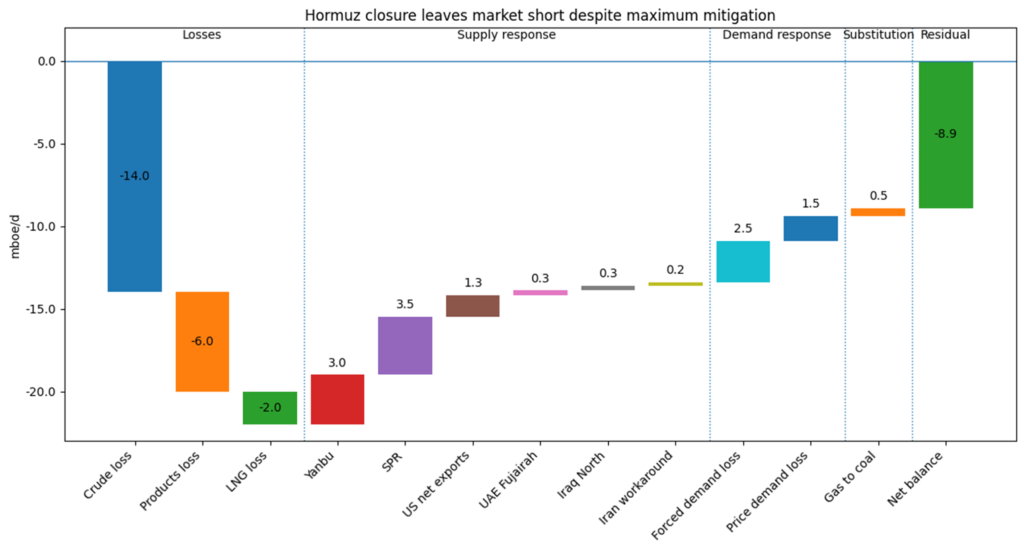
Global inventories are drawing down day by day. How much? In the meantime the Strait of Hormuz stays closed. There is varying measures and estimates of how much global inventories are drawing down. Our rough estimate, back of the envelope, is that global inventories are drawing down by at least some 10 mb/d or about 300 mb/d in a balance between loss of supply versus demand destruction. Other estimates we see are a monthly draw of 250-270 mb/d. The IEA only ’measured’ a draw in global observable stocks of 117 mb in April with oil on water rising 53 mb while on shore stocks fell 170 mb. But global stocks are hard to measure with large invisible, unmeasured stocks. As such a back of the envelope approach may be better.
Oil products is what the world is consuming. Oil product prices likely to rise while product stocks fall. Strategic Petroleum Reserves (SPR) are predominantly crude oil. Discharging oil from OECD SPR stocks, a sharp reduction in Chinese crude imports and a reduction in global refinery throughput of 6-7 mb/d has helped to keep crude oil markets satisfactorily supplied. But global inventories are drawing down none the less. And oil products is really what the world is consuming. So if global refinery throughput stays subdued, then demand will eventually have to match the supply of oil products. The likely path forward this summer is a steady draw down in jet fuel, diesel and gasoline. Higher prices for these. Then, if possible, higher refinery throughput and higher usage of crude in response to very profitable refinery margins. And lastly sharper draw in crude stocks and higher prices for these. But some 6 mb/d of oil products used to be exported through the Strait of Hormuz. And it may not be so easy to ramp up refinery activity across the world to compensate. Especially as Ukraine continues to damage Russian refineries as well as Russian crude production and export facilities.
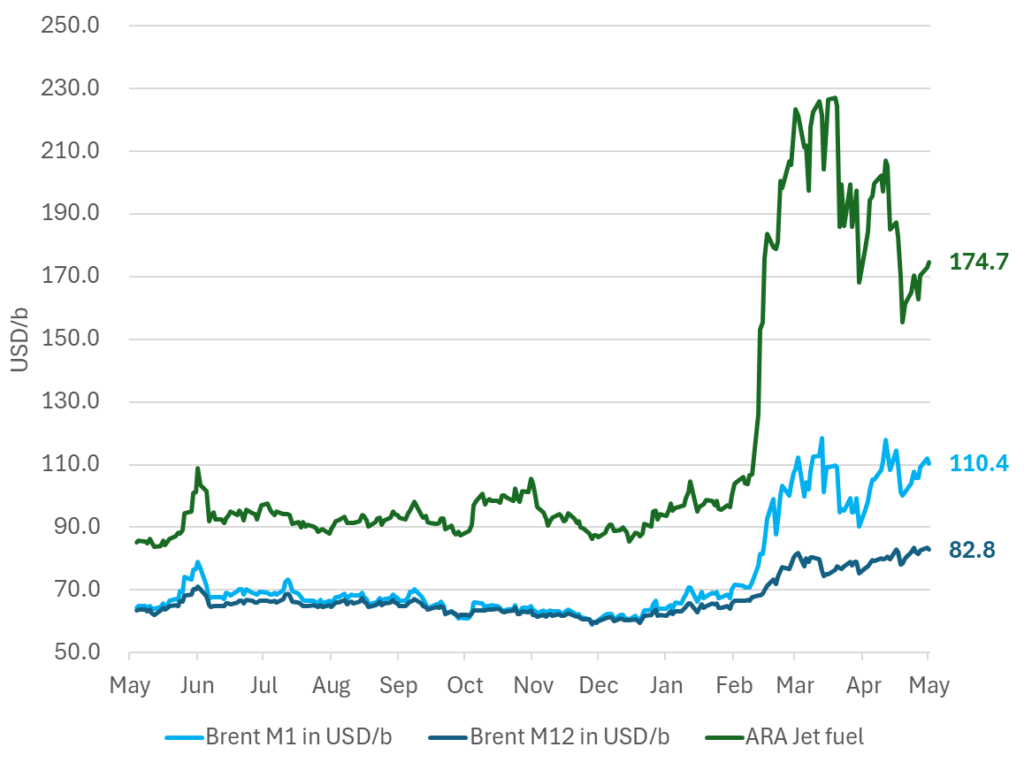
Watch oil product stocks and prices as well as Brent calendar 2027. What to watch for this summer is thus oil product inventories falling and oil product premiums to crude rising. Another measure to watch is the Brent crude 2027 contract as it rises steadily day by day as the Strait of Hormuz stays closed and global oil inventories decline. The latter is close to the highest level since the start of the war and keeps rising.
The Brent M1 contract and the Brent 2027 prices and current price of jet fuel in Europe (ARA). All in USD/b
Our back of the envelope calculation of the global shortage created by the closure of the Strait of Hormuz. Note that 3.5 mb/d of discharge from SPR is also a draw. Note also that ’Forced demand loss’ of 2.5 mb/d is probably temporary and will fall back towards zero as logistics are sorted out leaving ’Price demand loss’ to do the job of balancing the market. Thus a shortfall of at least 9 mb/d created by the closure. More if SPR discharge is included and more if Forced demand loss recedes.
Brent is climbing higher. Front-month is at USD 106.3/bl this morning, close to a weekly high and a USD 9/bl jump from Mondays open. This is the move we flagged as a risk earlier in the week: the market shifting from ”a deal is around the corner” to ”this is going to take longer than we thought”.

Analyst Commodities, SEB
During April, rest-of-year Brent remained remarkably stable around USD 90/bl. A stability which rested on one single assumption: the SoH reopens around 1 May. That assumption is now slowly falling apart.
As we highlighted yesterday: every week of delay beyond 1 May adds (theoretically) ish USD 5/bl to the rest-of-year average, as global inventories draw 100 million barrels per week. i.e., a mid-May reopening implies rest-of-year Brent closer to USD 100/bl, and anything pushing into June or July takes us meaningfully higher.
What’s changed in the last 48 hours:
#1: The US military has formally warned that clearing suspected sea mines from SoH could take up to six months. That is a completely different timescale from what the financial market is pricing. Even a political deal tomorrow does not immediately reopen the strait.
#2: Trump has shifted his tone from urgency to ”strategic patience”. In yesterday’s press conference: ”Don’t rush me… I want a great deal.” The market is reading this as a president no longer feeling pressured by timelines, with the naval blockade running in the background.
#3: So far, the military activity is escalating, not de-escalating. Axios reports Iran is laying more mines in SoH. The US 3rd carrier strike group (USS George H.W. Bush) is arriving with two countermine vessels. Trump yesterday ordered the US Navy to destroy any Iranian boats caught laying mines. While CNN reports that the Pentagon is actively drawing up plans to strike Iranian SoH capabilities and individual Iranian military leaders if the ceasefire collapses. i.e., NOT a attitude consistent with an imminent deal!
Spot crude and product prices eased off the early-April highs on a combination of system rerouting and deal optimism. Both now weakening. Goldman estimates April Gulf output is reduced by 14.5 mbl/d, or 57% of pre-war supply, a number that keeps getting worse the longer this drags on.
Demand-side adaptation is ongoing: S. Korea has cut its Middle East crude dependence from 69% to 56% by pulling more from the Americas and Africa, and Japan is kicking off a second round of SPR releases from 1 May. But SPRs are finite.
Ref. to the negotiations, we should not bet on speed. The current Iranian leadership is dominated by genuine hardliners willing to absorb economic pain and run the clock to extract concessions. That is not a setup for a rapid resolution. US/Israeli media briefings keep framing the delay as ”internal Iranian divisions”, the reality is more complicated and points toward weeks and months, not days.
Our point is that the complexity is large, and higher prices have only just started (given a scenario where the negotiations drag out in time). The market spent April leaning on the USD 90/bl rest-of-year assumption; that case is diminishing by the hour. If ”early May reopening” is replaced by ”June, July or later” over the next week or two, both crude and products have meaningful room to reprice higher from here. There is a high risk being short energy and betting on any immediate political resolution(!).
Down on Friday. Up on Monday. The Brent June crude oil contract traded down 5.1% last week to a close of $90.38/b. It reached a high of $103.87/b last Monday and a low of $86.09/b on Friday as Iran announced that the Strait of Hormuz was fully open for transit. That quickly changed over the weekend as the US upheld its blockade of Iranian oil exports while Iran naturally responded by closing the SoH again. The US blew a hole in the engine room of the Iranian ship TOUSKA and took custody of the ship on Sunday. Brent crude is up 5.6% this morning to $95.4/b.
The cease-fire is expiring tomorrow. The US has said it will send a delegation for a second round of negotiations in Islamabad in Pakistan. But Iran has for now rejected a second round of talks as it views US demands as unrealistic and excessive while the US is also blocking the Strait of Hormuz.
While Brent is up 5% this morning, the financial market is still very optimistic that progress will be made. That talks will continue and that the SoH will fully open by the start of May which is consistent with a rest-of-year average Brent crude oil price of around $90/b with the market now trading that balance at around $88/b.
Financial optimism vs. physical deterioration. We have a divergence where the financial market is trading negotiations, improvements and resolution while at the same time the physical market is deteriorating day by day. Physical oil flows remain constrained by disrupted flows, longer voyage times and elevated freight and insurance costs.
Financial markets are betting that a US/Iranian resolution will save us in time from violent shortages down the road. But every day that the SoH remains closed is bringing us closer to a potentially very painful point of shortages and much higher prices.
The US blockade is also a weapon of leverage against its European and Asian allies. When Iran closed the SoH it held the world economy as a hostage against the US. The US blockade of the SoH is of course blocking Iranian oil exports. But it is also an action of disruption directed towards Europe and Asia. The US has called for the rest of the world to engaged in the war with Iran: ”If you want oil from the Persian Gulf, then go and get it”. A risk is that the US plays brinkmanship with the global oil market directed towards its European and Asian allies and maybe even towards China to force them to engage and take part. Maybe unthinkable. But unthinkable has become the norm with Trump in the White House.





Sommarväder skapar prisrally på elbörsen
Oil product price pain is set to rise as the Strait of Hormuz stays closed into summer

Solkraften pressar elpriserna dagtid

Michel Gubel ger sin syn på oljemarknaden