
Analys
SEB – Jordbruksprodukter, vecka 11 2012

 Den senaste veckan har priserna rört sig uppåt för några jordbruksprodukter och nedåt för andra. Raps och sojabönor tillhör vinnarna. WASDE-rapporten förra veckan gav den här typen av signal. För majs var rapporten totalt ointressant.
Nyhet! Förbättringar med fler kontrakt på Matif
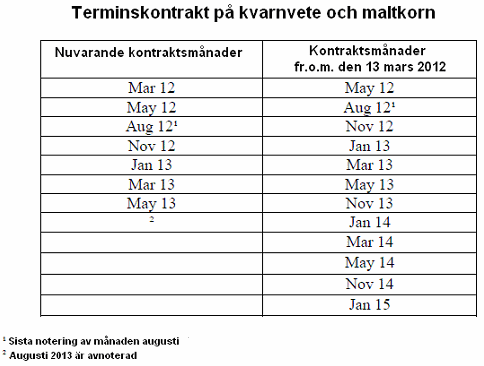
Den europeiska börsen Euronext (Matif) har utökat antalet kontraktsmånader för terminer och optioner på kvarnvete, maltkorn, rapsfrö och majs med fr.o.m. tisdagen den 13 mars 2012. En annan förändring som sker är också att kontraktsmånaden augusti för kvarnvete och maltkorn kommer att försvinna. Augusti 2012 blir därmed den sista noterade augusti månaden för dessa två råvaror. För kvarnvete och maltkorn kommer antalet kontraktsmånader att utökas från nuvarande 8 till 12 enligt nedan:
För rapsfrö kommer antalet kontraktsmånader att utökas från nuvarande 6 till 10 enligt nedan:
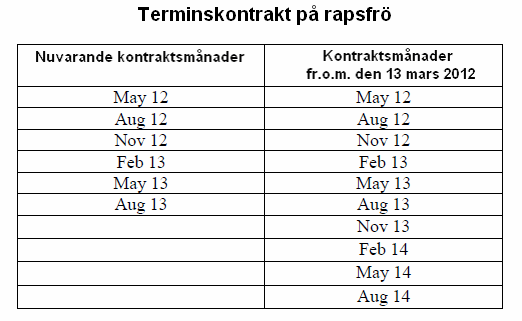
Detta gör det möjligt att implementera en ”trappstegsstrategi” för att hantera prisvariation mellan odlingsåren och därmed avsevärt sänka intäktsvariationen på spannmåls- och oljeväxtodling mellan åren (utan att behöva använda Chicagovetekontrakten).
Odlingsväder
La Niña fortsätter att hålla sig kring noll. Även i veckan som gick rapporteras från Australiens meteorologiska byrå att ENSO-förhållandena är normala.
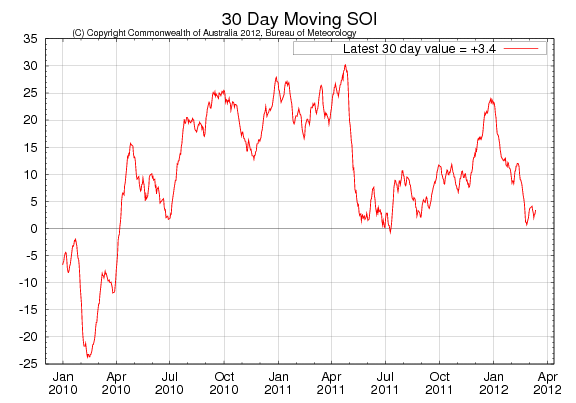
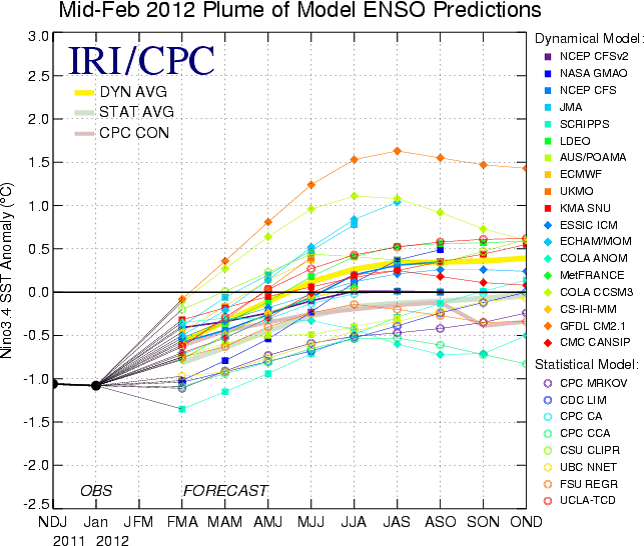
Nedan ser vi ensembleprognosen från amrikanska Climate Prediction Center. Den är gjord i mitten av februari, och den visade då att La Niña skulle klinga av och försvinna till neutrala ENSO-förhållanden till juni. Detta tycks nu, som vi sett, redan inträffat.
Vete
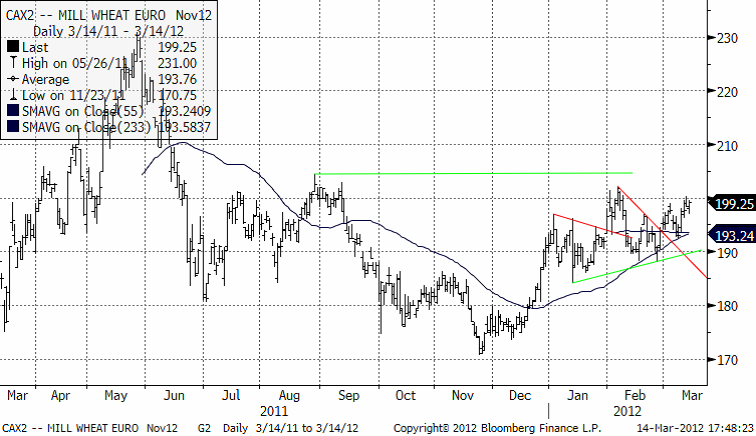
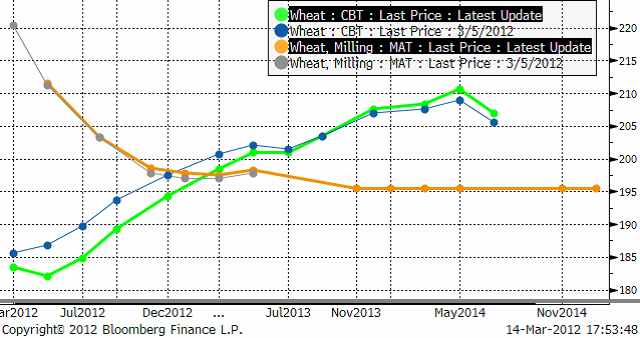
Novemberterminen på Matif testar återigen 200 euro per ton. Det finns så gott om motstånd på ovansidan att det är svårt att tänka sig att priset med lätthet skulle kunna gå uppåt. Statistiken är något ”bullish”, men inte överdrivet så. WASDE:n var något litet ”bullish”, medan senare FAO-statistik är något ”bearish”.
USA visade återigen sin konkurrenskraft på världsmarknaden efter att för tredje gången tagit hem anbudet från Egypten i förra veckan då GASC köpte ytterligare 60 000 ton amerikanskt vete. Priset på det amerikanska vetet låg klart under de priser som erbjöds från Kanada, Frankrike och Ukraina, även med de extra kostnaderna för frakt över Atlanten inräknat. [ USA; 259$/t + frakt 27.75$/t från Venus I Kanada; 267.75$/t från Louis Dreyfus I Frankrike; 286.89$/t från Cargill I Ukraina; 277.45$/t från Venus (exkluderad då den inte uppfyllde anbudets krav) ]
Den franska veteproduktionen kommer sannolikt att sjunka till 33.8 mt för 2011/12 från uppskattningsvis 35.7 mt under samma period året innan enligt France AgriMer, vilket också är något lägre än föregående månads prognos på 34 mt. De estimerar också att exporten av vete till ickeeuropeiska länder kommer att sjunka till 8.6 mt, en minskning från 12.9 mt under 2010/11, och exporten till europeiska länder kommer att falla till 6.5 mt jämfört med 6.7 mt förra säsongen. Tysklands produktion av vete (alla sorter) för 2012 förväntas öka med 6.3 procent till 24.2 mt jämfört med 22.7 mt under 2011.
Ukrainas regering justerar ned sin prognos för landets vete produktion för 2012 till 14 mt, från en tidigare förväntad produktion på nästan 16 mt, samtidigt som man betonar att de förväntade skördevolymerna kommer att täcka den inhemska efterfrågan på kvarnvete i Ukraina, vilket är i nivå med nästan 6 mt. Prognosen för landets spannmålsexport 2011/12 (juli-juni) justeras också ned med ca 20 procent, till 20-21 mt, till följd av att försäljningstakten har avtagit. Ukrainas premiärminister sa också att ”införande av någon form av kvoter (för spannmål) inte finns på agendan för 2012/13” och att landet kommer att ”få en genomsnittlig skörd som bör göra det möjligt för oss att lösa alla våra problem”.
Även analysföretagen UkrAgroConsult och ProAgro justerar också ned sina prognoser för Ukrainas vete produtkion till 13.8 mt resp 14.3 mt.
FAO’s första prognos över den globala vete produktionen för 2012 uppgår till 690 mt och blir därmed den näst högsta ur ett historiskt perspektiv. Jämfört med rekordåret 2011 är det en nedgång med 10 mt eller 1.4 procent men fortfarande en bra bit över genomsnittet för de senaste fem åren. Utsikterna för 2012 års globala vete produktion ser dock gynnsamma ut. Även om odlingen har ökat eller förväntas öka i många länder i år till följd av fortsatt starka priser, så förväntas en återgång till mer normala avkastningar i områden där rekordnivåer uppnåddes förra året. Men det är fortfarande tidigt att estimera den globala spannmålsproduktionen.
I Europa, förväntas arealen för vete att öka marginellt till strax över genomsnittet för de senaste fem åren och utifrån ett antagande om normala säsongsmässiga förhållanden för resten av perioden förväntas produktionen bli i stort sett oförändrar från 2011 års nivå på 138 mt.
I Ryssland rapporteras grödorna vara i gott skick med ett i allmänhet tilläckligt snötäcke som skyddat grödorna under en period av riktigt låga temperaturer, utom i vissa södra delar av landet. Sådden av höstvete har ökat markant jämfört med föregående år till följd av goda förutsättningar vid sådd. En viss ökning av vårvete väntas också. Under antagandet normala odlingsförhållanden för resten av säsongen, förväntas produktionen bli i stort sett oförändrad jämfört med förra årets relativt höga nivå på 56 mt.
I Ukraina däremot, är utsikterna för höstvete mindre gynnsamma med tanke på en minskad sådd till pga torkan i höstas och en ökad utvintring till följd av en period med kraftig kyla i kombination med begränsat snötäcke. Även om en viss del av bortfallet förväntas ersättas med vårvete, så uppskattas produktionen av vete i detta skede att falla från förra årets höga nivå.
I Nordamerika, visar tidiga indikationer på att veteproduktionen i USA pekar på en återhämtning på 10 procents jämförts med förra årets produktion som låg under genomsnittet. Årets produktion förväntas uppgå till 60 mt. Mars och april är den period då största delen av vetet i Kanada sås och arealen förväntas öka betydligt då lantbrukare åter sår en stor del av arealen som förra våren var för blöt för att kunna användas.
I Asien är utsikterna för veteproduktionen, där skörden börjar i april, i huvudsak gynnsamma för de flesta producerande länder. I Kina förväntas inga större förändringar i arealen, men produktionen kan komma att falla något, vilket skulle vara en återgång till en mer normal avkastning. I Indien och Pakistan väntas rekordskördar vilket bl.a. speglar en fullgod tillgång på vatten. I den asiatiska CIS är Kazakstan den största producenten och merparten av grödorna där sås i vår. Givet att ett stort överskott kvarstår sedan förra årets rekordskörd av vete, så förväntas årets vete areal att minska till förmån för andra grödor och därmed också en minskad produktion av vete.
I Mellanöstern rapporteras utsikterna för höstvete att vara goda och för Nordafrika är tidiga prognoser blandade. Utsikterna i Egypten är goda där grödorna till stor del är bevattnade och vattentillgången god medan det är värre för Marocko där sådden påverkades av det torra vädret och där betydande regn behövs snart för att förhindra ett betydande bortfall. På det södra halvklotet sker merparten av sådden av vete senare i år. I Australien, där sådden börjar i april, pekar tidiga indikationer på ytterligare en god skörd, även om den troligtvis inte når upp till 2011 års rekordskörd.
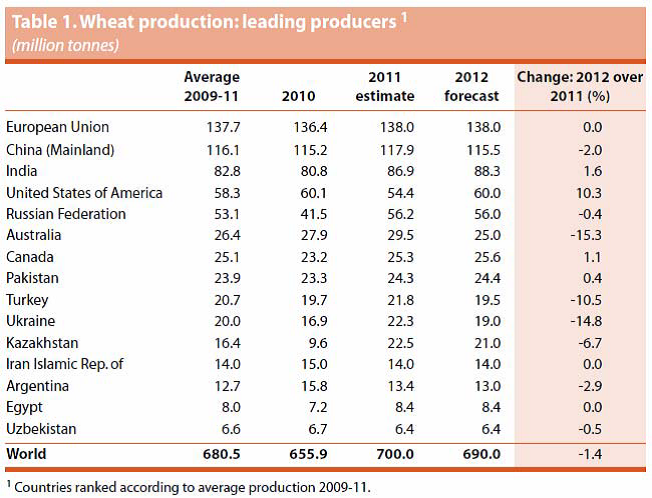
Precis efter förra veckans veckobrev publicerade USDA sin WASDE-rapport för mars månad. Den visade ingen förändring. Kicki trodde först att de skickat ut februaris siffror av misstag, därför att det var nästan ingenting som skiljde (vi tittar först och främst på USA:s siffror, eftersom det är det största exportlandet och det är export och importmarknaden som avgör världsmarknadspriset). Men totalt för vete blev det en liten uppjustering av väntad skörd globalt sett:
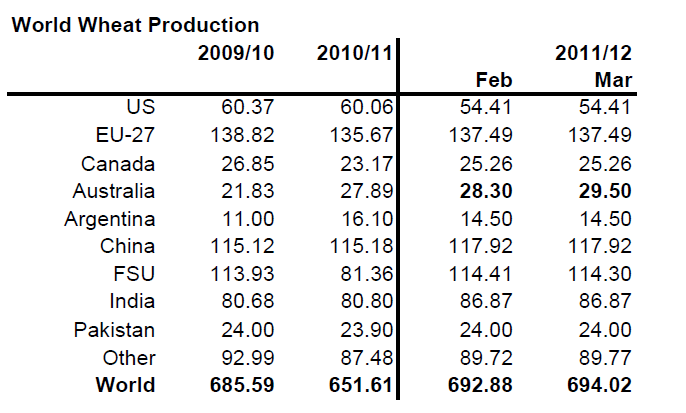
Ökad konsumtion framförallt i Kina (vi har tidigare nämnt wheat-for-feed), leder till lägre utgående globala lager.
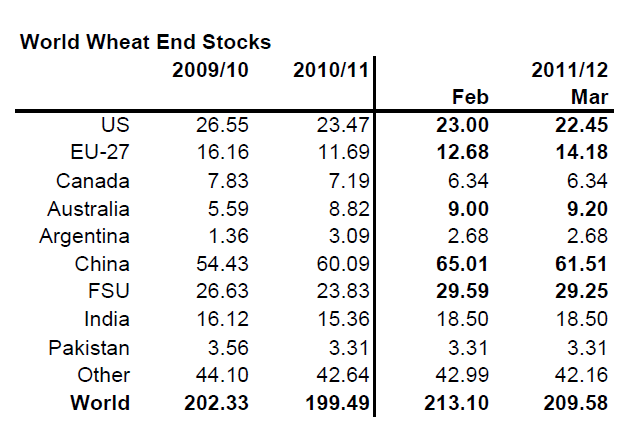
Detta gav en liten skjuts uppåt på priset. Inte så mycket för Kinas konsumtion, som för att utgående lager i USA väntas bli lägre. För vetepriset såsom världsmarknadspris är det USA som i egenskap av största exportör, är den helt avgörande marknaden. Vi såg fallande priser på terminer med kort löptid i USA, medan terminskurvan i Europa är helt oförändrad de senaste sju börsdagarna:
Maltkorn
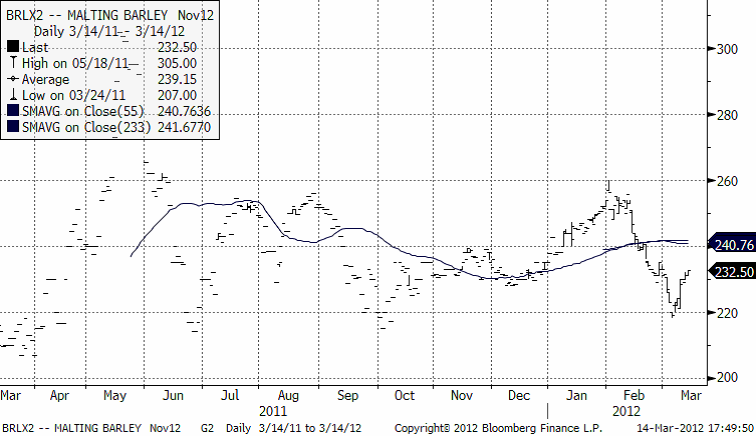
Novemberkontraktet på maltkorn rekylerade upp i veckan som gick.
Potatis
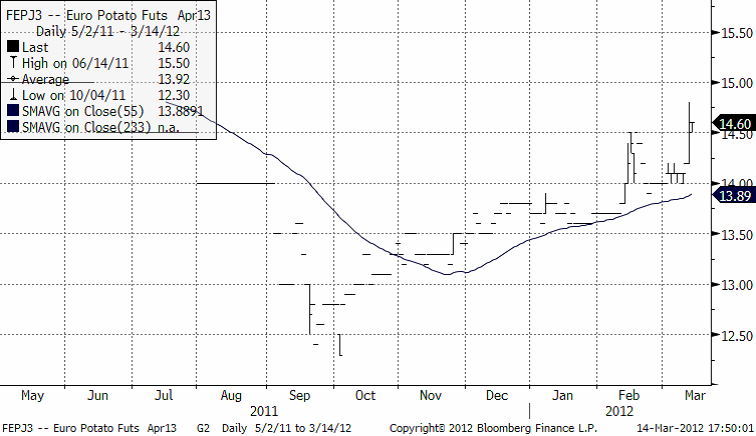
Priset på industripotatis för leverans nästa år steg ganska ordentligt i veckan som vi ser i nedanstående kursdiagram.
Majs
Majspriset har rört sig ovanligt lite den senaste veckan. WASDE-rapporten för en vecka sedan var likaledes ointressant.
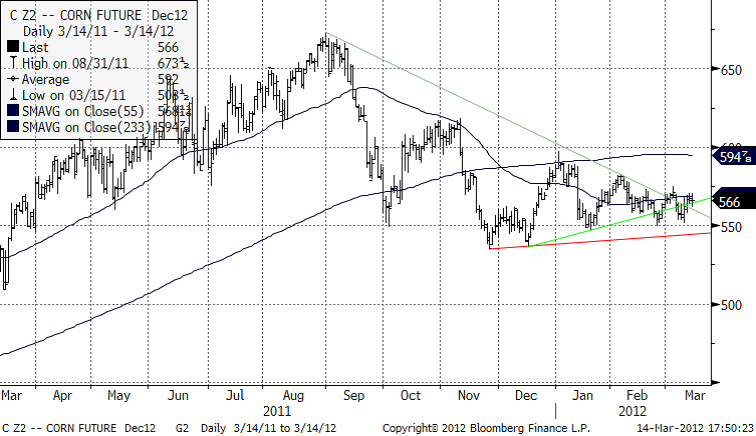
USDA gjorde inga stora förändringar på hur mycket som man tror kommer att skördas i år. Man höjde skörden i Brasilien med 1 mt och sänkte Sydafrika med 500 kt. Vi noterar att man lämnat Argentina helt oförändrat från februaris rapport.
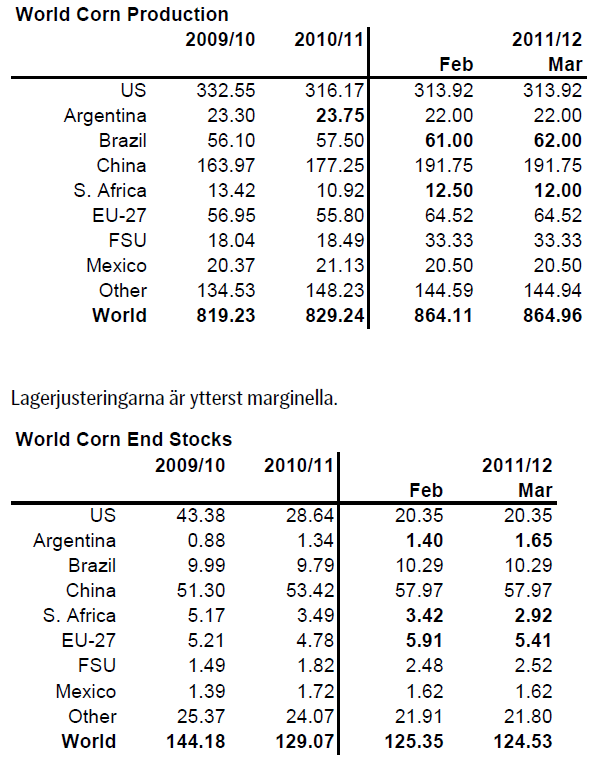
Om två veckor kommer lagerstatistikrapporten från USDA och den kanske blir något mer intressant.
Sojabönor
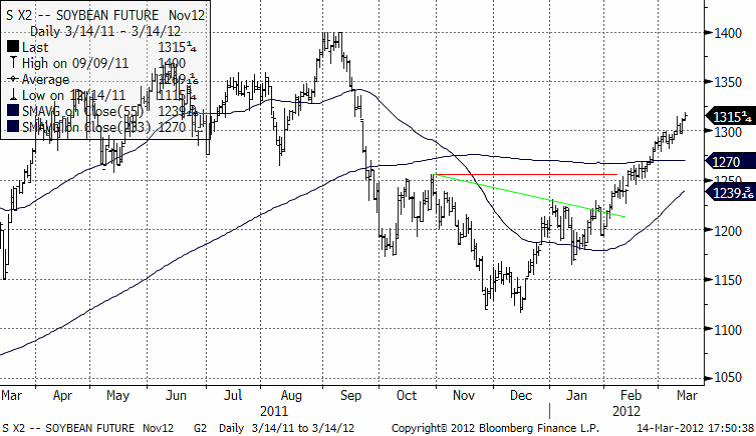
Novemberkontraktet gick efter en väldigt liten tvekan genom 13 dollar. Nästa motstånd finns på 1350 cent. Det är ovanligt med en så här pass lång och stadig trend uppåt, men när ska man gå emot?
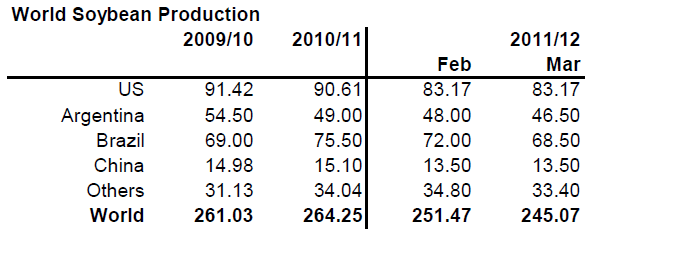
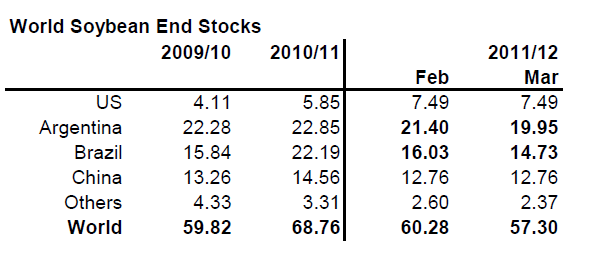
WASDE-rapporten förra veckan visade lägre produktion av sojabönor. Globalt sänktes prognosen med 6.4 mt. Brasiliens skörd sänktes med 3.5 mt, Argentina 1.5 mt och Paraguay 1.4 mt. USDA:s skördeestimat ligger faktiskt lite lägre än vad Conab har.
Utgående lager sänktes 3 mt, främst i Argentina och Brasilien. Pga de redan låga utgående lagren i USA har man på USDA valt att inte sänka USA:s lager.
Raps
Den brittiska rapsexporten är fortsatt stark, och uppgår hittills för säsongen 2011/12 (juli-juni) till ca 500 000 ton, vilket redan överstiger de 435 311 ton som exporterades under 2011/11. Tyskland är den viktigaste marknaden för den brittiska rapsexporten och då Tysklands egen rapsskörd kollapsade med 30 procent pga av dåligt väder under 2011 så finns en fortsatt stark efterfrågan på import av raps som nu brittiska lantbrukare fortsätter att dra nytta av.
Dock förväntas Tysklands produktion av höstraps att öka under 2012 till 4.8 mt jämfört med 3.8 mt år 2011 enligt tidiga prognoser.
Vissa farhågor finns också hur den kraftiga kylan som har varit i Europa kommer att påverka rapsen. Det femåriga genomsnittet för EU’s rapsproduktion ligger på 19.5 mt och prognosen för 2012 från Europeiska kommissionen ligger nu på 20.2 mt. Andra privata analysfirmor uppskattar att produktionen kan bli så låg som 18 mt.
Europa står för ungefär en tredjedel av världens rapsproduktion, vilket innebär att bortfall i produktionen kan ha en stor inverkan på den internationella marknaden och vilket skulle ge ett visst indirekt stöd till den kanadensiska canolan. Även om inte Kanada exporterar mycket raps direkt till Europa, så skulle med stor sannolikhet exporten från Svartahavs-länderna och Australien till Europa öka och därmed skulle Kanada möta en minskad konkurrens på den asiatiska marknaden från dessa länder.
Nedan ser vi kursdiagrammet för novemberkontraktet. När 440 euro bröts fortsatte haussen under mycket kraftig handel. Det var säkert många som inte köpt tillbaka sålda kontrakt på 400 och det tvångsstängs antagligen en del kontrakt på en del konton nu.
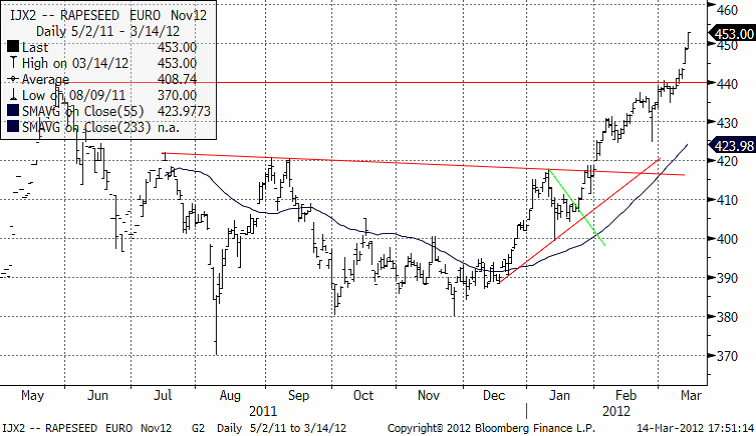
Vi tycker att priset är högt, men marknaden är stark, och 440-nivån bröts. Därför har vi en neutral vy.
Gris
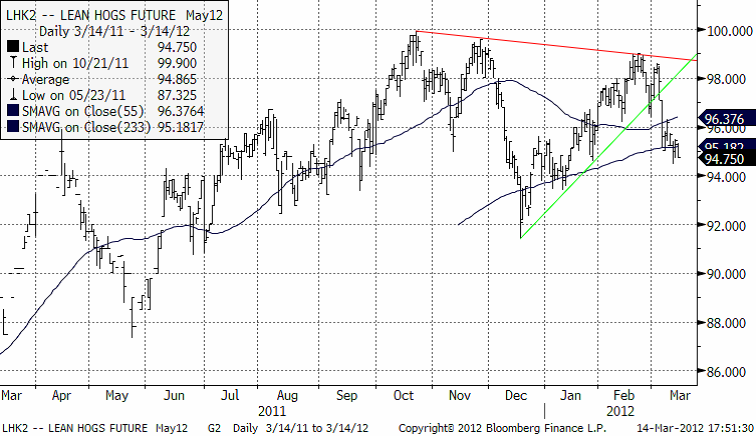
Majkontraktet som vi säljrekommenderade för en två veckor sedan har fortsatt att falla. Vi trodde för en vecka sedan att den kunde gå ner till 92, men kraften i nedgången har avtagit och om prisnedgången når 94 är det nog bra så.
[box]SEB Veckobrev Jordbruksprodukter är producerat av SEB Merchant Banking och publiceras i samarbete och med tillstånd på Råvarumarknaden.se[/box]
Disclaimer
The information in this document has been compiled by SEB Merchant Banking, a division within Skandinaviska Enskilda Banken AB (publ) (“SEB”).
Opinions contained in this report represent the bank’s present opinion only and are subject to change without notice. All information contained in this report has been compiled in good faith from sources believed to be reliable. However, no representation or warranty, expressed or implied, is made with respect to the completeness or accuracy of its contents and the information is not to be relied upon as authoritative. Anyone considering taking actions based upon the content of this document is urged to base his or her investment decisions upon such investigations as he or she deems necessary. This document is being provided as information only, and no specific actions are being solicited as a result of it; to the extent permitted by law, no liability whatsoever is accepted for any direct or consequential loss arising from use of this document or its contents.
About SEB
SEB is a public company incorporated in Stockholm, Sweden, with limited liability. It is a participant at major Nordic and other European Regulated Markets and Multilateral Trading Facilities (as well as some non-European equivalent markets) for trading in financial instruments, such as markets operated by NASDAQ OMX, NYSE Euronext, London Stock Exchange, Deutsche Börse, Swiss Exchanges, Turquoise and Chi-X. SEB is authorized and regulated by Finansinspektionen in Sweden; it is authorized and subject to limited regulation by the Financial Services Authority for the conduct of designated investment business in the UK, and is subject to the provisions of relevant regulators in all other jurisdictions where SEB conducts operations. SEB Merchant Banking. All rights reserved.

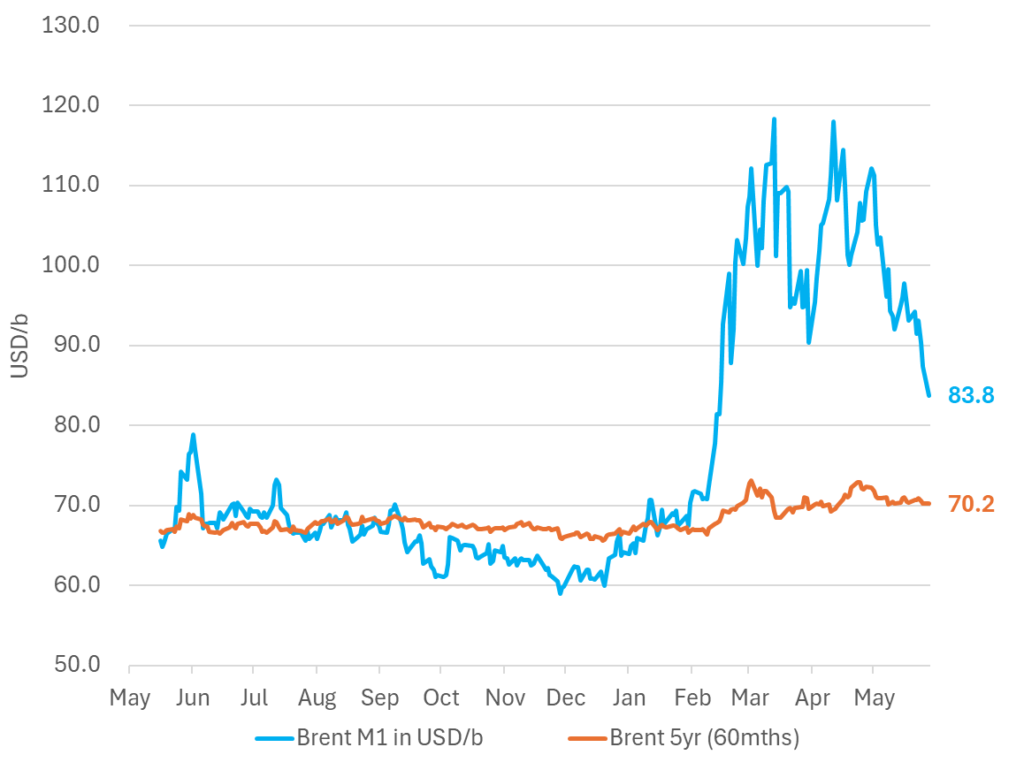
Selling down on a ”deal”. Brent crude fell 6.2% last week with accelerated weakness towards the end of the week. Close of the week at $87.33/b and low of the week (and on Friday) of $85.8/b. Brent is falling another 4% this morning to $83.7/b on confirmation by Iran that a MoU text has been reached and that it will be signed on Friday this week.

So what is this ”deal” worth? Talk on the desk here this morning is that it is much like ”putting lipstick on a pig” where Trump has to sell this at home as a victory where ”the SoH has reopened”, the nuclear issue will be ironed out over the coming 60 days (or maybe 600 days?) and US consumers are getting a lower gasoline price and maybe US republicans survives the midterm elections.
The importance for Iran is that it emerges as the defacto winner of this war in the eyes of the non-US public world. That Iran now onwards is the ”ruler of the SoH” (combo of geography and new weapons systems like drones) or more softer: ”the guarantor of safe passage through the SoH”.
Iran doesn’t need nuclear weapons any more. Nuclear deterrence doesn’t work any more. Ukraine has made many attacks deep into Russia without being nuked in return. Plenty of Iranian ballistic rockets blasts over Israel but Iran wasn’t nuked in return.
There is no trust between the US and Iran. We don’t know all the details yet of the MoU. But what we do know is that there is no trust between the US and Iran what so ever. This is probably more like a descriptive text on how they can cooperate in a way where both sides keeps tactical leverage. Neither side makes irreversible concessions. Violations can be punished quickly. Cooperation produces immediate benefits.
This is a fragile structure. It can easily break down. There may be details which cannot be overcome. To be seen on Friday. The US has to show that it is willing put enough force behind managing and restraining Israel versus Hezbollah in Lebanon. We have seen that Netanyahu hasn’t listened all that much to Trump’s directives and wishes. This could be a major obstacle.
A gradual reopening is tactically preferable for Iran. A tactical leverage for Iran right now is that global oil stocks have been drawn down towards painful and increasingly dangerous levels with increasing risks for oil price spikes in mid-July to August. This together with US midterm elections on 3 November gives tactical leverage to Iran. Iran probably doesn’t want to fully give up on that leverage. A rapid, full reopening where global stocks are able to refill over the coming 60 days will significantly erode that leverage. If Iran reinstates a closure of the SoH after 60 days (if talks break down again), then the effect won’t be that impactful in terms of prices and the US midterm elections.
So a gradual and partial reopening where global markets gets the oil they need while they are unable to rebuild stocks could be a practical middle way for both parties. Trump can sell it as ”the SoH has reopened” and get affordable gasoline for US consumers. Iran can sell it as ”the SoH has fully reopened, but there is some friction” so flow is only 60-80% of normal.
Not much real demand destruction below $100/b. What we do know is that there is not much real price pain demand destruction for oil globally at an oil price below $100/b. A lot of demand-shock destruction. Fear. But demand should now come roaring back towards normal with fear for exceptionally high prices now is rapidly receding.
Sudden China demand destruction due to EVs? Bullocks. EV share of total Chinese carpool now around 13%. Share of new sales of EVs has reached 50%. This is a very gradual process. It doesn’t make oil demand fall like a rock over night. When EV new sales share reaches 100%, then the gasoline car pool will contract by some 5-10% per year. But that is only gasoline. Sudden reduction in Chinese oil demand is more about shock and risk.
Chinese crude oil imports will come roaring back. At what price? Today’s ”neutral” oil price is $70/b. That is the five year price which has steadily traded around the $70/b mark over the past 3-4 years. With still a risky picture one would think that China and the rest of the world will be big buyers of oil in the range of $70-85/b.
Global demand will likely snap back towards normal, forecasted demand and growth at such prices.
Physical reopening is a gradual process. The physical and practical reopening of the SoH will likely be gradual rather than sudden. And that probably suites Iran tactically as well.
Brent M1 price versus the Brent 5-yr (today’s ”normal” price)
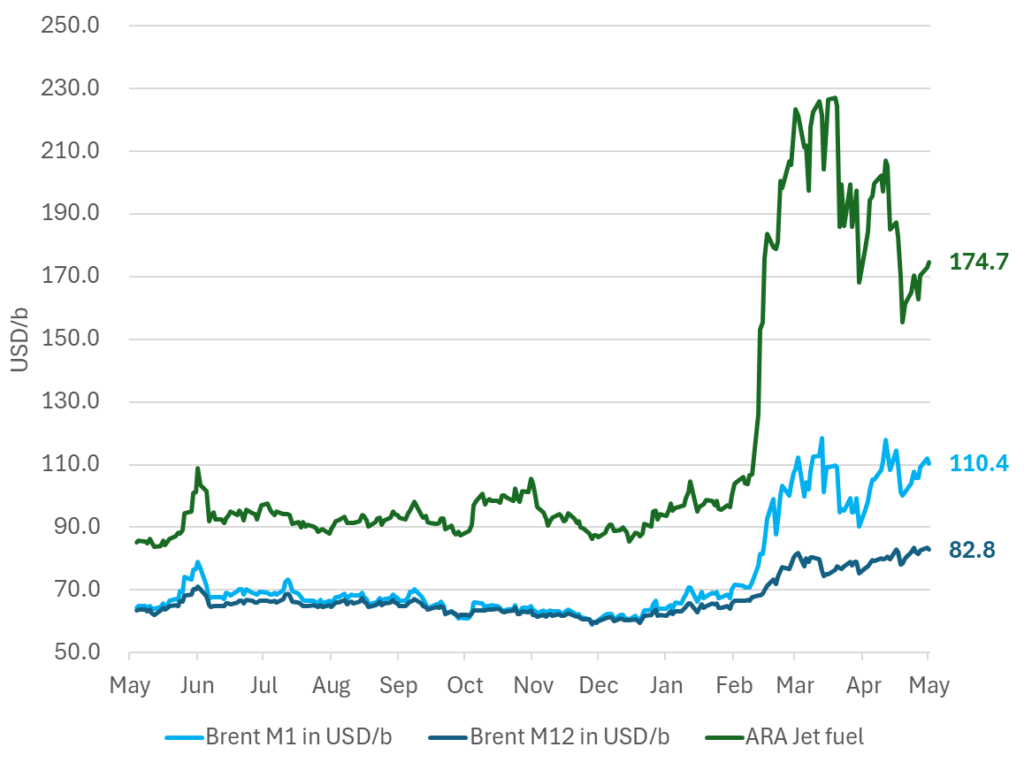
Market is starting to take US/Iran headlines with a pinch of salt. Brent crude rose $2.8/b yesterday to an official close of $112.1/b. But after that it traded as low as $108.05/b before ending late night at around $109.7/b. Through the day it traded in a range of $106.87 – 112.72/b amid a flurry of news or rumors from Iran and the US. ”US temporary sanctions during negotiations” (falls alarm). ”We will bomb Iran” (not anyhow),… etc. While the market is still fluctuating to this kind of news flow, it is starting to take such headlines with a pinch of salt.
We’ll see. Maybe, maybe not. The Brent M1 contract is trading at $110.2/b this morning which very close to the average ticks through yesterday of $110.4/b.
Trump with bearish, verbal intervention whenever Brent trades above $110/b it seems. What seems to be a pattern is that Trump states something like ”very good negotiations going on with Iran”, ”New leaders in Iran are great,..”, ”Great progress in negotiations,…”, ”Deal in sight,..” etc whenever the Brent M1 contract trades above $110/b. An effort to cool the market. These hot air verbal interventions from Trump used to have a heavy bearish impact on prices, but they now seems to have less and less effect unless they are backed by reality.
As far as we can see there has been no real progress in the negotiations between the US and Iran with both sides still standing by their previous demands.
Iran is getting stronger while the cease fire lasts making a return to war for Trump yet harder. Iran is naturally in constant preparation for a return to war given Trump’s steady threats of bombing Iran again. Iran is naturally doing what ever is possible to prepare for a return to war. And every day the cease fire lasts it is better prepared. This naturally makes it more and more difficult and dangerous for the US to return to warring activity versus Iran as the consequences for energy infrastructure in the Persian Gulf will be more and more severe the longer the cease fire lasts. Israel seems to see it this way as well. That the war is not won and that current frozen state of a cease fire gives Iran opportunity to rebuild military and politically.
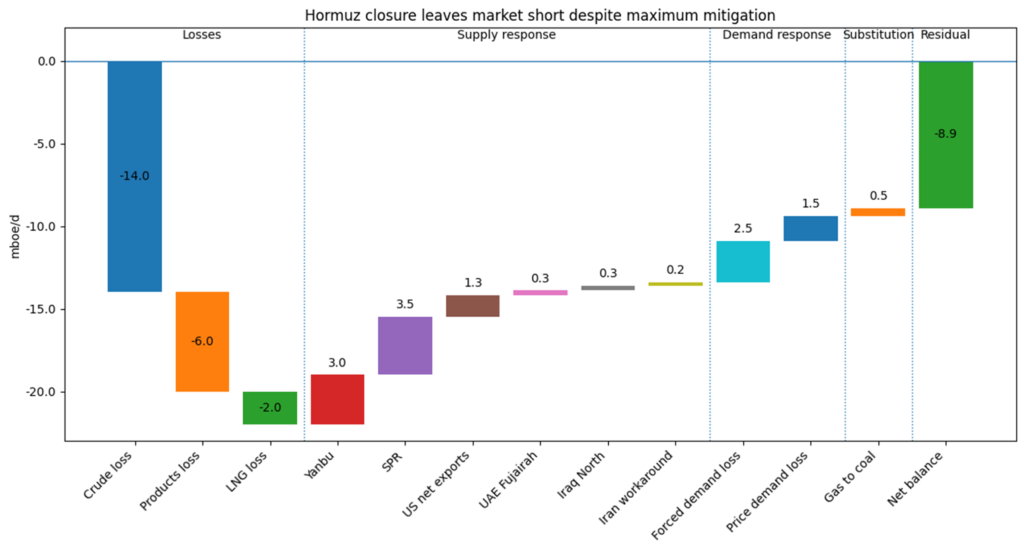
Global inventories are drawing down day by day. How much? In the meantime the Strait of Hormuz stays closed. There is varying measures and estimates of how much global inventories are drawing down. Our rough estimate, back of the envelope, is that global inventories are drawing down by at least some 10 mb/d or about 300 mb/d in a balance between loss of supply versus demand destruction. Other estimates we see are a monthly draw of 250-270 mb/d. The IEA only ’measured’ a draw in global observable stocks of 117 mb in April with oil on water rising 53 mb while on shore stocks fell 170 mb. But global stocks are hard to measure with large invisible, unmeasured stocks. As such a back of the envelope approach may be better.
Oil products is what the world is consuming. Oil product prices likely to rise while product stocks fall. Strategic Petroleum Reserves (SPR) are predominantly crude oil. Discharging oil from OECD SPR stocks, a sharp reduction in Chinese crude imports and a reduction in global refinery throughput of 6-7 mb/d has helped to keep crude oil markets satisfactorily supplied. But global inventories are drawing down none the less. And oil products is really what the world is consuming. So if global refinery throughput stays subdued, then demand will eventually have to match the supply of oil products. The likely path forward this summer is a steady draw down in jet fuel, diesel and gasoline. Higher prices for these. Then, if possible, higher refinery throughput and higher usage of crude in response to very profitable refinery margins. And lastly sharper draw in crude stocks and higher prices for these. But some 6 mb/d of oil products used to be exported through the Strait of Hormuz. And it may not be so easy to ramp up refinery activity across the world to compensate. Especially as Ukraine continues to damage Russian refineries as well as Russian crude production and export facilities.
Watch oil product stocks and prices as well as Brent calendar 2027. What to watch for this summer is thus oil product inventories falling and oil product premiums to crude rising. Another measure to watch is the Brent crude 2027 contract as it rises steadily day by day as the Strait of Hormuz stays closed and global oil inventories decline. The latter is close to the highest level since the start of the war and keeps rising.
The Brent M1 contract and the Brent 2027 prices and current price of jet fuel in Europe (ARA). All in USD/b
Our back of the envelope calculation of the global shortage created by the closure of the Strait of Hormuz. Note that 3.5 mb/d of discharge from SPR is also a draw. Note also that ’Forced demand loss’ of 2.5 mb/d is probably temporary and will fall back towards zero as logistics are sorted out leaving ’Price demand loss’ to do the job of balancing the market. Thus a shortfall of at least 9 mb/d created by the closure. More if SPR discharge is included and more if Forced demand loss recedes.
Brent is climbing higher. Front-month is at USD 106.3/bl this morning, close to a weekly high and a USD 9/bl jump from Mondays open. This is the move we flagged as a risk earlier in the week: the market shifting from ”a deal is around the corner” to ”this is going to take longer than we thought”.

Analyst Commodities, SEB
During April, rest-of-year Brent remained remarkably stable around USD 90/bl. A stability which rested on one single assumption: the SoH reopens around 1 May. That assumption is now slowly falling apart.
As we highlighted yesterday: every week of delay beyond 1 May adds (theoretically) ish USD 5/bl to the rest-of-year average, as global inventories draw 100 million barrels per week. i.e., a mid-May reopening implies rest-of-year Brent closer to USD 100/bl, and anything pushing into June or July takes us meaningfully higher.
What’s changed in the last 48 hours:
#1: The US military has formally warned that clearing suspected sea mines from SoH could take up to six months. That is a completely different timescale from what the financial market is pricing. Even a political deal tomorrow does not immediately reopen the strait.
#2: Trump has shifted his tone from urgency to ”strategic patience”. In yesterday’s press conference: ”Don’t rush me… I want a great deal.” The market is reading this as a president no longer feeling pressured by timelines, with the naval blockade running in the background.
#3: So far, the military activity is escalating, not de-escalating. Axios reports Iran is laying more mines in SoH. The US 3rd carrier strike group (USS George H.W. Bush) is arriving with two countermine vessels. Trump yesterday ordered the US Navy to destroy any Iranian boats caught laying mines. While CNN reports that the Pentagon is actively drawing up plans to strike Iranian SoH capabilities and individual Iranian military leaders if the ceasefire collapses. i.e., NOT a attitude consistent with an imminent deal!
Spot crude and product prices eased off the early-April highs on a combination of system rerouting and deal optimism. Both now weakening. Goldman estimates April Gulf output is reduced by 14.5 mbl/d, or 57% of pre-war supply, a number that keeps getting worse the longer this drags on.
Demand-side adaptation is ongoing: S. Korea has cut its Middle East crude dependence from 69% to 56% by pulling more from the Americas and Africa, and Japan is kicking off a second round of SPR releases from 1 May. But SPRs are finite.
Ref. to the negotiations, we should not bet on speed. The current Iranian leadership is dominated by genuine hardliners willing to absorb economic pain and run the clock to extract concessions. That is not a setup for a rapid resolution. US/Israeli media briefings keep framing the delay as ”internal Iranian divisions”, the reality is more complicated and points toward weeks and months, not days.
Our point is that the complexity is large, and higher prices have only just started (given a scenario where the negotiations drag out in time). The market spent April leaning on the USD 90/bl rest-of-year assumption; that case is diminishing by the hour. If ”early May reopening” is replaced by ”June, July or later” over the next week or two, both crude and products have meaningful room to reprice higher from here. There is a high risk being short energy and betting on any immediate political resolution(!).




Vattenfalls och Industrikrafts kärnkraftsbolag Videberg Kraft har valt Rolls-Royce SMR
Selling down on a ”deal”

Sommarväder skapar prisrally på elbörsen
Oil product price pain is set to rise as the Strait of Hormuz stays closed into summer