

Analys
SEB Jordbruksprodukter, 21 oktober 2013


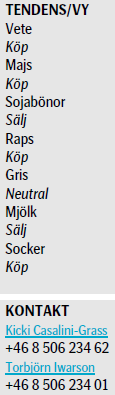 Det var en positiv vecka för jordbruksprodukter förra veckan. Alla spannmål som vete och majs steg med 2% i pris. Sojabönorna steg även de med 2% och rapsen med 3%. Sojamjölet backade med 3%, medan sojaoljan, som fallit kraftigt i pris efter en lång nedgång återhämtade sig med 4%. Efter en brand i ett lagerhus i Santos, hamnstad till São Paulo, steg sockerpriset från 19 cent upp mot 20 cent, men stängde på 19.50. Mjölkpriserna var oförändrade på såväl Eurex som på CME. Mjölkpriserna i Sverige fortsätter att stiga, genom att med eftersläpning anpassa sig till de högre internationella börspriserna. Skillnaden mellan det internationella priset och det svenska är historiskt högt på 80 öre per kilo. Om inte börspriserna faller, borde priset på mjölkråvara i Sverige kunna nå en ny rekordnivå, i vart fall den högsta på fem år inom någon eller några månader. Samtidigt har pristrenden på Eurex planat ut, även om den volatila Fonterranoteringen stigit något den senaste tiden. Kinas BNP-statistik kom in på +7.8% tillväxt för det tredje kvartalet. Det var precis på förväntningarna, men högre än tidigare under året. Man får tolka det som att Kinas ekonomi håller på att få upp farten igen, vilket har stor betydelse för efterfrågan på råvaror. En temporär budgetöverenskommelse har nåtts i USA. USDA meddelade i torsdags att oktober månads WASDE-rapport inte kommer att publiceras och att nästa som vanligt kommer ut den 8 november. Crop progress för den 7 och 15 oktober kommer inte heller att publiceras, utan nästa kommer den 21 oktober.
Odlingsväder
Väderprognoser för USA indikerar gynnsamt väder för sådden och utvecklingen av det amerikanska höstvetet. Det finns en del analytiker som redan nu säger att höstvetet kommer att vara i det bästa tillståndet sedan 2010 när det går in i vintervila.
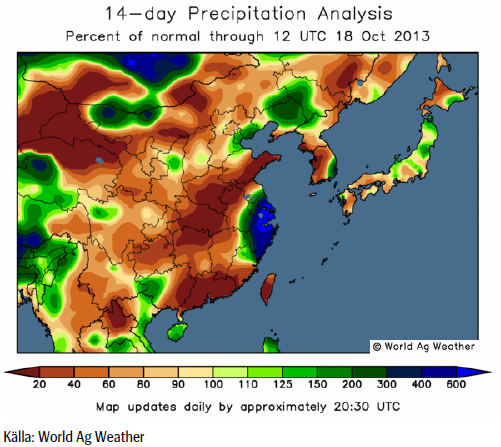
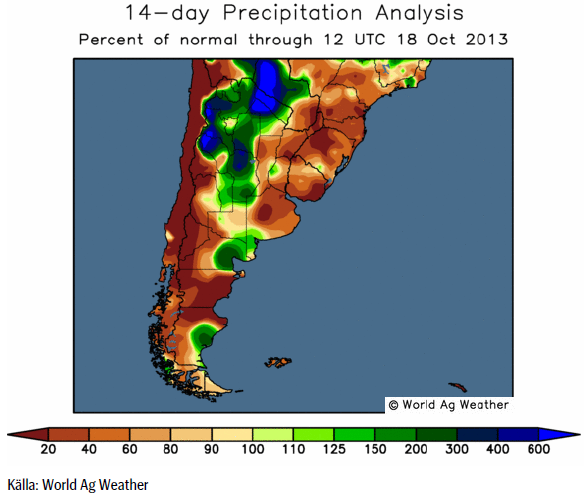
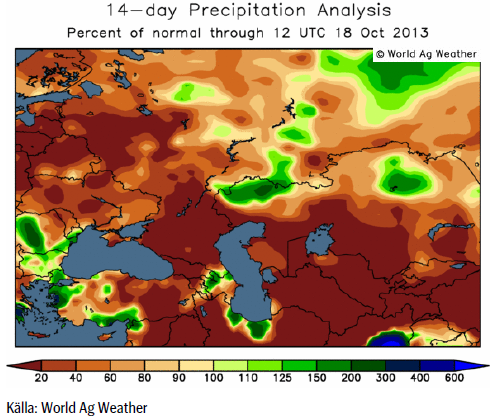
Så till orosmomenten: Torkan i Kina, Argentina och Ryssland. Vi ser på kartbilder som visar avvikelsen från normal nederbörd nedan.
Vete
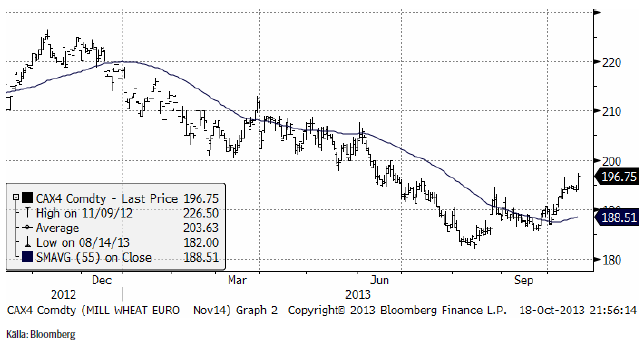
November månads terminskontrakt på Matif bröt igenom motståndet på 200 euro och avslutade veckan med att handlas på 204.75 euro per ton. Eftersom detta kontrakt snart går in i leverans, i början på november, lämnar vi det och hoppar ett år framåt, till november 2014. I kursdiagrammet nedanför ser vi att priserna ligger en bit under årets priser. Det råder alltså ”backwardation” i terminsmarknaden för kvarnvete på Matif. Vi ser också fredagens starka prisuppgång, som ”borde” kunna fortsätta och ta Nov 2014 till 200 euro, även det ett tekniskt motstånd. Om det bryts, ligger nästa motståndsnivå på 210 euro.
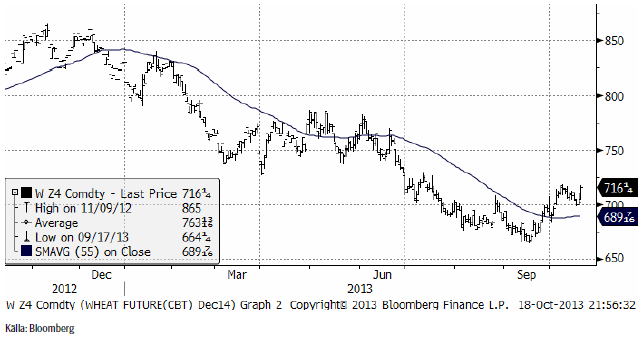
Decemberkontraktet 2014 på CBOT steg krafitgt även det, i fredags, och avslutar därmed en liten rekylfas. Siktet ser ut att bara inställt på 750 cent per bushel.
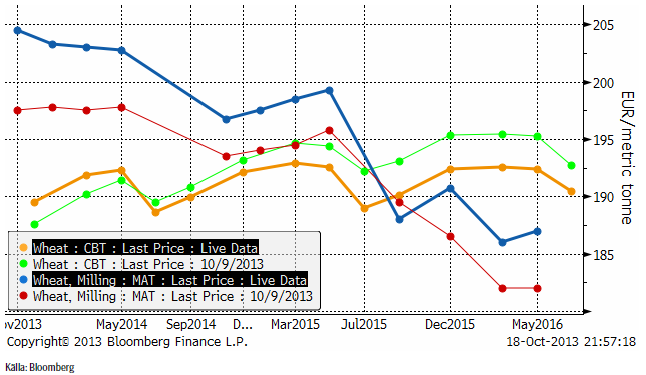
Nedan ser vi terminskurvorna för Chicagovete och Matif. Från att ha varit ”nästan” i backwardation är nu Matif helt och hållet det. Det innebär att ”bristsituationen” har förvärrats ytterligare, vilket i sin tur beror på att Europas spannmålsbönder blivit ännu mer irrationella. De borde sälja sin spannmål och köpa terminer. Spannmålen är dyrare än terminerna.
I torsdags estimerade Argentinas jordbruksdepartement den kommande veteskörden till 8.8 mt. USDA låg senast på 12 mt och International Grains Council hade den på 11 mt.
AgCanada (AAFC) reviderade sin prognos för Kanadas totala veteproduktion genom att justera upp den till 33.2 mt från förra månadens estimat på 30.7 mt.
Torkan i Kina är bra för skörden av majs och sojabönor, men hindrar sådden av höstvetet. Detta väntas leda till att 10% mindre areal blir sådd i år än man tidigare hoppats. CNGOIC estimerar Kinas vete produktion till 122.17 mt 2012/13, jämfört med USDA’s estimat på 121 mt.
Indien kan komma att sänka prisgolvet på vete för att främja exporten.
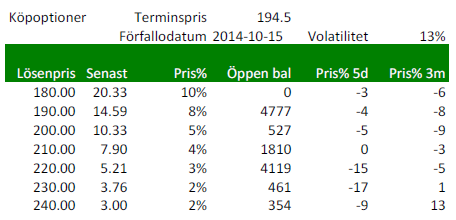
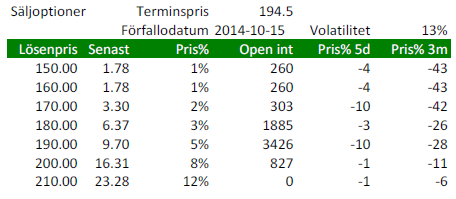
Nedan ser vi priserna på köpoptioner på Matif på November-2014 (Matif vete). Notera att volatiliteten 13% är ganska låg. Volatiliteten brukar vara låg när priserna är låga. Den är faktiskt något lägre än förra veckan, vilket inneburit att priset på såväl köpoptioner som säljoptioner gått ner i pris.
Nedanstående optioner är köpoptioner. Terminen (Nov 2014) handlas i 194.25 euro per ton. En köpoption om ett ton vete, som ger rätt att köpa vete för 200 euro kostar 10.33 euro, eller 5% av 194.25 euro. När man köper optionen får man betala det beloppet (plus lite till för säljkurs, detta är senast betalt). Om priset i oktober (vid förfall) nästa år är 250 euro på terminen betalar banken 50 euro till optionsinnehavaren (omräknat till kronor om man vill och kommer överens om det). Om terminen står i 190 euro (under lösenpriset) förfaller optionen värdelös och inget belopp betalas ut.
Nedanstående är priser på säljoptioner. Om du köpt optionen med lösenpris 200 euro (för 16.31) och terminen i oktober nästa år står i 180 euro, betalar banken ut 20 euro. Om terminspriset är över 200 euro betalar banken inte ut någonting alls och optionen förfaller värdelös.
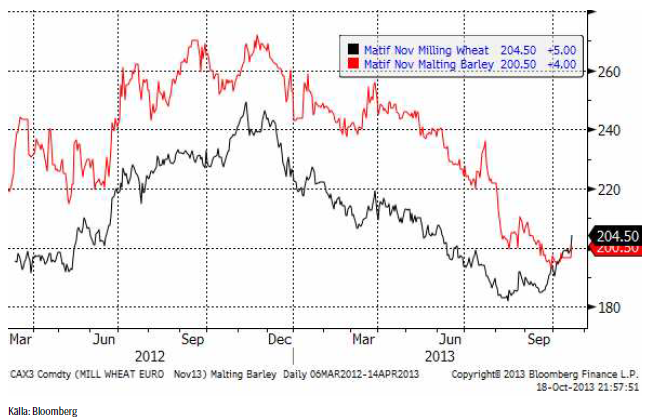
Förra veckan varnade vi för att en rekyl skulle kunna komma, om priset inte tog sig genom 200 euro på November 2013-kontraktet på Matif. Vi sade också att en sådan rekyl skulle vara ett ytterligare köptillfälle. Tyvärr fick vi inte den chansen, att köpa mer. Priset låg precis under 200 euro hela veckan, för att slutligen gå över. Vi rekommenderar naturligtvis en köpt position i vete. Marknaden har visat att trenden har vänt och kommer förmodligen att stiga ytterligare i veckan som kommer.
Maltkorn
Terminspriset (november) ligger nu 4.5 euro under vetepriset, för november 2013, som snart förfaller.
Majs
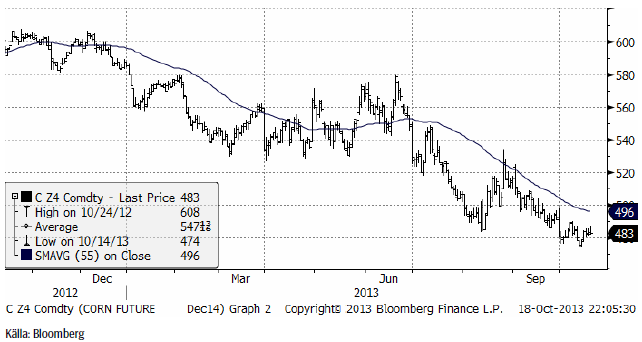
Majspriset – och nu tittar vi på nästa års skörd, december 2014-kontraktet, steg i veckan. Nedgången från slutat av augusti har tappat kraft, vilket brukar föregå en vändning uppåt.
Sådden av sommarmajs är i full gång i Brasilien sedan slutet av september. Längst har lantbrukare i södra delen av landet kommit, där majs förlorar stort mot sojabönor. CONAB rapporterar från Brasilien att arealen av majs kan bli den minsta sedan 1970-talet, när CONAB började föra statistik. I Paraná var 56% av den väntade arealen sådd i mitten av oktober. I Rio Grande do Sul rapporteras 52% vara sått. Conab estimerar att arealen kan bli 6.36 – 6.57 mha, som är 3.7% – 6.8% lägre än förra året. Hektarskörden estimeras bli 5,104 Kg / ha. Om man tar hänsyn till skörd nummer två, säger CONAB att den totala arealen kan bli 15.36 – 15.57 mha, vilket kan leda till en skörd på 78.43 – 79.63 mt. Det ska jämföras med skörden förra året 2012/13 på 81 mt. Utgående lager, som i Brasilien avser innan skörd i januari, väntas bli rekordhöga 14.6 mt.
CNGOIC estimerar Kinas majs produktion till 215 mt, vilket är högre än USDA:s nuvarande estimat på 211 mt.
Vi väljer att hålla fast vid köprekommendationen.
Sojabönor
Marskontraktet 2014 har på ett mer tydligt sätt än november 2013 funnit stöd på 1250 cent per bushel. Det återstår att se om stödet på 1250 kommer att hålla, eller om priset går ända ner till 1200 cent. Fundamentalt är talar mycket för att utbudet av sojabönor kommer att öka kraftigt efter Brasiliens skörd.
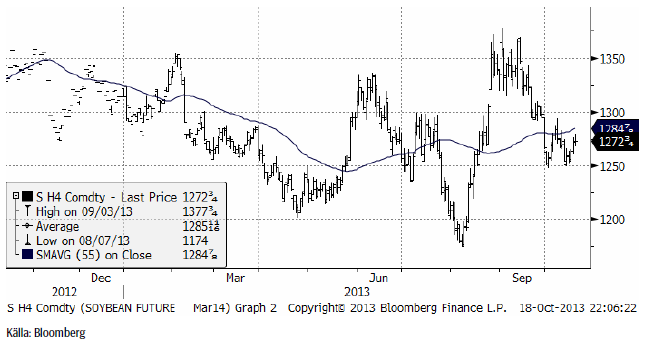
Vi ser också att November 2014 ligger betydligt under marskontraktet, se nedan.
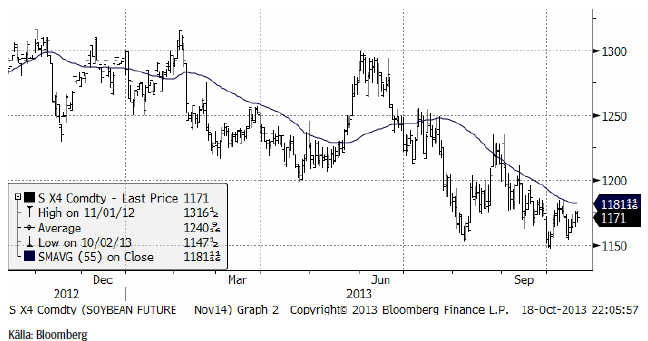
Brasilianska CEPEA rapporterade i fredags att sojaarealen kan bli rekordstor. Med hänsyn till den trendmässiga förbättringen i avkastning, kan skörden bli uppåt 90 mt. CEPEA rapporterade också att inhemska priser fortsatte att falla i oktober. Förra veckan estimerade CONAB landets skörd 2014 till 87.6 – 89.7 mt, baserat på en areal mellan 28.7 och 29.4 mha och en avkastning på mellan 2,938 och 3,058 Kg/ha. Det är något högre än USDA:s 88 mt.
I USA talar en del nu, något oväntat, om en skörd på 43 bushels per acre. Efter torkan i augusti har marknaden tagit emot en serie av estimat från privata firmor och analytiker som visar på bättre skörd än befarat.
Vi behåller säljrekommendation.
Raps
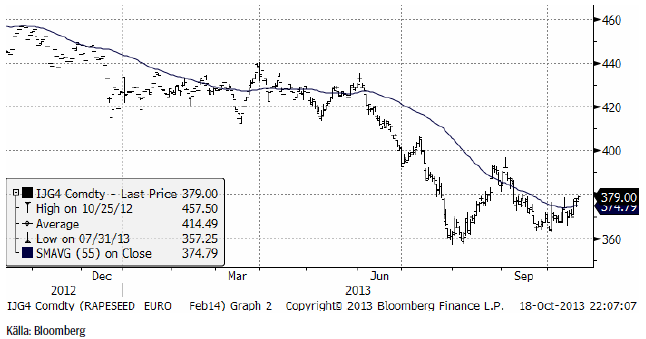
Rapspriset (februari 2014) gick inte under det tekniska stödet på 360 euro i början av oktober och har sedan dess stigit på ett sätt som inte riktigt kan förväntas av en marknad som ska vara i fallande trend. Priset ligger nu strax under 380 euro. Om priset går över 380 euro förändras bilden ytterligare. Det kan vara en trendvändning uppåt på gång. Det återstår att se.
November 2014-kontraktet steg relativt kraftigt i fredags och stängde på 378 euro per ton. Även där är 380 euro ett tekniskt motstånd. 55-dagars glidande medelvärde, som är en trendindikator är nu faktiskt stigande, vilket är ett tecken på att trenden kan ha vänt uppåt.
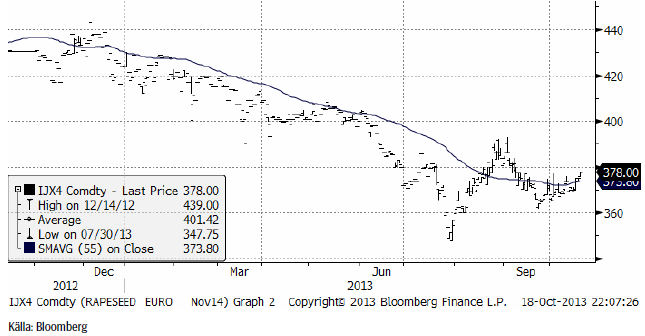
Jag tycker den tekniska bilden av rapsmarknaden ser lite ut som en trendvändning (uppåt). Därför väljer vi att lämna säljrekommendationen och gå över till en tidig köprekommendation.
Potatis
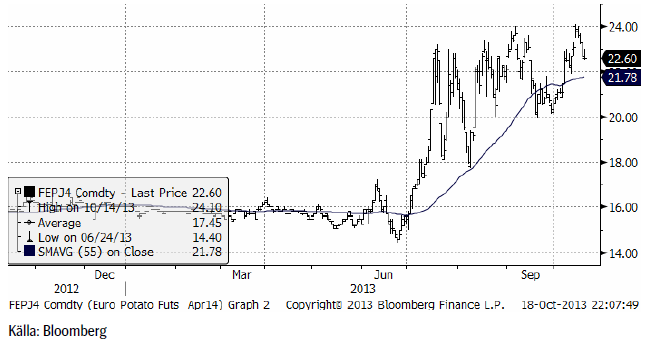
Potatispriset av årets skörd, som handlas i april-kontraktet på Eurex, nådde upp till 24 euro, samma nivå som marknaden vände ner från förra månaden. Därefter föll priset kraftigt i veckan och stängde på 22.60. Det verkar som om 24 euro är den övre gränsen för potatispriset den här säsongen.
Gris
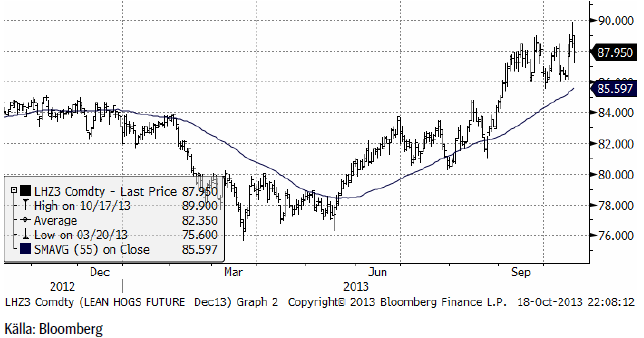
Prist på Lean Hogs inledde veckan med att stiga kraftigt och vände sedan ner lika kraftigt. Frågan är om detta innebär att man ska vänta sig ytterligare prisuppgångar, eller om det innebär det motsatta…
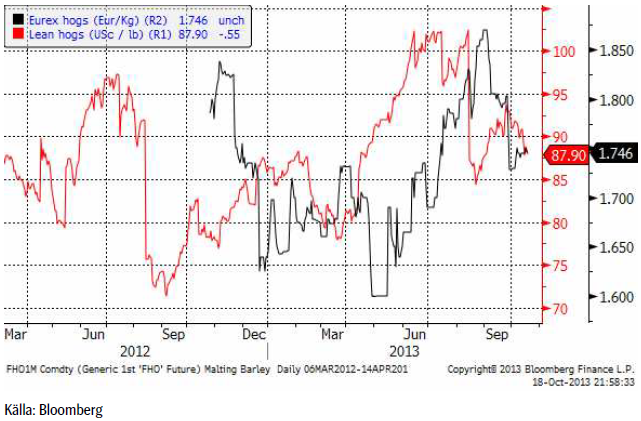
Nedan ser vi spotkontraktens historik för Eurex-grisar och Lean Hogs.
Mjölk
Terminerna på smör och skummjölkspulver vid Eurex-börsen var stabila och rörde sig inte mycket under veckan som gick. Fonterras pris steg något, efter det kraftiga prisfall från toppen som varit.
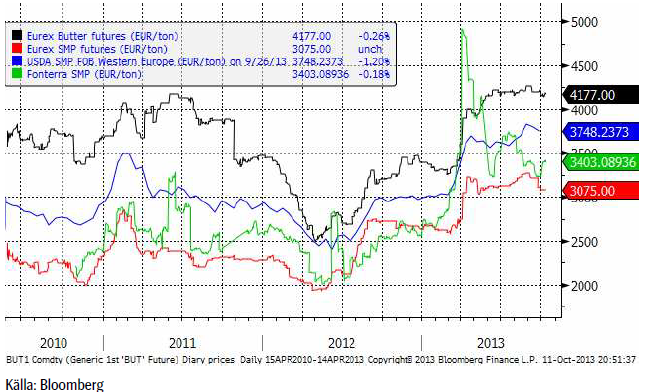
Det svenska avräkningspriset som betalas till mjölkbönder fortsätter att stiga, enligt Arlas prisnotering. Nedan ser vi ett diagram över prisutvecklingen på mjölk och på ett pris härlett från priset på terminerna på Eurex-börsen för SMP och smör, omräknat till kronor per Kg. USDA publicerar även ett index för WMP FOB Western Europe, som omräknat till kilo mjölk ligger mycket nära Eurexbörsens priser.
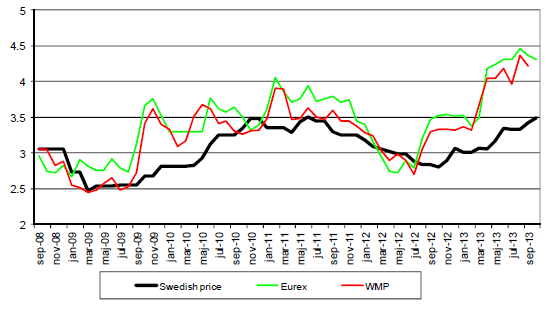
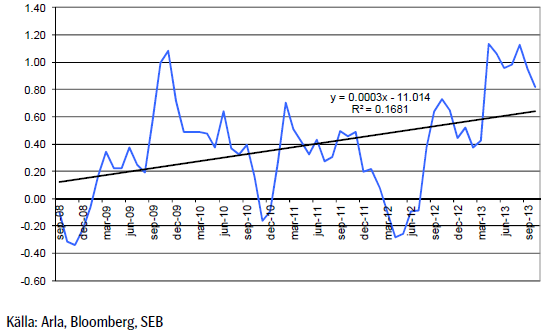
Det kan vara intressant att studera skillnaden mellan Eurex-börsens priser och avräkningspriserna på mjölkråvaran och den ser vi nedan i kronor per Kg. Vi ser att skillnaden nu ligger på en historiskt hög nivå om 80 öre per Kilo, men att den ändå har backat i takt med att det priset på mjölkråvaran successivt anpassar sig till de högre börspriserna. Det är tydligt att det finns en inbyggd eftersläpning i anpassningen och då börspriserna rört sig ”sidledes” har priset på mjölkråvara hämtat in lite av skillnaden, vilket förklarar varför skillnaden har minskat.
En till skillnaden mellan Eurex-priserna och Arla-priserna anpassad linjär kurva, tycks visa en med tiden ökande skillnad, som vi ser i diagrammet nedan. I datamaterialet är faktiskt den här tendensen till ökande skillnad statistiskt signifikant.
Socker
Marskontraktet på råsocker steg kraftigt i fredags efter att 180,000 ton råsocker förstörts i en brand i Brasilien. I fredags klockan 6 på morgonen väcktes boende i hamnstaden Santos, öster om São Paulo, av en kraftig smäll då en eldsvåda startat i ett lagerhus för socker. Snart var 3 stora lagerhus övertända. Bilder kan ses på Globos sajt.
Marknaden präglades redan innan detta av brist på socker för omedelbar leverans, eftersom regn i början på oktober fått ”crushers” av sockerrör att stå still i en vecka. Mot den bakgrunden var förlusten av exportlagret extra känsligt för marknaden.
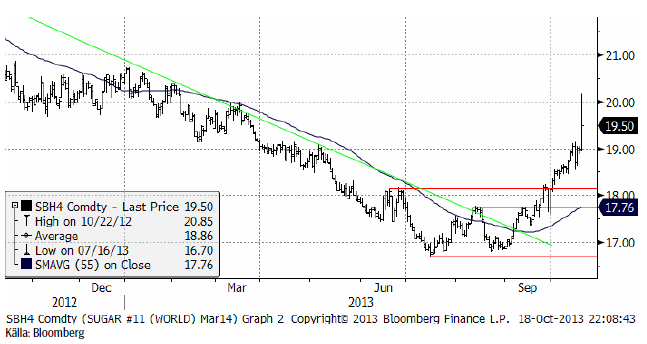
Det råder inget tvivel om att trenden för sockerpriset har vänts från att vara fallande de senaste åren, till att bli stigande. Vi rekommenderar en köpt position i socker.
Gödsel
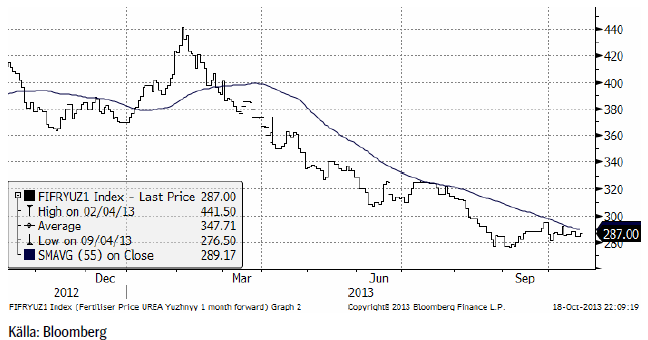
Priset på kväve / urea var stabilt i veckan som gick med endast små kursförändringar.
[box]SEB Veckobrev Jordbruksprodukter är producerat av SEB Commodities Sales desk och publiceras i samarbete och med tillstånd på Råvarumarknaden.se[/box]
Detta marknadsföringsmaterial, framtaget av SEB’s Commodities Sales desk, har upprättats enbart i informationssyfte.
Även om innehållet är baserat på källor som SEB bedömt som tillförlitliga ansvarar SEB inte för fel eller brister i informationen. Den utgör inte oberoende, objektiv investeringsanalys och skyddas därför inte av de bestämmelser som SEB har infört för att förebygga potentiella intressekonflikter. Yttranden från SEB’s Commodities Sales desk kan vara oförenliga med tidigare publicerat material från SEB, då den senare hänvisas uppmanas du att läsa den fullständiga rapporten innan någon åtgärd vidtas.
Dokumentationen utgör inte någon investeringsrådgivning och tillhandahålls till dig utan hänsyn till dina investeringsmål. Du uppmanas att självständigt bedöma och komplettera uppgifterna i denna dokumentation och att basera dina investeringsbeslut på material som bedöms erforderligt. Alla framåtblickande uttalanden, åsikter och förväntningar är föremål för risker, osäkerheter och andra faktorer och kan orsaka att det faktiska resultatet avviker väsentligt från det förväntade. Historisk avkastning är ingen garanti för framtida resultat. Detta dokument utgör inte ett erbjudande att teckna några värdepapper eller andra finansiella instrument. SEB svarar inte för förlust eller skada – direkt eller indirekt, eller av vad slag det vara må – som kan uppkomma till följd av användandet av detta material eller dess innehåll.
Observera att det kan förekomma att SEB, dess ledamöter, dess anställda eller dess moder- och/eller dotterbolag vid olika tillfällen innehar, har innehaft eller kommer att inneha aktier, positioner, rådgivningsuppdrag i samband med corporate finance-transaktioner, investment- eller merchantbankinguppdrag och/eller lån i de bolag/finansiella instrument som nämns i materialet.
Materialet är avsett för mottagaren, all spridning, distribuering mångfaldigande eller annan användning av detta meddelande får inte ske utan SEB:s medgivande. Oaktat detta får SEB tillåta omfördelning av materialet till utvald tredje part i enlighet med gällande avtal. Materialet får inte spridas till fysiska eller juridiska personer som är medborgare eller har hemvist i ett land där sådan spridning är otillåten enligt tillämplig lag eller annan bestämmelse.
Skandinaviska Enskilda Banken AB (publ) är ett [publikt] aktiebolag och står under tillsyn av Finansinspektionen samt de lokala finansiella tillsynsmyndigheter i varje jurisdiktionen där SEB har filial eller dotterbolag.

Wild moves yesterday. Brent crude traded to a high of $114.43/b and a low of $96.0/b and closed at $99.94/b yesterday.

US – Iran negotiations ongoing or not? What a day. Donald Trump announced that good talks were ongoing between Iran and the US and that the 48 hour deadline before bombing Iranian power plants and energy infrastructure was postponed by five days subject to success of ongoing meetings. Iranian media meanwhile stated that no meetings were ongoing at all.
Today we are scratching our heads trying to figure out what yesterday was all about.
Friends and family playing the market? Was it just Trump and his friends and family who were playing with oil and equity markets with $580m and $1.46bn in bets being placed by someone in oil and equity markets just 15 minutes before Trump’s announcement?
Was Trump pulling a TACO as he reached his political and economic pain point: Brent at $112/b, US Gas at $4/gal, SPX below 200dma and US 10yr above 4.4%?
Different Iranian factions with Trump talking with one of them? Are there real negotiations going on but with the US talking to one faction in Iran while another, the hardliners, are not involved and are denying any such negotiations going on?
Extending the ultimatum to attack and invade Kharg island next weekend? Or, is the five day delay of the deadline a tactical decision to allow US amphibious assault ships and marines to arrive in the Gulf in the upcoming weekend while US and Israeli continues to degrade Iranian military targets till then. And then next weekend a move by the US/Israel to attack and conquer for example the Kharg island?
We do not really know which it is or maybe a combination of these.
We did get some kind of TACO ydy. But markets have been waiting for some kind of TACO to happen and yesterday we got some kind of TACO. And Brent crude is now trading at $101.5/b as a result rather than at $112-114/b as it did no the high yesterday.
But what really matters in our view is the political situation on the ground in Iran. Will hardliners continue to hold power or will a more pragmatic faction gain power?
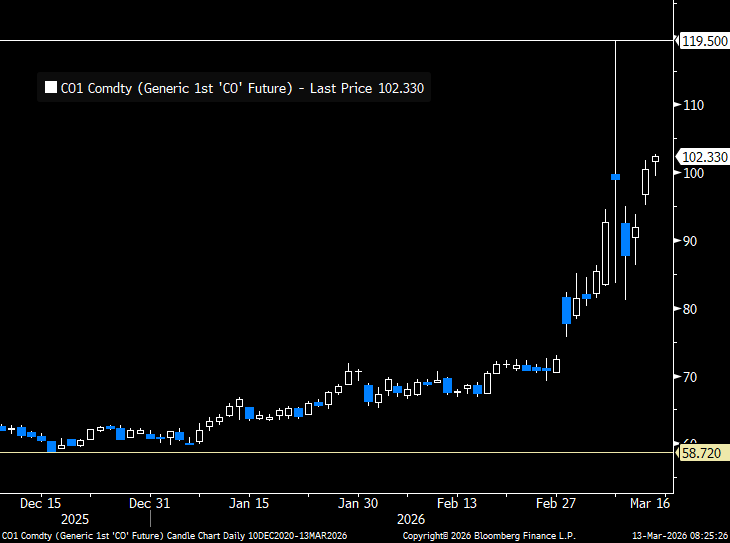
If the hardliners remain in power then oil pain should extend all the way to US midterm elections. The hardliners were apparently still in charge as of last week. Iran immediately retaliated and damaged LNG infrastructure in Qatar after Israel hit Iranian South Pars. The SoH was still closed and all messages coming out of Iran indicated defiance. Hardliners continues in power has a huge consequence for oil prices going forward. The regime has played its ’oil-weapon’ (closing or chocking the Strait of Hormuz). It is using it to achieve political goals. Deterrence: it needs to be so politically and economically expensive to attack Iran that it won’t happen again in the future. Or at least that the US/Israel thinks 10-times over before they attack again. The highest Brent crude oil closing price since the start of the war is $112.19/b last Friday. In comparison the 20-year inflation adjusted Brent price is $103/b. So Brent crude last Friday at $112.19/b isn’t a shockingly high price. And it is still far below the nominal high of $148/b from 2008 which is $220/b if inflation adjusted. So once in a lifetime Iran activates its most powerful weapon. The oil weapon. It needs to show the power of this weapon and it needs to reap political gains. Getting Brent to $112/b and intraday high of $119.5/b (9 March) isn’t a display of the power of that weapon. And it is not a deterrence against future attacks.
So if the hardliners remain in power in Iran, then the SoH will likely remain chocked all the way to US midterm elections and Brent crude will at a minimum go above the historical nominal high of $148/b from 2008.
Thus the outlook for the oil price for the rest of the year doesn’t depend all that much of whether Trump pulls a TACO or not. Stops bombing or not. It depends more on who is in charge in Iran. If it is the hardliners, then deterrence against future attacks via chocking of the SoH and high oil prices is the likely line of action. It is impacting the world but the Iranian ’oil-weapon’ is directed towards the US president and the the US midterm elections.
If a pragmatic faction gets to power in Iran, then a very prosperous future is possible. However, if power is shifting towards a more pragmatic faction in Iran then a completely different direction could evolve. Such a faction could possibly be open for cooperation with the US and the GCC and possibly put its issues versus Israel aside. Then the prosperity we have seen evolving in Dubai could be a possible future also for Iran.
So far it looks like the hardliners are fully in charge. As far as we can see, the hardliners are still fully in control in Iran. That points towards continued chocking of the SoH and oil prices ticking higher as global inventories (the oil market buffers) are drawn lower. And not just for a few more weeks, but possibly all the way to the US midterm elections.
A brief sigh of relief yesterday as oil infra at Kharg wasn’t damaged. But higher today. Brent crude dabbled around a bit yesterday in relief that oil infrastructure at Iran’s Kharg island wasn’t damaged. It traded briefly below the 100-line and in a range of $99.54 – 106.5/b. Its close was near the low at $100.21/b.
No easy victorious way out for Trump. So no end in sight yet. Brent is up 3.2% today to $103.4/b with no signs that the war will end anytime soon. Trump has no easy way to declare victory and mission accomplished as long as Iran is in full control of the Strait of Hormuz while also holding some 440 kg of uranium enriched to 60% and not far from weapons grade at 90%. As long as these two factors are unresolved it is difficult for Trump to pull out of the Middle East. Naturally he gets increasingly frustrated over the situation as the oil price and US retail gas prices keeps ticking higher while the US is tied into the mess in the Middle East. Trying to drag NATO members into his mess but not much luck there.
When commodity prices spike they spike 2x, 3x, 4x or 5x. Supply and demand for commodities are notoriously inflexible. When either of them shifts sharply, the the price can easily go to zero (April 2022) or multiply 2x, 3x, or even 5x of normal. Examples in case cobalt in 2025 where Kongo restricted supply and the price doubled. Global LNG in 2022 where the price went 5x normal for the full year average. Demand for tungsten in ammunition is up strongly along with full war in the middle east. And its price? Up 537%.
Why hasn’t the Brent crude oil price gone 2x, 3x, 4x or 5x versus its normal of $68/b given close to full stop in the flow of oil of the Strait of Hormuz? We are after all talking about close to 20% of global supply being disrupted. The reason is the buffers. It is fairly easy to store oil. Commercial operators only hold stocks for logistical variations. It is a lot of oil in commercial stocks, but that is predominantly because the whole oil system is so huge. In addition we have Strategic Petroleum Reserves (SPRs) of close to 2500 mb of crude and 1000 mb of oil products. The IEA last week decided to release 400 mb from global SPR. Equal to 20 days of full closure of the Strait of Hormuz. Thus oil in commercial stocks on land, commercial oil in transit at sea and release of oil from SPRs is currently buffering the situation.
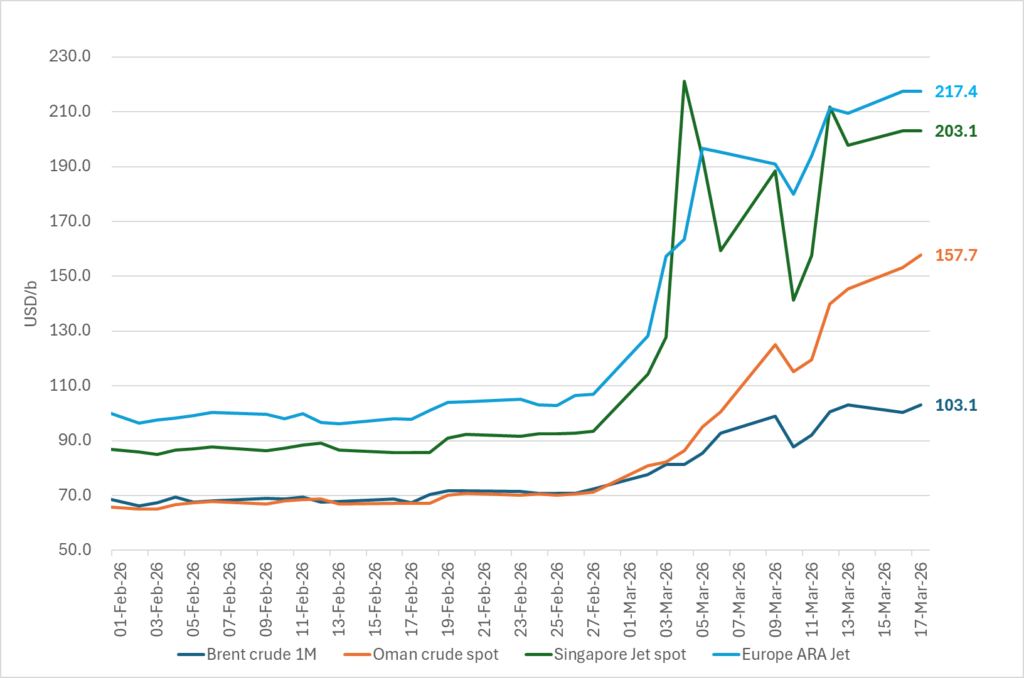
But we are running the buffers down day by day. As a result we see gradually increasing stress here and there in the global oil market. Asia is feeling the pinch the most. It has very low self sufficiency of oil and most of the exports from the Gulf normally head to Asia. Availability of propane and butane many places in India (LPG) has dried up very quickly. Local prices have tripled as a result. Local availability of crude, bunker oil, fuel oil, jet fuel, naphtha and other oil products is quickly running down to critical levels many places in Asia with prices shooting up. Oman crude oil is marked at $153/b. Jet fuel in Singapore is marked at $191/b.
Oil at sea originating from Strait of Hormuz from before 28 Feb is rapidly emptied. Oil at sea is a large pool of commercial oil. An inventory of oil in constant move. If we assume that the average journey from the Persian Gulf to its destinations has a volume weighted average of 13.5 days then the amount of oil at sea originating from the Persian Gulf when the the US/Israel attacked on 28 Feb was 13.5 days * 20 mb/d = 269 mb. Since the strait closed, this oil has increasingly been delivered at its destinations. Those closest to the Strait, like Pakistan, felt the emptying of this supply chain the fastest. Propane prices shooting to 3x normal there already last week and restaurants serving cold food this week is a result of that. Some 50-60% of Asia’s imports of Naphtha normally originates from the Persian Gulf. So naphtha is a natural pain point for Asia. The Gulf also a large and important exporter of Jet fuel. That shut in has lifted jet prices above $200/b.
To simplify our calculations we assume that no oil has left the Strait since that date and that there is no increase in Saudi exports from Yanbu. Then the draining of this inventory at sea originated from the Persian Gulf will essentially look like this:
The supply chain of oil at sea originating from the Strait of Hormuz is soon empty. Except for oil allowed through the Strait of Hormuz by Iran and increased exports from Yanbu in the Red Sea. Not included here.
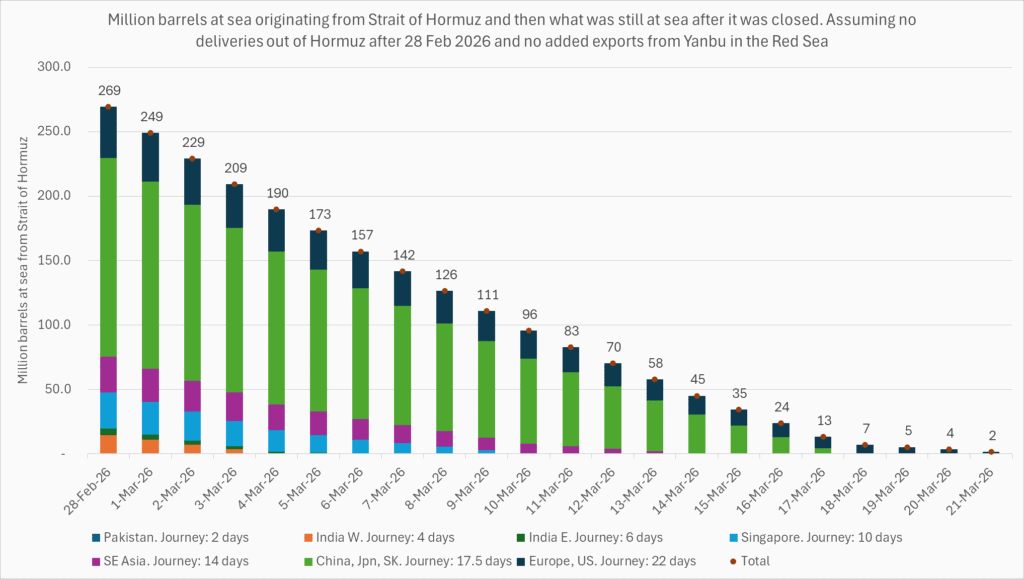
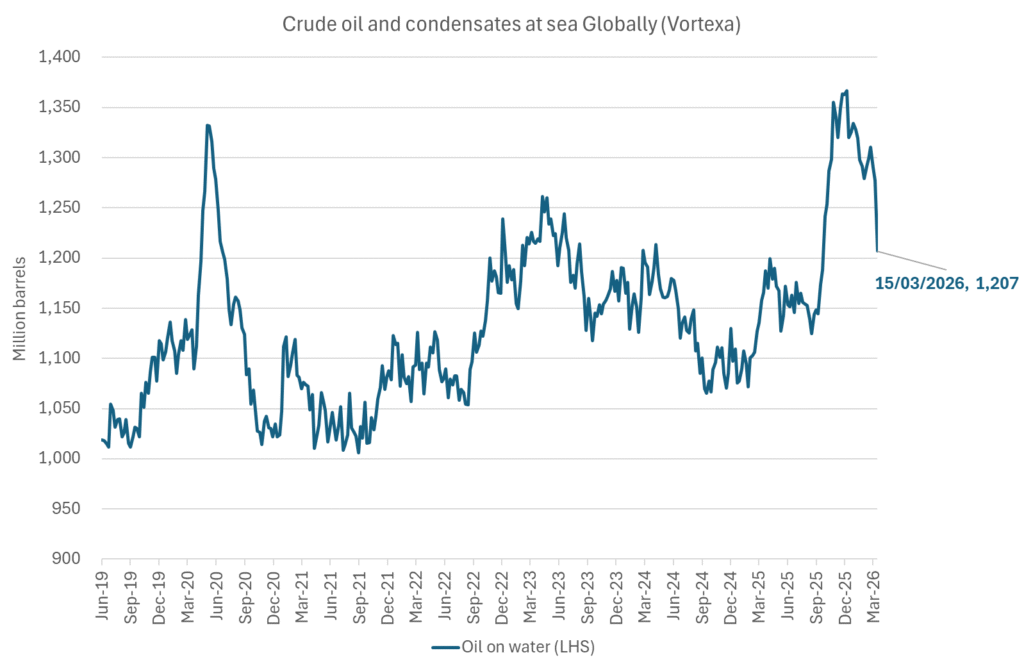
Oil at sea is falling fast as oil is delivered without any new refill in the Persian Gulf. Waivers for Russian crude is also shifting Russian crude to consumers. Brent crude will likely start to feel the pinch much more forcefully when oil at sea is drawn down another 200 mb to around 1000 mb. That is not much more than 10 days from here.
Oil and oil products are starting to become very pricy many places. Brent crude has still been shielded from spiking like the others.
Closing at highest since Aug 2022. Brent crude gained 9.2% yesterday. The trading range was limited to $95.2 – 101.85/b with a close at $100.46/b and higher than the Monday close of $98.96/b. Ydy close was the highest close since August 2022. This morning Brent is up 2% to $102.4/b and is trading at the highest intraday level since Monday when it high an intraday high of $119.5/b.
A military hit at Iran’s Kharg island would be a big, big bang for the oil price. The big, big risk for the weekend is that oil infrastructure could be damaged. For example Iran’s Kharg island which is Iran’s major oil export hub. If damaged we would have a longer lasting loss of supply stretching way beyond Trump’s announced ”two more weeks”. It will make the spot price spike higher and it will lift the curve. Brent crude 2027 swap would jump above $80/b immediately. An attack on Kharg island would naturally lead Iran to strike back at other oil infrastructures in the Gulf. Especially those belonging to countries who harbor US military bases. I.e. countries who essentially are supporting the attack by US and Israel towards Iran. Though if not in spirit, then in practical operational terms. An attack on Kharg island would not just lead to a lasting outage of supply from Iran until it would be repaired. It would immediately endanger other oil infrastructure in the region as well and additional lasting loss of supply.
No one in their right mind would dare to sit short oil over the coming weekend. Oil is thus set to close the week at a very strong note today.
Prepare for another 400 mb SPR release next week. This week’s announcement of a 400 mb release from Strategic Oil Reserves totally underwhelmed the market with the oil price going higher rather than lower following the announcement. For one it means that the market expects the war and the closure of the Strait of Hormuz to last longer than Trump’s recent announced ”two more weeks”. 400 mb only amounts to 20 days of lost supply to the world through Hormuz and we are already at day 14. So next week when we are getting close to the 20 day mark, we are likely to see another announcement of another 400 mb release of SPR stocks to the market. Preparing for the next 20 days of war.
Global oil logistics in total disarray. We have previously addressed the issue of the huge logistical web of the global oil market which is now in total disarray. The logistical disruption started to fry the oil market at the end of last week. Helped to spike the oil market on Monday. What we hear from our shipping clients is that the problems with supply of fuels locally in Korea, Singapore, India and Africa are getting worse with physical availability of fuels there drying up. It is getting increasingly difficult to find physical supply of bunker oil with local, physical prices shooting way higher than financial benchmarks. To the point that biofuels have become the cheap option many places. Availability of fuels in the US is still good. Not so surprising as the US is self-sufficient with crude and refineries.
The disruption in global oil logistics doesn’t seem to improve. Rather the opposite. If you cannot get fuel to run your ships, then how can you distribute fuels to where it is needed.
Buy Brent Dec-2026 calls with strike $150/b!! As the days goes by the oil price is ticking higher while Trump is getting one day closer to US midterm elections. Trump was betting that he could put this war to bead well before November. But that will probably not be up to him to decide. It will be up to Iran to decide when to reopen the Strait of Hormuz. It is very hard to imagine that Iran will let Trump easily off the hock after he has killed its Supreme Leader. This will likely go all the way to November. Buy Brent Dec-2026 calls with strike $150/b!!
Brent closed at highest since 2022 ydy. Will end this Friday at a very strong note! Consumers still dreaming of $60/b oil



Christian Kopfer om läget för oljan

Marknaden måste börja betrakta de höga kopparpriserna som det nya normala

Det fysiska spotpriset på brentolja har slagit nytt rekord

40 minuter med Javier Blas om hur världen verkligen påverkas av energikrisen

Efter tillväxten: Guldbrev satsar på expansion i Europa
40 minuter med Javier Blas om hur världen verkligen påverkas av energikrisen

Elpriserna fördubblas, stor osäkerhet inför sommaren

MP Materials, USA:s svar på Kinas dominans över sällsynta jordartsmetaller
Det fysiska spotpriset på brentolja har slagit nytt rekord

Studsvik har idag ansökt om att få bygga 1200-1600 MW kärnkraft i Valdemarsvik
-
 Nyheter2 veckor sedan
40 minuter med Javier Blas om hur världen verkligen påverkas av energikrisen
-
 Nyheter3 veckor sedan
Elpriserna fördubblas, stor osäkerhet inför sommaren
-
 Nyheter4 veckor sedan
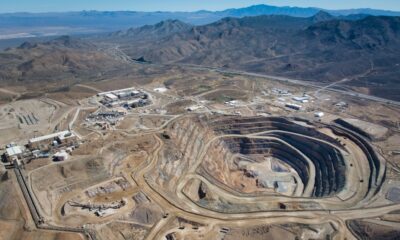
MP Materials, USA:s svar på Kinas dominans över sällsynta jordartsmetaller
-
 Nyheter2 veckor sedan
Det fysiska spotpriset på brentolja har slagit nytt rekord
-
 Nyheter4 veckor sedan
Studsvik har idag ansökt om att få bygga 1200-1600 MW kärnkraft i Valdemarsvik
-
 Nyheter2 veckor sedan
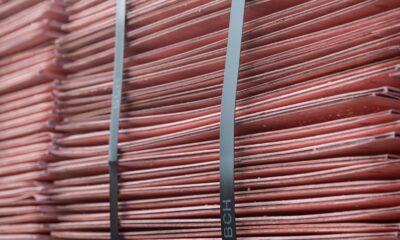
Marknaden måste börja betrakta de höga kopparpriserna som det nya normala
-

 Nyheter4 veckor sedan
Matproduktion är beroende av gödsel, Gulfkriget skapar brist
-
Analys4 veckor sedan
TACO (or Whatever It Was) Sends Oil Lower — Iran Keeps Choking Hormuz